Trice Generate
Contents
- 1. Bind Artifact Report
- 2. Colors
- 3. C-Code
- 4. C#-Code
- 5. Generating a Trice ABC Function Pointer List
For a compact, readable copy of the ID dictionaries, run trice generate -onelineJSON -til til.json -li li.json. This writes til.oneline.json and li.oneline.json in -genDir (default ./generated) as complete JSON objects with one ID entry per line. In the LI copy, each entry shows Line before File. The original files remain authoritative and unchanged; rerun the command after updating them. Use -li off to export only the TIL copy. Missing or invalid requested input files cause an error without replacing either copy. This option cannot be combined with -logC or -abc.
1. Bind Artifact Report
Use trice generate -bindReport to inspect existing generated files and their source references. This is an explicit diagnostic command, not an automatic step of every Bind run:
trice generate -bindReport -genDir generated -src Core
trice generate -bindReport -genDir generated -src Core -src ../../_test/testdata -exclude Core/vendor
Paths are relative to the calling directory. -genDir defaults to ./generated; -src defaults to the current directory and accepts multiple files or directories, with the usual C/C++ source/header selection and -exclude rules. Hidden paths and the selected generation directory are excluded from the source scan. The inventory lists immediate entries in -genDir; it does not descend into its subdirectories or follow non-regular entries. Missing directories or source roots and read failures are errors: no partial inventory is published. An empty generation directory is valid.
The report goes to standard output and needs neither til.json nor li.json. It never assigns IDs, runs Bind, creates directories, rewrites files or deletes artifacts. It cannot be combined with -logC, -onelineJSON, -abc or -colors. For an optional saved copy, redirect its output yourself:
trice generate -bindReport -src Core > bind-report.txt
For example, if Core/main.c includes trice_sidecar_main_c_1111111111111111.h, the relevant report entry is:
trice_sidecar_main_c_1111111111111111.h [sidecar]
  File Key: K1111111111111111; owner sidecar: trice_sidecar_main_c_1111111111111111.h
  Referenced in scan: Core/main.c
An existing trice_sidecar_triceCheck_c_2222222222222222.h whose source is outside -src Core instead says Not referenced in selected scan; owner source not established for this artifact. This does not mean that the owner was deleted or that the header is unused. Including ../../_test/testdata in the second command can reveal its reference from triceCheck.c. A source that moved without changing its include remains associated with the same sidecar.
Rebase entries name their owner sidecar and separately show whether the helper itself is referenced. A helper with no reference may be an old helper belonging to a still-referenced owner. Its contents must exactly match the generated phase helper to establish that metadata; missing or invalid owner declarations and edited helper contents are marked UNVERIFIED. Sidecar checks validate the File Key and BIND route declarations against the filename, not every descriptor or the freshness of the file. A handwritten file can imitate these declarations; this report is not a certificate of generated ownership.
AMBIGUOUS identifies a File Key claimed by multiple scanned sources. [missing] identifies a referenced artifact absent from -genDir. Repeated literal includes in one source are deduplicated; both #include "trice_...h" and #include <trice_...h> are recognized. Comments do not count as references. Macro-based include expressions are not resolved. Physical includes inside #if branches do count, because preprocessing conditions, compiler include search paths and actual build dependencies are not evaluated. Inventory findings are printed for inspection; UNVERIFIED, AMBIGUOUS and [missing] do not themselves cause a command error.
Other files remain [unclassified], explicitly with no ownership established. This includes user-owned ABC selection headers, field registries and unrelated files. Nothing in this report authorizes pruning. Bind only removes its own excess rebase helpers for a currently known owner; globally removing artifacts outside a selected scan is a separate operation that is not provided here. bind -v retains its existing summary of the current Bind operation; use generate -bindReport for an independent inventory.
The inventory behavior tests cover scope selection, real Bind output, ambiguous ownership, missing and altered artifacts, failure paths and zero attempted writes. The CLI tests also check mode exclusivity and inspection on a read-only filesystem without dictionaries or logfile setup.
2. Colors
Support for finding a color style:
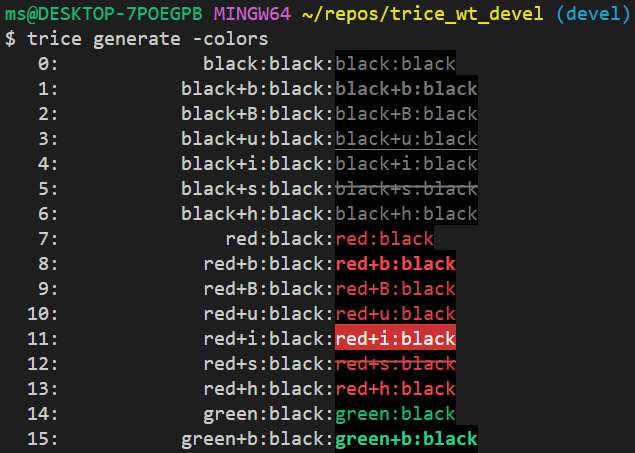
See Check Alternatives chapter.
3. C-Code
To generate a compact C metadata table for current target-side Trice sites, first run trice insert or trice bind and then run trice generate -src <source> -logC[=<output.c>]. Multiple -src options are accepted. Explicit Insert IDs and numeric Bind sidecar descriptors are validated against the selected TIL; no ID is guessed from a matching format string. Historical TIL entries that are absent from the selected sources are omitted without changing the TIL itself. Bind sidecars are read from ./generated by default; specify -genDir for a different directory. Bare -logC writes ./generated/til.c; an explicit output path takes precedence. -logC and -abc are alternative generation modes and cannot be combined.
Commented Trice calls with explicit Insert IDs remain selectable. An ID-free call that exists only in a C comment has no Bind preprocessor site and therefore no exact sidecar ID; -logC reports it instead of guessing or silently omitting it. Use trice insert for such retained commented calls, give the commented example an explicit authoritative ID, or exclude that source from this generated table.
// SPDX-License-Identifier: MIT

#include "triceRx.h"

const triceLog_t triceLog[] = {
	/* Trice type ( extended ) */ /*   id, bitWidth, paramCount, format-string */
	/* trice      ( trice_0   ) */ { 1000u, 32u, 0u, "ready\n" },
	/* trice      ( trice32_2 ) */ { 1001u, 32u, 2u, "value=%d hex=%x\n" },
};

const unsigned triceLogElements = sizeof(triceLog) / sizeof(triceLog[0]);
4. C#-Code
The current trice generate command does not provide a C# source generator. C# applications can read the generated til.json as input to their own decoder or use the Trice host tool to produce text, JSON, or KV output.
5. Generating a Trice ABC Function Pointer List
Use -abc=<target> to generate the target-specific ABC receive selection and table files:
trice generate -i til.json -abc=deviceX
Run from the project directory. This creates generated/deviceX.h if it does not exist, otherwise uses it as the user-edited selection input. It always regenerates generated/deviceX.c from til.json and the active declarations in generated/deviceX.h. -genDir changes the generated directory; an explicit target path such as -abc=custom/deviceX keeps that path. For the workflow and examples see Trice ABC - Asynchronous Broadcast Commands.