Trice Reference Manual
+ Speed of Light `printf` Comfort Within Interrupts And Everywhere +
-   (TL;DR)   ->  Too Long; Don't Read - use it as reference only❗
Table of Contents
Show/hide Table of Contents
- 1. Abstract
- 2. A brief history of Trice
- 3. How it works - the main idea
- 4. Trice Features (Overview)
- 4.1. No Dynamic Memory Management needed
- 4.2. Open source
- 4.3. Easy-to-use
- 4.4. Small size - using Trice frees FLASH memory
- 4.5. Execution speed
- 4.6. Robustness
- 4.7. Minimal Transfer Bytes Amount
- 4.8. More comfort than printf-like functions but small differences
- 4.9. Tags, Color and Log Levels
- 4.10. Compile Time Enable/Disable Trice Macros on File or Project Level
- 4.11. Target and host timestamps
- 4.12. Target source code location
- 4.13. Several target devices in one log output
- 4.14. Any byte-capable 1-wire connection usable
- 4.15. Scalability
- 4.16. Portability and Modularity
- 4.17. Optional Trice messages encryption
- 4.18. Trice Protection
- 4.19. Trice Diagnostics
- 4.20. Trice Cache
- 4.21. Avoiding False-Positive Editor Warnings
- 4.22. Trice Generator
- 4.23. Versions and Variants Trice Stability
- 4.24. Legacy Project Code Integration
- 5. Start with Trice
- 6. Quickstarts
- 7. Trice Trouble Shooting Hints
- 8. Trice Cache for Compilation Speed
- 9. Embedded system code configuration
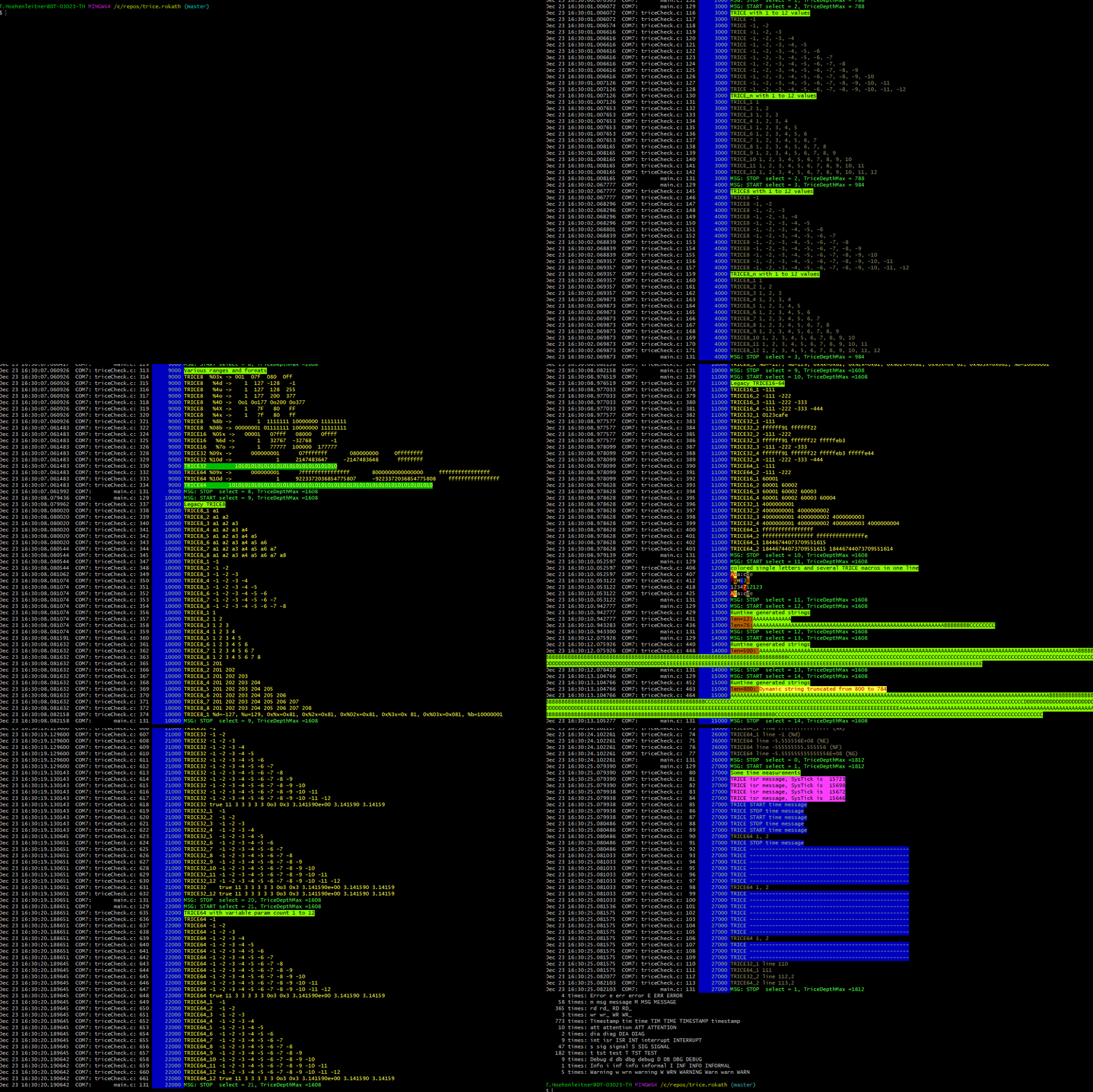
- 10. Trice tool in logging action
- 11. Optional XTEA Encryption
- 12. Trice Command Line Interface & Examples
- 12.1. Common information
- 12.2. Further examples
- 12.2.1. Automated pre-build insert command example
- 12.2.2. Some Log examples
- 12.2.3. Logging over a display server
- 12.2.4. Logfile output
- 12.2.5. Binary Logfile
- 12.2.6. TCP4 output
- 12.2.7. TCP4 input
- 12.2.8. UDP4 input
- 12.2.9. Stimulate target with a user command over UART
- 12.2.10. Explore and modify tags and their colors
- 12.2.11. Location Information
- 12.3. Visualization output with -vis
- 12.4. Setting up the LabPlot Demo
- 13. Limitations
- 14. Additional hints
- 14.1. Pre-built executables are available
- 14.2. Configuration file triceConfig.h
- 14.3. Setting up the very first connection
- 14.4. Avoid buffer overruns
- 14.5. Buffer Macros
- 14.6. Logfile viewing
- 14.7. Using the Trice tool with 3rd party tools
- 14.8. Several targets at the same time
- 14.9. Executing go test -race -count 100 ./…
- 14.10. TRICESTACKBUFFER could cause stack overflow with -o0 optimization
- 14.11. Cycle Counter
- 15. Switching Trice ON and OFF
- 16. Framing
- 17. Endianness
- 18. Trice (Time)Stamps
- 19. Binary Encoding
- 20. typeX0 User Packets
- 21. Trice Decoding
- 22. Trice ID Numbers
- 23. Trice ID management
- 24. Trice Bind
- 24.1. Overview
- 24.2. Requirements
- 24.3. Quick Start
- 24.4. Persistent and Generated Files
- 24.5. Hierarchical Metadata Reuse
- 24.6. File Key and Sidecar Name
- 24.7. Sidecar Contents
- 24.8. Why the Sidecar Include Is File-Local
- 24.9. Headers and static inline
- 24.10. Automatic Include Position
- 24.11. File Classification and Mixed Projects
- 24.12. Supported Trice Calls
- 24.13. ID and Stamp Forms
- 24.14. Command Line
- 24.15. Build Integration
- 24.16. TRICE_CLEAN
- 24.17. Re-Migration to trice insert
- 24.18. Automatic Local Counter Rebase
- 24.18.1. When the Normal Line Path Is Sufficient
- 24.18.2. When trice bind Rebases Locally
- 24.18.3. Concrete Wrapper Example
- 24.18.4. Preferred Form: Normal or static inline Function
- 24.18.5. Headers and Translation Units
- 24.18.6. Compact Source Boundaries and Generated Helper Headers
- 24.18.7. Missing __COUNTER__
- 24.18.8. Unchanged Interfaces
- 24.19. Supported Boundaries and Remaining Limitations
- 24.20. Diagnostics and Troubleshooting
- 24.21. Result
- 24.22. Appendix: Preprocessor Fundamentals
- 24.23. Appendix: Stable ID Assignment and Binding Background
- 24.24. Appendix: TRICE_CLEAN States at a Glance
- 24.25. Appendix: Why Bind Uses Local Counter Rebasing
- 24.26. Appendix: Bind and Insert Test Evidence
- 25. Trice version 1.0 Log-level Control
- 26. ID reference list til.json
- 27. The Trice Insert Algorithm
- 28. Trice Speed
- 29. Trice memory needs
- 29.1. F030bare Size
- 29.2. F030inst Size with TRICEOFF=1
- 29.3. F030inst with ring buffer
- 29.4. F030inst with ring buffer
- 29.5. A developer setting, only enabling SEGGERRTT
- 29.6. A developer setting, only enabling SEGGERRTT and without deferred output gives after running ./build.sh TRICE_DIAGNOSTICS=0 TRICE_PROTECT=0:
- 29.7. Settings Conclusion
- 29.8. Legacy Trice Space Example (Old Version)
- 29.9. Memory Needs for Old Example 1
- 29.10. Memory Needs for Old Example 2
- 30. Trice Project Image Size Optimization
- 31. Trice Tags, Color, and Weights
- 32. Structured Logging
- 33. Trice Context Enrichment
- 33.1. Getting Started with Position and Speed
- 33.2. Rules and Selectors
- 33.3. Reversible Workflow with insert and clean
- 33.4. Expressions, Fields and Evaluation
- 33.5. Using Global and Local Values
- 33.6. Build, IDs and Generated Files
- 33.7. Supported Log Sites and Alternatives
- 33.8. Test Coverage
- 33.9. Appendix: CE Feasibility Proofs
- 33.10. Approach and Boundaries
- 34. Trice without UART
- 35. Trice over RTT
- 35.1. For the impatient (2 possibilities)
- 35.2. Segger Real Time Transfer (RTT)
- 35.3. J-Link option
- 35.4. Segger RTT
- 35.5. Segger J-Link SDK (800 EUR) Option
- 35.6. Additional Notes (leftovers)
- 35.7. Further development
- 35.8. NUCLEO-F030R8 example
- 35.9. Possible issues
- 35.10. OpenOCD with Darwin (macOS)
- 35.11. SEGGER J-Link on Darwin (macOS)
- 35.12. Links
- 36. Writing the Trice logs into an SD-card (or a user specific output)
- 37. Trice Target Code Implementation
- 38. Trice Similarities and Differences to printf Usage
- 38.1. Printf-like functions
- 38.2. Trice IDs
- 38.3. Trice values bit width
- 38.4. Many value parameters
- 38.5. Floating Point Values
- 38.6. Runtime Generated 0-terminated Strings Transfer with triceS
- 38.7. Runtime Generated counted Strings Transfer with triceN
- 38.8. Runtime Generated Buffer Transfer with triceB
- 38.9. Extended format specifier possibilities
- 38.10. Unsupported printf format features
- 38.11. UTF-8 Support
- 38.12. Switch the language without changing a bit inside the target code
- 38.13. Format tags prototype specifier examples
- 39. Trice ABC - Asynchronous Broadcast Commands
- 39.1. Quick use
- 39.2. ABC macro families
- 39.3. Command names and handler names
- 39.4. Receiver selection and generated table
- 39.5. Receive runtime contract
- 39.6. Handler payload handling
- 39.7. Responses
- 39.8. What ABC is not
- 39.9. Example: examples/TriceAbc
- 39.10. BcSim Broadcast Byte-Stream Simulator
- 39.11. Host tests
- 39.12. Building RPC-like protocols on top
- 39.13. Security boundary
- 39.14. Summary
- 40. Development Environment Setup
- 40.1. Common Information
- 40.2. Important to know
- 40.3. Animation
- 40.4. Setup Linux PC - Example with Debian12 - KDE Desktop
- 40.5. Setup Windows PC Example
- 40.6. Makefile with Clang too
- 40.7. Download Locations
- 40.8. Install Locations
- 40.9. Environment Variables
- 40.10. Build command
- 40.11. Run & Debug
- 40.12. Logging
- 40.13. Setting up a new project
- 40.14. Third-party packages and retained versions
- 41. Example Projects without and with Trice Instrumentation
- 42. Trice Generate
- 43. Testing the Trice Library C-Code for the Target
- 44. Test Issues
- 45. Add-On Hints
- 46. Trice And Legacy User Code
- 47. Future Development
- 48. Working with the Trice Git Repository
- 49. Trice Maintenance
- 49.1. Trice Project structure (Files and Folders)
- 49.2. 📁 The .github Folder — Purpose and Contents
- 49.2.1. 📁 .github Root
- 49.2.2. 📂 .github/workflows — GitHub Actions Workflows
- 49.2.3. GitHub Action clang-format.yml - Check C Code Formatting
- 49.2.4. GitHub Action codeql.yml - Static Code Analysis
- 49.2.5. GitHub Action coverage.yml - Test Coverage and Coveralls Integration
- 49.2.6. GitHub Action go.yml - Building and Testing Go Code
- 49.2.7. GitHub Action goreleaser.yml - Build & Pack Trice Distribution
- 49.2.8. GitHub Action label.yml - Automatic Labeling Rules
- 49.2.9. GitHub Action link-check.yml - Broken Links Check
- 49.2.10. GitHub Action manual.ym - To Be Triggered Manually
- 49.2.11. GitHub Action shellcheck.yml - Catching Common Bash Scripts Bugs
- 49.2.12. GitHub Action shfmt.yml - Ensure Consistent Shell Scripts Formatting
- 49.2.13. GitHub Action stale.yml - Automatic Stale Issue Handling
- 49.2.14. GitHub Action superlinter.yml - Ensure Consistent YAML and Markdown Formatting
- 49.2.15. GitHub Action pages.yml - Creates The Trice GitHub Pages
- 49.3. Trice Reference Manual Maintenance (or any *.md file)
- 49.4. Cleaning the Sources
- 50. Build and Release the Trice Tool
- 51. Ctrl-C robust use of trice insert and trice clean
- 51.1. Background: GitHub issue #658
- 51.2. What Bash scripts can and cannot protect against
- 51.3. Recommended build-script ownership rule
- 51.4. Recommended Bash pattern
- 51.5. Preserve the build exit code
- 51.6. Be careful with current working directory changes
- 51.7. Prefer Makefile clean targets when available
- 51.8. Example scripts
- 51.9. Summary
(Animated GIFs appear as still images in PDFs.)
1. Abstract
If you develop software for an embedded system, you need some kind of system feedback. Debuggers are awesome tools, but when it comes to analyzing dynamic behavior in the field, they are not usable.
Logging then, usually done with printf-like functions, quickly yields a result after having i.e. putchar() implemented. This turns out to be an expensive way in terms of processor clocks and needed FLASH memory, when you regard the library code and all the strings needing FLASH memory space. For small microcontrollers that’s it.
Bigger microcontrollers are coming with embedded trace hardware. To use it, an expensive tool is needed. Useful for analyzing complex systems, but for in-field related issues at least unhandy.
Unhappy with this situation, the developer starts thinking of using digital pins or starts emitting some proprietary LED blinking codes or byte sequences, difficult to interpret.
The Trice technique tries to fill this gap, being minimal invasive for the target and as comfortable as possible. It is the result of a long-year dissatisfaction and several attempts to find a loophole to make embedded programming more fun and this way more effective.
Trice is an unusual software tracer-logger, using internally IDs instead of format strings to get maximum speed but provides the user with a printf-like comfort:
trice("Hello! 👋🙂");

int a = -4;
float x = 3.14159265;
trice("info:π/%d is %f with the bit pattern %032b\n", a, aFloat(x/a), x );

string s = "world";
triceS("msg:A runtime generated string: %s", s);
Replacing a printf library, the Trice target source code occupies 1-4 KB Flash memory and less than 1 KB RAM depending on the configuration which is done with a user file named triceConfig.h:
#define TRICE_DEFERRED_OUTPUT 1
#define TRICE_BUFFER TRICE_DOUBLE_BUFFER
#define TRICE_DEFERRED_UARTA 1
#define TRICE_UARTA USART2
The open-source Trice PC tool is executable on all Go platforms, at least:
- Linux
- macOS
- Windows
In the future other ports are possible:

2. A brief history of Trice
Developing firmware means to deal also with interrupts and often with timing. How do you check, if an interrupt occurred? OK, increment a counter and display it in a background loop with some printf-like function. What about time measurement? Set a digital output to 1 and 0 and connect a measurement device. Once, developing software for a real-time image processing device, I had no clue where in detail the processing time exploded when the image quality got bad. A spare analog output with a video interrupt synced oscilloscope gave me the needed information, after I changed the analog output on several points in my algorithm. But, hey guys, I want to deal with my programming tasks and do not like all this hassle connecting wires and steer into instruments.
A printf is so cool on a PC, developing software there. But an embedded device often cannot use it for performance reasons. My very first attempt was writing the format string .const offset together with its values in a FIFO during a log statement and to do the printf it in the background. But that is compiler specific. OK the full string address is better but needs buffer space. Zephyr for example does something like that calling it “deferred logging”.
Then, one day I had the idea to compute short checksums for the format strings in a pre-compile step and to use them as ID in a list together with the format strings. That was a step forward but needed to write a supporting PC program. I did that in C++ in the assumption to get it better done that way. Finally, it worked, but I hated my PC code, as I dislike C++ now because of all its nuts and bolts to handle, accompanied by missing libraries on the next PC. The tool usability was also unhandy and therefore error prone and the need became clear for a full automated solution. Also, what is, if 2 different format strings accidentally generate the same short checksum? There was a way around, but an ID based message filtering will never be possible that way.
The need became clear for controllable IDs and management options. And there was Go now, an as-fast-as-C language, easy to learn, promising high programming efficiency and portability. It would be interesting to try it out on a real PC project.
Trying to add tags in form of partial Trice macro names was blowing up the header code amount and was a too rigid design. Which are the right tags? One lucky day I came to the conclusion to handle tags just as format string parts like "debug:Here we are!\n" and getting rid of them in the target code this way also giving the user freedom to invent any tags.
Another point in the design was the question how to re-sync after data stream interruption, because that happens often during firmware development. Several encodings were tried out and a proprietary escape sequence format and an alternative flexible data format with more ID bits were working reliably but with COBS things got satisfactory. A side result of that trials is the Trice tool option to add different decoders if needed. Now the default Trice message framing is TCOBSv1 which includes short message compression and this way allows very low transmit bandwidths and/or saves storage, when binary Trice data are stored in Flash memory.
There was a learning not to reduce the transmit byte count to an absolute minimum, but to focus more on Trice macro speed and universality. That led to a double buffer on the target side as an alternative to the ring buffer solution. The actual binary encoding, allowing alongside user protocols, is the result of the optional target timestamps and location info some users asked for, keeping the target code as light as possible. Float and double number support was implementable for free because this work is done mainly on the host side.
Trice grew, and as it got usable I decided to make it Open Source to say “Thank You” to the community this way.
Learning that Trice is also a baby girl name, our daughter Ida designed the little girl with the pen symbolizing the Trice macro for recording and the eyeglasses standing for the PC tool Trice visualizing the logs.

3. How it works - the main idea
Trice performs no costly printf-like functions on the target at all. The Trice macro, instead, just copies an ID together with the optional values to a buffer and is done. In the minimum case this can happen in 6(six!) processor clocks even with target timestamps included. When running on a 64 MHz clock, light can travel about 30 meters in that time.
To achieve that, a pre-compile step is needed, executing a trice insert command on the PC. This is fast enough not to disturb the build process. The Trice tool parses then the source tree for macros like trice( "msg: %d Kelvin\n", k ); and patches them to trice( iD(12345), "msg: %d Kelvin\n", k );, where 12345 is a generated 14-bit identifier (ID) copied into a Trice ID List. During compilation, the Trice macro is translated to the 12345 ID only, and the optional parameter values. The format string is ignored by the compiler.
The target code is project specific configurable. In direct mode the stack or a static buffer is used as Trice buffer and the Trice macro execution includes optionally the quick COBS encoding and the data transfer. This more straightforward and slower architecture can be interesting for many cases because it is anyway much faster than printf-like functions calls. Especially when using Trice over RTT a single Trice is executable within ~100 processor clocks. See TRICE_DIRECT_SEGGER_RTT_32BIT_WRITE inside triceDefaultConfig.h and look into the examples folder. In deferred mode a service swaps the Trice double buffer or reads the Trice ring buffer periodically, the configured encoding, default is TCOBS, takes part and with the filled buffer the background transfer is triggered. Out buffer and Trice buffer share the same memory for efficiency.
During runtime the PC Trice tool receives all what happened in the last ~100ms as a package from the UART port. The 0x30 0x39 is the ID 12345 and a map lookup delivers the format string “msg: %d Kelvin\n” and also the bit width information. Now the Trice tool can write target timestamp, set msg color and execute printf("%d Kelvin\n", 0x0000000e);

The Trice tool is a background helper giving the developer focus on its programming task. The once generated ID is not changed anymore without need. If for example the format string gets changed into "msg: %d Kelvin!\n", a new ID is inserted automatically and the reference list gets extended. Obsolete IDs are kept inside the Trice ID List for compatibility with older firmware versions. It could be possible, when merging code, an ID is used twice for different format strings. In that case, the ID inside the reference list wins and the additional source gets patched with a new ID. This maybe unwanted patching is avoidable with proper Trice ID management. The reference list should be kept under source code control.
Moreover, using trice i -cache && make && trice c -cache in a build script makes the IDs invisible to the developer reducing the data noise giving more space to focus on the development task. See build.sh as a working example and the Trice Cache chapter for details.
4. Trice Features (Overview)
4.1. No Dynamic Memory Management needed
All internal Buffers are static allocations and usually need only a few Hundred bytes size.
4.2. Open source
Target code and PC tool are open source. The MIT license gives full usage freedom. Users are invited to support the further Trice development.
4.3. Easy-to-use
Making it facile for a user to use Trice was the driving point just to have
- one Trice tool
- one additional target code source folder
- a project specific simple to use triceConfig.h
- and to get away with the one macro
tricefor most situations.
Trice understands itself as a silent helper in the background to give the developer more focus on its real task. If, for example, trice log is running and you re-flash the target, there is no need to restart the Trice tool just to load changed decoding tables. When til.json is updated in a pre-build step, the Trice tool automatically reloads it during logging. The location table selected with -li is also reloaded if it was present when logging started.
For example, keep trice log -i til.json -li li.json running while you rebuild with trice bind or trice insert. New IDs, changed structured field names, and updated source locations become available to subsequent records in text, JSON, and KV output. Both ordinary file writes and replacement by a newly generated file are supported. Each save is read after a short settling interval (normally about 100 ms), including saves made shortly after one another. Active visualization rules check new or changed records against their existing rules; a rule already disabled because of an incompatible format stays disabled until the logger is restarted.
If a file is temporarily missing, empty, or invalid JSON while being saved, the logger keeps that table’s last valid contents, reports a warning on stderr, and retries automatically. The two files reload independently; updating them is not a single atomic transaction. A valid JSON object replaces the respective in-memory table completely, including removal of keys no longer in the file. {} intentionally clears a table. Successful reloads are silent unless -v is enabled; reload diagnostics never enter the application logfile or JSON/KV output.
Use -li off to disable location information. If no location file existed at startup, create it before starting the logger to enable its automatic reload. File watching requires an available local directory; if setup fails, the logger warns which path cannot be watched and continues using the loaded data. Restart it after resolving that problem. Reloading dictionaries does not repair a disconnected RTT server or other transport connection, and location information still needs to match the firmware actually running on the target.
The Trice tool comes with many command line switches (trice help -all) for tailoring various needs, but mostly these are not needed. The generated file ref/trice-help-all.txt contains this information as well.
Normal Trice tool usage is:
- ./build.sh containing
trice insert -cache,makeandtrice clean -cache make logcontainingtrice l -p COMnfor logging with default baud rate.
In this example, the user code gets not polluted with Trice IDs - they exists only during the compilation step and the Trice cache makes this invisible for the user and the build system.
4.4. Small size - using Trice frees FLASH memory
Compared to a printf-library code which occupies 1 to over 20 KB FLASH memory, the Trice code is normally smaller but provides full support.
4.5. Execution speed
Can it get faster than 6 clocks only? Only 3 runtime Assembler instructions per Trice needed in the minimum case! Optional target timestamp, critical sections, cycle counter, diagnostics and overflow protection can consume a few more processor clocks, if enabled, but a Trice is still incomparable fast.
4.6. Robustness
When a Trice data stream is interrupted, the optional COBS or TCOBS encoding allows an immediate re-sync with the next COBS/TCOBS package delimiter byte and a default Trice cycle counter gives a high chance to detect lost Trice messages. See also Versions and Variants Trice Stability.
4.7. Minimal Transfer Bytes Amount
A Trice message is 4 bytes long (2 ID bytes and 2 count bytes) plus optional time stamps and/or values. In conjunction with the compressing TCOBS framing the Trice data stream is as small as possible. Use the -debug switch to see the compressed and framed packages alongside the decompressed ones together with the decoded messages.
To see the encoding for each single message #define TRICE_DEFERRED_TRANSFER_MODE TRICE_SINGLE_PACK_MODE inside the project specific triceConfig.h.
Without -debug CLI switch:
ms@MacBook-Pro G0B1_inst % trice log -p /dev/tty.usbmodem0007722641261 -prefix off -li off -hs off -ts off
...
This is a message without values and without stamp.
...
With -debug CLI switch:
ms@MacBook-Pro G0B1_inst % trice log -p /dev/tty.usbmodem0007722641261 -prefix off -li off -hs off -ts off -debug
...
TCOBSv1: c1 74 e2 23 00
->TRICE: c1 74 e2 00
This is a message without values and without stamp.
...
The TCOBS encoding cannot compress in the example above, because the data are too small, but here is a significant compression result shown:
ms@MacBook-Pro G0B1_inst % trice log -p /dev/tty.usbmodem0007722641261 -prefix off -hs off -debug
...
TCOBSv1: b8 76 7b 18 84 fe e1 fd e1 fc e1 fb e1 fa e1 00
->TRICE: b8 76 7b 18 ff ff ff ff fe ff ff ff fd ff ff ff fc ff ff ff fb ff ff ff fa ff ff ff
_test/testdata/triceCheck.c   805              value=-1, -2, -3, -4, -5, -6
...
- The
TRICE_SINGLE_PACK_MODEinserts after each Trice a package delimiter0. - The
TRICE_MULTI_PACK_MODEinserts after a group of Trice messages a package delimiter0, what minimizes the transmit data amount.
When encryption is active, a compression makes no sense, but the TRICE_MULTI_PACK_MODE can help to reduce the total amount of padding bytes, because each encrypted package must have a multiple of 8 as length.
ms@MacBook-Pro G0B1_inst % trice log -p /dev/tty.usbmodem0007722641261 -prefix off -hs off -pw MySecret -pf cobs -debug
...
cobs: 21 84 b7 60 8b 21 89 1e e3 07 6d dc d9 2d 6f 59 04 8e 50 8f 24 1c a2 63 2e 3d 4a 57 ef 39 63 01 cb 00
->TRICE: 84 b7 60 8b 21 89 1e e3 07 6d dc d9 2d 6f 59 04 8e 50 8f 24 1c a2 63 2e 3d 4a 57 ef 39 63 01 cb
-> DEC:  cc b6 63 01 71 02 ff fe cd 76 72 03 ff fe fd ce f6 64 81 00 00 73 04 ff fe fd fc 00 00 00 00 00
_test/testdata/triceCheck.c   827        0_355 value=-1, -2
_test/testdata/triceCheck.c   828              value=-1, -2, -3
_test/testdata/triceCheck.c   829    0,033_124 value=-1, -2, -3, -4
cobs: 19 50 70 79 d7 75 6f d7 99 dc d8 ec 06 e1 66 e7 a7 c1 0d 96 85 df 19 25 55 00
->TRICE: 50 70 79 d7 75 6f d7 99 dc d8 ec 06 e1 66 e7 a7 c1 0d 96 85 df 19 25 55
-> DEC:  cf b6 64 01 74 05 ff fe fd fc fb d0 76 75 06 ff fe fd fc fb fa 00 00 00
_test/testdata/triceCheck.c   830        0_356 value=-1, -2, -3, -4, -5
_test/testdata/triceCheck.c   831              value=-1, -2, -3, -4, -5, -6
...
4.8. More comfort than printf-like functions but small differences
Trice is usable also inside interrupts and extended format specifier possibilities give options like binary or bool output. Transmitting runtime generated strings could be a need, so a triceS macro exists supporting the %s format specifier for strings up to 32737 bytes long. It is possible to log float/double numbers using %f and its relatives, but the numbers need to be covered with the fast converter function aFloat(x) or aDouble(y). Also UTF-8 encoded strings are implicitly supported, if you use UTF-8 for the source code. See chapter Trice Similarities and differences to printf usage for more details.

4.9. Tags, Color and Log Levels
You can label each Trice with a tag specifier to colorize the output. This is free of any runtime costs because the tags are part of the Trice log format strings, which are not compiled into the target. The Trice tool will strip full lowercase tag descriptors from the format string after setting the appropriate color, making it possible to give each message its color.
Loggers use log levels and offer a setting like “log all above INFO” for example. The Trice tags can cover that but can do better: Inside package emitter.ColorChannels in a single file ./internal/emitter/lineTransformerANSI.go all common log levels defined as Trice tags alongside with user tags. The user can adjust this. The Trice tool has the -pick and -ban switches to control the display in detail. Also a -logLevel switch is usable to determine a display threshold as tag position inside ColorChannels.
If an inside-target log selection is needed (routing), the Trice tool can assign each log tag a separate ID range and a target side ID based log selector can control which IDs are transmitted over which output channel. See chapter Trice ID management or type trice help -insert and look for -IDRange.

4.10. Compile Time Enable/Disable Trice Macros on File or Project Level
After debugging code in a file, there is no need to remove or comment out Trice macros. Write a #define TRICE_OFF 1 just before the #include "trice.h" line and all Trice macros in this file are ignored completely by the compiler, but not by the Trice tool. In case of reconstructing the Trice ID List, these no code generating macros are regarded.
#define TRICE_OFF 1 // Disable trice code generation for this file object.
#include "trice.h"
When you wish to build a firmware without any Trice code, it is sufficient to add
C_DEFS += -DTRICE_OFF=1 // Define TRICE_OFF=1 for the whole project.
or similar to your Makefile.
4.11. Target and host timestamps
For each Trice you can have (time) stamps or not:
trice( "...", ...);orTRICE( id(0), ( "...", ...): no stamp:Trice( "...", ...);orTRICE( Id(0), ( "...", ...): 16-bit stamp:TRice( "...", ...);orTRICE( ID(0), ( "...", ...): 32-bit stamp:
The optional 16- or 32-bit value then carries the system clock, a millisecond counter, or another event counter configured in the project specific triceConfig.h. The Trice tool will automatically recognize and display the stamps in a mode you can control. If several Trice macros form a single line, the Trice tool only displays the target timestamp of the first Trice macro.
Embedded devices often lack a real-time clock and some scenarios can last for weeks. Therefore the Trice tool precedes each Trice line with a PC timestamp, if not disabled. This is the Trice reception time on the PC, which can be some milliseconds later than the target Trice event.
4.12. Target source code location
Some developers like to see the filename.c and line in front of each log line for quick source location. During trice i a file li.json is generated containing the location information. If trice log finds this file, filename and line number are displayed in front of each log line, otherwise not.
Because software is a matter of change it could happen you get obsolete information this way. Therefore the Trice tool log option -showID exists to display the Trice ID in front of each log line what gives a more reliable way for event localization in some cases. Also you can get it for free, because no target code is needed for that.
4.13. Several target devices in one log output
Several Trice tool instances can run in parallel on one or different PCs. Each Trice tool instance receives Trices from one embedded device. Instead of displaying the log lines, the Trice tool instances can transmit them over TCP/IP (trice l -p COMx -ds) to a Trice tool instance acting as display server (trice ds). The display server can fold these log lines in one output. For each embedded device a separate Trice line prefix and suffix is definable. This allows comparable time measurements in distributed systems.
4.14. Any byte-capable 1-wire connection usable
The usual Trice output device is an UART but also SEGGER-RTT is supported over J-Link or ST-Link devices. Many microcontroller boards can act as Trice bridge to a serial port from any port (Trice without UART).
4.15. Scalability
The various Trice ID management options allow the organization also of bigger software systems. 16383 possible different IDs should match also large projects. Just in case: 16-bit for the ID is a not too hard changeable value.
4.16. Portability and Modularity
The Trice tool is written in the open source language Go and is therefore usable on many platforms. That means the automatic code patching and ID handling side with trice insert.
All C-compilers should be usable to compile the target Trice code and there is no hardware dependency despite the byte transmission. MCUs with 8-bit to 64-bit, little or big endian are supported.
Any user program able to read a JSON file, can receive the documented Trice message format, look-up the ID and perform a printf-like action to translate into log strings. The Trice tool with its log switch is a working example.
Using no framing, COBS or TCOBS packages starting with a package descriptor allows alongside user protocols. The other way around is also implementable: In a user protocol embedded Trice messages.
The Trice tool is expandable with several decoders. So it is possible to implement a minimal Trice encoding, if bandwidth matters heavily and control that with switches.
When less RAM usage is more important the target double buffer is replaceable with a ring buffer. So the user will be able to decide at compile time about that. A ring buffer mode is selectable inside triceConfig.h avoiding any buffer by paying a time toll.
The Trice tool supports many command line switches.
4.17. Optional Trice messages encryption
The encryption opportunity makes it possible to test thoroughly a binary with log output and releasing it without the need to change any bit but to make the log output unreadable for a not authorized person. Implemented is the lightweight XTEA as option, what will be sufficient for many cases. It should be no big deal to add a different algorithm.
4.18. Trice Protection
When using Trice, data are written into buffers. A buffer overflow is impossible with the default configuration #define TRICE_PROTECT 1 by simply ignoring possible overflow causing Trice statements. Those cases are not detectable by the cycle counter evaluation because non-existing Trice data on the embedded system cannot cause cycle errors. Therefore overflow error counters exists, which the user can watch. In ./examples/exampleData/triceLogDiagData.c an option is shown. Of course this buffer overflow protection costs valuable execution time. If you prefer speed over protection, simply write into your project specific triceConfig.h #define TRICE_PROTECT 0.
4.19. Trice Diagnostics
A trice statement produces 4 bytes buffer data plus optional values data. When for example TRice16("Voltage=%u\n", x); is called inside the ms system-tick interrupt every 5th time, 10 bytes data are generated each 5 millisecond. This needs a transfer baudrate of at least 20.000 bit/s. A UART running at 115.200 baud can easily handle that.
Anyway after 100 ms, a 200 Bytes buffer is filled and the question arises what is the optimal Trice buffer size. A calculation is error prone, so measuring is better. So configure the buffer sizes bigger than estimated and watch the max depth of their usage. In ./examples/exampleData/triceLogDiagData.c an option is shown. After you optimized your buffer sizes, you can deactivate the Trice diagnostics in your project specific triceConfig.h with #define TRICE_DIAGNOSTICS 0.
4.20. Trice Cache
One may think, automatically cleaning the IDs in the target code with trice c after building and re-inserting them just for the compilation needs file modifications all the time and a permanent rebuild of all files containing Trices will slow down the re-build process. That is true, but by using the Trice cache this is avoidable.
Simply one-time create a .trice/cache folder in your home directory and use trice insert -cache and trice clean -cache in your build.sh script.
Find more details in chapter Trice Cache for Compilation Speed.
4.21. Avoiding False-Positive Editor Warnings
When the user writes
trice("msg: Hello! 👋🙂\n");
after trice insert this gets
trice(iD(123), "msg: Hello! 👋🙂\n");
and the compiler builds and then with trice clean, this gets again
trice("msg: Hello! 👋🙂\n");
Sophisticated editors may detect the missing ID and warn by underlining the trice command:

To avoid this you can add the following line to your project specific triceConfig.h file:
#define TRICE_CLEAN 1
The Trice tool, will change the value to 0 and change it back to 1, when performing the ID insertion and cleaning, when this line occurs inside the triceConfig.h file. This way these false-positive editor warnings are avoidable:


It is recommended to use the Trice cache in conjunction with this to avoid a permanent re-translation of files including Trice code.
TRICE_CLEAN==1 changes all Trice macros into empty ones. It is used only to silence sophisticated editors. In the cleaned state, when the IDs are removed from the files, the editor could underline the Trice macros indicating a false positive.
Do not use TRICE_CLEAN for disabling Trice macros. The triceConfig.h line #define TRICE_CLEAN 0 changes to 1 with every trice clean and to 0 with every trice insert. This line is optional and must not be in a different file. If you want to disable Trice macros use TRICE_OFF.
4.22. Trice Generator
The Trice tool is able to generate colors or code to support various tasks. One interesting option is the Asynchronous Broadcast Command support, allowing ABC usage in a network of embedded devices.
Read chapter Trice ABC - Asynchronous Broadcast Commands or type:
trice help -generate
4.23. Versions and Variants Trice Stability
When developing firmware, we get often different versions and variants in the developing process. When, for example, getting an older device back, it could be, we do not know the flashed firmware version at all. Because the Trice tool adds only IDs and their Trices to the project specific til.json file, the complete development history remains in that file. So connecting an old device to the Trice tool will deliver correct output. Of course the location information will be outdated. But when reading the Trice logs the compiled version should get visible and it is no big deal to get the corresponding li.json from the repository. If not, using the -showID "%6d" Trice log option displays the Trice IDs and you can easily grab the source code file and line.
4.24. Legacy Project Code Integration
When it comes to instrument legacy project with Trice or to integrate legacy project files into a Trice instrumented project different approaches are possible:
- Use for user specific log statements a different output channel. No special care has to be taken. This is maybe acceptable in some cases.
- Replace user specific log statements with Trice statements using a text processor and adapt the float, double or runtime strings handling manually. This is acceptable for small code amounts and when it is no problem to edit the legacy sources.
- Get the legacy output packages before transmitting them, add a 2-byte count in little-endian (0-16383) in front and frame them the same way the trice packages get framed (for example with COBS). This will set the 2 most significant bits to 00 and the Trice tool, can get informed via CLI switch to treat those packages accordingly. The user code containing specific logs will work unchanged together with Trice code over the same output channel.
- Take advantage of the new support for dynamic trice and triceS macro aliases (Legacy User Code Option Trice Aliases Adaptation).
5. Start with Trice
5.1. Get it
- Download latest release assets for your system: Compressed source code and binaries.
- OR Get the repo:

- Create a GitHub Account
- Create SSH key pair inside
~/.ssh/:ssh-keygen -t ed25519 - Add content of
~/.ssh/id_ed25519.pubas SSH key to GitHub. - Execute
git clone git@github.com:rokath/trice.gitto get the trice repository.
- OR use the
 button
5.2. Install It
- Place the extracted Trice binary somewhere in your PATH.
- Copy the src folder into your project and add all files.
- Copy a triceConfig.h from a subfolder in the examples or test folder and optionally adapt it. See file triceDefaultConfig.h for help.
- Inside the triceConfig.h file you can control, if Trice works in direct or deferred mode or both parallel.
5.3. Try it
- Create a file
tryTrice.cand write in it:
#include "trice.h"

int tryIt( void ){
    trice( "Hello! 👋🙂\a\n" ); // A message with sound and without target timestamp.
}
You can also edit any of your existing project files accordingly. Just replace any printf with trice. (Handle float or double numbers and runtime-generated strings, according to Trice Similarities and Differences to printf Usage. The file _test/testdata/triceCheck.c shows many usage examples.
The uppercase Trice macros are inlining the complete Trice code and the lowercase Trice macros are function calls, so most probably you want use trice to keep the overall code size smaller.
- Create 2 empty files
til.jsonandli.jsonin your project root. - Run
trice insertand the trice code line changes totrice( iD(1234), "Hello! 👋🙂\a\n" );. - The 2 JSON files are now filled with information.
- Run
trice cleanand the trice code line changes back totrice( "Hello! 👋🙂\a\n" );.
You can use trice insert as pre- and trice clean as post-compile step, to not spoil your source code with IDs.
The optional Trice cache technique avoids un-edited file changes at all, which means no Trice-related build speed disadvantages.
See Trice Cache for Compilation Speed for more details and examples/G1B1_inst/build.sh as example.
- Or, use
trice insertin a post-checkout andtrice cleanin a pre-check-in script to keep just the repository clean of Trice IDs. Using onlytrice insertas pre-compile step is possible too, especially when the code is used just in a single project and you wish to have it as compiled. - When using Trice in libraries for several projects, it may make sense to check-in the libraries with IDs and to use a dedicated ID space for them. See ../_test/testdata/triceCheck.c as an example - especially when building several projects parallel like shown in the examples folder.
A quick setup is possible when using RTT as output channel. Otherwise you need to setup a serial port for Trice data transmission. Other output paths possible too using the auxiliary interface.
5.4. Use It
- In a console, like git bash, type
trice help -all. You should see the complete Trice tool CLI documentation.- Do not worry, most of it you will never need.
- There are only 2 important commands:
trice insertandtrice log. Call them with the right CLI switches.trice help -insertandtrice help -logshow partial help.-
Examples:
CLI command Description touch ./til.jsonCreate an empty til.json file. This is needed only the very first time.trice i -src . -src ../myLibInsert IDs to the current and your ../myLibfolder. This will read|extend|modify./til.jsonand use & create the./li.jsonfile.… Compile your project trice c -src . -src ../myLibOptionally restore the current and your ../myLibfolder. This will read|extend|modify./til.jsonand use & create the./li.jsonfile.trice l -p com1 -baud 921600 -lf my/path/autoStart Logging over UART and create automatically a new log file in my/path/.cat filename.logView a recorded log file. trice l -p JLINK -args "..."Start Logging over RTT. Binary log files are collected in ./temp.trice l -p FILEBUFFER -args logfile.binPlay a recorded binary log file. - It is recommended to add
trice insert ...as pre-compile step into the tool chain. - Hint: It is possible to add
trice clean ...as a post-compile step, so that you can check in your project sources without IDs. That is supported in v0.61.0 and later. This allows to use library sources with trices in different projects and the source code is not spoiled with IDs. The-cacheCLI switch is recommended then. See Trice Cache for Compilation Speed.
- The command
tricedoes not make any assumptions about the target processor - 8-bit to 64-bit, supports little and big endianness. - The command
triceis compiler agnostic - it should work with any compiler. - The VS Code editor is free to download and use, like shown in the
examples/F030_instproject.- Even if you do not have such hardware, you can compile the
examples/F030_instproject just to get started. - When adding or modifying Trice macros inside examples/F030_inst/Core/Src/main.c and recompiling you should see automatically changed ID numbers inside the code.
- Even if you do not have such hardware, you can compile the
- The examples and test subfolders contain several VS Code Makefile projects and they are also usable as starting points for your configuration.
- You can use Trice calls also inside header files but when running
trice insertas pre- andtrice cleanas post-compile step, all files including these headers will be re-compiled every time, what may be too time consuming. Enable the Trice cache then. See Trice Cache for Compilation Speed for more information.
5.5. Fork It (get a contributor)
If you wish to get a contributor please fork the Trice repository.
5.5.1. ✅ What “forking” means
Forking creates your own copy of someone else’s repository under your account.
You can then:
- freely make changes,
- push commits to your fork,
- and later submit a pull request to propose changes back to the original repo.
5.5.2. 🧭 How to Fork (GitHub)
1. Go to the repository you want to fork
Example: https://github.com/rokath/trice
2. Click the **“Fork” button (top-right)**
You’ll be taken to a Create Fork page.
3. Choose options (usually leave defaults)
- Owner → your GitHub account
- Repository name → auto-filled
- Optional: copy only the default branch
Click Create Fork.
4. Clone your fork locally
git clone https://github.com/YOUR_USERNAME/trice.git && cd trice
5. (Optional but recommended) Add the original repo as upstream
This lets you pull updates later.
git remote add upstream https://github.com/rokath/trice.git
Check remotes:
git remote -v
6. Keep your fork updated
git fetch upstream git merge upstream/main
Or:
git pull upstream main
5.6. Clone It
1. Make sure Git is installed
Check with:
git --version
If not installed, download from https://git-scm.com
2. Clone the repository
Run this command in your terminal or command prompt:
git clone https://github.com/rokath/trice.git
This creates a local folder named trice with the full project history.
3. (Optional) Enter the project folder
cd trice
5.7. Build It
See Build Trice tool from Go sources.
5.8. Modify It
If for example you wish to change the logging capabilities, like changing/extending CLI switches, thanks to Go this is very easy also if you are not familiar with Go. See this example.
5.9. Port it
Trice should be usable on any MCU with any compiler. On ARM MCUs the easiest way is to use SEGGER J-Link with RTT as output. Setting up UART transmission as alternative or additionally is also no big deal.
Compare folders of one of these folder groups:
| Without Instrumentation | With Trice Instrumentation | Remarks |
|---|---|---|
./examples/F030_bare |
./examples/F030_inst |
no RTOS |
./examples/G0B1_bare |
./examples/G0B1_inst |
FreeRTOS |
./examples/L432_bare |
./examples/L432_inst |
FreeRTOS |
This way you see in a quick way any needed adaptations for your target project to port trice to it.
The chapter Example Projects without and with Trice Instrumentation contains further helpful information.
5.9.1. Target Macros
The easiest and mostly sufficient way to use Trice on the target side is the Trice macro
trice("Hello world!"); // without     timestamp
Trice("Hello world!"); // with 16-bit timestamp
TRice("Hello world!"); // with 32-bit timestamp
which you can mostly use as a printf replacement in legacy code. See Trice Similarities and differences to printf usage for more details. Is uses the TRICE_DEFAULT_PARAMETER_BIT_WIDTH value (usually 32), which is equal for all values.
The additional macros
trice8,trice16,trice32,trice64Trice8,Trice16,Trice32,Trice64TRice8,TRice16,TRice32,TRice64
are always usable and the number 8, 16, 32, 64 specifies the parameter width, which is equal for all values within one macro. Trice macros are partially disabled, when the value TRICE_SINGLE_MAX_SIZE is defined to be smaller than 104. For example with TRICE_SINGLE_MAX_SIZE == 8, TRice32 can have no parameter value (4 byte Trice header, 4 byte stamp) and trice8 can have up to 4 parameter values (4 byte Trice header, 4 byte values) That’s mainly to get compiler errors rather than runtime errors.
More examples:
| Trice | Header | Stamp | max. Values | Trice Size |
|---|---|---|---|---|
trice8 |
4 | 0 | 0 *1 byte | 4 |
| … | … | … | … | … |
trice8 |
4 | 0 | 12 *1 byte | 16 |
Trice8 |
4 | 2 | 0 *1 byte | 6 |
| … | … | … | … | … |
Trice8 |
4 | 2 | 12 *1 byte | 18 |
TRice8 |
4 | 4 | 0 *1 byte | 8 |
| … | … | … | … | … |
TRice8 |
4 | 4 | 12 *1 byte | 20 |
trice16 |
4 | 0 | 2 *2 byte | 8 |
Trice16 |
4 | 2 | 1 *2 byte | 8 |
trice32 |
4 | 0 | 1 *4 byte | 8 |
Trice32 |
4 | 2 | 1 *4 byte | 10 |
TRice32 |
4 | 4 | 2 *4 byte | 16 |
trice64 |
4 | 0 | 1 *8 byte | 12 |
TRice64 |
4 | 4 | 1 *8 byte | 16 |
| … | … | … | … | … |
TRice64 |
4 | 4 | 12 *8 byte | 104 |
The value TRICE_DEFAULT_PARAMETER_BIT_WIDTH is the parameter bit with for the macros trice, Trice, TRice (without number). It can make sense to set this value to 16 on smaller machines.
The full uppercase macro Trice is a Trice macro only using inline code. Because the main design aim was speed, this was the original design. Then it became clear, that several hundred of Trice macros increase the needed code amount too much and that it is better to have just a function call instead of having inline macros. If speed matters use TRICE(id(0), TRICE(Id(0), TRICE(ID(0) else use trice(iD(0), Trice(iD(0), TRice(iD(0) or mix usage as you like. The lower case macros internally use Trice like code but each is only a function call and therefore needs less space.
5.9.2. Target Trice Stamps
-
If you wish to have your Trice messages stamped, most probably time stamped, add the 2 hardware specific macros/functions to your project (example in ./examples/F030_inst/Core/Inc/triceConfig.h and ./examples/F030_inst/Core/Src/stm32f0xx_it.c ). The time base is in your hands and is allowed to be different for the 16-bit and 32-bit stamps. Example:
//! ms32 is a 32-bit millisecond counter, counting circularly in steps of 1 every ms. extern uint32_t ms32; #define TriceStamp16 (SysTick->VAL) // Counts from 31999 -> 0 in each ms. #define TriceStamp32 ms32 - In the code snippet above the 32-bit timestamp is used for milliseconds and the 16.bit timestamp is used as clock counter what allows fine grained time measurements.
-
In the screenshot below, the 16-bit timestamp is a parallel counter running between 0-9999 milliseconds, which allows 16-bit timestamps all the time and only every 10 seconds is a full 32-bit timestamp needed.

- The trice tool
-ts*CLI switches allow customization. With-hs offhost time stamps are suppressed. - It is also possible to use the stamp option not for time stamps but for any values, like addresses or a voltage or a random number.
Hint: I usually have the 32-bit timestamp as millisecond counter and the 16-bit timestamp as systick counter to measure short execution times.
5.9.3. Trice Checks
- Optionally copy parts of ./_test/testdata/triceCheck.c to your project if you wish to perform some checks.
- Do not include this file directly, because it could get changed when
updateTestData.shis executed inside the./testfolder. - The only-uppercase
TRICE*macros include trice code sequences what can lead to a significant code amount if you use plenty of them, whereas the lowercase macrostrice,Trice,TRiceand their relatives are just function calls and better suited to be used normally.
- Do not include this file directly, because it could get changed when
- In your source files add line
#include "trice.h"at the top. - In a function write a trice message like:
TRice( "1/11 = %g\n", aFloat( 1.0/11 ) );. - In project root:
- Create empty file:
touch til.json. trice insertshould perform automatically the following things (The numbers are just examples.):- Patch source.c to
TRice( iD(12363), "1/11 = %g\n", aFloat( 1.0/11 ) );- C & H files containing Trice macros, are only modified if needed (missing IDs or changed format strings).
- Extend
til.json- If no
til.jsonis found nothing happens. At least an empty file is needed (Safety feature).
- If no
- Patch source.c to
- Create empty file:
- When the program runs later, it should output something similar to

- Look into Trice Similarities and differences to printf usage for options.
- Read chapter Trice Project Image Size Optimization if needed.
5.9.4. Communication Ports
- For RTT the SEGGER source is already included. See Trice over RTT for more info.
- If RTT is used, no hardware-specific adaptations needed and it is the fastest possible data transfer. But you cannot use it in the field usually.
- The direct trice mode is recommended for RTT. The single trice execution is a bit longer then, but the log is completely done in one shot. It takes about 100-150 processor clocks, aka 1-2 microseconds.
- Info: All deferred trice modes are faster in the runtime execution but the Trice logs appear slightly delayed. You can tune the Trices down to only 3 Assembler instructions executable within 6 processor clocks. See Trice Speed as example.
- For UART transfer add UART write functionality. The deferred mode is recommended for UART transfer.
- It is possible to log over several channels parallel and to select an ID range for each tag.
- An additional device, like local file, GPIO pin or SPI, is possible by providing an appropriate write functionality.
- See also Trice without UART.
5.9.5. Target Code Overview
./src: User Interface
| File | description |
|---|---|
| trice.h | trice runtime lib user interface, #include trice.h in project files, where to use Trice macros. Add ./src to your compiler include path. |
triceConfig.h |
Create this file to overwrite triceDefaultConfig.h as needed. |
./src: Internal Components (only partially needed, add all to your project - the configuration selects automatically)
| File | description |
|---|---|
| cobs.h | message packaging, alternatively for tcobs |
| cobsEncode.c | message encoding, alternatively for tcobs |
| cobsDecode.c | message decoding, normally not needed |
| trice.c | trice core lib |
| trice8McuOrder.h | trice MCU endianness lib |
| trice8McuReverse.h | trice MCU reverse endianness lib |
| trice16McuOrder.h | trice MCU endianness lib |
| trice16McuReverse.h | trice MCU reverse endianness lib |
| trice32McuOrder.h | trice MCU endianness lib |
| trice32McuReverse.h | trice MCU reverse endianness lib |
| trice64McuOrder.h | trice MCU endianness lib |
| trice64McuReverse.h | trice MCU reverse endianness lib |
| SEGGER_RTT.h | Segger RTT code interface |
| SEGGER_RTT.c | Segger RTT code |
| tcobs.h | message compression and packaging interface |
| tcobsv1Encode.c | message encoding and packaging |
| tcobsv1Decode.c | message decoding and packaging, normally not needed |
| tcobsv1Internal.h | message decoding and packaging internal interface |
| trice8.h | 8-bit trice code interface |
| trice8.c | 8-bit trice code |
| trice16.h | 16-bit trice code interface |
| trice16.c | 16-bit trice code |
| trice32.h | 32-bit trice code interface |
| trice32.c | 32-bit trice code |
| trice64.h | 64-bit trice code interface |
| trice64.c | 64-bit trice code |
| triceAuxiliary.c | trice code for auxiliary interfaces |
| triceDefaultConfig.h | This file contains the most probably settings and serves also as a reference for tuning your project triceConfig.h |
| triceDoubleBuffer.c | trice runtime lib extension needed for fastest deferred mode |
| triceStackBuffer.c | trice runtime lib extension needed for direct mode |
| triceRingBuffer.c | trice runtime lib extension needed for recommended deferred mode |
| xtea.h | XTEA message encryption/decryption interface |
| xtea.c | XTEA message encryption/decryption code |
- The tcobs*.* files are copied from tcobs v1. They are maintained there and extensively tested and probably not a matter of significant change.
- The SEGGER files are copied and you could check for a newer version at https://www.segger.com/downloads/jlink/.
5.9.6. User Code Adaptation
- Replace all strings
putswith the stringtrice, when the string follows immediately. For runtime generated strings seetriceS. - Replace all strings
printfwith the stringtrice, when the format string follows immediately. -
Check for float and double format specifiers in the format strings. The appropriate parameters need to be covered with
aFloat()oraDouble(). Example:printf( "%d, %3.2f EUR, %g rate\n", i, price, change );trice64( "%d, %3.2f EUR, %g rate\n", i, aFloat(price), aDouble(change) );- Because double needs 8 bytes the trice macro in this case needs to be trice64 (see Trice Parameter Bit Widths).
-
Check for string format specifiers in the format strings. Put each in a separate trice message. Example:
printf( "name: %16s, surname: %32s, birthday: %4u-%02u-%02u\n", n, s, y, m, d);trice( "name: %16s, ", n); trice( "surname: %32s, ", s ); trice( "birthday: %4u-%02u-%02u\n", y, m, d);
The Trice macros are designed for maximal execution speed and therefore we have to pay the price for their limited capabilities.
-
Optionally add tags to get color. Example:
puts( "A message");trice( "msg:A message"); -
Add
#include trice.hto all user files using trice.
5.9.7. Limitations
- The maximum parameter count per trice is 12, but buffer transfer allows up to 32764 bytes payload. See
triceBand its relatives. - Each trice must fit into a single line in trice versions before v0.61.0.
-
Not ok before v0.61.0 but ok for later versions:
trice( "hello %u\n",
        year);
-
- But several trices can be in one line.
-
OK:
trice( "hello %u\n", year); trice( "good time");
-
- Strings directly as parameter are possible now.
-
OK from v0.61.0 with
trice insertandtrice clean:triceS( "hello %s\n", "world" ); -
OK always:
s = "world"; TRICE_S( "hello %s\n", s );
#define WORLD "world"
triceS( "hello %s\n", WORLD );
-
You should be aware that these parameter strings go into the target and slow down the execution. So, whenever a string is known at compile time it should be part of the Trice format string.
The Trice source code parser has very limited capabilities, so it cannot handle C-preprocessor string concatenation.
- Excluded trices are seen by the trice insert process.
-
Example: The following code will be patched and get an ID as well:
// trice( "Hi!" );
-
-
All parameters inside one trice have the same bit width. If for example there are a single double and 10 bytes values, the needed trice macro is
trice64providing 8 bytes space for all parameter values, therefore increasing the transmit overhead. With the default TCOBS framing the overhead is marginal because of the compression. Also this can be handled by splitting into 2 trices:// 92 bytes: 4 bytes header plus 11 times 8 bytes trice64( "%g: %c%c%c%c%c%c%c%c%c%c", aDouble(3.14159), 61, 62, 63, 64, 65, 66, 67, 68, 69, 10 ); // 24 bytes: 4 bytes header plus 1 times 8 bytes plus 4 bytes header plus 8 times 1 byte trice64( "%g: ", aDouble(3.14159)); trice8( "%c%c%c%c%c%c%c%c%c%c", 61, 62, 63, 64, 65, 66, 67, 68, 69, 10 ); - See also Avoid it.
5.9.8. Trice (Time) Stamps
- Trice messages can have no or 16-bit or 32-bit (time) stamps.
-
recommended (function calling) syntax:
trice( "hello %u\n", year); // no (time) stamp Trice( "hello %u\n", year); // 16-bit (time) stamp TRice( "hello %u\n", year); // 32-bit (time) stamp -
legacy (inlining) syntax (usable for fastest execution):
  TRICE( id(0), "hello %u\n", year); // no (time) stamp
  TRICE( Id(0), "hello %u\n", year); // 16-bit (time) stamp
  TRICE( ID(0), "hello %u\n", year); // 32-bit (time) stamp
-
5.9.9. Trice Parameter Bit Widths
- The macros
trice,Trice,TRiceandTRICEuse 32-bit parameter values per default. SeeTRICE_DEFAULT_PARAMETER_BIT_WIDTHinside src/triceDefaultConfig.h to change that. -
If for example the bit width of all trice parameters is 8-bit, it is writable as trice8 macro, reducing the transmitted byte count per parameter from 4 to 1:
char b[8] = {1,2,3,4,5,6,7,8};

// 36 bytes: 4 bytes plus 32 (8 times 4) bytes payload
trice( "%02x %02x %02x %02x %02x %02x %02x %02x\n", b[0], b[1], b[2], b[3], b[4], b[5], b[6], b[7]);`

// 12 bytes: 4 bytes plus 8 (8 times 1) bytes payload
trice8( " %02x %02x %02x %02x %02x %02x %02x %02x\n", b[0], b[1], b[2], b[3], b[4], b[5], b[6], b[7]);`

// 12 bytes: 4 bytes plus 8 (8 times 1) bytes payload in short notation.
triceB( "deb: %02x\n", &b, sizeof(b) );
Hint: With the default TCOBS framing 8-bit values as 32-bit parameters typically occupy only 2-bytes during transmission.
5.10. Avoid it
5.10.1. Parser Limitation
Because the implemented source code parser for trice insert and trice clean is only a simple one, there is one important limitation:
- Do not use an unescaped single double quote in source code comments. Example:
trice( "hi 0" );
// An "allowed" example comment.
trice( "hi 1");
// An \" allowed example comment.
trice( "hi 2");
// A " NOT allowed example comment. This disrupts the parsing.
trice( "hi 3");
// A " NOT allowed example comment. This enables the parsing after a disruption.
trice( "hi 4");
- The
trice insertandtrice cleanwill not see thetrice( "hi 3");line here, but the compiler will mark an error then. - See also issue #427, issue #465 and see also Limited Trice Parser Capabilities.
5.10.2. Trice macros in header files
- There is nothing wrong, when putting trice macros into header files.
- But: When you use
trice insertas pre-build command andtrice cleanas post build command, those header files get touched on each build and therefore all source code files including them will be re-translated every time. - For efficiency avoid that.
- With inventing the Trice Cache this is of no relevance.
5.10.3. Trice macros inside other macros
There is nothing wrong, when putting Trice macros into other macros. But: When running the self made macro, the location information of the inner trice macro will point to the self made macro definition and not to its execution location.
Example: When Functions fnA and fnB are executed, the MY_MESSAGE location information points to file.h and not into the appropriate lines inside file.c.
file.h:
#define MY_MESSAGE trice("msg:Hi\n"); // self made macro
file.c:
void fnA( void ){
  ...
  MY_MESSAGE
  ...
}

void fnB( void ){
  ...
  MY_MESSAGE
  ...
}
5.10.4. Upper case only TRICE macros should be written with id(0), Id(0) or ID(0)
The stamp size 0, 16 or 32 is usually controlled by writing trice, Trice or TRICE or for upper case only Trice macros by using id(0), Id(0) or ID(0). When writing TRICE("hi"); for example, the Trice CLI switch -defaultStampSize controls the ID insertion, but this is then equal for all new TRICE messages.
6. Quickstarts
6.1. Quickstart: Existing non-blocking byte writer, deferred auxiliary 8-bit
Use this path when your project already has a tested output function, for example:
- a non-blocking UART TX queue,
- a USB CDC/VCOM TX queue,
- a DMA-backed byte stream,
- a socket or pipe in a host-native test program,
- a file writer in a PC-side demo.
This is often the most universal first integration because Trice does not need to know your peripheral driver. It only needs a function that accepts a byte buffer and length.
6.1.1. Add Trice target sources
Add the complete src folder to your target project unchanged and add src to the compiler include path.
Create a project-specific triceConfig.h in your application include path.
6.1.2. Configure deferred auxiliary 8-bit output
Minimal triceConfig.h starting point:
#ifndef TRICE_CONFIG_H_
#define TRICE_CONFIG_H_

#define TRICE_DEFERRED_OUTPUT 1
#define TRICE_BUFFER TRICE_RING_BUFFER
#define TRICE_DEFERRED_AUXILIARY8 1

/* Adapt these to your target if Trice can run from interrupts or multiple contexts. */
#define TRICE_ENTER_CRITICAL_SECTION {
#define TRICE_LEAVE_CRITICAL_SECTION }

#endif /* TRICE_CONFIG_H_ */
Notes:
TRICE_RING_BUFFERis a balanced default.TRICE_DOUBLE_BUFFERcan be faster for the Trice call itself, at the cost of more RAM and different buffer behavior.- Keep the writer non-blocking or at least tightly bounded. A blocking writer moves the latency problem into
TriceTransfer().
6.1.3. Assign your writer function
Example:
#include "trice.h"

static void MyNonBlockingByteWrite(const uint8_t* data, size_t len) {
    /* Replace this with your project's existing writer. */
    ExistingTxQueueWrite(data, len);
}

void AppInit(void) {
    BoardInit();
    TriceInit(); // normally only needed when SEGGER_RTT is used. Otherwise it is an empty function.

    UserNonBlockingDeferredWrite8AuxiliaryFn = MyNonBlockingByteWrite;

    trice("boot\n");
}

void AppMainLoop(void) {
    for (;;) {
        AppRun();
        TriceTransfer();
    }
}
TriceTransfer() moves accumulated Trice records from the deferred buffer to your writer. Call it cyclically from the main loop, a low-priority task, or another context that is safe for your output driver.
6.1.4. Insert IDs before compiling
From your project root:
touch til.json li.json
trice insert -src ./ -i ./til.json -li ./li.json
Then build and flash your target.
6.1.5. Decode on the PC
For a serial or USB virtual COM port:
trice log -p COM15 -baud 921600 -i ./til.json -li ./li.json
On Linux/macOS, adapt the port:
trice log -p /dev/ttyACM0 -baud 921600 -i ./til.json -li ./li.json
If your writer produces a file, pipe, TCP stream, or another source, use the matching trice log -p ... input port.
6.1.6. Common first checks
- If you see no output, first confirm that your writer is called from
TriceTransfer(). - If raw data appears but does not decode, check framing settings on target and host.
- If output stops under burst load, increase
TRICE_DEFERRED_BUFFER_SIZE, callTriceTransfer()more often, or improve the non-blocking writer queue. - If interrupts or multiple tasks can call Trice, provide real critical-section macros.
6.1.7. Why this quickstart matters
The old README led many first-time readers toward SEGGER RTT because it is convenient and fast. That path is still valuable, but it also implies J-Link hardware and SEGGER tooling. The auxiliary writer path is more portable: many projects already have a byte-stream output, and Trice can reuse it.
6.2. Quickstart: SEGGER RTT direct mode with J-Link
Use this path when you have a SEGGER J-Link and want the smallest amount of target-specific transport code. See Convert Evaluation Board onboard ST-Link to J-Link for a cheap option.
6.2.1. Install tools
- Install the
tricehost tool. - Install the SEGGER J-Link software package so that
JLinkRTTLoggeror the relevant J-Link tools are inPATH.
6.2.2. Add target sources
Add the complete src folder to your target project unchanged and add src to the compiler include path.
6.2.3. Configure direct RTT
Minimal triceConfig.h:
#ifndef TRICE_CONFIG_H_
#define TRICE_CONFIG_H_

#define TRICE_DIRECT_OUTPUT 1
#define TRICE_BUFFER TRICE_STACK_BUFFER
#define TRICE_DIRECT_SEGGER_RTT_32BIT_WRITE 1

#endif /* TRICE_CONFIG_H_ */
6.2.4. Add a first Trice call
#include "trice.h"

int main(void) {
    BoardInit();
    TriceInit(); // normally only needed when SEGGER_RTT is used. Otherwise it is an empty function.

    trice("Hello RTT\n");

    for (;;) {
        AppRun();
    }
}
Direct RTT does not require TriceTransfer() for the normal direct output path.
6.2.5. Insert, build, flash
touch til.json li.json
trice insert -src ./ -i ./til.json -li ./li.json
Build and flash the target.
6.2.6. Log through J-Link RTT
Example command; adapt the device name and speed:
trice log -p JLINK \
  -args "-Device STM32G0B1RE -if SWD -Speed 4000 -RTTChannel 0" \
  -pf none -prefix off -hs off -d16 \
  -i ./til.json -li ./li.json
Alternative file-based workflow:
rm -f ./temp/trice.bin
mkdir -p ./temp
touch ./temp/trice.bin
JLinkRTTLogger -Device STM32G0B1RE -If SWD -Speed 4000 -RTTChannel 0 ./temp/trice.bin
In a second terminal:
trice log -p FILE -args ./temp/trice.bin \
  -pf none -prefix off -hs off -d16 \
  -i ./til.json -li ./li.json
6.2.7. When this path is ideal
Direct RTT is excellent for lab development because the target writes to RTT memory and the probe drains it. It avoids UART setup and usually feels close to printf debugging.
6.2.8. When this path is not ideal
It depends on J-Link/RTT infrastructure. If that hardware or closed host tooling is a blocker, start with the Quickstart: Existing non-blocking byte writer, deferred auxiliary 8-bit or a UART/VCOM deferred path.
6.3. Quickstart: UART or USB-VCOM deferred output
See also Communication Ports, the example projects, and the UART-related configuration examples. This section is intentionally short because UART setup is MCU/vendor-specific.
Use this path when the target has a UART, USB CDC/VCOM, or board-specific serial path and you want Trice to use the built-in UART backend rather than an auxiliary writer.
Minimal shape of triceConfig.h:
#ifndef TRICE_CONFIG_H_
#define TRICE_CONFIG_H_

#include "main.h" /* or your MCU/vendor header */

#define TRICE_DEFERRED_OUTPUT 1
#define TRICE_BUFFER TRICE_RING_BUFFER
#define TRICE_DEFERRED_UARTA 1
#define TRICE_UARTA USART2 /* adapt to your project */

#endif /* TRICE_CONFIG_H_ */
Application shape:
#include "trice.h"

int main(void) {
    BoardInit();
    UartInit();
    TriceInit(); // normally only needed when SEGGER_RTT is used. Otherwise it is an empty function.

    trice("boot\n");

    for (;;) {
        AppRun();
        TriceTransfer();
    }
}
Host side:
trice log -p COM15 -baud 921600 -i ./til.json -li ./li.json
On Linux/macOS:
trice log -p /dev/ttyACM0 -baud 921600 -i ./til.json -li ./li.json
For a quick first success, the Quickstart: Existing non-blocking byte writer, deferred auxiliary 8-bit may be easier if your project already has a working serial or USB write function.
7. Trice Trouble Shooting Hints
7.1. Initial Data Transfer Setup Hints
If you do not succeed initially, you can try this:
triceConfig.h:
#define TriceStamp32 0x44434241 // a fixed value

#define TRICE_DIRECT_OUT_FRAMING TRICE_FRAMING_NONE   // default
#define TRICE_DEFERRED_OUT_FRAMING TRICE_FRAMING_NONE // no framing to interpret the byte stream manually
main.c:
int main( void) {
    // system init...
    TriceInit();
    TRice(iD(170), "Fun %x!\n", 0xadded ); // with "fixed" iD(170), 32-bit stamp, and with `\n`
    TriceTransfer(); // call cyclically for deferred mode
    // system run ...
}
- Command line with expected output (
-sis):
trice log -s -port com1 -v -ts32="att:%08x fix" # enter this (adapted)
#       /-------------------------------------- ID low byte (170)
#       |  /----------------------------------- ID high byte (6 bits=0) with 2 most significant bits set (32-bit stamp follows)
#       |  |       /--------------------------- 32-bit (time) stamp
#       |  |       |      /-------------------- initial cycle counter: 192
#       |  |       |      |  /----------------- payload size
#       |  |       |      |  |       /--------- payload (0x00added)
#       |  |       |      |  |       |      / - 0-delimiter or next Trice
#       |  |       |      |  |       |      |
#       v  v  vvvvvvvvvvv v  v  vvvvvvvvvvv v
# Input(aa c0 41 42 43 44 c0 04 ed dd 0a 00 ... ) # expected byte stream
# ...
#              main.c    84 44434241 fix   170 Fun added!
# ...
- If you receive something different, you have to debug your system.
- To interpret the bytes see Trice Binary encoding chapter.
33 ffID as 16-bit little endian33low part of ID 0x3333ffhigh part if ID 0x3333 - the 6 least significant bits ored with 0b11000000 to signal a 32-bit timestamp
41 42 43 4432-bit timestamp, usually as little endianc0cycle counter, initial value is 19204parameter size22 22 22 224 parameter bytes
7.2. Short Trouble Shooting Hints
| Problem | Hint |
|---|---|
Missing objcopy in macOS |
brew install binutils |
| Small GUI Editor for macOS | brew install cotedit Usage: cot (not as root) |
| Small In-Terminal Editor Linux | https://cte.e10labs.com/, tilde, micro, joe, https://craigbarnes.gitlab.io/dte/ (also as root) |
Nothing shown with trice -s |
Check that format strings end with \n and/or use -addNL |
8. Trice Cache for Compilation Speed
The trice insert and trice clean commands are parsing and modifying the source code files. Even this is a reasonable fast procedure, this could get time consuming on large projects, especially when using these commands as permanent pre-compile and post-compile steps. It is assumed, that usually between 2 compile steps not all project files are changed. The project files majority will stay unchanged despite the ID insertion and removal. This repeated parsing and modifying of unchanged source code is avoidable with the Trice cache technique. Also it could get annoying to recompile files all the time only because they got Trice IDs removed and inserted. With the Trice cache we get also a solution not to re-compile un-edited files as well.
8.1. Trice Cache Idea
Lets talk about just one source file $HOME/my/src/foo.c and imagine we process many in one shot.
- On
trice insert foo.c, get full path offoo.c, then: If.trice/cache/cleaned/home/my/src/foo.cexists and has the same modification time as/home/my/src/foo.c, copy.trice/cache/inserted/home/my/src/foo.c(if existing) to/home/my/src/foo.c. Otherwise insert IDs into/home/my/src/foo.cand afterwards copy it to.trice/cache/inserted/home/my/src/foo.c. - On
trice clean foo.c, get full path offoo.c, then: If.trice/cache/inserted/home/my/src/foo.cexists and has the same modification time as/home/my/src/foo.c, copy.trice/cache/cleaned/home/my/src/foo.c(if existing) to/home/my/src/foo.c. Otherwise remove IDs from/home/my/src/foo.cand copy it to.trice/cache/cleaned/home/my/src/foo.c. - On any repeated or alternate
trice insertandtrice clean, we are done. - When a file in cleaned or inserted ID state was edited somehow, its IDs are inserted/cleaned and the cache is updated accordingly on
trice cleanortrice insertbecause the file modification time has changed.
8.2. Trice Cache Logic
When id.TriceCacheEnabled is true (applied -cache CLI switch) and the folder ~/.trice/cache exists, we have
- optionally a cleaned cache file
~/.trice/cache/cleaned/fullpath/filewith mtime of IDs cleaned - optionally an inserted cache file
~/.trice/cache/inserted/fullpath/filewith mtime of IDs inserted fullpath/filewith mtime of IDs cleaned OR IDs inserted OR last edit. When mtime ofpath/fileis:- IDs cleaned:
- On command
trice c, nothing to do - On command
trice i, copy, if existing, inserted cache file intofullpath/file. Otherwise processtrice iand copy result into inserted cache file.
- On command
- IDs inserted:
- On command
trice c, copy, if existing, cleaned cache file intofullpath/file. Otherwise processtrice cand copy result into cleaned cache file. - On command
trice i, nothing to do
- On command
- last edit:
- On command
trice c, invalidate cache, processtrice cand update cleaned cache file, file gets a new mtime, the mtime of IDs cleaned. On a following commandtrice i, file mtime is IDs cleaned, BUT the cache is invalid, so processtrice iand update cache/inserted. - On command
trice i, invalidate cache, processtrice iand update inserted cache file, file gets a new mtime, the mtime of IDs inserted. On a following commandtrice c, file mtime is IDs inserted, BUT the cache is invalid, so processtrice cand update cache/cleaned.
- On command
- IDs cleaned:
8.3. Trice Cache Remarks
fullpath/filemeans/home/me/proj3/filefor example. When copied to the cache, the real “fullpath” is there/home/me/.trice/cache/cleaned/home/me/proj3/file.
Should the
.trice/cachebe better located inside the project folder? What, if the user has several projects and several users on the same machine working on projects together? What about libraries containing trice code?
- The
~/.trice/cachefolder should the Trice tool not create automatically in the users home folder$HOME. The existence of this folder is user controlled. The folder must exist. If several users work on the same project and some use the cache and some not - it is possible this way, even build scripts are shared. - The
~/.trice/cachefolder should not go under revision control. - A CLI switch
-cachedoes enable/disable the Trice cache. Default is off. - The user should consider what happens, if other pre-compile or post-compile steps are modifying files as well, before enabling the Trice cache.
8.4. Trice Cache Tests
| Nr | Action | cCache | iCache | ID state | Edited state | Test function |
|---|---|---|---|---|---|---|
| 0,1 | 0:clean | 0:inval | 0:inval | 0:cleaned | X:any | Test_0_1_0000X_clean_on_invalid_cCache_invalid_iCache_cleaned_file |
| 2,3 | 0:clean | 0:inval | 0:inval | 1:inserted | X:any | Test_2_3_00011_clean_on_inalid_cCache_invalid_iCache_inserted_edited_file |
| 4,5 | 0:clean | 0:inval | 1:valid | 0:cleaned | X:any | Test_4_5_0010X_clean_on_invalid_cCache_valid_iCache_cleaned_file |
| 6 | 0:clean | 0:inval | 1:valid | 1:inserted | 0:not | Test_6_00110_clean_on_invalid_cCache_valid_iCache_inserted_not_edited_file |
| 7 | 0:clean | 0:inval | 1:valid | 1:inserted | 1:yes | Test_7_00111_clean_on_invalid_cCache_valid_iCache_inserted_edited_file |
| 8 | 0:clean | 1:valid | 0:inval | 0:cleaned | 0:not | Test_8_01000_clean_on_valid_cCache_invalid_iCache_cleaned_not_edited_file |
| 9 | 0:clean | 1:valid | 0:inval | 0:cleaned | 1:yes | Test_9_01001_clean_on_valid_cCache_invalid_iCache_cleaned_edited_file |
| 10 | 0:clean | 1:valid | 0:inval | 1:inserted | 0:not | Test_10_01011_clean_on_valid_cCache_invalid_iCache_inserted_not_edited_file |
| 11 | 0:clean | 1:valid | 0:inval | 1:inserted | 1:yes | Test_11_01011_clean_on_valid_cCache_invalid_iCache_inserted_edited_file |
| 12 | 0:clean | 1:valid | 1:valid | 0:cleaned | 0:not | Test_12_01100_clean_on_valid_iCache_valid_cCache_clean_file_not_edited |
| 13 | 0:clean | 1:valid | 1:valid | 0:cleaned | 1:yes | Test_13_01101_clean_on_valid_iCache_valid_cCache_clean_file_edited |
| 14 | 0:clean | 1:valid | 1:valid | 1:inserted | 0:not | Test_14_01110_clean_on_valid_iCache_valid_cCache_inserted_file_not_edited |
| 15 | 0:clean | 1:valid | 1:valid | 1:inserted | 1:yes | Test_15_01111_clean_on_valid_iCache_valid_cCache_inserted_file_edited |
| 16,17 | 1:insert | 0:inval | 0:inval | 0:cleaned | X:any | Test_16_17_1000X_insert_on_invalid_cCache_invalid_iCache_cleaned_file |
| 18,19 | 1:insert | 0:inval | 0:inval | 1:inserted | X:any | Test_18_19_1001X_insert_on_invalid_cCache_invalid_iCache_inserted_edited_file |
| 20,21 | 1:insert | 0:inval | 1:valid | 0:cleaned | X:any | Test_20_21_1010X_insert_on_invalid_cCache_valid_iCache_cleaned_file |
| 22 | 1:insert | 0:inval | 1:valid | 1:inserted | 0:not | Test_22_10100_insert_on_invalid_cCache_valid_iCache_inserted_not_edited_file |
| 23 | 1:insert | 0:inval | 1:valid | 1:inserted | 1:yes | Test_23_10101_insert_on_invalid_cCache_valid_iCache_inserted_edited_file |
| 24 | 1:insert | 1:valid | 0:inval | 0:cleaned | 0:not | Test_24_11000_insert_on_valid_cCache_invalid_iCache_cleaned_not_edited_file |
| 25 | 1:insert | 1:valid | 0:inval | 0:cleaned | 1:yes | Test_25_11001_insert_on_valid_cCache_invalid_iCache_cleaned_edited_file |
| 26,27 | 1:insert | 1:valid | 0:inval | 1:inserted | X:any | Test_26_27_1010X_insert_on_invalid_cCache_valid_iCache_cleaned_file |
| 28 | 1:insert | 1:valid | 1:valid | 0:cleaned | 0:not | Test_28_11100_insert_on_valid_cCache_valid_iCache_cleaned_not_edited_file |
| 29 | 1:insert | 1:valid | 1:valid | 0:cleaned | 1:yes | Test_29_11100_insert_on_valid_cCache_valid_iCache_cleaned_edited_file |
| 30 | 1:insert | 1:valid | 1:valid | 1:inserted | 0:not | Test_30_11110_insert_on_valid_cCache_valid_iCache_inserted_not_edited_file |
| 31 | 1:insert | 1:valid | 1:valid | 1:inserted | 1:yes | Test_31_11111_insert_on_valid_cCache_valid_iCache_inserted_edited_file |
8.5. Possible Trice Cache Editor-Issues And How To Get Around
- When a
trice i -cache && make && trice c -cachesequence is executed, it could happen that the editor-view is not refreshed for opened and unedited files containing Trice statements.- It looks like the Trice IDs were not cleaned.
- Closing and opening the file again shows, that the Trice IDs are indeed cleaned.
- If the file is edited then without refreshing the view, that means with the shown Trice IDs, this is no problem, because after saving the edited file, it gets processed anyway, so no data loss is possible.
- An automatic view refresh (close & open) for the editor could help here. But how to do that in an universal way?
- A workaround is, at least for VS Code, to first run
trice cleanin the build script.- See examples/G1B1_inst/build.sh for an implementation.
8.6. Activating the Trice Cache
- Create Trice cache folder:
mkdir -p ~/.trice/cache
-
Apply
-cacheCLI switch ontrice insertandtrice clean. See ../scripts/_230_legacy_insert_ids.sh and ../scripts/_240_legacy_clean_ids.sh, which both call ../scripts/_120_setup_trice_environment.sh and are used for example in ../examples/G0B1_inst/build.sh. - Do NOT add the Trice cache to the version control.
- It is safe to
rm -rf ~/.trice/cacheand not to use the-cacheCLI switch anymore.
9. Embedded system code configuration
Check comments inside triceDefaultConfig.h and adapt your project configuration like shown in triceConfig.h as example.
A Trice macro is avoiding all the printf() internal overhead (space and time) but is nearly as easy to use. For example instead of writing
printf("time is %d:%d:%d\n", hour, min, sec);
you can write
trice8("time is %d:%d:%d\n", hour, min, sec);
into a source file of your project. The 8 stands here for 8 bit values (16, 32 and 64 also possible). Values of mixed size up to 32-bit size are allowed in one trice macro, so you can use Trice consequently to match most cases for the prize of little data overhead.
10. Trice tool in logging action
With trice log -port COM12 you can visualize the trices on the PC, if for example COM12 is receiving the data from the embedded device at the 115200 default baudrate.
The following capture output comes from an (old) example project inside ../examples.
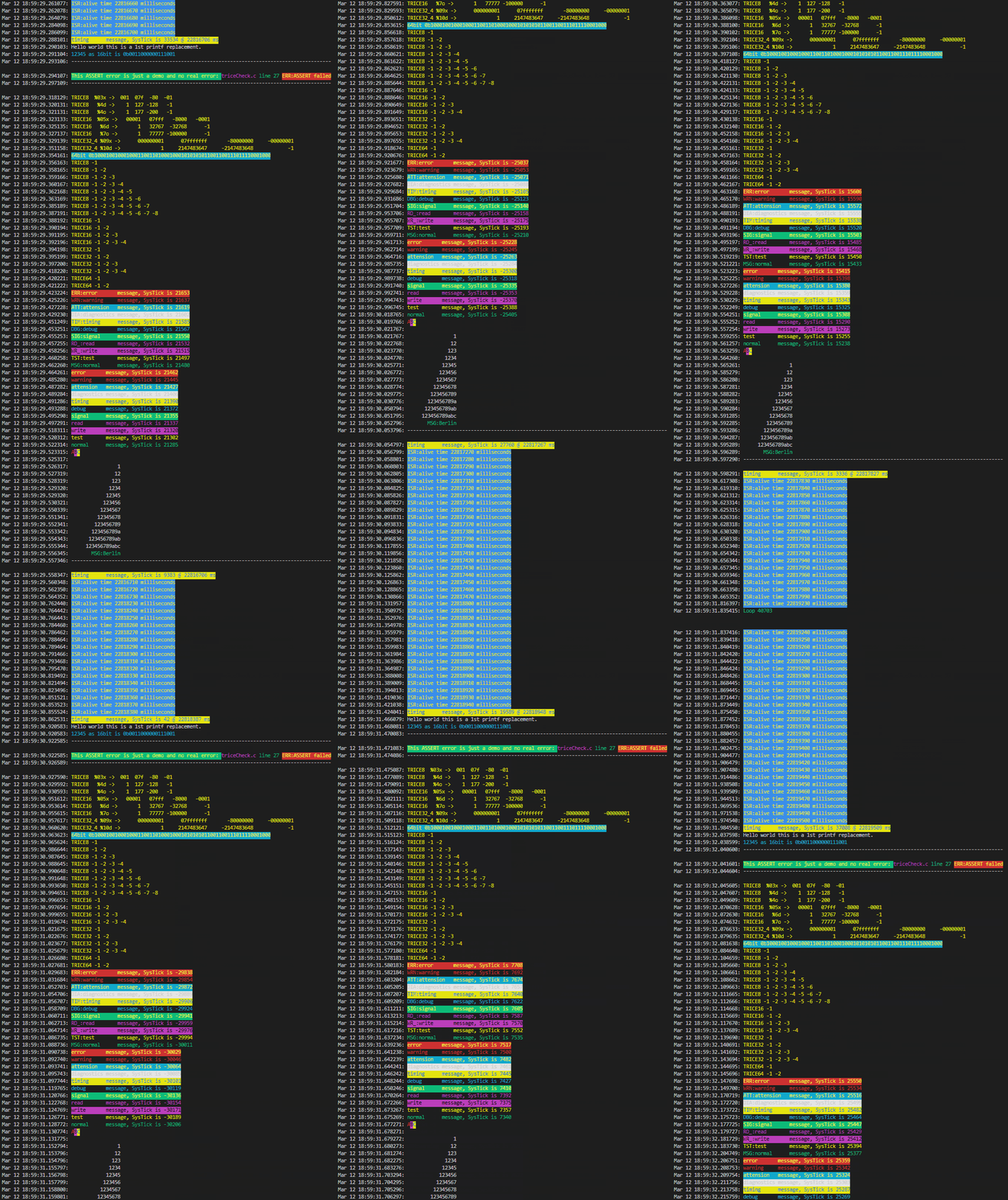
See ../_test/testdata/triceCheck.c for reference. The Trices can come mixed from inside interrupts (light blue ISR:...) or from normal code. For usage with a RTOS, Trices are protected against breaks (TRICE_ENTER_CRITICAL_SECTION, TRICE_LEAVE_CRITICAL_SECTION). Regard the differences in the read SysTick values inside the GIF above These differences are the MCU clocks needed for one trice (~0,25µs@48MHz).
Use the -color off switch for piping output in a file. More convenient is the -lf auto switch.
11. Optional XTEA Encryption
- You can deliver your device with encrypted trices. This way only the service [wo]men is able to read the Trices.
- Implemented is XTEA but this is exchangeable.
- The to 8 byte padded blocks can get encrypted by enabling
#define ENCRYPT...inside triceConfig.h. You need to add-password MySecretastrice logswitch and you’re done. - Any password is usable instead of
MySecret. Simply add once the-showswitch and copy the displayed passphrase into the triceConfig.h file. - The encryption takes part before the COBS encoding.
- TCOBS is usable but not recommended after encryption, because it cannot compress effective arbitrary data.
- If XTEA is used, the encrypted packages have a multiple-of-8 byte length containing 1-7 padding bytes.
- The optional decryption is the next step after unpacking a data frame.
- Enabling XTEA, automatically switches to COBS framing. There is no need to use the Trice tool
-packageFramingswitch in that case because the Trice tool, when getting the CLI switch-password "phrase"automatically assumes COBS encoded data, overwriting the default value for-packageFraming.
12. Trice Command Line Interface & Examples
The trice tool is very easy to use even it has a plenty of options. Most of them normally not needed. The trice tool can be started in several modes (sub-commands), each with several mandatory or optional switches. Switches can have a single parameter string or not.
trice sub-command -switch1 -switch2 parameter -switch3 ...
Which sub-command switches are usable for each sub-command is shown with trice help -all. This gives also information about their default values.
Info for a special sub-command is shown with trice help -log for example.
- The command history is usable for example inside the bash, simply enter CTRL-R and start typing
trice...and you can select from the history. - The most convenient way is to use trice inside scripts like in this example.
12.1. Common information
trice h -allshows all options of the current version.trice verprints version information.trice sshows you all found serial ports for your convenience.trice l -p COM17could fail if something is wrong. Additional switches are for help tracking the issue:- Use log witch
-s[howInputBytes]to check if any bytes are received at all.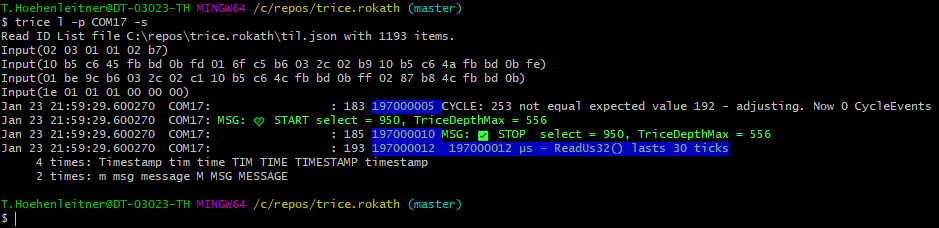
- With
-debugyou can see the [T]COBS packages and decoded Trice packages.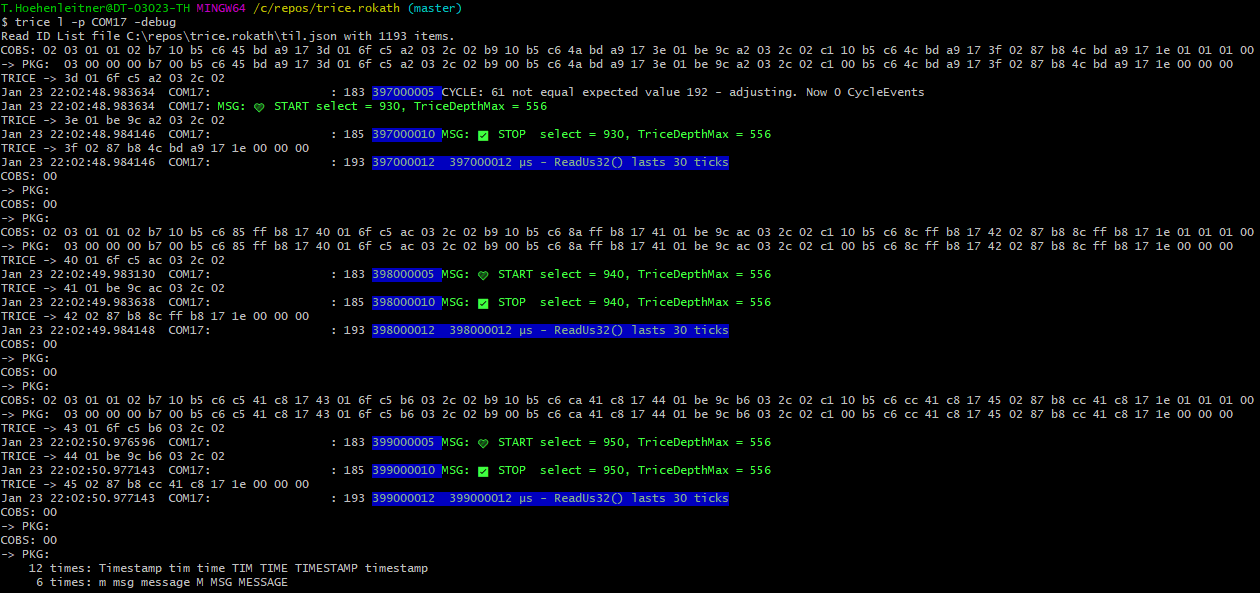
- Use log witch
-
trice iin the root of your project parses all source files for Trice macros, adds automatically ID´s if needed and updates a file named til.json containing all ID´s with their format string information. To start simply generate an empty file named til.json in your project root. You can addtrice ito your build process and need no further manual execution. trice dsstarts a display server listening on default ip address 127.0.0.1:61487 or any specified value. This is possible also on a remote device, lets say with ip address 192.168.1.200.trice l -p COM18 -dssends the log strings to a display server with default ip address 127.0.0.1:61487 or any specified value, if for example-ipa 192.168.1.200the trice logs go to the remote device. You can start several trice log instances, all transmitting to the same display server.
12.2. Further examples
12.2.1. Automated pre-build insert command example
- Scan directories
../src,../lib/srcand./to insert the IDs there and extend list file../../../til.json
trice i -v -i ../../../til.json -src ../src -src ../lib/src -src ./
This is a typical line you can add to your project as an automatic pre-compile step.
12.2.2. Some Log examples
- Log trice messages on COM3 8N1 115200 baud
trice log -i ./myProject/til.json -p=COM3
- Log trice messages on COM3 8N1 9600 baud and use default til.json
trice l -s COM3 -baud=9600
12.2.3. Logging over a display server
- Start displayserver on ip 127.0.0.1 (localhost) and port 61497
trice ds
- Log trice messages on COM3 and display on display server
trice l -ds -p COM3
- Shutdown remote display server on IP 192.168.1.23 port 45678
trice sd -r 192.168.1.23:45678
The IP address and port are free selectable. Using a display server, allows to watch the logs of one or many MCUs on a local or remote machine with the same or different display servers.
A local Trice instance sends Trice messages to a display server only, when a log line is complete (if consisting of several Trices). By using the CLI switches -prefix and -suffix you can decorate the loglines target specific to distinguish them in the output window(s).
12.2.4. Logfile output
trice l -p COM3 -logfile auto
This creates a new logfile 2022-05-16_2216-40_trice.log with the actual timestamp on each Trice start.
trice l -p COM3 -logfile trice.log
This creates a new logfile trice.log on first start and appends to it on each next Trice start.
Logfiles are text files one can see with 3rd party tools. Example: cat trice.log. They contain also the PC reception timestamps if where enabled.
12.2.5. Binary Logfile
trice l -p COM3 -binaryLogfile auto
This creates a new binary logfile 2022-05-16_2216-40_trice.bin with the actual timestamp on each Trice start.
trice l -p COM3 -binaryLogfile trice.bin
This creates a new binary logfile trice.bin on first start and appends to it on each next Trice start.
Binary logfiles store the Trice messages as they come out of the target in binary form. They are much smaller than normal logfiles, but the Trice tool with the matching til.json is needed for displaying them and the PC timestamps are the displaying time: trice l -p FILEBUFFER -args trice.bin.
Recording happens before decoding, -pick, -ban, -logLevel, and visualization. These host options therefore do not remove received bytes from the binary recording, even with -logLevel off. Partial or malformed input is also recorded; a recording write failure is returned as an error. Data already lost or suppressed on the target cannot be recovered from this file.
Replay can use a different selection, for example trice log -p FILEBUFFER -args trice.bin -pick err:wrn. Keep the matching dictionary and decoding settings (encoding, framing, and encryption) with the recording. An explicit binary filename is appended to across runs; use a new filename when separate captures are needed. Keep binary recording disabled during replay, or write to a different file, never the replay input itself.
Binary logfiles are handy in the field for long data recordings.
When using RTT, the data are exchanged over a file interface. These binary logfiles are stored in the project [./temp] folder and accessible for later view: trice l -p FILEBUFFER -args ./temp/logfileName.bin. Of course the host timestamps are the playing time then.
12.2.6. TCP4 output
trice l -p COM3 -tcp 127.0.0.1:23
This additionally sends Trice output to a 3rd party TCP listener, for example like Putty:
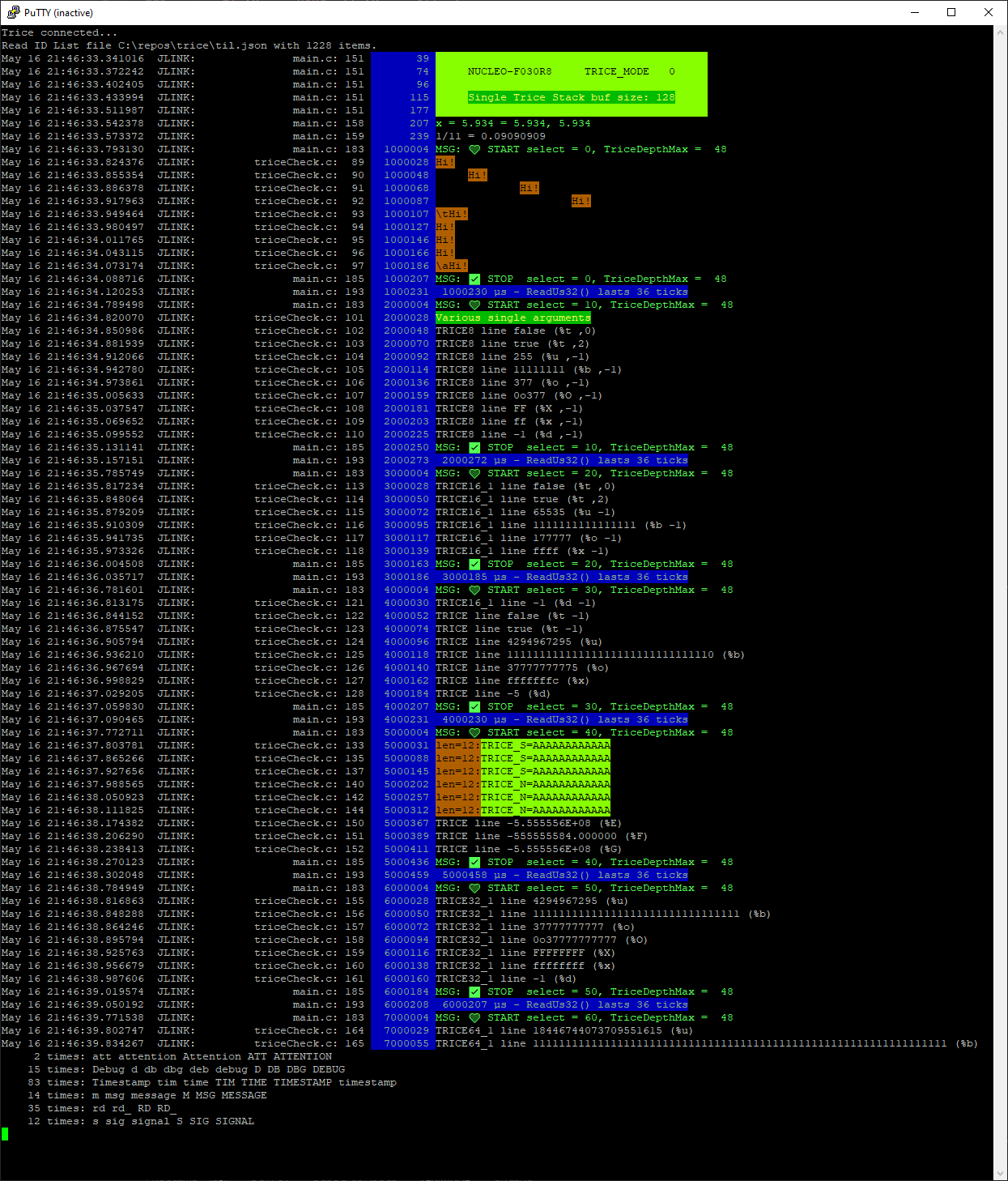
12.2.7. TCP4 input
trice l -p TCP4 -args "192.168.2.3:45678"
This expects a TCP4 server at IP address 192.168.2.3 with port number 45678 to read binary Trice data from.
12.2.8. UDP4 input
The pull request #529 introduces key enhancement:
    IPv4 UDP Receiver
    Adds support for receiving data over IPv4 using UDP. This enables integration with systems that broadcast or transmit telemetry, logs, or other messages over the network.
-port UDP4 Example
To receive Trice logs over IPv4 UDP, use the -port UDP4 option. By default, it listens on 0.0.0.0:17005, which accepts packets on all network interfaces. You can specify a different address or multicast group via -args.
trice log -p UDP4
12.2.9. Stimulate target with a user command over UART
Sometimes it is handy to stimulate the target during development. For that a 2nd screen is helpful what is possible using the display server option:
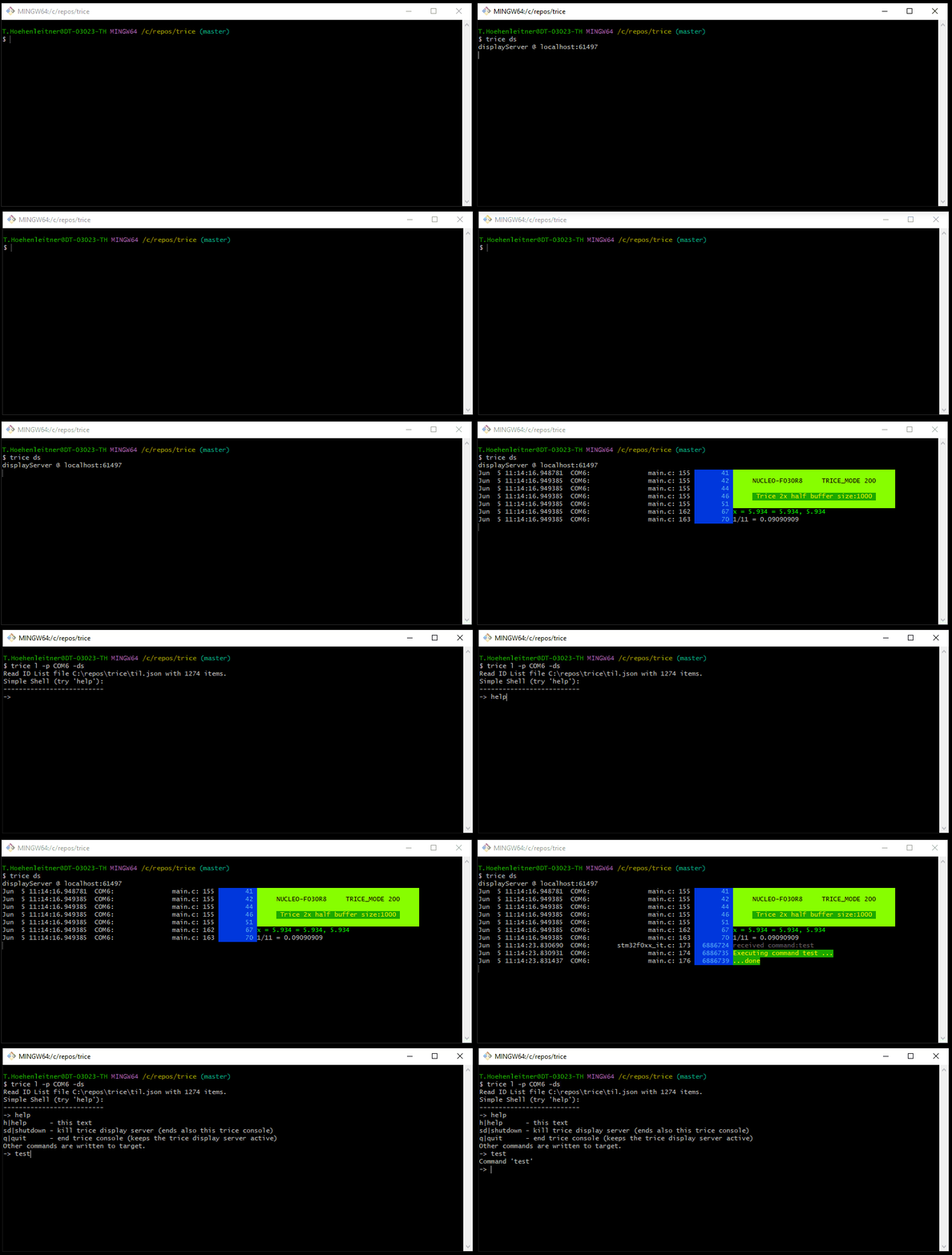
12.2.10. Explore and modify tags and their colors
See chapter Trice Tags and Color.
12.2.11. Location Information
The add, insert, and clean commands generate the file selected by -li|locationInformation. Each entry stores one canonical source path and its line number:
{
  "1234": {
    "File": "examples/TriceABC/src/main.c",
    "Line": 42
  }
}
File is relative to -liRoot and always uses / separators. The default root is the directory containing the selected li.json. An explicit relative -liRoot is resolved from the current working directory. If a relative path cannot be represented, for example across Windows volumes, Trice stores a normalized absolute path without resolving symbolic links.
For example, when build/demoLI.json and examples/TriceABC/src/main.c are below the project directory, the default stores ../examples/TriceABC/src/main.c. To store a project-relative path instead, run:
trice insert -li build/demoLI.json -liRoot . -src examples/TriceABC
During logging, -liMaxDirs controls how much of the stored path is shown. Its default 0 shows only the filename. For examples/TriceABC/src/main.c, values 1, 2, and 3 show src/main.c, TriceABC/src/main.c, and the complete stored path respectively. Leading .. components describe the relation to -liRoot and are not displayed or counted. -liFmt continues to control the surrounding filename and line-number format.
Location information must match the exact firmware version. In field deployments, keeping li.json private and showing the numeric ID with -showID can be preferable. When trice clean is used, consider versioning the matching li.json so later insert operations can reuse locations consistently.
12.3. Visualization output with -vis
tlog and trice log support the same repeatable -vis option for sending selected numeric measurements to external visualization tools. Consumers can, for example, be LabPlot, Serial Studio, PlotJuggler, uPlot, Grafana, or a custom program; these names do not imply a tool-specific protocol. Trice itself does not draw a graph. It transforms one typed Trice message into one user-defined text record and writes that record to a file or UDP destination.
The syntax is:
-vis='<tag>:printf("<go-fmt>",<expression-list>)@<file-path-or-udp-sink>[;log=keep|drop]'
For example, this target message keeps its visualization details independent of the host tool:
TRice("imu:ax=%f,ay=%f,az=%f\n", aFloat(ax), aFloat(ay), aFloat(az));
It can be written as CSV:
tlog ... \
  -vis='imu:printf("%d,%0.3f,%0.3f,%0.3f\n",ts32,v0,v1,v2)@imu.csv'
or sent as one UDP datagram per record:
tlog ... \
  -vis='imu:printf("%0.3f,%0.3f,%0.3f\n",v0*0.5,v1*0.5,v2*0.5)@udp://127.0.0.1:7010;log=drop'
The selector matches the original Trice format prefix <tag>:. -pick and -ban run first. A message removed by either existing filter is therefore invisible both to normal output and to -vis.
The supported fields are:
id                unsigned Trice ID
ts                raw 16- or 32-bit Target-Stamp, with one width latched per rule
ts16              raw 16-bit Target-Stamp
ts32              raw 32-bit Target-Stamp
v0 ... v11        typed positional Trice values
The value fields are positional and can be reordered in the expression list. -vis does not extract names such as ax or rpm from the human-readable target format and does not accept those names as identifiers. For example, printf("%g,%g\n",v2,v0) deliberately emits the third value before the first. Structured Logging field names are not visualization expression identifiers; use v0 through v11 for this interface.
A Target-Stamp is an unscaled number. -vis does not assume that it represents time and does not perform unit conversion, wrap extension, or mixed-width reconstruction. Scaling is explicit in an expression, for example ts32*0.001. A rule may use ts16 or ts32, but not both. A generic ts rule is disabled with a warning if an otherwise eligible message later changes between 16 and 32 bits.
Separate rules make the expected stamp width explicit:
tlog ... \
  -vis='fast:printf("%d,%g\n",ts16,v0)@fast.csv' \
  -vis='slow:printf("%d,%g\n",ts32,v0)@slow.csv'
Expressions support decimal, floating-point, and hexadecimal literals, parentheses, unary minus, and +, -, *, /. A direct field retains its signed, unsigned, floating-point, or Boolean type. Arithmetic is evaluated as float64. A floating result used with an integer verb must be finite and inside the int64 range; it is then truncated toward zero.
The printf encoder supports:
integer:       %d %b %o %x %X
floating:      %f %e %E %g %G
generic:       %v
Boolean:       %t with a direct Boolean field
literal:       %%
formatting:    literal width and precision, such as %08x or %0.3f
%u, dynamic * width or precision, explicit argument indexes, string conversions, and other Go formatting verbs are not supported. The expression count must equal the number of consuming verbs. The encoder adds no implicit newline; include \n in the format when the receiving tool expects one. A one-line JSON record is possible as well:
tlog ... \
  -vis='imu:printf("{\"stamp\":%d,\"x\":%g,\"y\":%g,\"z\":%g}\n",ts32,v0,v1,v2)@udp://127.0.0.1:7011'
A bare path and file:<path> both select an append-only file:
@out.csv
@logs/imu.csv
@file:out.csv
Missing files are created. Rules using the same normalized file path share one open file. file://out.csv is rejected because standard URI parsing treats out.csv as a host, not as a relative path. Full file-URI semantics are not part of this implementation.
UDP destinations use:
@udp://127.0.0.1:7010
@udp://localhost:7010
The address is resolved and opened before decoding starts. File and UDP writes are synchronous. There is no queue, retry, reconnect, acknowledgement, TCP, WebSocket, or named-pipe support in this first implementation.
log=keep is the default and leaves the decoded message in normal output. log=drop removes it from normal output only after that rule has encoded and written the visualization record successfully. All overlapping rules are still attempted; one successful log=drop rule wins. An ignored record or a failed encoder or sink write does not drop the normal log.
Only fixed-width numeric Trice messages are eligible. The first twelve values are addressable as v0 through v11; additional values do not prevent a rule from using that addressable prefix and remain available to normal logging. Trice string, buffer, function-display, character, typeX0, CHAR, and DUMP inputs are not supported. Named values, specialized JSON or binary encoders, TCP, WebSocket, named pipes, and process pipes are deferred behind the same selector/encoder/sink separation. One eligible Trice must also form one complete log line by itself. Partial, multi-line, and multi-Trice lines continue through normal logging but are ignored by -vis; verbose mode reports every such occurrence.
At startup, each rule checks all matching historical til.json entries. Incompatible old entries are excluded independently, so one stale ID does not block another compatible ID. A rule with no compatible entry is disabled with a prominent warning. Rules are also disabled, never silently, after a generic Target-Stamp width conflict, an unsafe runtime expression conversion, or a sink failure. Normal logging continues.
12.4. Setting up the LabPlot Demo
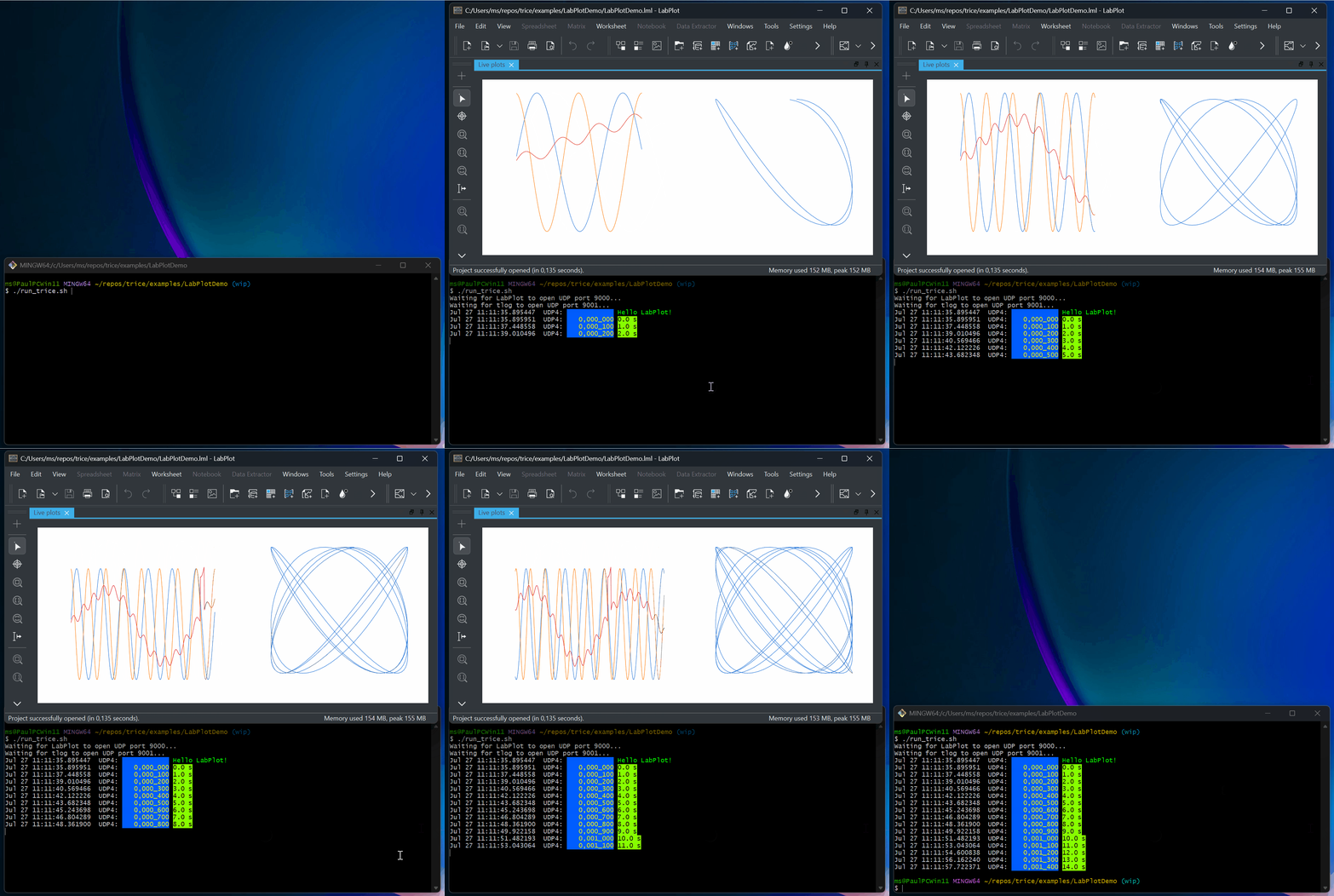
This section uses LabPlot, a cross-platform interactive
plotting application. The finished, ready-to-run example is in
./examples/LabPlotDemo/; the guided learning path is in
./examples/LabPlotUser/. The project uses a UDP socket so that it can
display an endless stream without repeatedly importing files.
12.4.1. The common live-data format
Both producers describe the same three signals: x, y, and z. LabPlot
receives normalized numeric CSV records with this column layout:
time_s,x,y,z
The finished project predeclares the four numeric columns and performs one initial read while loading. This prepares LabPlot’s UDP socket before the first live record arrives. The UDP stream therefore needs no header row.
The LabPlot demo rate is 50 samples per second. The project retains 500 rows.
The time plot is configured for the last 500 values, so its horizontal
resolution stays constant and it always displays approximately the most
recent ten seconds. The Lissajous plot uses only the last 150 values, which
creates a moving three-second trace instead of an increasingly dense full
history. A slow phase modulation of y makes the figure change continuously.
The CSV producer sends this format directly. The Trice producer sends binary
Trice records to tlog; tlog decodes them and sends the same CSV format
onward. This separation means that one LabPlot project works for both
examples.
12.4.2. ./examples/DemoData_CSV
The CSV producer is a small C11 program
for Windows, macOS, and Linux. Each newline-terminated record contains
time_s,x,y,z, all represented as double; time is in seconds. It writes to
standard output by default, to a fresh file with --output FILE, or to UDP
with one record per datagram. Use --help for all options.
Both data producers require a C compiler and CMake 3.16 or newer. Run their
build.sh in Git Bash on Windows or a POSIX shell on macOS/Linux; restore its
executable permission with chmod +x build.sh if necessary. Executables are
installed in each project’s bin/, with intermediate files in build/.
For the CSV producer, the equivalent explicit CMake commands are:
cd examples/DemoData_CSV
cmake -S . -B build
cmake --build build --config Release
cmake --install build --config Release --prefix .
These commands also work in PowerShell. Its executable invocation is
.\bin\DemoData_CSV.exe; in Git Bash use ./bin/DemoData_CSV.
From the CSV project directory, try:
./build.sh
./bin/DemoData_CSV
./bin/DemoData_CSV --rate 50 --samples 500 --no-delay --header --output DemoData_CSV.csv
./bin/DemoData_CSV --udp 127.0.0.1 9000
Run these alternatives separately. The second command runs continuously at
50 Hz; interrupt it with Ctrl-C. The third writes ten seconds of data
without real-time waiting. On Windows PowerShell the UDP command is
.\bin\DemoData_CSV.exe --udp 127.0.0.1 9000.
For Serial Studio, choose Quick Plot (Comma Separated Values), then
Network Socket > UDP, set local port 9000, connect, and start the UDP
producer. Quick Plot treats all four columns as values. A custom project can
instead name the columns and use the first column as a timestamp axis. Its
input must be seconds,x,y,z; do not send --header on the live stream.
There is currently no versioned DemoData.ssproj in this repository.
Both producers use the following signal model for time t in seconds:
phase = (pi/3) * sin(2*pi*0.04*t)
x = sin(2*pi*0.70*t)
y = sin(2*pi*0.91*t + pi/2 + phase)
z = 0.6*sin(2*pi*0.13*t) + 0.2*x*y + pulse
The pulse has height 0.8 during the final 250 ms of every eight-second
interval. The slow phase modulation keeps the Lissajous plot moving. The
Trice producer calculates the signals as doubles and transmits float32 values.
After running build.sh inside ./examples/DemoData_CSV/, the executable is
installed in the local bin/ folder. You can run it there:
th@Thomass-MacBook-Pro-7 bin % ./DemoData_CSV --header -o log.csv
^C
th@Thomass-MacBook-Pro-7 bin % head log.csv
time_s,x,y,z
0.000000,0.000000,1.000000,0.000000
0.020000,0.087851,0.992854,0.027246
0.040000,0.175023,0.971519,0.053608
0.060000,0.260842,0.936300,0.078239
0.080000,0.344643,0.887701,0.100367
0.100000,0.425779,0.826415,0.119328
0.120000,0.503623,0.753319,0.134594
0.140000,0.577573,0.669459,0.145795
0.160000,0.647056,0.576032,0.152736
th@Thomass-MacBook-Pro-7 bin %
12.4.3. ./examples/DemoData_Trice
The Trice producer transports the
same signals as binary Trice records. Keep it inside the repository: its
CMake project uses the unchanged target library from ../../src.
Its build script prepares Bind and the
repository-root demoTIL.json before building; it requires the Trice host
tool in addition to the CSV producer’s prerequisites. Use this script rather
than plain CMake commands that omit Bind preparation. There is no private
til.json or fixed iD(1000) for this ID-free producer.
The 32-bit target stamp uses units of 10 ms: at 50 Hz the stamps are
0, 2, 4, .... Convert with seconds = ts/100.0 or
milliseconds = ts*10; ts*100 does not give seconds.
From examples/DemoData_Trice:
./build.sh
./bin/DemoData_Trice --samples 500 --no-delay
trice log -p FILEBUFFER -args DemoData_Trice.bin -pf TCOBS -til ../../demoTIL.json -li off
Without an output option, the producer recreates DemoData_Trice.bin in the
current directory (wb truncates its previous contents). --output FILE
selects another fresh file, --stdout writes binary data to standard output,
and --udp HOST PORT sends one complete TCOBS-framed record per datagram.
Without --samples it runs until interrupted. --samples 500 counts signal
samples, not all log records: startup and periodic diagnostic logs are extra.
Use --help for all options. On Windows PowerShell, run
.\bin\DemoData_Trice.exe with the same arguments.
After running build.sh inside ./examples/DemoData_Trice/, the executable is
installed in the local bin/ folder. You can run it there:
- Create binary log file:
th@Thomass-MacBook-Pro-7 bin % ./DemoData_Trice -o log.bin
Writing log.bin
^C
- Show logs in binary log file:
th@Thomass-MacBook-Pro-7 bin % tlog -p FILEBUFFER -args log.bin -til ../../../demoTIL.json -ulabel vis_demo | head
Jul 25 15:38:55.411676  FILEBUFFER:    0,000_000 0.000000,1.000000,0.000000
Jul 25 15:38:55.411691  FILEBUFFER:    0,000_002 0.087851,0.992854,0.027246
Jul 25 15:38:55.411705  FILEBUFFER:    0,000_004 0.175023,0.971519,0.053608
Jul 25 15:38:55.411714  FILEBUFFER:    0,000_006 0.260842,0.936300,0.078239
Jul 25 15:38:55.411725  FILEBUFFER:    0,000_008 0.344643,0.887701,0.100367
Jul 25 15:38:55.411737  FILEBUFFER:    0,000_010 0.425779,0.826415,0.119328
Jul 25 15:38:55.411752  FILEBUFFER:    0,000_012 0.503623,0.753319,0.134594
Jul 25 15:38:55.411765  FILEBUFFER:    0,000_014 0.577573,0.669459,0.145795
Jul 25 15:38:55.411776  FILEBUFFER:    0,000_016 0.647056,0.576032,0.152736
th@Thomass-MacBook-Pro-7 bin %
- Get CSV log file:
th@Thomass-MacBook-Pro-7 bin % tlog -p FILEBUFFER -args log.bin -til ../../../demoTIL.json -ulabel vis_demo -vis='vis_demo:printf("%0.3f,%0.3f,%0.3f,%0.3f\n",ts/100.0,v0,v1,v2)@log.csv;header="time_s,X,Y,Z\n";log=drop'
th@Thomass-MacBook-Pro-7 bin % head log.csv
time_s,X,Y,Z
0.000,0.000,1.000,0.000
0.020,0.088,0.993,0.027
0.040,0.175,0.972,0.054
0.060,0.261,0.936,0.078
0.080,0.345,0.888,0.100
0.100,0.426,0.826,0.119
0.120,0.504,0.753,0.135
0.140,0.578,0.669,0.146
0.160,0.647,0.576,0.153
th@Thomass-MacBook-Pro-7 bin %
The preceding file visualization rule recreates log.csv when tlog starts.
Its header is written once per sink; the quoted Go string supports \n.
Keep a single backslash in the shell’s single-quoted rule. log=drop suppresses
the successfully visualized records, while unrelated diagnostic logs remain.
For a live Serial Studio or other CSV viewer listening on UDP 9000, start
the decoder from the repository root before starting the binary producer:
trice log -p UDP4 -args 127.0.0.1:9001 -pf TCOBS -til demoTIL.json -ulabel vis_demo \
  -vis='vis_demo:printf("%0.6f,%0.6f,%0.6f,%0.6f\n",ts/100.0,v0,v1,v2)@udp://127.0.0.1:9000;log=drop'
In another terminal, also from the repository root:
examples/DemoData_Trice/bin/DemoData_Trice --udp 127.0.0.1 9001
On Windows the executable has an .exe suffix. The producer sends binary
Trice to 9001, not CSV; connecting it directly to the viewer on 9000
cannot work. The decoder converts its records to seconds,x,y,z. The LabPlot
launchers below automate this pipeline and its receiver-readiness checks.
12.4.4. Quick LabPlot demonstration
Install LabPlot 2.12 or newer. From the repository root, run one of these commands in a POSIX shell:
./examples/LabPlotDemo/run_csv.sh
./examples/LabPlotDemo/run_trice.sh
The script opens LabPlotDemo.lml and starts the selected producer. The first
script sends CSV directly to UDP port 9000. The second uses UDP port 9001
for binary Trice input and runs tlog as the decoder/forwarder to port 9000.
The script first waits until LabPlot has opened port 9000, then starts
tlog and waits until its input port 9001 is ready. Only then does it start
the Trice producer. The project opens one worksheet containing two plots side
by side:
Time series:x,y, andzversustime_s, always showing the last 500 values (ten seconds).Lissajous:yversusx, showing the last 150 values (three seconds) on fixed axes. The producer’s slow phase drift keeps the figure in motion.
Press Ctrl-C in the shell to stop the producer and decoder. If LabPlot is
not found automatically, set LABPLOT to its executable. On Windows, Git
Bash is a suitable shell; for example, use
LABPLOT=/c/Program\ Files/LabPlot/bin/labplot.exe.
12.4.5. Recreate the project in LabPlot
The following steps explain the project without requiring prior LabPlot
knowledge. Start run_csv.sh first and leave it running.
- Create a new LabPlot project and choose Add New > Live Data Source.
- Select Network UDP Socket, enter host
127.0.0.1and port9000. - Select the ASCII filter, comma as separator, and disable header detection.
Set all four data types to
Doubleand enter the namestime_s,x,y, andz. - Select Update on new data and retain
500values. This is the moving ten-second window at the demo’s 50 Hz rate. - Add a worksheet with a Cartesian plot. Add three XY curves. For every
curve choose
time_sas the X column and choosex,y, orzas the Y column. Enable the legend, label the axestime [s]andvalue, and enable automatic range scaling. In the plot’s range settings select Last values and enter500; otherwise the time axis keeps growing and the curves become increasingly compressed. - Add a second Cartesian plot to the same worksheet and select a horizontal
two-column worksheet layout. Add one XY curve with
xas its X column andyas its Y column. Select Last values and enter150. Fixed X and Y ranges from-1.1to1.1keep the scale stable while the three-second trace and the signal’s slow phase drift make the movement visible. - Save the project as
LabPlotUser.lml.
The finished LabPlotDemo.lml contains
these settings and no machine-specific paths. Open it manually if LabPlot is
already running. The LabPlotUser directory is the
place for your recreated LabPlotUser.lml; this section is its complete
rebuild guide. Both producers end at the same numeric UDP stream, for example
0.000000,0.000000,1.000000,0.000000.
Stop the producer and start the other launcher without changing the LabPlot
project. Keep only one producer sending to UDP 9000 and keep the live source
connected. The Trice launcher first waits for LabPlot on 9000, then for its
decoder on 9001. The supplied project predeclares all four numeric columns
and triggers an initial read when loaded so that LabPlot prepares its socket.
12.4.6. Troubleshooting and adaptations
labplotmust be discoverable or selected withLABPLOT. macOS also checks its standard application bundle. Windows searchesProgramFiles,ProgramW6432, andLOCALAPPDATAforlabplot.exeorlabplot2.exe; an explicitLABPLOToverride takes precedence.TLOGcan select a decoder outsidePATH. Producer executables stay in each demo’sbin/, with CMake intermediates inbuild/.- If the plots remain empty, verify that the producer is running and that no
other process owns UDP port
9000. - If
tlogreports that a-visrule was disabled because writing to port9000was refused, LabPlot was not listening when the decoder started. Restartrun_trice.sh; its readiness check normally prevents this race. Once a visualization rule is disabled, normal logging intentionally resumes, and itslog=dropoption is no longer applied. - For the Trice path, verify that
tlogis onPATHand thatdemoTIL.jsonis present at the repository root. SetTLOGorTRICE_TILwhen using non-default locations. - Keep the complete
-visexpression inside one pair of quotes. The semicolon separatesheaderandlogoptions inside that expression; it must not be interpreted by the shell. - To show another history length, change the retained-value count to
50 * seconds. For example,1000values show approximately 20 seconds. - The Trice path still uses UDP port
9001internally between the demo andtlog. If that port is busy, stop the other receiver or change it inrun_trice.shand its-argsvalue together.
13. Limitations
13.1. Permanent Limitations
13.1.1. Limitation TRICE in TRICE not possible
- No-Good Example:
int f0( void ){ TRICE( "msg:f0\n"); return 0; }
void f1( void ){ TRICE( "No; %d", f0() ); }
- This will compile normally but corrupt TRICE output.
The reason is: When f1() gets active, the “No” Trice header is created, than the f0() Trice is executed and afterwards the “No” Trice tail is written. This works well during compile time but causes a mismatch during runtime.
- Workaround:
int f0( void ){ TRICE( "msg:f0\n"); return 0; }
void f1( void ){ int x = f0(); TRICE( "Yes: %d", x ); }
13.2. Current Limitations
13.2.1. String Concatenation Within TRICE Macros Not Possible
String concatenation within TRICE macros does not work. The reason lays inside the way the trice tool parser works:
void f0( void ){ TRICE( "msg:" ## "Hello\n" ); } // ERROR!
To implement this would need to build a trice preprocessor or to run the C preprocessor first and to modify the preprocessor output with the trice tool. That would make things unneccessary complicate and fragile for now.
13.2.2. Limited Trice Parser Capabilities
The Trice tool internal parser has only limited capabilities. In works well in most cases, but could lead to problems in some cases. The compiler run will for sure end up with some error messages in the following examples, so the developer can fix the code.
An example, provided by @KammutierSpule, is this:
- started from a empty li.json/til.json
void trice0_test() {
    Trice0( "OK");
    Trice( InvalidUse );
    Trice( "%u", Variable );
}
- run
trice insert
void trice0_test() {
    Trice0( iD(2740), "OK"); // ok, iD is added
    Trice( InvalidUse ); // no warning or error
    Trice( "%u", Variable ); // id is not added / inserted
}
As said, the compiler will complain about that in any case.
13.2.3. Special Care Demands
More than 12 printf parameters
- use several printf-calls
- Use triceB and its relatives
Float Numbers
- surround each with
aFloat()
Double numbers
- surround each with
aDouble()and use thetrice64macro and relatives
Runtime Generated Strings
- Each needs its own
triceSmacro, example:-
Legacy code:
printf( "Entered name is %20s %30s, favorite numbers %d, %f\n", "Paul", "Luap", 42, 3.14159 ); -
Trice code:
name = "Paul"; triceS( "Entered name is %20s", name );`
surname = "Luap";  triceS( " %30s, ", surname );`
trice( "favorite numbers %d, %f\n", 42, aFloat(3.14159) );`
-
The triceS macro is ment to be used with strings not known at compile time.
Usage intention and recommendation: (given by @escherstair)
char runtime_string[50];
fillRuntimeStringFromSomewhere(runtime_string); // the content of runtime_string is filled at run time
triceS( "msg:This part of the string is known at compile time. This part is dynamic: %s\n", runtime_string);
All the string literals (i.e. compile-time known strings) should be put inside the format string. Only the runtime strings should be used as variables in triceS macro for best performance.
14. Additional hints
14.1. Pre-built executables are available
See https://github.com/rokath/trice/releases.
14.2. Configuration file triceConfig.h
- When setting up your first project you need a
triceConfig.hfile. - You should not use the
./_test/cgo.../triceConfig.hdirectly, because these are customized for internal tests with CGO. But you can use their settings as helper for a starting point. - Please choose one of these files as starting point:
- Comparing them and understandig the differences helps quick starting.
- The file triceDefaultConfig.h contains all possible config keys with descriptions.
14.3. Setting up the very first connection
If you see nothing in the beginning, what is normal ;-), add the -s (-showInputBytes) switch to see if any data arrive. There is also a switch -debug showing you the received packages, if you are interested in.
14.4. Avoid buffer overruns
It is your responsibility to produce less data than transmittable. If this is not guarantied, a data loss is not avoidable or you have to slow down the user application. The buffers have an optional overflow protection (TRICE_PROTECT), which is enabled by default. Recommendation: Make the buffer big and emit the maxDepth cyclically, every 10 or 1000 seconds. Then you know the needed size. It is influenced by the max Trice data burst and the buffer switch interval. See ./examples/exampleData/triceLogDiagData.c for help.
If the target application produces more Trice data than transmittable, a buffer overrun can let the target crash, because for performance reasons no overflow check is implemented in versions before v0.65.0. Such a check is added now per default using TRICE_PROTECT, but the Trice code can only throw data away in such case. Of course you can disable this protection to get more speed.
Configuring the ring buffer option with TRICE_PROTECT == 0 makes buffer overruns not completely impossible, because due to partial Trice log overwrites, false data are not excluded anymore and overwriting the buffer boundaries is possible, because of wrong length information. Also losses will occur when producing more data than transmittable. This is detectable with the cycle counter. The internal 8-bit cycle counter is usually enabled. If Trice data are lost, the receiver side will detect that because the cycle counter is not as expected. There is a chance of 1/256 that the detection does not work for a single case. You can check the detection by unplugging the trice UART cable for a time. Also resetting the target during transmission should display a cycle error.
Gennerally it is recommended to enable TRICE_PROTECT during development and to disable it for performance, if you are 100% sure, that not more data are producable than transmittable.
Important to know: If the TRICE_PROTECT code inhibits the writing into a buffer, there will be later no cycle error because a non existing Trice cannot cause a cycle error. Therefore the TriceDirectOverflowCount and TriceDeferredOverflowCount values exist, which could be monitored.
14.5. Buffer Macros
(Examples in ../_test/testdata/triceCheck.c)
| Macro Name | Description |
|---|---|
triceS |TriceS |TRiceS |TRICE_S |
Output of runtime generated 0-terminated strings. |
triceN |TriceN |TRiceN |TRICE_N |
Is for byte buffer output as string until the specified size. It allows limiting the string size to a specific value and does not rely on a terminating 0. If for example len = 7 is given and “Hello\0World\n” is in the buffer, the byte sequence “Hello\0W” is transmitted but the trice tool probably shows only “Hello”. |
triceB |TriceB |TRiceB |TRICE_B |
Is buffer output according to the given format specifier for a default unit according to configuration (8|16|32|64-bit value) - default is #define TRICE_B TRICE8_B. |
trice8B |Trice8B |TRice8B |TRICE8_B |
Is for byte buffer output according to the given format specifier for a single byte. |
trice16B|Trice16B|TRice16B|TRICE16_B |
Is for 16-bit buffer output according to the given format specifier for a 16-bit value. |
trice32B|Trice32B|TRice32B|TRICE32_B |
Is for 32-bit buffer output according to the given format specifier for a 32-bit value. |
| See chapter Trice ABC - Asynchronous Broadcast Commands for the following lines. | |
triceC |TriceC |TRiceC |TRICE_C |
Is for ABC buffer output according to the given function handler for a default unit according to configuration (8|16|32|64-bit value) - default is #define TRICE_C TRICE8_C. |
trice8C |Trice8C |TRice8C |TRICE8_C |
Is for ABC byte buffer output according to the given function handler. |
trice16C|Trice16C|TRice16C|TRICE16_C |
Is for ABC 16-bit buffer output according to the given function handler for a 16-bit wide buffer. |
trice32C|Trice32C|TRice32C|TRICE32_C |
Is for ABC 32-bit buffer output according to the given function handler for a 32-bit wide buffer. |
14.6. Logfile viewing
Logfiles, Trice tool generated with sub-command switch -color off, are normal ASCII files. If they are with color codes, these are ANSI escape sequences.
- Simply
cat trice.log. One view option is alsoless -R trice.log. The Linux commandlessis also available inside the windows git bash. - Under Windows one could also download and use ansifilter for logfile viewing. A monospaced font is recommended.
- See also Color issues under Windows
14.7. Using the Trice tool with 3rd party tools
Parallel output as logfile, TCP or binary logfile is possible. See examples above.
14.8. Several targets at the same time
You can connect each target over its transmit channel with an own Trice instance and integrate all transmissions line by line in an additional Trice instance acting as display server. See https://github.com/rokath/trice#display-server-option.
14.9. Executing go test -race -count 100 ./...
The C-code is executed during some tests. Prerequisite is an installed GCC.
14.10. TRICE_STACK_BUFFER could cause stack overflow with -o0 optimization
As discussed in issue #294 it can happen, that several TRICE macros within one function call increase the stack usage more than expected, when compiler optimization is totally switched off.
14.11. Cycle Counter
- The trice tool expects the first cycle counter to start with 0xC0 (=192). If the target is already running and you connect the trice tool then, the first message is marked with “CYCLE: ? not equal expected value 192 - adjusting. Now 1 CycleEvents”.
- If the target is resetted asynchronous, the trice tool receives a cycle counter 192. Most probably the last cycle counter was not 191, so this triggers also a message with “CYCLE: 192 not equal expected value ?- adjusting. Now n CycleEvents”.
- In the Trice tool is some heuristics to suppress such obvious false positives.
15. Switching Trice ON and OFF
15.1. Target side compile-time Trice On-Off
- If your code works well after checking, you can add
#define TRICE_OFF 1just before the#include "trice.h"line and no Trice code is generated anymore for that file, so no need to delete or comment out Trice macros:
#define TRICE_OFF 1
#include "trice.h"
void fn(void) {
    trice( iD(123), "Hi"); // Will generate code only, when TRICE_OFF == 0.
    trice( "Lo");          // Will generate code only, when TRICE_OFF == 0.
}
With #define TRICE_OFF 1, macros in this file are ignored completely by the compiler, but not by the Trice tool. In case of reconstructing the Trice ID List these no code generating macros are regarded and go into (or stay inside) the ID reference list.
- Hint from @escherstair: With
-D TRICE_OFF=1as compiler option, the trice code diappears completely from the binary. - No runtime On-Off switch is implemented for several reasons:
- Would need a control channel to the target.
- Would add little performance and code overhead.
- Would sligtly change target timing (testing).
- User can add its own switches anywhere.
- The short Trice macro code is negligible.
- The trice output is encryptable, if needed.
- Because of the low Trice bandwidth needs and to keep the target code as clear as possible the runtime On-Off decision should be done by the Trice tool.
15.2. Host side Trice On-Off
- The PC Trice tool offers command line switches to
-pickor-banfor Trice tags and will be extended with display switches. - A Trice tool
-logLevelswitch is usable too.
16. Framing
- Trice messages are framed binary data, if framing is not disabled.
- Framing is important for data disruption cases and is done with TCOBS (has included data compression) but the user can force to use COBS, what makes it easier to write an own decoder in some cases or disable framing at all.
- Change the setting
TRICE_FRAMINGinsidetriceConfig.hand use the Trice tool-packageFramingswitch accordingly.
- Change the setting
- For robustness each Trice can get its own (T)COBS package (
TRICE_DEFERRED_TRANSFER_MODE == TRICE_SINGLE_PACK_MODE). That is configurable for transfer data reduction. Use#define TRICE_DEFERRED_TRANSFER_MODE TRICE_MULTI_PACK_MODEinsidetriceConfig.h(is now default). This allows to reduce the data size a bit by avoiding many 0-delimiter bytes but results in some more data loss in case of data disruptions.
17. Endianness
- To interpret a decoded package, it´s endianness needs to be known.
- For efficiency, binary trice data are normally stored and transmitted in MCU endianness and the Trice tool expects binary data in little endian format as most MCUs are little endian.
- On big endian MCUs the compiler switch
TRICE_MCU_IS_BIG_ENDIANneeds to be defined as 1 andTRICE_TRANSFER_ORDER_IS_BIG_ENDIANshould have the same value. The Trice tool has a CLI switch “triceEndianness” which needs to be set to “bigEndian” then. - If trice transmit data are needed to be not in MCU order for some reason, that increases the critical trice storage time and target code amount.
- De facto different values for
TRICE_MCU_IS_BIG_ENDIANandTRICE_TRANSFER_ORDER_IS_BIG_ENDIANare mainly used to test the Trice CLI switch-triceEndianness bigEndianautomatically.
18. Trice (Time)Stamps
- Each Trice message can carry stamp bits, which are free usable like for time, addressing or filtering.
- By selecting the letter case (trice, Trice, TRice) you decide for each single Trice macro about the stamp size.
-
Default notation (function call):
notation stamp size remark trice( iD(n), "...", ...);0-bit no stamp at all, shortest footprint Trice( iD(n), "...", ...);16-bit calls internally uint16_t TriceStamp16( void )for trice message stampingTRice( iD(n), "...", ...);32-bit calls internally uint32_t TriceStamp32( void )for trice message stamping -
No upper case macro, like
TRICE_Sworks with the internaliD(n)macro. They needid(n),Id(n)orID(n). See next table. -
Legacy notation (code inlining):
notation stamp size remark TRICE( id(n), "...", ...)0-bit no stamp at all, shortest footprint TRICE( Id(n), "...", ...)16-bit calls internally uint16_t TriceStamp16( void )for trice message stampingTRICE( ID(n), "...", ...)32-bit calls internally uint32_t TriceStamp32( void )for trice message stamping
It is up to the user to provide the functions TriceStamp16 and/or TriceStamp32. Normally they return a µs or ms tick count but any values are allowed.
The PC feature tour makes this distinction visible without hardware: its 16-bit stamp is a sample phase, while its 32-bit stamp counts milliseconds. The matching G0B1 feature tour uses the board’s own timers.
18.1. Target (Time)Stamps Formatting
To get a short overview run trice help -log and read about the CLI switches ts, ts0, ts16, ts32, ts0delta, ts16delta, ts32delta in the generated CLI help file. The ts32 switch supports also “epoch” now as format. That is useful for example, if the binary logs are stored internally in the device flash and read out later. Such usage assumes 1 second as ts32 unit in uint32_t format and the Trice tool displays the UTC time. It is also possible to adapt the displayed format like this for example: trice log -ts32='epoch"06-01-02_15:04:05"'. The additional passed string must match the Go time package capabilities. A few examples:
trice log -port FILEBUFFER -args myLogs.bin -ts32='"Mon Jan _2 15:04:05 2006"'             # ANSIC
trice log -port FILEBUFFER -args myLogs.bin -ts32='"Mon Jan _2 15:04:05 MST 2006"'         # UnixDate
trice log -port FILEBUFFER -args myLogs.bin -ts32='"Mon Jan 02 15:04:05 -0700 2006"'       # RubyDate
trice log -port FILEBUFFER -args myLogs.bin -ts32='"02 Jan 06 15:04 MST"'                  # RFC822
trice log -port FILEBUFFER -args myLogs.bin -ts32='"02 Jan 06 15:04 -0700"'                # RFC822Z     (RFC822 with numeric zone)
trice log -port FILEBUFFER -args myLogs.bin -ts32='"Monday, 02-Jan-06 15:04:05 MST"'       # RFC850
trice log -port FILEBUFFER -args myLogs.bin -ts32='"Mon, 02 Jan 2006 15:04:05 MST"'        # RFC1123
trice log -port FILEBUFFER -args myLogs.bin -ts32='"Mon, 02 Jan 2006 15:04:05 -0700"'      # RFC1123Z    (RFC1123 with numeric zone)
trice log -port FILEBUFFER -args myLogs.bin -ts32='"2006-01-02T15:04:05Z07:00"'            # RFC3339
trice log -port FILEBUFFER -args myLogs.bin -ts32='"2006-01-02T15:04:05.999999999Z07:00"'  # RFC3339Nano
trice log -port FILEBUFFER -args myLogs.bin -ts32='"3:04PM"'                               # Kitchen
After the year 2106 the Trice tool needs a small modification to correctly compute the epoch time then. Probably I will not be alive anymore to do that then, but, hey, Trice is Open Source!
18.2. Target (Time)Stamp Delta Columns
trice can display target timestamps not only as absolute values, but also as deltas to the previous target timestamp of the same size. For that purpose the CLI provides three additional switches:
-ts0delta-ts16delta-ts32delta
These switches are delta variants of -ts0, -ts16, and -ts32. All three default to "", which means disabled.
18.2.1. Purpose
The delta switches add a second, independent timestamp column. This makes it possible to show:
- only absolute timestamps
- only delta timestamps
- both absolute and delta timestamps side by side
- differently formatted absolute and delta columns
This is useful when absolute time is needed for long-term orientation, while delta time is needed for short-term timing analysis.
18.2.2. General Behavior
-ts16delta and -ts32delta behave like the corresponding absolute timestamp switches, except that they print the difference to the previous timestamp of the same type:
-ts16deltaprintscurrent ts16 - previous ts16-ts32deltaprintscurrent ts32 - previous ts32
Wraparound is handled naturally:
- 16-bit deltas wrap modulo
2^16 - 32-bit deltas wrap modulo
2^32
If no previous timestamp of that type exists yet, the delta column shows an aligned placeholder:
- for simple numeric formats like
dt:%6d, the placeholder is- - for built-in delta formats like
"us"or"ms", the placeholder is blank space with the same display width as later delta values
-ts0delta does not calculate a delta value. It exists only to generate a matching placeholder column for trices without target timestamps, so absolute and delta columns can stay aligned independently.
An explicitly passed empty delta switch is treated as a hard disable for that stamp size:
-ts16delta ""means no delta output and no auto-placeholder on 16-bit stamp lines-ts32delta ""means no delta output and no auto-placeholder on 32-bit stamp lines-ts0delta ""means no delta placeholder on no-stamp lines
18.2.3. Column Order
When both absolute and delta timestamps are enabled, the output order is:
- absolute timestamp column
- delta timestamp column
- message text
This applies independently for ts0, ts16, and ts32.
18.2.4. Independence from -ts
The general switch -ts still sets defaults only for:
-ts0-ts16-ts32
It does not set defaults for:
-ts0delta-ts16delta-ts32delta
Delta columns are therefore always explicit and opt-in.
18.2.5. Formatting Rules
The delta switches use the same general formatting logic as the corresponding absolute timestamp switches, but independently from them. Examples:
-ts16delta="ms"-ts32delta="time:%8d"-ts16delta="dt:%6d"
This means the absolute column and the delta column can use different formats and widths.
For the first delta value, trice prints the same aligned placeholder behavior described above: - for simple numeric directives, blank space for the built-in "us"/"ms" delta formats.
18.2.6. Special Case: -ts32 epoch
-ts32 supports epoch-based formatting for absolute 32-bit timestamps, for example:
-ts32=epoch
-ts32=epoch2006-01-02 15:04:05 UTC
This is intended only for absolute timestamps.
For -ts32delta, the input values are still treated as plain numeric 32-bit values, and the delta is computed from those raw values before any epoch formatting would apply. Therefore -ts32delta accepts numeric formats, not epoch formats.
Typical usage with epoch-based absolute timestamps is:
trice log -ts32=epoch -ts32delta="dt:%8d"
Here the absolute column shows human-readable UTC time, while the delta column shows the difference in seconds between consecutive 32-bit timestamps.
18.2.7. Automatic -ts0delta Placeholder
If -ts0delta is not passed explicitly at all, trice can derive it automatically from the active delta formats.
The generated placeholder is blank space with the width of the widest active -ts16delta or -ts32delta column.
For that width derivation:
- a lowercase-only tag prefix ending with
:such astime:ordt:is treated as cosmetic and ignored - a mixed-case or uppercase tag prefix such as
Time:ortimeStamp:remains part of the width, because that tag text is rendered later too
This mechanism keeps the delta column aligned for messages without target timestamps even when the active delta columns use different widths.
If -ts0delta "" is passed explicitly, this automatic placeholder generation is disabled.
18.2.8. Typical Use Cases
Show only delta values instead of absolute 16-bit timestamps:
trice log -ts16="" -ts16delta="dt:%6d"
This suppresses absolute ts16 output and shows only the delta to the previous 16-bit timestamp.
Show both absolute and delta 16-bit timestamps in separate columns:
trice log -ts16="t:%6d " -ts16delta="dt:%6d "
Show absolute 32-bit timestamps as UTC epoch time and the delta in seconds:
trice log -ts32=epoch -ts32delta="dt:%8d "
Show absolute timestamps for all messages, but add a delta column only for 32-bit timestamps:
trice log -ts0="time: " -ts16="time:%6d " -ts32=epoch -ts32delta="dt:%8d "
If alignment for messages without target timestamps should follow the delta column too, add -ts0delta explicitly:
trice log -ts0="time: " -ts0delta=" " -ts16="time:%6d " -ts32=epoch -ts32delta="dt:%8d "
Use only a delta column and keep no-stamp lines aligned:
trice log -ts0="" -ts16="" -ts32="" -ts16delta="dt:%6d "
If -ts0delta is omitted, trice derives it automatically from the widest active delta column.
18.2.9. Example Screenshots
1) Add a column to show just the ts16 delta values (microseconds).
trice log -p jlink -args "-Device STM32G0B1RE" -pf none -prefix off -hs off -d16 -i ../../demoTIL.json -li ../../demoLI.json -ts16delta "uS:%6d"
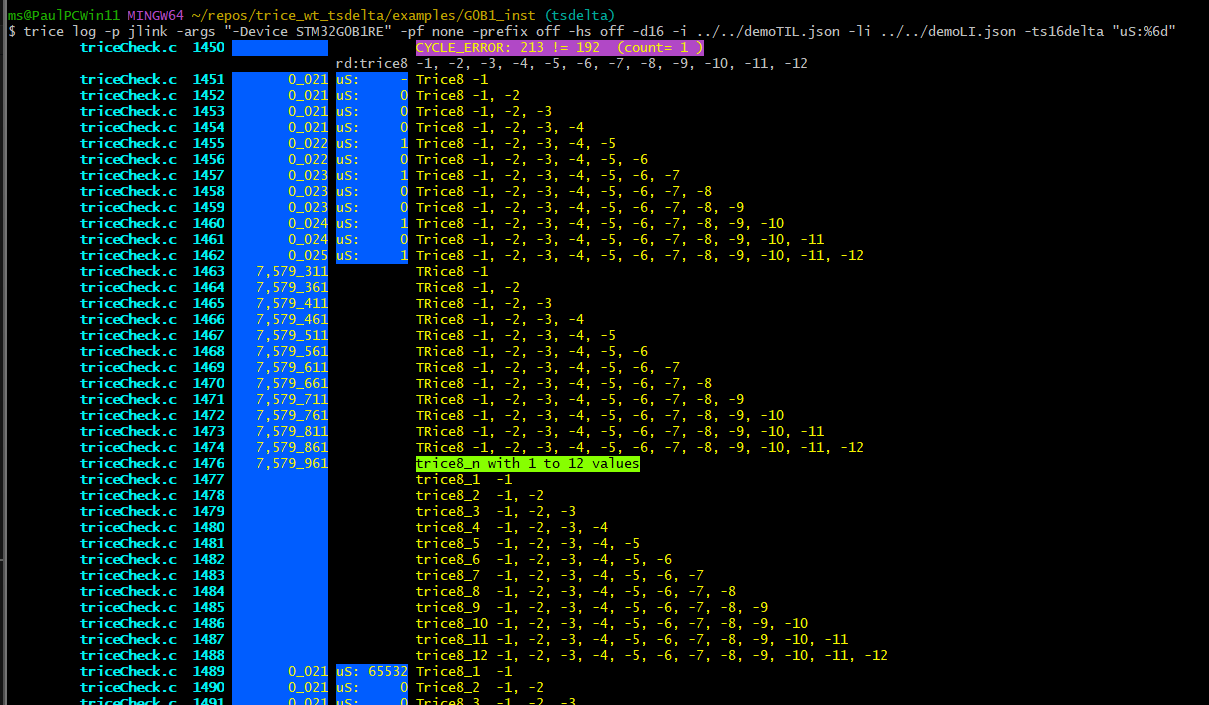
2) Same as 1) but with continuously colored row.
trice log -p jlink -args "-Device STM32G0B1RE" -pf none -prefix off -hs off -d16 -i ../../demoTIL.json -li ../../demoLI.json -ts16delta "uS:%6d" -ts0delta "time: "
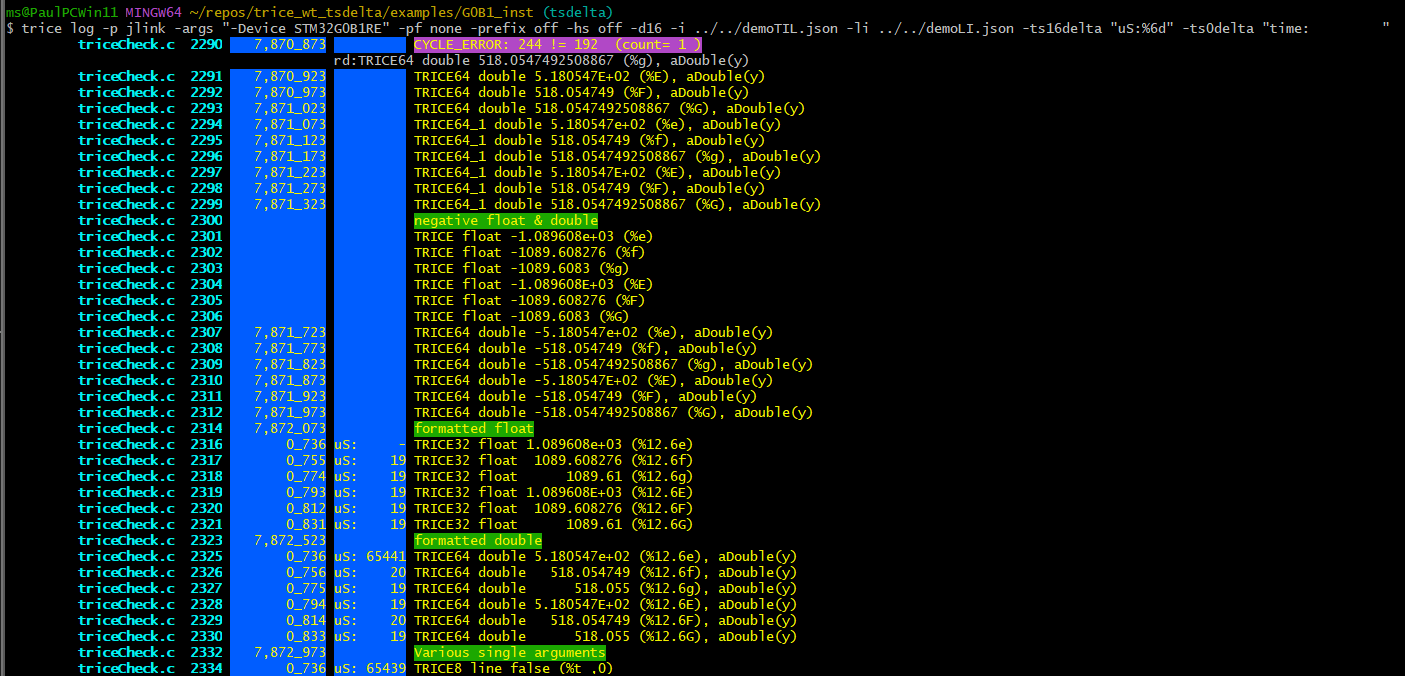
3) Add a column to show just the ts32 delta values (microseconds).
trice log -p jlink -args "-Device STM32G0B1RE" -pf none -prefix off -hs off -d16 -i ../../demoTIL.json -li ../../demoLI.json -ts32delta "att:%4d"
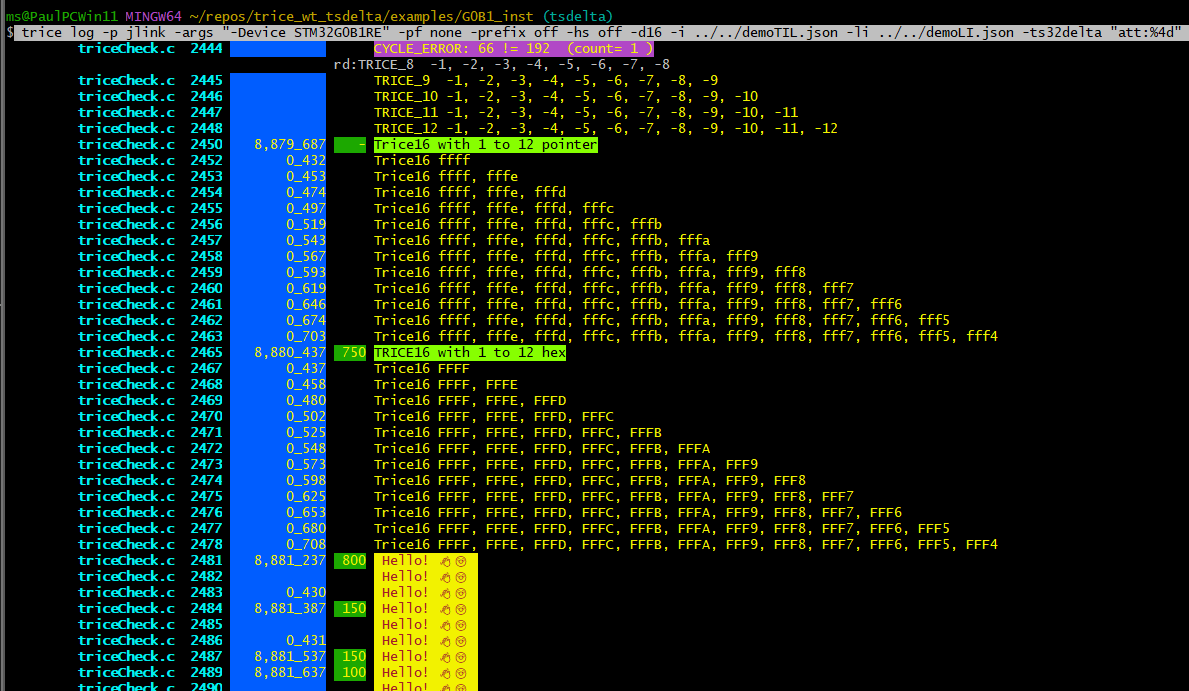
4) Show only ts16 absolute values in microseconds together with ts32delta values. Because -ts16delta "" is passed explicitly, ts16 lines get no delta placeholder. Lines without timestamps are decorated explicitly to show formatting options.
trice log -p jlink -args "-Device STM32G0B1RE" -pf none -prefix off -hs off -d16 -i ../../demoTIL.json -li ../../demoLI.json -ts32 "" -ts32delta "deb:%12d" -ts16 us -ts16delta "" -ts0 "rd:~~~~~~" -ts0delta "att:_____"
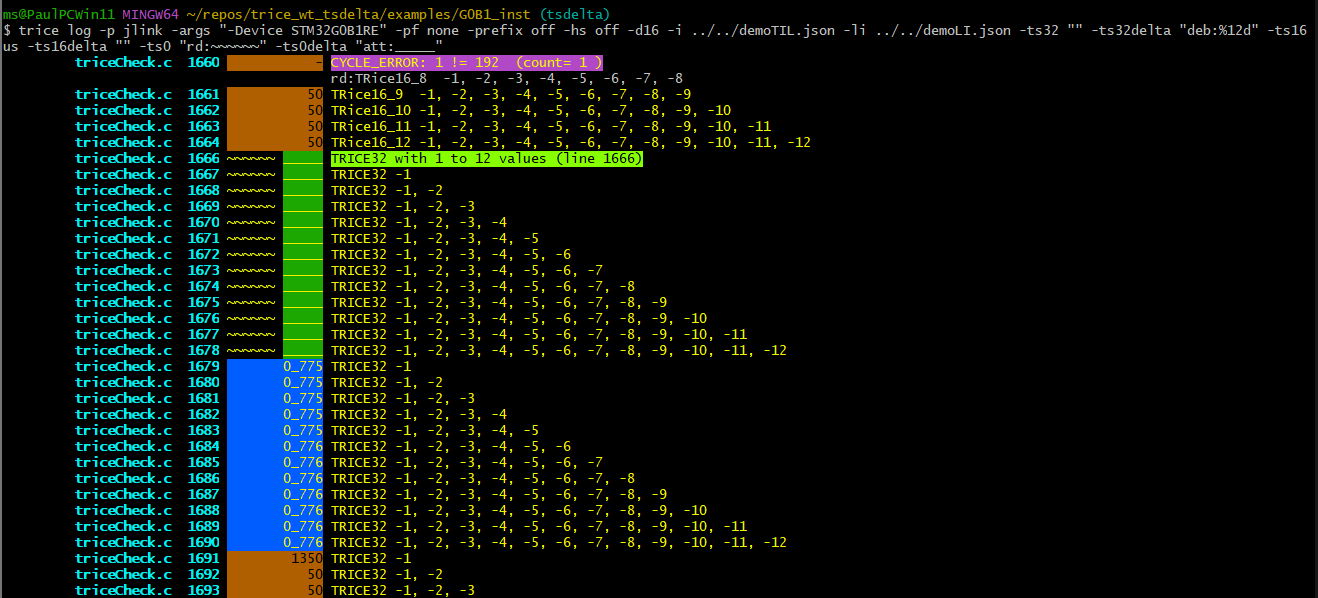
5) Show ts16 absolute values together with ts32delta values and explicit no-stamp separators. Again, -ts16delta "" suppresses any automatic placeholder on ts16 lines.
trice log -p jlink -args "-Device STM32G0B1RE" -pf none -prefix off -hs off -d16 -i ../../demoTIL.json -li ../../demoLI.json -ts32 "" -ts32delta "att:%12d" -ts16 us -ts16delta "" -ts0 "| " -ts0delta " |"
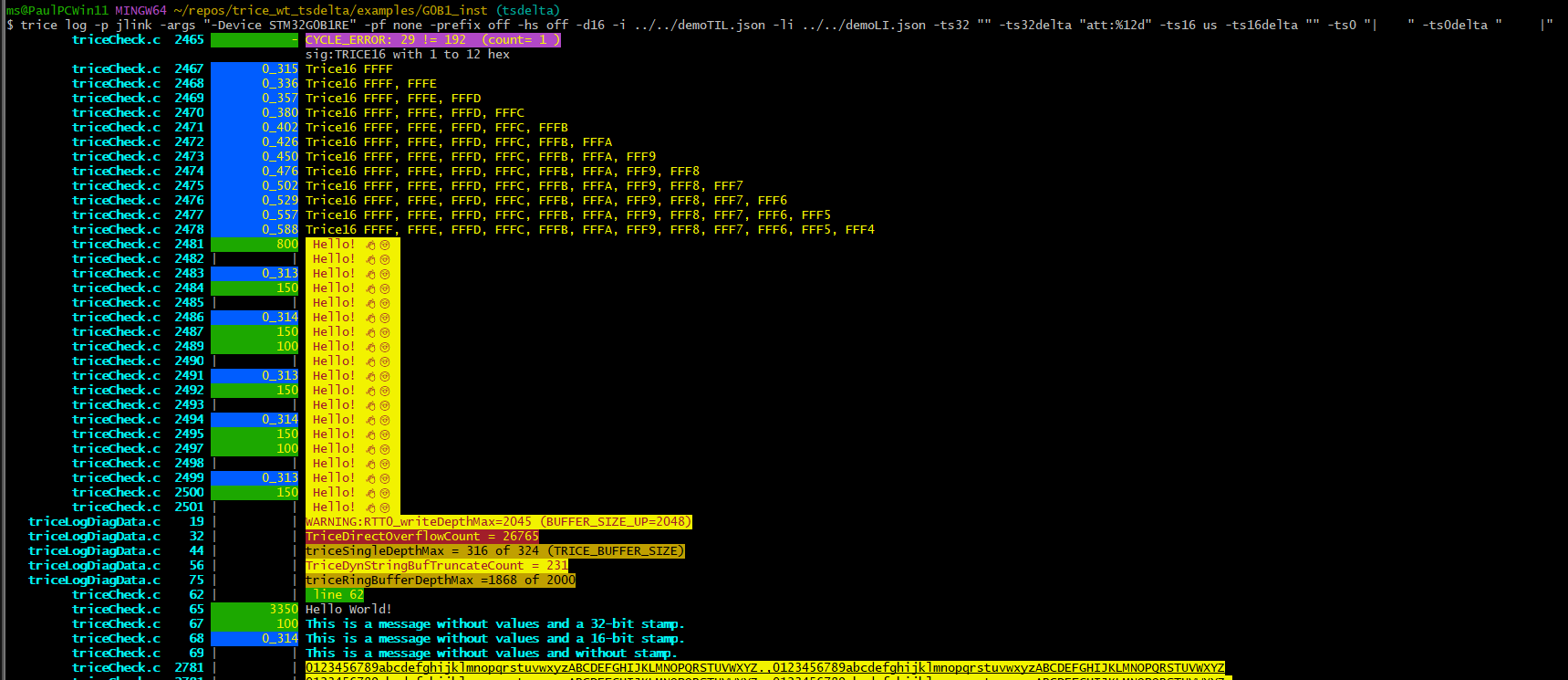
6) Show ts32 as epoch followed by ts32delta in seconds. (Hint: In translator.go inside function formatTargetStamp32 the call of correctWrappedTimestamp(uint32(timestamp)) was temporarily deactivated for this check)
trice log -p jlink -args "-Device STM32G0B1RE" -pf none -prefix off -hs off -d16 -i ../../demoTIL.json -li ../../demoLI.json -ts32 "epoch2006-01-02_15:04:05" -ts32delta "note:%4d" -ts0delta " "
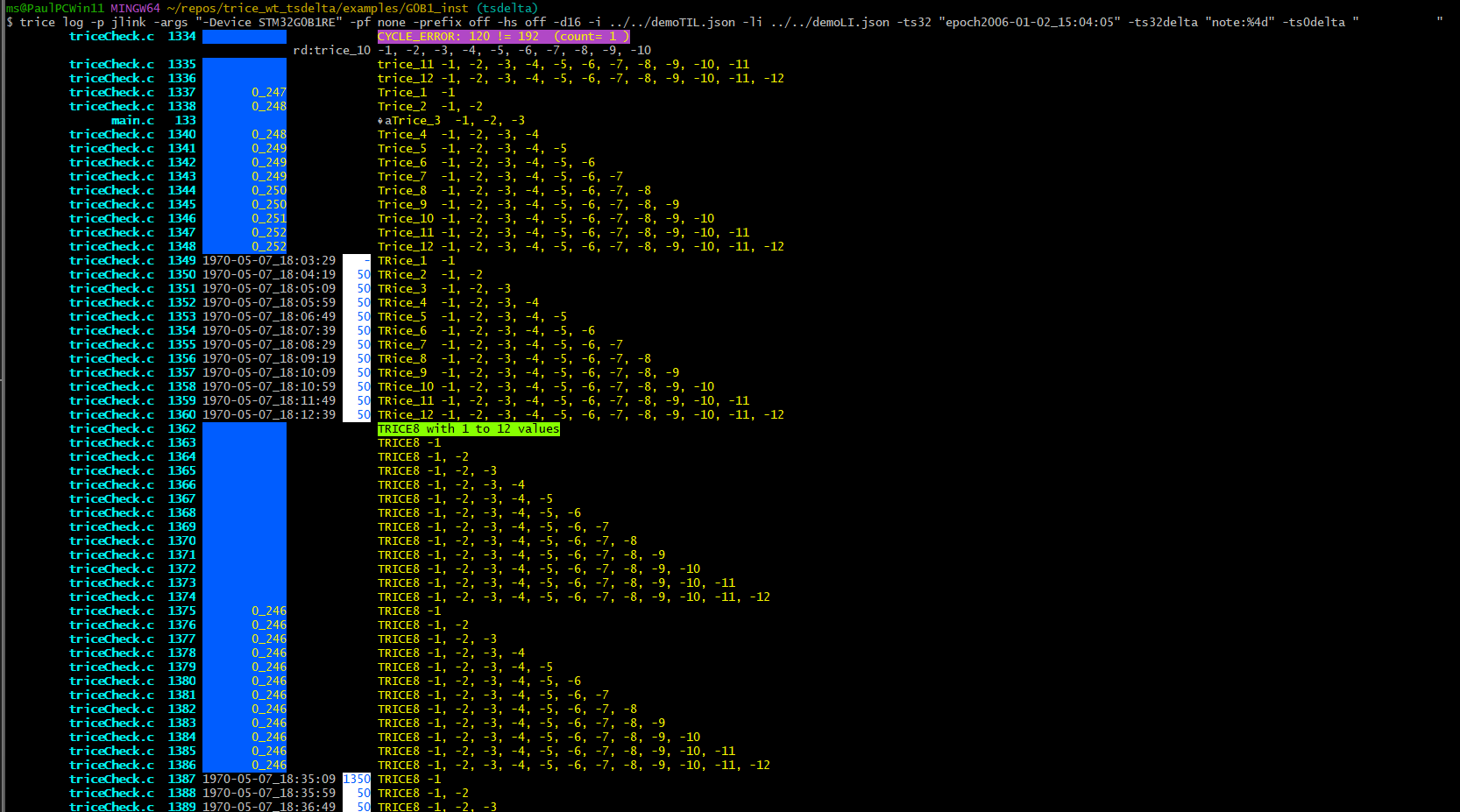
7) Like 6 but additionally show ts16delta in microseconds
trice log -p jlink -args "-Device STM32G0B1RE" -pf none -prefix off -hs off -d16 -i ../../demoTIL.json -li ../../demoLI.json -ts32 "epoch2006-01-02_15:04:05" -ts32delta "note:%5d" -ts16delta us -ts0delta " "
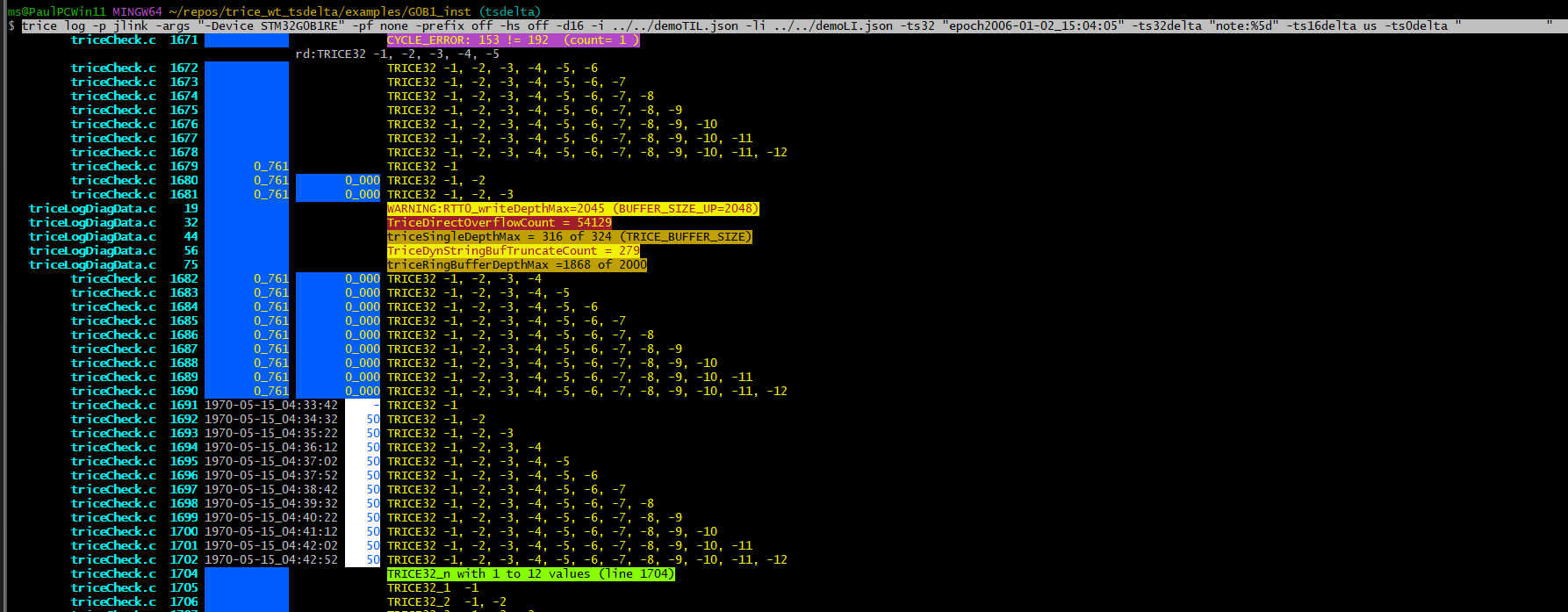
18.2.10. Summary
The tsdelta switches make timestamp display more flexible by separating:
- absolute time representation
- delta time representation
- alignment of messages without target timestamps
This allows trice output to be tailored for debugging, profiling, timing analysis, and mixed absolute/delta log views without changing the target-side encoding.
19. Binary Encoding
19.1. Symbols
| Symbol | Meaning |
|---|---|
i |
ID bit |
I |
iiiiiiii = ID byte |
n |
number bit |
z |
count selector bit |
s |
stamp selector bit |
N |
znnnnnnnn = count selector bit plus 7-bit number byte |
c |
cycle counter bit |
C |
z==0 ? cccccccc : nnnnnnnn = cycle counter byte or number byte extension |
t |
(time)stamp bit |
T |
tttttttt = (time)stamp byte |
d |
data bit |
D |
dddddddd = data byte |
... |
0 to 32767 data bytes |
"..." |
format string |
W |
bit width 8, 16, 32 or 64 (uW stands for u8, u16, or u64) |
x |
unspecified bit |
X |
=xxxxxxxx unspecified byte |
19.2. Package Format
- Because of TCOBS or COBS package framing, package sizes are detectable by the Trice tool without additional length information from the payload itself.
-
A decoded frame of 0 bytes is ignored. A 1-byte frame is unsupported. Frames with 2 or 3 bytes are selector-0 candidates when their selector bits are
00; valid countedtypeX0handling then still depends on the embedded count. Otherwise they are unsupported short user data.bytes Comment ` ` This is an empty package, which can have also a meaning. It is detectable by 2 consecutive 0-delimiter bytes. X1-byte message, unsupported and reserved for extensions or user data XX2-byte message, counted typeX0if selector00, otherwise unsupported and reservedXXX3-byte message, counted typeX0if selector00, otherwise unsupported and reserved - In decoded frames with at least 2 bytes, the first 2 bytes contain 2 selector bits at the most significant position in the known endianness.
- The
0selector is usable for any user encoding. The Trice tool handles such packages according to the CLI switch-typeX0. -
The
1,2and3selector bits are followed by the 14-bit ID.16-bit groups Selector (2 msb) Comment Endianness sizes _____ 00xxxxxxX ...0 typeX0 record, >= 2-byte message, reserved for extensions or user data ___ u16 ?...?_____ 01iiiiiiI NC ...1 >= 4-byte message, Trice format without stamp ___ u16 u16 [uW] ... [uW]_____ 10iiiiiiI TT NC ...2 >= 4-byte message, Trice format with 16-bit stamp ___ u16 u16 u16 [uW] ... [uW]10iiiiiiI 10iiiiiiI TT NC ...2 First 16bit are doubled. Info over -d16trice switch.u16 u16 u16 u16 [uW] ... [uW]_____ 11iiiiiiI TT TT NC ...3 >= 4-byte message, Trice format with 32-bit stamp ___ u16 u32 u16 [uW] ... [uW] - The selector
2encoding has 2 possibilities. When usingTRICE_DIRECT_SEGGER_RTT_32BIT_WRITEor encryption, for alignment reasons the first 16bit ID field is doubled. The Trice tool discards these 2 doubled bytes when the CLI switch-d16is given or encryption is active. - Default endianness is little endian as most MCUs use little endianness. Otherwise the
-triceEndianness=bigEndianCLI switch is needed. - The receiving tool first evaluates the 2 selector bits and follows these rules:
- 0: handle it according to
-typeX0or report an error and ignore the whole package when no X0 handling is selected. - 1: next 14 bits are the ID followed by 2 bytes u16=NC and optional parameter values. Package size is >= 4 bytes.
- 2 and
-d16CLI switch not provided: next 14 bits are the ID and convert then u16=TT=stamp16 followed by 2 bytes u16=NC and optional parameter values. Package size is >= 6 bytes. - 2 and
-d16CLI switch provided: next 14 bits are the ID, discard 2 following bytes and convert then u16=TT=stamp16 followed by 2 bytes u16=NC and optional parameter values. Package size is >= 8 bytes. - 3: next 14 bits are the ID and convert then u32=TTTT=stamp32 followed by 2 bytes u16=NC and optional parameter values. Package size is >= 8 bytes.
- 0: handle it according to
- Use the ID to get parameter width
W=8,16,32,64 and parameter count from file til.json, then convert the payload accordingly.- Within one trice message the parameter bit width
Wdoes not change.
- Within one trice message the parameter bit width
Example for Trices without timestamps
- The ([T]COBS decoded) binary Trice data normally starts with a little endian u16 Trice ID value.
- All following values are encoded in the known endianness.
| value | byte offset | type | comment |
|---|---|---|---|
| IdLo | 0 | byte | The first byte is always the Trice ID lower 8 bits. |
| IdHi | 1 | byte | The second byte 2 most significant bits are 01 and the 6 least significant bits are the Trice ID upper 6 bits. |
| NC | 2 | u16 | The most significant bit is the count selector bit z and usually 0, telling, that the following 7 bits are the payload byte count and that the 8 least significant bits are the cycle counter. If z is 1, the current Trice contains no cycle counter and has a 15-bit payload count instead (for payloads > 127). |
| payload | 4 | u8|u16|u32|u64 | The payload contains a number of equal size values. |
19.2.1. typeX0 Records
The user can insert any data with a well-defined structure into the Trice data stream. When interpreting the Trice binary data, the Trice tool handles selector-0/typeX0 records according to the CLI switch -typeX0.
One possible use case is to have user printi statements parallel to Trices (see Legacy User Code Option Print Buffer Wrapping and Framing). For the counted typeX0 variant, the user prepends a generated printi buffer with its payload size as a 16-bit count smaller than 16384. See ./_test/userprint_dblB_de_tcobs_ua/TargetActivity.c for an implementation option. See chapter 20. typeX0 User Packets for further details.
19.2.2. Framing - NONE or with COBS or TCOBS encoding
Summary Information for Trice Data Parsing
- With COBS or TCOBS framing (TCOBS includes compression):
- 1-3 package delimiter zeroes possible between 2 packages.
- One or more Trices packed together and only at the package end are 0-3(7) padding zero bytes possible.
- Counted
typeX0records can occur together with normal Trices in one package because their length is checkable. X0 formats without length information need their own package framing.
- With NONE framing:
- With XTEA encryption and
-pf=noneor-pf=none6464-bit alignment: 0-7 zero bytes after a single Trice. - Without encryption the stream is compact or 32-bit aligned. That does not change for one session and is detectable.
-pf=none-> detect stream (deprecated, only for backward compatibility)-pf=none8-> stream is compact-pf=none32-> stream is 32-bit aligned
- A stream with alignment is allowed to have only a single Trice between two alignments. An alignment is just a multiple of 4(8)-bytes distance.
- These combinations are forbidden, because we cannot safely know the actual padding count:
|TriceATriceB0|TriceC00|<- Is the0afterTriceBa padding zero or part ofTriceC?- Framing NONE && TRICE_MULTI_PACK_MODE && 32-bit write
- Framing NONE && TRICE_MULTI_PACK_MODE && XTEA encryption
- With XTEA encryption and
Details
- For maximum storage speed each Trice message starts at a 32-bit boundary and has 1-3 padding bytes inside the target device RAM.
- The macro
TRICE_LEAVEand/or functionTriceTransfer(Trice Target Code Implementation) are the Trice data output.- In direct mode each single message gets its own transfer buffer.
- In deferred mode any count of Trice messages is in the transfer buffer.
- Additional counted typeX0 records can share a transfer buffer with normal Trices. Non-counted selector-0 user data needs a separate transfer buffer because its length is not checkable.
Framing NONE Overview Table:
| mode | packed | -pf= |
encr | wr | use | pad | stream | remark |
|---|---|---|---|---|---|---|---|---|
| di | single | none32 |
NONE | 32 | 32 | 0-3 | aligned | done |
| de | single | none8 |
NONE | 8 | 8 | 0 | compact | done |
| de | single | none32 |
NONE | 8 | 32 | 0 | aligned | plan |
| de | multi | none8 |
NONE | 8 | 8 | 0 | compact | done |
| de | multi | none32 |
NONE | 8 | 32 | 0 | unknown | forbid |
| de | multi | none |
NONE | 8 | 32 | 0 | unknown | forbid |
| di | single | none64 |
XTEA | 32 | 32 | 0-7 | aligned | done |
| de | single | none64 |
XTEA | 8 | 8 | 0-7 | aligned | done |
| de | single | none64 |
XTEA | 8 | 32 | 0-7 | aligned | plan |
| de | multi | none |
XTEA | 8 | 8 | 0-7 | unknown | forbid |
| de | multi | none |
XTEA | 8 | 32 | 0-7 | unknown | forbid |
- wr: The internal write function bit width.
- use: The possible user write function bit width (auxiliary write)
20. typeX0 User Packets
Trice already has buffer macros for transferring runtime data buffers. triceN transfers a byte buffer as a counted string, and trice8B, trice16B, trice32B, trice64B and triceB transfer buffers as sequences of equally sized values formatted on the host side. These macros are the preferred choice when the data belongs to a normal Trice message and should use the usual Trice ID, til.json entry and format string handling.
typeX0 is an additional, more decoupled way to move user data through the same Trice transport path. It uses selector bits 00 in the first 16-bit word, interpreted in the configured Trice byte order (default little endian), and therefore carries no 14-bit Trice ID. The host-side meaning is selected by the Trice tool option -typeX0=.... This makes it useful for user payloads that should share the same UART/RTT/file/framing interface as Trice messages, but should not require an ID, a til.json entry or a fixed Trice format string.
Important: The typeX0 packages do not influence the cycle counter and do not carry a cycle counter value (or you implement your own). They also do not carry a Trice ID, target timestamp or location information normally. If log metadata columns such as -showID, -li or target timestamps are enabled, X0 output keeps the column alignment but blanks the actual values.
The current implementation supports -typeX0=counted:<formatstring>. This is intentionally just one example implementation of the selector-0 extension space. Other interpretations, for example forwarding, extended counted buffers or application-specific binary formats, can be added later without changing regular Trice messages. The counted implementation is expected to cover most use cases.
20.1. Packet Classification
For each decoded record or package, the receiver first checks the available length:
len == 0:
    invalid or ignored transport artifact

len == 1:
    error: unsupported short packet

len >= 2:
    read first uint16 using the configured Trice byte order
    selector = firstWord >> 14

    if selector == 0:
        handle as typeX0 packet

    else if len < 4:
        error: unsupported short packet

    else:
        handle as regular Trice packet
Summary:
| Packet length | Selector | Packet Type | Trice Tool Action |
|---|---|---|---|
0 |
- | user0B |
ignored (reserved) |
1 |
- | user1B |
error (reserved) |
2..3 |
!= 0 |
user2B, user3B |
error (reserved) |
>= 2 |
0 |
typeX0 |
according -typeX0 CLI |
>= 4 |
!= 0 |
regular Trice | default |
Packet length 0 is possible when framing like COBS is used and 2 delimiter bytes (usually 0) occur without a package in between.
Short user packets such as user0B, …, user3B are intentionally not supported. They can be added later if a concrete requirement appears. They do not carry length information and therefore cannot safely share a framed group with following records.
Short non-X0 user packets are not supported initially. They should be reported as errors and can be specified later if a real requirement appears.
20.2. The typeX0 Counted Format
A counted typeX0 record starts with one 16-bit word:
bits 15..14 = 00
bits 13..0  = count
The lower 14 bits contain the payload byte count:
firstWord = count
count     = firstWord & 0x3fff
payload   = record[2 : 2+count]
The logical payload length is exactly count bytes. Counts 0 and 1 are valid. Little endian examples without alignment padding are:
00 00                         count 0, empty payload
01 00 xx                      count 1, one payload byte, little endian example
02 00 xx yy                   count 2, two payload bytes, little endian example
The optional target helper src/triceX0.c writes into the normal Trice target buffer and keeps the next record 32-bit aligned. Therefore its physical buffer use is:
physicalRecordLen = align4(2 + count)
The zero padding bytes are not part of the payload. A host decoder shall use the count field to determine the payload and shall skip alignment padding where required by the decoded Trice buffer stream. Padding bytes written by the target helper are zero. The decoder consumes alignment padding only when the expected bytes are present and zero; otherwise following bytes can be the next record in a mixed package. Zero-only padding after a regular framed Trice message is removed before selector-0/typeX0 handling.
Malformed counted X0 examples are:
available bytes < 2 + count
alignment padding is consumed but not zero
Configuration errors such as an unsupported -typeX0 mode are reported separately.
20.3. CLI Option -typeX0
The Trice tool option is:
-typeX0=[mode:]<format>
Supported values:
-typeX0=error
Treat every typeX0 packet as an error after normal Trice padding has been removed. This is also the default when -typeX0 is not specified.
-typeX0=counted:ignore
-typeX0=ignore
Silently discard valid counted typeX0 packets. Malformed X0 packets are still errors.
The second form is a shorthand for counted:ignore.
-typeX0=all:ignore
Silently discard the complete decoded selector-0 package without checking an X0 length. This is only valid for non-mixed X0 packages. If normal Trices or other counted X0 records are behind the first selector-0 word in the same decoded package, they are discarded too.
-typeX0=counted:<format>
-typeX0=<format>
Interpret typeX0 packets as counted payloads and print the payload with Go fmt. The second form is a shorthand for counted:<format>.
The shorthand form is valid only when <format> contains no colon. If the format string contains a colon, use the explicit counted: prefix.
A future mode:argument prefix is a possible extension.
The format receives exactly one Go argument:
payload []byte
Conceptually:
fmt.Fprintf(out, format, payload)
Go fmt consumes arguments, not bytes. Therefore a normal format should contain one non-indexed formatting verb. To print the same payload more than once, use Go’s explicit argument index syntax.
Examples:
-typeX0="%s"
Print payload bytes as a string.
-typeX0="% x\n"
Print payload bytes as lower-case hex with spaces.
-typeX0="counted:X0: %q\n"
Print the payload quoted.
-typeX0="%[1]s %[1] x\n"
Print the same payload twice, once as string and once as spaced hex.
20.4. typeX0 Target Code
typeX0 is a free format selector-0 space the user can define. The only protocol requirement is that the 2 most significant bits in the very first uint16_t word, in the configured endianness, are zero. If the encoding carries length information, as the counted example does, multiple X0 records and normal Trice messages can be interleaved in one framed package. If no length information is encoded in the X0 record, each X0 record needs individual framing with COBS, TCOBS or another application-defined framing method.
triceX0.c contains the counted buffer reference implementation. The Trice tool then needs the CLI switch -typeX0=[mode:]<format>, where counted is the default mode for values without a colon. Examples:
CLI switch trice log ... |
Meaning |
|---|---|
-typeX0=all:ignore |
ignore the complete non-mixed X0 package without length checking |
-typeX0=counted:ignore |
just check for valid length and ignore |
-typeX0=ignore |
just check for valid length and ignore (short for counted:ignore) |
-typeX0=counted:"sig:%60s\n" |
print a right-aligned string with tag sig: |
-typeX0="%60s\n" |
print a right-aligned string without a tag (short form, no colon) |
-typeX0="sig:%60s\n" |
invalid sig: mode because shorthand cannot contain a colon |
-typeX0=sig:"%60s\n" |
invalid sig: mode |
-typeX0=forward:<ADDRESS> |
send X0 package to ADDRESS (not implemented) |
Hint: Depending on shell quoting, these forms can all pass the same raw option value counted:sig:%60s\n to the CLI parser:
-typeX0=counted:"sig:%60s\n"-typeX0="counted:sig:%60s\n"-typeX0=counted:sig:%60s\n
The typeX0 CLI parser takes the string in front of the first colon as typeX0 mode. Therefore format strings containing a colon cannot be given in the short form.
Known modes are:
error: The Trice tool reportstypeX0as an error by default when no-typeX0CLI switch is given.counted: explicit mode for counted X0 records and default mode for-typeX0=values without a colon.all: exactall:ignoremode for discarding a complete non-mixed X0 package.forward: possible extension fortrice logfunctionality, not specified or implemented yet.
This can be extended in many ways. typeX0 is just a way to mix application-defined binary data with Trice messages over the same output channel. Many cases are probably already covered by using Trice macros such as trice8B, trice16B, trice32B, trice64B, triceS, triceN, …
20.4.1. Target-side counted helper
The counted helper is optional target code and lives in:
src/triceX0.h
src/triceX0.c
The public function is intentionally small:
void triceX0(const void* buf, uint16_t len);
In the counted mode (default) it writes selector 00, stores the resulting payload length in the lower 14 bits and appends that many payload bytes. If len exceeds the supported range, the helper truncates to the smaller limit of TRICE_SINGLE_MAX_SIZE - 5 and 0x3fff, increments the dynamic buffer truncation diagnostic counter, and sends the truncated payload. It uses the normal Trice critical-section model with TRICE_ENTER / TRICE_LEAVE and the normal Trice output path. It does not use TRICE_PUT_BUFFER() after TRICE_PUT16(), because X0 has only a 2-byte header and the physical record size must be aligned as align4(2 + len).
For projects or tests that want this helper, define in triceConfig.h:
#define TRICE_TX_X0_COUNTED_BUFFER_SUPPORT 1
A project can also provide its own selector-0 writer. The counted helper is only the reference implementation for the -typeX0=counted:<format> use case.
20.4.2. typeX0 Build Switches
The counted typeX0 helper is controlled independently from the normal Trice macro switch:
#define TRICE_TX_X0_COUNTED_BUFFER_SUPPORT 1
When TRICE_TX_X0_COUNTED_BUFFER_SUPPORT == 1, the target-side function
void triceX0(const void* buf, uint16_t len);
is a real function and writes counted selector-0 records into the configured Trice output backend. The project must then compile src/triceX0.c together with the other Trice target sources. When TRICE_TX_X0_COUNTED_BUFFER_SUPPORT == 0, triceX0() is an inline no-op helper and no X0 backend code is needed.
This switch is intentionally independent from TRICE_OFF:
TRICE_OFF |
TRICE_TX_X0_COUNTED_BUFFER_SUPPORT |
Setting |
|---|---|---|
== 0 |
== 0 |
normal Trice macros are active, triceX0() is a no-op |
== 0 |
== 1 |
normal Trice macros are active, triceX0() emits counted X0 records |
== 1 |
== 0 |
normal Trice macros are off, triceX0() is a no-op |
== 1 |
== 1 |
normal Trice macros are off, triceX0() still emits counted X0 records |
The 4th combination is useful for applications that want to use only selector-0 user packets while keeping all normal Trice statements compiled out. The Trice tool can still scan normal Trice statements in the source code for ID maintenance, but the compiler receives no normal Trice output code from them.
TRICE_CLEAN is a tool-managed source state and should not be used as an application switch. trice clean may set it to 1 to make cleaned source files compile without inserted IDs and without editor warnings; trice insert sets it back to 0. With TRICE_TX_X0_COUNTED_BUFFER_SUPPORT == 1, the counted X0 helper is intended to compile in both states. Normal Trice macros remain disabled while TRICE_CLEAN == 1, but triceX0() stays available as a real function.
In short:
TRICE_OFFcontrols normal Trice macro code generation.TRICE_CLEANreflects the insert/clean source state.TRICE_TX_X0_COUNTED_BUFFER_SUPPORTcontrols whethertriceX0()is a real counted X0 writer.
A project configuration that wants counted X0 support and still allows command-line overrides can use:
#ifndef TRICE_TX_X0_COUNTED_BUFFER_SUPPORT
#define TRICE_TX_X0_COUNTED_BUFFER_SUPPORT 1
#endif
Then builds can explicitly test or select the behavior with compiler defines such as:
-DTRICE_OFF=1 -DTRICE_TX_X0_COUNTED_BUFFER_SUPPORT=1
-DTRICE_OFF=1 -DTRICE_TX_X0_COUNTED_BUFFER_SUPPORT=0
20.4.3. typeX0 Usage in ./examples/G0B1_inst
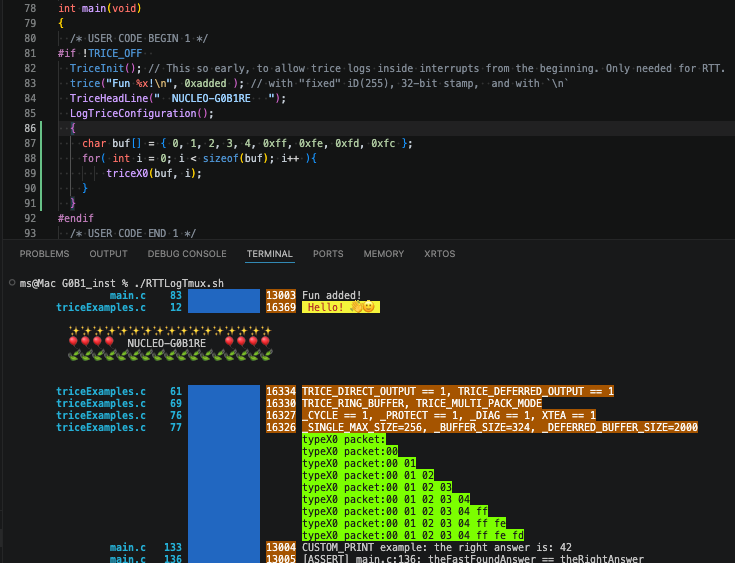
The point here is that with CLI switch -typeX0=ignore the counted X0 packages are invisible after their length has been checked. A future -typeX0=forward:<ADDRESS> option could be implemented as a trice log extension.
20.5. Go implementation layout
Keep the typeX0 mode parsing and handling centralized so later modes can be added without spreading switch logic through the decoder.
Code layout:
internal/args/...
    define CLI flag -typeX0 and help text

internal/decoder/typeX0.go
    hold the configured TypeX0 value
    parse error, ignore, all:ignore, counted:<format>, <format>
    format counted payloads with Go fmt
    reject unsupported mode prefixes clearly

internal/trexDecoder/trexDecoder.go
    detect selector == 0
    pass the remaining record buffer to the typeX0 helper
    append returned output to the decoder result
    consume the logical X0 record and zero alignment padding when present
Unsupported future modes shall fail with a clear diagnostic, for example:
unsupported typeX0 mode "forward"
This structure keeps future extensions local. For example:
-typeX0=forward:<ADDRESS>
could later forward valid X0 payload bytes to another sink instead of formatting them.
20.6. Tests
The counted X0 path is tested through the existing _test/testdata/triceCheck.c mechanism, because these test lines are processed by many Trice configurations.
The shared test configurations that build triceCheck.c define:
#define TRICE_TX_X0_COUNTED_BUFFER_SUPPORT 1
src/triceX0.c is compiled into the CGO test target through the master file _test/testdata/cgoPackage.go. Generated generated_cgoPackage.go copies are refreshed from that master file by scripts/_330_renew_ids_and_refresh_tests.sh.
The X0 block in _test/testdata/triceCheck.c is guarded by TRICE_TX_X0_COUNTED_BUFFER_SUPPORT == 1 and intentionally mixes different counted X0 lengths with normal Trices:
#if TRICE_TX_X0_COUNTED_BUFFER_SUPPORT == 1
        break; case __LINE__: triceX0(x0Payload, 0);
        break; case __LINE__: triceX0(x0Payload, 5); trice8B("wr:X0-B: %02x\n", x0Payload, 5);
        break; case __LINE__: triceX0(x0Payload, 2); triceX0(x0Payload + 2, 4); trice("wr:X0 tail\n");
#endif
The current shared CGO test option formats the X0 payload with the sig: prefix:
counted:sig:% x\n
For maintenance, keep these parts aligned:
- The master CGO file includes
../../src/triceX0.c. triceCheck.cusesTRICE_TX_X0_COUNTED_BUFFER_SUPPORT == 1as guard.- The X0 test block uses different lengths and mixed packages with
trice,triceS,TriceS,trice8B,Trice8BandTRice8B. _test/.../triceConfig.hfiles that buildtriceCheck.cenableTRICE_TX_X0_COUNTED_BUFFER_SUPPORT._testCGO checks setdecoder.TypeX0tocounted:sig:% x\n.- The full
_test/matrix remains the final coverage check.
Additional focused Go unit tests cover:
no -typeX0        -> X0 packet is an error
-typeX0=error     -> X0 packet is an error
-typeX0=ignore    -> valid X0 packet produces no output
-typeX0=all:ignore -> complete selector-0 package is consumed without counted parsing
-typeX0="%s"      -> payload is printed as string
-typeX0="[%s]"    -> payload is printed with formatting
-typeX0="% x"     -> payload is printed as spaced hex
-typeX0=counted:sig:%s -> explicit counted mode is needed when the format contains a colon
-typeX0=sig:%s   -> unsupported mode "sig"
malformed X0      -> error, also with -typeX0=ignore
unsupported mode  -> clear error
mixed package     -> counted X0 can be followed by a regular Trice in framed data
NONE framing      -> counted X0 consumes zero alignment padding when present
20.7. Initial scope
The initial implementation includes only:
selector-0 detection for records with len >= 2
counted X0 payloads
-typeX0=error as default
-typeX0=counted:ignore
-typeX0=ignore as counted shorthand
-typeX0=all:ignore
-typeX0=counted:<format>
-typeX0=<format> as counted shorthand only when <format> contains no colon
errors for unsupported short non-X0 packets
clear errors for malformed X0 packets and unsupported modes
No counted32, forward, JSON descriptor, plugin interface or user1B / user2B / user3B handling is part of the initial scope.
21. Trice Decoding
The 14-bit IDs are used to display the log strings. These IDs are pointing in two reference files.
21.1. Trice ID list til.json
- This file integrates all firmware variants and versions and is the key to display the message strings. With the latest version of this file all previous deployed firmware images are usable without the need to know the actual firmware version.
- A compact C metadata table can be generated to help write a decoder or format buffered Trices on the target. First run
trice insertortrice bind, then usetrice generate -src <source> -logC[=<output.c>]. That can be interesting in environments where Go-compiled binaries are not executable, such as PCs running QNX OS. See also chapter Trice Generate.
21.2. Trice location information file li.json
- If the generated
li.jsonis available, the Trice tool automatically displays file name and line number. But that is accurate only with the exact matching firmware version. That usually is the case right after compiling and of most interest at the developers table. - The Trice tool will silently not display location information, if the
li.jsonfile is not found. For in-field logging, the option-showID "inf:%5d"could be used. This allows later an easy location of the relevant source code. - Another option is to record the binary trice messages (
trice log -p com1 -blf aFileName) and to play them later with the Trice tool using the correctli.json(trice log -p FILEBUFFER -args aFileName). - Each entry contains only
FileandLine.Fileretains the normalized source path relative to-liRoot; the default root is the directory containingli.json. - Use an explicit project root when
li.jsonlives in a build directory but stable project-relative paths are wanted:trice insert -li build/demoLI.json -liRoot .. Fileuses/separators on every platform. Required leading..components are preserved. If Windows cannot make a source path relative across volumes, the normalized absolute path is stored.trice logandtlogshow only the filename by default.-liMaxDirs=Nadds at mostNimmediately preceding parent directories. Leading..components are never displayed or counted.- The v1.3.0 option
-liPathis replaced by-liRootfor storage and-liMaxDirsfor display. Both v1.3.0 and the current location files useFileandLine. - The Trice repository uses
-liRoot .while generating the shareddemoLI.json, so all stored paths remain relative to the repository root across supported platforms.
22. Trice ID Numbers
22.1. ID number selection
- The default encoding TREX supports 14-bit IDs, so over 16000 IDs possible. Other encodings can work with other ID sizes.
trice("Hi!\n");➡trice i➡trice( iD(12345), "Hi!\n");➡trice c➡trice("Hi!\n");- The ID
12345is a number assigned totrice( "Hi!\n");in the above example.- It is a so far unused number, according to rules you can control:
- The
-IDMethodswitch allows a selection method for new IDs.- Per default new IDs determined randomly to keep the chance low, that several developers grab the same ID.
- Example:
trice insert -IDMin 1000 -IDMethod upwardwill choose the smallest free ID >= 1000.- This allows to use the ID space without wholes.
- The
-IDMinand-IDMaxswitches are usable to control the ID range, a new ID is selected from, making it possible to divide the ID space. Each developer can gets it region.- Example:
trice insert -IDMin 6000 -IDMax 6999will choose new randomly IDs only between 6000 and 6999.
- Example:
- The
- It is a so far unused number, according to rules you can control:
- It is possible to give each Trice tag an ID range making it possible to implement Trice tag specific runtime on/off on the target side if that is needed. This could be interesting for routing purposes also. Please run
trice help -insertand read about the-IDRangeswitch for more details.
22.1.1. Trice tool internal Method to get fast a random ID
- Create Slice with numbers 1…16383
- Remove all used ID numbers from this slice
- Get random number between 0 and len(slice)
- remove this ID from slice and use it as new ID
22.2. ID number usage and stability
- If you write
trice( "msg:%d", 1);again on a 2nd location, the copy gets a different ID, because each Trice gets its own ID. - If you change
trice( "msg:%d", 1);totrice8( "msg:%d", 1);, to reduce the needed parameter space, a new ID is assigned. That is because the parameter bit width is implicit a part of the now changed Trice. If you change that back, the previous ID is assigned again. - If you change
trice( "msg:%d", 1);toTRice8( "msg:%d", 1);, to get a 32-bit stamp, the associated ID remains unchanged. That is because the optional stamp is not a part of the Trice itself. - IDs stay constant and get only changed to solve conflicts.
- To make sure, a single ID will not be changed, you could change it manually to a hexadecimal syntax.
- This lets the
trice insertcommand ignore such Trice macros and therefore a full til.json rebuild will not add them anymore. Generally this should not be done, because this could cause future bugs. - It is possible to assign an ID manually as decimal number. It will be added to the ID list automatically during the next
trice i|cif no conflicts occur.
- This lets the
- If a Trice was deleted inside the source tree (or file removal) the appropriate ID stays inside the ID list.
- If the same string appears again in the same file this ID is active again.
- If a trice occurs more than one time, each occurrence gets a different ID. If then 2 of them disappear, their ID numbers stay in
til.json. If then one of them comes back, it gets its ID back.
22.3. Trice ID 0
- The trice ID 0 is a placeholder for “no ID”, which is replaced automatically during the next
trice insertaccording to the used trice switches-IDMethod,-IDMinandIDMax.- It is sufficient to write the
TRICEmacros just without theid(0),Id(0),ID(0),. It will be inserted automatically according the-defaultStampSizeswitch. Withtrice cleanthese stay with 0-values in the source code to encode the intended stamp size. - It is recommended to use the
trice,TriceandTRicemacros instead ofTRICE. They encode the stamp size in their names already. There may be cases, where the user prefers to use the code inserting macrosTRICEto get maximum performnce.
- It is sufficient to write the
23. Trice ID management
23.1. Trice inside source code
23.1.1. Trice in source code comments
- Trice macros commented out, are visible for the
trice insertcommand and therefore regarded.- Example:
// trice("Hi!\n");is still regarded by thetrice i.
- Example:
- During
trice insertcommented out Trice macros, are treated in the same way as active Trice macros. Even after deletion their content stays inside til.json. This is intensionally to get best stability across several firmware versions or variants. - The trice tool does treat trice statements inside comments or excluded by compiler switches also.
23.1.2. Trice parser exclusion markers
Use TRICE_INSERT_OFF and TRICE_INSERT_ON markers to exclude a source section from trice insert, trice clean, trice add and ID refresh parsing.
// TRICE_INSERT_OFF
TRice("This text is ignored by the trice tool.");
// TRICE_INSERT_ON
The markers are case-sensitive, must be written as comments, and affect only the Trice tool parser. TRICE_INSERT_OFF without a following TRICE_INSERT_ON disables Trice parsing until the end of the file. The marker state is local to the scanned file and does not affect source files including that file. This is useful for Trice target sources or other source sections containing Trice-like comments or helper macros that should not create or change IDs.
23.1.3. Different IDs for same Trices
Every active textual Trice site needs its own ID so that location information remains unambiguous. Copying a call with its explicit ID does not create shared ownership: trice insert resolves the duplicate and allocates or reuses another eligible ID.
Both trice insert and trice bind then order identical, interchangeable Trices by normalized relative file path, numeric line number, and position from left to right within the line. Paths use / separators and an ordinal, case-sensitive comparison (A.c precedes a.c), independent of locale. The root is -liRoot, or the directory containing the selected LI file by default; the absolute checkout directory does not determine the order. Overlapping -src roots visit each physical path only once.
Within each group, the IDs already selected by normal allocation are sorted numerically ascending and assigned to the sites in that order. Identical means the same normalized transport type and exact canonical format, including any structured field schema and Context Enrichment. Equal visible messages with different types or field names are separate groups. Existing tag-specific ID ranges still apply. New ID selection through -IDMethod random, upward, or downward is unchanged: this rule orders the selected pool; it does not introduce a new global allocation strategy or renumber unrelated Trices.
For example, assume these three IDs belong to one group:
| Source state | Site in path order | Assigned ID |
|---|---|---|
| Before | b.c:10 |
100 |
| Before | d.c:20 |
200 |
After adding a.c:5, with ID 300 also selected |
a.c:5 |
100 |
| After | b.c:10 |
200 |
| After | d.c:20 |
300 |
Both existing sites may change IDs when an identical site is added, removed, or moved. This is intentional. An unchanged source selection with the same selected ID pool produces the same mapping on subsequent runs, regardless of scan-root order or worker completion. The same rule applies after Clean/Insert; Clean itself does not allocate IDs. An explicit ID in an Insert source is not a request to exempt that site from ordering. Bind changes its own generated descriptors and leaves Insert-owned source files and their IDs alone.
A partial scan orders only its selected sites. IDs recorded in the primary LI as belonging to files outside that selection, including excluded files, are reserved and cannot be taken by the selected sites. Keep the shared LI available for partial scans: without location data, ownership of unscanned IDs cannot be inferred from TIL alone. For one order across the whole project, scan the complete intended source tree. A rename can leave the old path recorded in LI; its ID stays reserved while another eligible ID is selected for the new path.
The final assignment is written consistently to Insert sources or Bind sidecars and to LI. Historical TIL mappings remain available for older recordings. Rebuild firmware after an assignment changes and retain the matching metadata for recordings whose exact old source positions matter.
The behavioral tests cover group changes, partial scans, path and column order, cache reuse, and ownership. The target/decoder integration checks actual C/C++ records from both workflows against the generated mapping and decoded fields.
23.1.4. Same IDs for different Trices
- If duplicate ID’s with different format strings found inside the source tree (case several developers or source code merging) one ID is replaced by a new ID. The probability for such case is low, because of the default random ID generation.
- Also you can simply copy a Trice statement and modify it without dealing with the ID.
- The Trice tool will detect the 2nd (or 3rd) usage of this ID and assign a new one, also extending the ID list.
- That is done silently for you during the next
trice insert. - When you use the Trice Cache, the IDs are invisible and all happens in the background automatically.
23.1.5. ID Routing
With trice insert or trice bind, -IDRange tag:min,max assigns a range to a complete tag group. Register a free tag with -ulabel first; option order does not matter. Groups without a specific range use -IDMin through -IDMax.
Tag-specific ranges include both endpoints and must satisfy 1 <= min <= max <= 16383. They must not overlap the general range or any other tag range. A shared endpoint is an overlap; adjacent disjoint ranges and a range containing one ID are valid. Two aliases of the same group cannot define two separate ranges. Missing parts, malformed numbers, unknown tags, reversed bounds, and out-of-range values are rejected before source, dictionary, or bind-artifact changes. All supplied rules are validated together.
trice insert -src src -IDMin 1000 -IDMax 1999 -IDRange err:10,99
The current policy also applies to IDs recovered from sources, location data, or the dictionary. An active Error site with ID 250 is reassigned to a usable ID in 10..99 on the next run. Its old mapping remains in til.json so recordings from older firmware can still be decoded. A subsequent unchanged run retains the corrected ID. Only the selected source scope is processed. Bind updates its generated descriptors; an insert-owned source requiring correction must first be processed by trice insert. Rebuild affected firmware after reassignment.
With -v, each run reports historical dictionary entries outside the current policy in one additional warning: their total count, the smallest affected ID as one example, and its expected range. The historical 250 remains part of that count after reassignment; the new compliant ID does not. No warning is emitted without -v or when every entry complies. The warning neither changes the dictionary nor turns a successful command into a failure. A historical entry alone does not prove that an ID is still active.
Target routing is configured separately in the project-specific triceConfig.h. For the enabled deferred UARTA, UARTB, Auxiliary8, Auxiliary32, and SEGGER RTT 8-bit outputs, the corresponding *_MIN_ID and *_MAX_ID select inclusive ranges. Missing bounds default to zero. 0/0 disables ID selection for that output, so its ordinary output path accepts all IDs; it does not disable the output itself. Exactly one nonzero bound, reversed bounds, or bounds outside 1..16383 cause a compile-time error naming the defines.
Active deferred ID selection requires TRICE_DEFERRED_TRANSFER_MODE to be TRICE_SINGLE_PACK_MODE, with both ring and double buffers. Multi-pack is allowed when no ID range is active. This requirement concerns deferred ID routing, not TCOBS framing in general or custom/direct routing. See triceDefaultConfig.h for the output-specific define names.
23.1.6. Possibility to create new tags without modifying trice tool source
According to the demand in 541 a CLI switch -ulabel exists now.
Use -ulabel for additional user labels. Try this example in an empty folder:
- File main.c:
#include "trice.h"

int main(void){
    trice("msg:hi\n");
    trice("man:hi\n");
    trice("wife:hi\n");
    trice("any:hi\n");
}
- Bash:
touch til.json li.json
trice i -IDMin 1004 -IDMax 6999 -IDRange wife:16000,16009 -IDRange man:1000,1003 -ulabel man -ulabel wife
- File main.c:
#include "trice.h"

int main(void){
    trice(iD(5778), "msg:hi\n");
    trice(iD(1002), "man:hi\n");
    trice(iD(16004), "wife:hi\n");
    trice(iD(2184), "any:hi\n");
}
24. Trice Bind
This chapter is the reference for the current trice bind workflow, supported source constructs and limitations. Ordinary sites use file-and-line binding; supported ambiguous sites use automatic local counter rebasing. The restrictions for Context Enrichment are narrower and are explained under Bind Limits.
This chapter describes the supported workflow, generated files, compiler requirements and troubleshooting. Use Bind Limits to choose between Bind and the explicit-ID insert/clean workflow for your source constructs.
24.1. Overview
trice bind assigns and manages stable Trice IDs without writing numeric IDs into bind-managed user Trice calls.
For example, the user code remains:
trice("msg:module initialized\n");
trice bind scans the project sources, uses the existing ID management with til.json and li.json, and generates one temporary sidecar header for each bind-managed source or header file. The compiler still compiles the original sources directly.
The normal workflow is:
trice bind
Build
A subsequent trice clean is not required in a stable bind project.
trice bind must be run after every change to a scanned source or header file and before the build. An outdated sidecar may still compile in some cases but contain an ID that no longer matches.
24.2. Requirements
A bind project requires:
- the normal Trice library under
./src, til.json,li.json,- the PC tool with the
trice bindsubcommand, - a build step before C/C++ compilation,
- the sidecar directory on the include path.
The default directory is:
./generated
trice bind creates the directory when needed. It is normally not version-controlled.
24.3. Quick Start
24.3.1. New ID-Free Project
-
Write Trice calls without numeric IDs:
trice("msg:start\n"); -
Run
trice bind:trice bind [shared insert options] -
Add the sidecar directory to the compiler include path:
-I./generated -
Build the project.
trice bind adds a file-local include to bind-managed files, for example:
#include "trice_module_c_K73A915E9C4021B8.h" // trice-bind: keep as last include before this file's Trice calls
24.3.2. Migration from trice insert
For a project previously managed entirely with insert:
trice clean
trice bind
Build
trice clean removes inserted IDs. trice bind then generates file keys, sidecar includes, and sidecars.
24.4. Persistent and Generated Files
The following files and lines are persistent and normally version-controlled:
- user sources,
til.json,li.json,- the sidecar include lines added by
trice bind, - for counter-dependent constructs, one clearly marked begin and one end include line in each affected source or header file.
The following are generated and normally not version-controlled:
- owner sidecars under
./generated, - rebase helper headers in the same directory with the suffixes
_begin.hand_end.h, - other normal build artifacts.
The owner include line stores the stable file key. The sidecar and rebase helper headers can be regenerated by trice bind at any time. Rebase include pairs are validated and logically removed during every bind run, then regenerated from the current source analysis. Formatter-owned horizontal whitespace is retained when the regenerated boundary has the same identity. The lines must not be moved, renamed, or partially edited manually.
If the last managed Trice call is removed from a previously bound file, its owner include and file key remain. Bind generates an owner sidecar without site descriptors, preserving the file identity for later calls. This does not allocate an ID for an absent log site.
24.5. Hierarchical Metadata Reuse
Each trice bind invocation has one writable primary TIL, LI, and generated-file directory selected with -genDir. Files selected by -src may be individual files or directories. Existing valid File Keys remain unchanged; a bind-owned file without a File Key receives one when needed.
For each source, bind performs a bounded search from its directory up to its -src anchor, optionally one level higher, and around the configured TIL and LI paths. Hidden directories such as .git and .trice are ignored. Immediate *.json files are recognized as TIL or LI data by their contents, so custom names such as demoIDs.json work without another option.
Discovered JSON and historical sidecars in build/triceIDs are read-only evidence. Sidecars are parsed to recover earlier assignments but are never copied because their line descriptors may be stale. Current sidecars are always regenerated from the current source into the selected generated-file directory.
The primary TIL always wins a numeric-ID conflict. A conflicting subproject ID quietly yields to another matching or newly allocated primary ID; -verbose explains such decisions. A conflict-free historical ID is retained and only its actively used mapping is added to the primary TIL. Secondary TILs, LIs, and build artifacts are never modified.
For repeated identical Trice calls (the same normalized type and exact format string) in one file, a valid sidecar assignment takes precedence over conflicting LI positions when selecting ID candidates. A sidecar in the current build directory has priority over discovered sidecars. File modification times do not decide ownership. TIL format compatibility and existing file ownership still have to match. Candidate selection is followed by the identical-Trice ordering rule, which determines the final per-site assignment.
Without a usable sidecar assignment, LI candidates for repeated calls are consumed in stored line order as the current calls are visited in source order. Metadata search priority is retained; equal stored lines are ordered by numeric ID. Bind does not independently choose the closest old line for each repeated call. A single current call still uses line proximity to select among matching LI candidates. These rules choose the usable pool, not its final permutation: if IDs 15982 and 15849 are selected for two identical calls, the earlier site receives 15849 and the later site 15982.
li.json stores one position per ID, not a sequence of past versions. Bind writes the newly assigned positions back to the primary LI. The final ordering uses the already parsed source sites; it requires no additional source scan. Adding, removing, or moving identical calls may deliberately change their earlier IDs. The original per-call association cannot be recovered from TIL alone and is not preserved across such changes.
All discovery and conflict resolution completes before regular output is written. A fatal ambiguity therefore leaves sources, JSON files, and generated outputs unchanged. The complete normative implementation strategy and fallback order are documented in internal/id/bindIDs_doc.go.
24.6. File Key and Sidecar Name
Every bind-managed file receives a randomly generated 64-bit key once:
K73A915E9C4021B8
Example:
module.c
→ trice_module_c_K73A915E9C4021B8.h
The base name improves readability. The key also distinguishes files with identical names in different directories.
The key has a K prefix followed by 16 uppercase hexadecimal digits. It is generated once with crypto/rand and retained when the file contents, path or name change. The readable sidecar name normalizes characters outside [A-Za-z0-9_] to _; the key supplies its identity. The key itself is not a transmitted Trice ID and adds no target runtime data.
If a source is copied together with its sidecar include line, both files initially have the same key. trice bind detects this as a conflict; one of the files must receive a new key.
Including the same header in multiple translation units is expected and supported.
24.7. Sidecar Contents
A sidecar may look like this:
/// \file trice_module_c_K73A915E9C4021B8.h
/// \brief Generated by trice bind. Do not edit.

#undef TRICE_BIND_FILE_KEY
#define TRICE_BIND_FILE_KEY K73A915E9C4021B8
#define TRICE_BIND_ROUTE_K73A915E9C4021B8 BIND

// -defaultStampSize 16
#define TRICE_BIND_SITE_K73A915E9C4021B8_L9 TRICE_BIND_AUTO, Id(12345u) // TRICE("Hello");
#define TRICE_BIND_SITE_K73A915E9C4021B8_L10 TRICE_BIND_REPLACE, id(12346u) // TRICE(id(0), "world");
#define TRICE_BIND_SITE_K73A915E9C4021B8_L11 TRICE_BIND_AUTO, iD(12347u) // trice("!\n");
Meaning:
TRICE_BIND_AUTO: The TID expression is inserted as the missing first argument.TRICE_BIND_REPLACE: An existing zero placeholder is replaced with the stable ID.iD,id,Id, andIDretain the existing Trice stamp semantics.- The comments support diagnostics.
- Each site definition occupies one physical line.
During preprocessing, the ID becomes a normal compile-time constant. The target needs neither a string lookup nor an additional runtime mapping table.
Owner sidecars intentionally have no conventional include guard: including an owner sidecar again must reactivate that physical file’s bind context. Do not add a guard or maintain generated descriptors manually.
24.8. Why the Sidecar Include Is File-Local
The include does more than provide ID definitions. It activates the bind context of the physical file for the following Trice calls.
Within one translation unit, sidecars for several headers and the .c file can become active in sequence. Therefore, each file must activate its own file key before its own Trice calls.
Typical .c file:
#include "trice.h"
#include "module.h"
#include "driver.h"
#include "trice_module_c_K73A915E9C4021B8.h" // trice-bind: keep as last include before this file's Trice calls

void moduleInit(void)
{
    trice("msg:module initialized\n");
}
A central include of all sidecars in triceConfig.h cannot replace this local selection.
24.9. Headers and static inline
Headers containing direct Trice calls receive their own sidecar:
#ifndef MODULE_H
#define MODULE_H

#include "trice.h"
#include "dependency.h"
#include "trice_module_h_K1111111111111111.h" // trice-bind: keep as last include before this file's Trice calls

static inline void moduleCheck(int value)
{
    trice("msg:value=%d\n", value);
}

#endif
All translation units use the same stable ID for this textual header site.
For reusable logging helpers with multiple Trice sites, a static inline function is normally preferable to a preprocessor macro. Its Trice sites can use the normal file-and-line path and therefore need no rebase includes at each call site. Preferred Form: Normal or static inline Function shows the recommended implementation and the semantic differences.
After the header include, the .c file activates its own file key again through its own sidecar.
The same owner sidecar may be included several times within a file if a later header switches the active file key.
24.10. Automatic Include Position
If the sidecar include is missing, trice bind uses a conservative heuristic:
- It finds the last include before the first bindable Trice site.
- It inserts the sidecar immediately after that include.
- If there is no preceding include, it inserts the sidecar directly before the first bindable Trice site.
- If a bindable Trice site appears before a later include, no unsafe automatic change is made; the user receives a diagnostic.
An existing valid include is not moved unnecessarily.
The // trice-bind: ... comment is a developer aid. Technical detection uses the include directive, sidecar name, and file key; removing only the comment is allowed.
24.11. File Classification and Mixed Projects
trice bind classifies every physical file.
24.11.1. Insert-Owned
All managed Trice calls have explicit IDs greater than zero:
trice(iD(123), "msg:legacy\n");
trice bind validates the file but does not modify it or generate a sidecar.
24.11.2. Bind-Owned
The file contains only ID-free calls and/or zero placeholders:
trice("msg:bound\n");
TRICE(ID(0), "msg:bound with stamp\n");
trice bind manages the file key, include, and sidecar.
24.11.3. Mixed
A file contains both forms:
trice(iD(123), "msg:legacy\n");
trice("msg:new\n");
This state is not allowed. The file must be managed entirely by either insert or bind. Regions excluded with TRICE_INSERT_OFF and TRICE_INSERT_ON are not managed and do not contribute to this classification.
24.11.4. Insert-Owned File After a Bind Header
A bind-owned header can be included by an insert-owned file. Before its own explicitly instrumented Trice calls, the file must remove the bind context:
#include "bound_header.h"

#undef TRICE_BIND_FILE_KEY

trice(iD(123), "msg:insert-owned source\n");
This hybrid case is possible but is not the preferred normal workflow.
24.12. Supported Trice Calls
trice bind uses the same parser, ID assignment and user-level macro detection as trice insert.
In particular, the following are supported:
- the public lowercase, mixed-case, and uppercase families,
- 8-, 16-, 32-, and existing 64-bit forms,
- arity-encoded forms,
- string, count, buffer, float, RPC/ABC, and assertion families,
- special macros such as
triceAssertOrReturnValue, where they are part of the public interface, - the
-aliasand-saliasnames supported byinsert, - direct calls in C, C++, and header files,
- normal,
inline, andstatic inlinefunctions, - multiple ID-free calls on the same physical line,
- the ordinary statement wrappers described under Automatic Local Counter Rebase.
TRICE_INSERT_OFF and TRICE_INSERT_ON behave as they do with trice insert.
24.13. ID and Stamp Forms
24.13.1. ID-Free
trice("msg:hello\n");
TRICE8_3("msg:%d %d %d\n", a, b, c);
For macro names containing at least one lowercase letter, the sidecar uses iD(...).
For all-uppercase user-level macros, -defaultStampSize determines the form:
0→id(...),16→Id(...),32→ID(...).
24.13.2. Zero Placeholders
TRICE8_3(id(0), "msg:%d %d %d\n", a, b, c);
TRICE8_3(Id(0), "msg:%d %d %d\n", a, b, c);
TRICE8_3(ID(0), "msg:%d %d %d\n", a, b, c);
The wrapper form is retained; semantically, the sidecar replaces only the zero with the stable ID. An explicit zero placeholder therefore takes precedence over -defaultStampSize. Zero placeholders are supported on ordinary line-addressable sites, not in counter-selected regions.
24.14. Command Line
Basic form:
trice bind [options]
Short form:
trice b [options]
In general, bind accepts the insert options relevant to source search, parsing, ID assignment, alias handling, til.json, and li.json.
bind, insert, and generate accept -genDir:
-genDir string
    Directory for generated Trice files, relative to the invocation directory.
    Default: ./generated
bind writes sidecar headers and trice-fields.txt there; insert writes trice-fields.txt. generate -logC reads bind sidecars there and writes til.c there when no output path is supplied. generate -onelineJSON writes <name>.oneline.json views there; generate -abc target writes target.h and target.c there. Explicit -logC=path/file.c and -abc path/target paths retain their own location. Add ./generated to the compiler include path when building bound sources. -buildDir and -bindDir are no longer accepted.
Bind automatically excludes its selected generated-file directory from the source scan. This prevents generated descriptors from being treated as new user log sites, including when -src names a parent directory.
With:
trice bind -dry-run
planned changes are calculated and displayed, but no user, JSON, or sidecar files are written.
24.15. Build Integration
trice bind is a required generator step before compilation:
Source change
→ trice bind
→ C/C++ build
The build system should:
- run
trice bindbefore dependent compilations, - add
./generatedto the include path, - track sidecars as normal header dependencies,
- not replace the generator with a mere compiler failure.
The generator replaces a sidecar file only if its contents change. This keeps incremental builds limited to the translation units that are actually affected.
24.16. TRICE_CLEAN
TRICE_CLEAN remains optional. trice bind does not introduce a new global TRICE_MODE.
If TRICE_CLEAN exists in triceConfig.h:
trice bindkeeps its value at0,trice binddoes not add the definition,trice binddoes not remove it automatically.
24.16.1. trice clean After trice bind
Bind-owned Trice calls already contain no IDs greater than zero. Therefore, trice clean does not remove IDs from them and deletes neither sidecar includes nor sidecars.
With an existing definition:
#define TRICE_CLEAN 0
trice clean changes it as before to:
#define TRICE_CLEAN 1
The library then uses the clean/off path. Existing sidecars remain as artifacts but do not produce normal logging code.
Without TRICE_CLEAN, running trice clean after a bind run has practically no effect:
- user Trice calls remain ID-free,
- sidecar includes remain,
- sidecars remain,
- the bind context remains available for the next build.
Running trice bind again resets an existing definition to 0 and updates the sidecars.
TRICE_CLEAN=1 disables logging; it does not make an included header optional. If an owner sidecar or rebase helper is physically missing, the compiler may still report a missing include even in a disabled build. Regenerate the files with trice bind before compiling; do not delete isolated include lines to silence the error.
24.17. Re-Migration to trice insert
A public re-migration subcommand is still not part of the normal user workflow. However, the repository helper script for returning to the clean state uses the same validated bind re-migration as the tests. It removes complete rebase include pairs, their helper headers, sidecar includes, and owner sidecars together, and corrects the affected lines in li.json.
Anyone performing the return manually must remove all related artifacts and must not leave behind an individual begin or end include line. The previous workflow then follows:
trice insert
Build
24.18. Automatic Local Counter Rebase
Automatic local counter rebasing does not add another command to the normal workflow:
trice bind
Build
The user neither sees nor maintains counter values or local ordinals. __COUNTER__ is used only as a local compile-time selector; its value is never a Trice ID.
24.18.1. When the Normal Line Path Is Sufficient
Unambiguous sites continue to use only the file key and __LINE__. These include:
- one direct Trice call per physical line,
- Trice calls in normal,
inline, andstatic inlinefunctions, - a statement wrapper with exactly one inner Trice site when its calls are unambiguous by line.
Such source and header files receive no counter guard, rebase boundaries, or rebase helper headers. A compiler without __COUNTER__ can build them as before.
24.18.2. When trice bind Rebases Locally
A local rebase is generated automatically only where file and line cannot distinguish an expansion unambiguously:
trice("msg:first\n"); trice("msg:second\n"); trice("msg:third\n");
This also applies to wrappers with several inner Trice sites, multiple wrapper calls on the same physical line, and a wrapper call written across several lines. Before the smallest safely enclosing region, the generated code captures a local counter base value. Immediately afterwards, it restores the normal bind path. Earlier counter consumption in the same translation unit is therefore irrelevant.
The smallest region is normally exactly one physical source line. Two independent adjacent lines are deliberately not combined into a common rebase. A larger region could save include lines, but it could also contain unrelated macro expansions, conditional compilation, or an additional indirect use of __COUNTER__. A local change would then unnecessarily affect several log sites.
One necessary exception is a single, syntactically connected wrapper call whose argument list spans several physical lines:
LOG_ERROR(
    determineErrorCode(
        fileHandle,
        operation
    )
);
A preprocessor directive such as #include must occupy its own physical line and cannot be inserted into an open argument list. Therefore, the minimal rebase in this case covers the complete call from the macro name through the terminating semicolon. This does not combine independent statements; it is the smallest syntactically possible enclosure of a single call.
24.18.3. Concrete Wrapper Example
An ordinary statement macro can be defined and used as follows:
#define LOG_ERROR(value)                                      \
    do {                                                      \
        switch (value) {                                      \
        case 0:                                               \
            break;                                            \
        case 7:                                               \
            trice("cannot open file\n");                     \
            break;                                            \
        default:                                              \
            trice("error=%d", 8);                             \
            break;                                            \
        }                                                     \
    } while (0)

void report(int status)
{
    LOG_ERROR(status);
    LOG_ERROR(7); LOG_ERROR(8);
}
The two Trice sites in LOG_ERROR receive a total of two stable IDs. The first ID permanently belongs to cannot open file, and the second to error=%d. Every wrapper call uses these two definition IDs in definition order; it does not create additional IDs. The fact that only one switch branch executes at runtime does not change the preprocessor order.
For both IDs, li.json points to the respective inner definition site in the macro. The call sites contain only generated selection descriptors.
24.18.4. Preferred Form: Normal or static inline Function
If a logging helper does not need genuine preprocessor functionality, it should preferably be written as a normal or static inline function. The recommended form of the previous example is:
static inline void logError(int value)
{
    switch (value) {
    case 0:
        break;
    case 7:
        trice("cannot open file\n");
        break;
    default:
        trice("error=%d", 8);
        break;
    }
}

void report(int status)
{
    logError(status);
    logError(7);
    logError(8);
}
The two Trice calls now occupy two unambiguous physical lines inside the function. They use the normal file-key-plus-__LINE__ path. The three logError call sites require neither local counter scopes nor additional begin/end includes. This minimizes the source insertions made by trice bind and the number of generated rebase helper headers. A target compiler without __COUNTER__ can also compile this construct.
static inline does not imply that a runtime function call must be generated. Depending on optimization, size, and target architecture, common C and C++ compilers can insert the function directly at the call site. Whether they actually inline it remains a compiler decision; the stable Trice ID does not depend on that decision.
For a definition in a header file, the sidecar belongs to the header. All translation units use the same two textual Trice sites and therefore the same stable IDs. For a definition in a .c file, the sites belong to that .c file accordingly.
When converting a macro to a function, observe the normal C/C++ differences:
- Function arguments are evaluated exactly once and are type-checked.
- A macro may intentionally process tokens, type names, or compile-time configuration; a function cannot always replace that behavior.
return,break, or local declarations intended to affect the caller’s context must not be moved blindly from a macro into a function.- If the call site itself is required as log metadata, a function moves the Trice site by definition into its own function body.
For ordinary helpers such as LOG_ERROR(value), which merely select among several fixed Trice messages based on a value, static inline is the most robust and simplest form. A logging macro with several inner Trices should be used only when its preprocessor semantics are actually required.
24.18.5. Headers and Translation Units
If LOG_ERROR is defined in logging.h and called from several .c files, its definition IDs remain identical in all translation units. The rebase for a call resides in the respective calling file.
If the wrapper call or a line with several direct Trices is itself located in a header, the rebase is also located in that header. Every translation unit that processes this exact header region then requires __COUNTER__. Unrelated files and ordinary headers do not become counter-dependent. The local base value makes the number of counter values consumed before the header irrelevant.
24.18.6. Compact Source Boundaries and Generated Helper Headers
An affected single-line statement is enclosed by exactly two clearly marked include lines:
#include "trice_module_c_K73A915E9C4021B8_R0_begin.h" // trice-bind: generated rebase begin K73A915E9C4021B8_R0
trice("first"); trice("second");
#include "trice_module_c_K73A915E9C4021B8_R0_end.h" // trice-bind: generated rebase end K73A915E9C4021B8_R0
One affected user line therefore becomes three source lines. Scope definitions, phase macros, and cleanup directives that older generator versions exposed directly in the source are now located entirely in the two generated helper headers under ./generated. The begin file captures the local counter base and activates the appropriate selection descriptor. The end file checks the consumed counter count and restores the normal bind path.
Two independent lines remain two independent regions:
#include "trice_module_c_K73A915E9C4021B8_R0_begin.h" // trice-bind: generated rebase begin K73A915E9C4021B8_R0
trice("first"); trice("second");
#include "trice_module_c_K73A915E9C4021B8_R0_end.h" // trice-bind: generated rebase end K73A915E9C4021B8_R0
#include "trice_module_c_K73A915E9C4021B8_R1_begin.h" // trice-bind: generated rebase begin K73A915E9C4021B8_R1
trice("third"); trice("fourth");
#include "trice_module_c_K73A915E9C4021B8_R1_end.h" // trice-bind: generated rebase end K73A915E9C4021B8_R1
trice bind does not combine these lines even when they are adjacent. Saving two include lines does not justify increasing the region affected by the counter. In particular, an unrelated macro between two log lines must never endanger the mapping of both lines together.
A single multiline wrapper call, however, is enclosed as one syntactic unit:
#include "trice_module_c_K73A915E9C4021B8_R2_begin.h" // trice-bind: generated rebase begin K73A915E9C4021B8_R2
LOG_ERROR(
    determineErrorCode(
        fileHandle,
        operation
    )
);
#include "trice_module_c_K73A915E9C4021B8_R2_end.h" // trice-bind: generated rebase end K73A915E9C4021B8_R2
The boundary appears before the call’s first line and after the line containing its semicolon. No directive is inserted into the open argument list. If this minimal region itself contains a preprocessor directive, another unassignable Trice site on a boundary line, or a __COUNTER__ expansion that cannot be safely bounded, trice bind rejects the site and changes no regular output files.
A rebase over an entire function, several independent statements, or the whole file is deliberately not generated. Technically, such a region could work as long as exactly the expected Trice macros—and no other expansion—consume __COUNTER__. In practice, every included line increases the dependency on unrelated macros, build configurations, and conditional compilation. Minimal enclosure limits a possible error to exactly one source site, and the final check turns a discrepancy into a compiler error instead of a silently incorrect ID.
The include lines and helper headers are related generator artifacts. They must not be moved, renamed, split, or deleted individually. After relevant source changes, trice bind must run again; the generator validates existing artifacts and transactionally updates source boundaries, helper headers, descriptors, IDs, and location information. Another bind run can restore missing helper headers. Modified helper headers are rejected with a diagnostic instead of being silently overwritten. Helper headers that are no longer needed are removed.
Older multiline rebase blocks from a previous generator version are still recognized. A successful new bind run replaces them with the compact include boundaries.
24.18.7. Missing __COUNTER__
Only the affected rebase region contains a capability guard. If __COUNTER__ is unavailable, the target compiler stops with a message explicitly stating that normal bind sites are unaffected.
The available alternatives are:
- preferably express an ordinary logging helper as a normal or
static inlinefunction, - place multiple direct Trice calls on separate physical lines,
- if the macro form is indispensable, use a target compiler with
__COUNTER__or thetrice insert/trice cleanworkflow.
The static inline form is especially advisable for frequently called LOG_ERROR-style helpers: one function definition replaces rebase includes and helper headers at every individual call site.
Compile-time checks also detect additional counter consumption within the region, an incorrect expansion count, and missing generated descriptors. Such discrepancies stop the build instead of silently selecting a different ID.
24.18.8. Unchanged Interfaces
The rebase introduces no mutable runtime state, dynamic allocation, or runtime ID table. til.json, li.json, the Trice wire format, decoders, and public CLI options remain unchanged.
TRICE_CLEAN=1 and TRICE_OFF=1 still disable the Trice macros completely. Generated rebase helper headers are processed without a counter check in these build modes, so a disabled build does not require __COUNTER__, even for a file that would otherwise depend on it.
24.19. Supported Boundaries and Remaining Limitations
ID-free Trice calls with a statically and directly recognizable format string are supported, as are ordinary function-like statement macros with one or more direct Trice calls. A single wrapper call may span several physical lines if its complete region through the semicolon can be enclosed unambiguously and safely.
Within a counter-selected region, the following are still rejected with a precise diagnostic:
id(0),Id(0), orID(0), and explicit IDs greater than zero,- nested or recursive logging wrappers,
- token pasting in the wrapper,
- stringification that generates or changes the format string,
- dynamically composed format strings,
- indirect redefinitions of Trice macros,
- explicit or unbounded additional
__COUNTER__consumption, - preprocessor directives within a multiline wrapper call,
- additional Trice or wrapper sites on a physical boundary line of a multiline call,
- expression contexts and control-flow continuations across physical line boundaries that cannot be enclosed safely,
- conflicting wrapper definitions for which no unambiguous common semantics can be determined.
Zero placeholders on ordinary bind sites that are unambiguous by line remain supported. Format strings must still be statically recognizable within the scope of the shared insert/bind parser.
For an unsupported site, trice bind does not silently fall back to insert and does not write a numeric ID into the user Trice call.
24.19.1. bind-limits
When bind rejects a source construct, it cannot safely map or support the log sites it contains. The short hint Search UM for "bind-limits". points to this section. The error message still includes the file, line and specific cause. A compiler error for a required but unavailable __COUNTER__ also includes this reference.
For a direct Trice call, the file and source line normally suffice for mapping. Multiple calls on the same line, or a wrapper macro containing multiple calls, may need additional support. Bind uses the compiler counter __COUNTER__ for this. It counts during compilation; it is neither a runtime counter nor a cycle counter. Not every compiler provides it. Direct, uniquely addressable log sites work without it.
With Context Enrichment (bind -ce), additional values must be available precisely at the selected log site. A variable that exists only inside one function or block must not also be required at an unrelated site. The existing implementation of complex Bind sites would make the compiler check expressions from other scopes as well. Therefore, CE currently supports only direct sites uniquely addressable by source line. A direct call spanning multiple lines is also possible if none of its lines contains another Bind log site. A selected wrapper/rebase site is rejected before files are changed. The separate architecture proof is documented in the CE PoC appendix; integrating that approach into production remains deferred. Available __COUNTER__ alone is insufficient. Without a matching CE rule, existing Bind capabilities still apply.
Possible adjustments are:
-
Put direct calls on separate lines. Change
trice("msg:first"); trice("msg:second");to:trice("msg:first"); trice("msg:second"); -
Replace suitable wrappers with an ordinary or
static inlinefunction. Put each Trice call on its own line within the function. Pass required local values as parameters; a function cannot automatically see its caller’s local variables. For example:static inline void logPosition(int x, int y) { trice("msg:x=%d, y=%d", x, y); }The caller passes its values with
logPosition(pos.x, pos.y);. This is suitable only for wrappers that need no special macro capabilities. The guidance on replacing wrappers with functions explains the differences. -
Use the permanently available
insert/cleanworkflow.trice insertwrites IDs directly into log sites;trice cleanremoves them again. This avoids Bind mapping through source lines or compiler counters. Format strings and calls must still be recognizable by the Trice parser. For already bound projects, first follow re-migration totrice insert; do not remove individual generated Bind files or include lines in isolation.
Automatic insert/clean -ce is also available: Insert extends recognized source calls, including static wrapper definitions, and Clean removes matching extensions using the same rules. This path needs neither Bind line mapping nor __COUNTER__. Additional values can still be specified explicitly in the format string and arguments, for example trice("msg:Value=%d, x={x}", value, x);. Examples and removal conditions are described in the CE chapter.
24.20. Diagnostics and Troubleshooting
24.20.1. Sidecar Not Found
Check:
- whether
trice bindwas run after the last source change, - whether
./generatedexists, - whether the directory is on the compiler include path,
- whether the sidecar name in the include line is correct.
24.20.2. File-Key Conflict
Typical cause: A source was copied together with its sidecar include line.
Solution: Remove the copied sidecar include from one copy and run trice bind again so that a new key is generated.
24.20.3. File Is mixed
Either:
- run
trice cleanfor this file or managed scope and bind afterwards, - or keep all Trice calls in this file in the inserted workflow.
24.20.4. Bind Include Is in the Wrong Place
The sidecar must be active when the direct Trice calls of the physical file are expanded. In particular, headers included later can activate a different file key.
24.20.5. Unexpected Message After a Source Change
Run trice bind again. The line number is part of the build-local site name.
24.20.6. Advanced Construct Requires __COUNTER__
The compiler is processing a generated rebase region but does not provide __COUNTER__. Only this source construct is affected. Use one of the alternatives described under Missing __COUNTER__ or a target compiler with local counter support.
24.20.7. Counter Count or Rebase Descriptor Does Not Match
The build is using outdated or manually modified generator artifacts, or an additional counter is expanded inside the region. Do not repair generated include boundaries and helper headers manually. Inspect the source construct and run trice bind again.
24.21. Result
With trice bind, bind-managed user Trice calls remain free of numeric IDs. The stable ID truth remains in til.json and li.json; a reproducible sidecar passes the ID as a compile-time constant to the existing Trice transport path. Unambiguous sites continue to use the existing line path, while only ambiguous regions are locally rebased and checked at compile time.
24.22. Appendix: Preprocessor Fundamentals
24.22.1. Local Insert/Bind Dispatch
A simple #ifdef TRICE_BIND_FILE_KEY while reading trice.h is insufficient because the sidecar is normally included later.
Instead, the selection is expanded at the actual call site:
#define TRICE_BIND_ROUTE_TRICE_BIND_FILE_KEY INSERT
#define TRICE_BIND_ROUTE_I(key) TRICE_BIND_ROUTE_##key
#define TRICE_BIND_ROUTE(key) TRICE_BIND_ROUTE_I(key)

#define TRICE_DISPATCH_I(route, ...) TRICE_ROUTE_##route(__VA_ARGS__)
#define TRICE_DISPATCH(route, ...) TRICE_DISPATCH_I(route, __VA_ARGS__)

#define trice(...) TRICE_DISPATCH(TRICE_BIND_ROUTE(TRICE_BIND_FILE_KEY), __VA_ARGS__)
Without an active sidecar, TRICE_BIND_FILE_KEY remains as a token:
TRICE_BIND_ROUTE(TRICE_BIND_FILE_KEY)
→ TRICE_BIND_ROUTE_TRICE_BIND_FILE_KEY
→ INSERT
With an active sidecar:
#define TRICE_BIND_FILE_KEY K73A915E9C4021B8
#define TRICE_BIND_ROUTE_K73A915E9C4021B8 BIND
it expands to:
TRICE_BIND_ROUTE(TRICE_BIND_FILE_KEY)
→ TRICE_BIND_ROUTE(K73A915E9C4021B8)
→ TRICE_BIND_ROUTE_K73A915E9C4021B8
→ BIND
24.22.2. Site Descriptor
The site name is formed from the file key and __LINE__:
#define TRICE_BIND_SITE_I(key, line) TRICE_BIND_SITE_##key##_L##line
#define TRICE_BIND_SITE(key, line) TRICE_BIND_SITE_I(key, line)
#define TRICE_BIND_SITE_HERE() TRICE_BIND_SITE(TRICE_BIND_FILE_KEY, __LINE__)
A descriptor:
#define TRICE_BIND_SITE_K73A915E9C4021B8_L10 TRICE_BIND_REPLACE, id(12346u)
provides both the operation and the complete TID expression.
TRICE_BIND_AUTO inserts the TID. TRICE_BIND_REPLACE discards an existing id(0), Id(0), or ID(0) and uses the bound TID.
The generated-target integration tests check these mechanisms using current Bind output, including C/C++ compilation, invalid counter sequences and emitted runtime IDs.
24.23. Appendix: Stable ID Assignment and Binding Background
The development of trice bind is based on separating two tasks.
24.23.1. Stable ID Assignment
The first task is:
logical Trice site → stable numeric ID
It includes:
- recognizing known sites again,
- assigning new IDs,
- ID ranges and policy,
- maintaining
til.jsonandli.json, - long-term decodability.
This persistent mapping does not have to reside in the source code.
24.23.2. Transfer into the Target Code
The second task is:
stable numeric ID → target code
trice insert solves it with a numeric ID in the user Trice call. trice bind solves it with a generated sidecar and standardized preprocessor facilities.
After preprocessing, the compiler likewise sees a normal constant. Therefore, there is:
- no runtime lookup,
- no target-side string search,
- no additional mapping table,
- no change to the wire format.
24.23.3. Why the Source Scan Remains Authoritative
trice bind scans the project sources before preprocessing. This allows sites in currently inactive #if branches to retain a stable ID as well.
That is beneficial for ID stability: changing the build configuration does not remove the persistent identity of a log site.
A future analysis of the active configuration or the final image would be an additional reporting function. It is not required for binding.
24.23.4. Requirements Met by the Sidecar Approach
The chosen approach combines:
- ID-free bind-managed user sources,
- stable IDs and the existing ID policy,
- cumulative
til.jsonandli.json, - immediate compile-time constants,
- portable C/C++ preprocessor mechanisms,
- direct compilation of the original sources,
- no build-specific ELF requirement for later decoding.
The former standalone architecture paper “Trice IDs Without Source-Code Patching” has been superseded by the current Bind description in this manual. Its conclusions that remain valid are summarized in this appendix.
24.24. Appendix: TRICE_CLEAN States at a Glance
| State | TRICE_CLEAN |
Own sidecar active | Effect |
|---|---|---|---|
| Inserted | undefined or 0 |
no | Explicit TIDs from the source |
| Bound | undefined or 0 |
yes | TIDs from the sidecar |
| Clean/Off | 1 |
irrelevant | Existing clean/off path |
Tool effect when the definition exists:
| Tool | Effect on TRICE_CLEAN |
|---|---|
trice insert |
sets it to 0 |
trice clean |
sets it to 1 |
trice bind |
sets it to 0 |
If the definition is absent, trice bind does not add it.
24.25. Appendix: Why Bind Uses Local Counter Rebasing
The original design comparison considered three ways to distinguish log sites that share a source line or occur inside a wrapper macro. These were alternatives for transferring an already assigned stable ID into the target code, not alternative ID databases. The existing TIL/LI assignment remains authoritative in all three designs.
A translation unit is one C or C++ source file together with the headers processed for that compilation. __LINE__ cannot distinguish two calls on the same physical line. __COUNTER__ can distinguish expansions, but its absolute value also depends on unrelated macros and headers in that translation unit. Binding a stable ID directly to that absolute value would make unrelated source edits affect the mapping.
| Approach | How it distinguishes sites | Benefit | Cost and limitation | Current status |
|---|---|---|---|---|
| Local counter rebase | Record a counter base immediately before a small source region and select IDs by the difference from that base. | Compile the original source; no target-compiler invocation or compilation database is required by bind. Earlier unrelated counter use does not affect the region. |
Generated begin/end includes are necessary. Counter use inside the region must match exactly; only safely bounded source constructs are accepted. | Implemented for the ordinary Bind constructs described in this chapter. |
| Exact target-preprocessor pass | Observe expansions using the actual target compiler and the build’s options. | Can observe macros and active branches in a particular build configuration. | Requires the real compiler, defines, include paths, forced includes and any precompiled headers. Bind and the later build must agree; multiple configurations may require distinct mappings. Preprocessed text alone does not portably recover every wrapper’s definition identity. | Considered as an alternative; not a normal Bind build step. The separate CE PoC investigates a related approach without providing production CE wrapper support. |
| Generated compiler input | Give sites explicit ordinals in generated copies of sources and headers. | Site selection need not depend on a compiler counter. | The compiler processes generated copies. Build integration must preserve relative includes, dependencies, diagnostics, debugging paths and IDE navigation. | Considered as an alternative; no supported shadow-source mode is provided. |
For example, a local base of 87 followed by three Trice counter expansions at 88, 89 and 90 gives local ordinals 0, 1 and 2. If an earlier header consumes another ten counter values, the base and those three values all increase by ten; the ordinals remain unchanged. If an unrelated macro consumes a counter value inside the region, that property no longer holds. Generated range and final-count checks turn the discrepancy into a compile error instead of accepting a silently shifted ID.
The implemented rebase selects stable IDs with generated constant expressions. An early design sketch used an ID array, but that sketch is not the current target interface and does not introduce a runtime lookup table. The user maintains neither counters nor ordinals. A wrapper’s inner definition sites retain their IDs across invocations; runtime if or switch decisions do not change the preprocessor expansion order.
Compiler capability is checked in the generated region that needs it. Finding a host compiler on the developer’s machine would not prove what an embedded target compiler supports, so bind does not use host-compiler discovery as an ID-binding guarantee. Ordinary file-and-line sites require no counter. For affected sites on a compiler without the necessary capability, use separate source lines, a suitable ordinary function, or the explicitly selected insert/clean workflow. See Bind Limits.
Checking whether a compiler defines __COUNTER__ and checking whether a region consumes the expected sequence are different tasks; the generated code addresses both. A successful historical PoC run is evidence for that experiment’s compiler and language modes, not a promise for every compiler, precompiled-header setup or build configuration. The CE wrapper/rebase appendix describes its separate evidence and remaining integration limits.
24.26. Appendix: Bind and Insert Test Evidence
Bind and Insert tests share canonical sources, ID configuration and build/test workers. The workflow wrapper prepares the source state and include paths; the shared worker performs the actual compiler or decoder checks. This avoids maintaining independent copies of triceCheck.c or weakening one workflow’s expected output. The relevant states are ID-free without active Bind artifacts, Inserted with explicit IDs, and Bound with owner includes and generated headers.
| Check or component | What it establishes | Repository entry point |
|---|---|---|
| Shared ID settings and transitions | The repository helpers use the same source scope, aliases, TIL, LI, ID policy and generated directory. | _120_setup_trice_environment.sh, _130_trice_id_workflow.sh |
| Managed state restoration | Snapshot affected source/metadata bytes and generated artifacts; restore the initial state after success, failure, SIGINT or SIGTERM. Failed restoration makes the wrapper fail. |
_140_trice_test_state.sh, portability tests |
| Generator behavior | File ownership, stable IDs, stamps, include placement, idempotence, ordered diagnostics and rollback on rejected input or write failure. | bindIDs_test.go, bindMVP2_test.go |
| Generated target behavior | Compile real generated headers as C/C++; check counter guards, expansion invariants, emitted IDs and canonical Trice macro coverage. | bindIntegration_test.go, _500_test_bind.sh |
| Return from Bound to Inserted | Remove only validated owner and rebase artifacts, correct LI positions and reject ambiguous or modified artifacts without partial changes. | bindRemigrate_test.go, _250_legacy_remigrate_bind_to_clean.sh |
| Shared PC target matrix | Run the same selected configurations and expectations in Insert and Bind state, with separate logs and restored inputs. | _160_pc_target_test_worker.sh, _630_test_pc_targets_insert.sh, _640_test_pc_targets_bind.sh |
The compiler-build matrices also use shared workers for Insert and Bind. TRICE_OFF is checked separately because disabling logging does not depend on ID binding. See Testing the Trice Library C-Code for the Target for current selections, required tools, parallelism, logs and failure handling. Standalone build/ID maintenance helpers can intentionally leave a new source state; the restoration contract belongs to the managed test wrappers. An uncatchable process kill or machine failure cannot execute a shell restoration trap, so retained recovery data must be reviewed in that case.
To check current Bind generation and generated C/C++ target code from the repository root:
./scripts/_500_test_bind.sh
To run both PC target workflows with the same quick selection:
./scripts/_170_pc_target_tests_all_workflows.sh quick
These focused checks do not replace the repository’s final full regression run. Check each run’s reported tool availability: a missing compiler causes a skip, not a successful compiler check.
25. Trice version 1.0 Log-level Control
25.1. Trice version 1.0 Compile-time Log-level Control
In Trice version 1.0 is no compile-time log-level control. You can only disable all Trice logs
- on file level by adding a
#define TRICE_OFFline before#include "trice.h" - or project level by using
-DTRICE_OFFas compiler switch.
25.2. Trice version 1.0 Run-time Log-level Control
Because the target Trice code is so fast and generates only a few bytes per log, in Trice version 1.0 is no direct run-time log-level control inside the target code. The user has the Trice CLI switches -ban, -pick and -logLevel, to control, which Trice messages are displayed by the Trice tool.
25.3. Trice Version 1.0 Compile-time - Run-time Log-level Control
During compilation the developer can control which Trice tags, like info in trice( "info:...\n"); get which ID range. Look for -IDRange in trice h -i output. By defining values like TRICE_UARTA_MIN_ID in the project specific triceConfig.h during compile-time is controllable, which Trice tags get routed to an output device or not.
26. ID reference list til.json
- The
trice insertcommand demands a til.json file - it will not work without it. That is a safety feature to avoid unwanted file generations. If you are sure to create a new til.json file, create an empty one:touch til.json. - The name til.json is a default one. With the command line parameter
-iyou can use any filename. - It is possible to use several til.json files - for example one for each target project but it is easier to maintain only one til.json file for all projects.
- The ID reference list keeps obsolete IDs with their format strings. Decoding former firmware versions also requires a compatible host template parser, as described below.
- One can delete the ID reference list when IDs inside the code. It will be reconstructed automatically from the source tree with the next
trice cleancommand, but history is lost then. - Keeping obsolete IDs makes it more comfortable during development to deal with different firmware variants at the same time.
26.1. Compatibility with firmware and host-tool versions
Keep each released firmware together with its til.json, matching li.json if needed, host-tool version, and decoding options such as framing, byte order, and default value width. Retaining an ID preserves its dictionary entry; it does not make every dictionary compatible with every host version. Location information must describe the firmware actually running, even when one cumulative TIL covers multiple firmware versions.
| Firmware and dictionary | Host tool | Supported use |
|---|---|---|
| v1.3.0 firmware with its unchanged dictionaries | v1.3.0 | Reproduce historical output with the corresponding original options. |
| Existing firmware with classic printf formats and retained IDs | Current host | Supported when the formats are valid under the current template syntax and transport settings match. Literal braces are a relevant exception; see the examples below. |
| Current firmware and current dictionaries, including structured fields or CE | Current host | Supported within the documented record families and CE limits. Current instrumentation and its matching target sources are required when building these features. |
| A dictionary containing current named fields or doubled literal braces | v1.3.0 | Not a supported interpretation of the new templates. The old host does not understand fields and prints doubled braces literally. |
| C headers, implementation files, or generated Bind sidecars mixed from different releases | Any host | No general source/build compatibility guarantee. Use target files from one release and regenerate sidecars with the corresponding host tool. |
The following examples use the same unstamped TREX record layout and ID in both host versions. Strg is the stored dictionary string; the scalar case carries the value 7.
Stored Strg |
Record payload | v1.3.0 interpretation | Current interpretation |
|---|---|---|---|
msg:count=%d |
One 32-bit value | count=7 |
count=7 |
hi |
No values | hi |
hi; JSON/KV classify it as untagged without inserting a tag into message. |
msg:literal={x} |
No values | literal={x} |
{x} requires a value; the record is rejected with a diagnostic. |
msg:set={1,2} |
No values | set={1,2} |
Invalid field name; the record is rejected with a diagnostic. |
msg:literal= |
No values | literal= |
literal={x} |
msg:value={x} |
One 32-bit value | Not a supported one-value printf format | value=7, with field x=7 in structured output. |
For unchanged historical firmware that used literal braces, replay with its archived dictionary and matching old host tool. In sources built with the current tools, write literal braces as ``, then regenerate IDs/dictionaries and rebuild. Logging does not rewrite supplied dictionaries, and historical dictionaries are not automatically converted. An unchanged binary record layout alone does not establish template compatibility. Replay checks must inspect output and diagnostics: a rejected record does not necessarily make the logger exit with a nonzero status.
Published command-line changes relative to v1.3.0 also matter when updating scripts:
| v1.3.0 usage | Current contract |
|---|---|
trice generate -tilC |
Use -logC. This is a source-based generator for current sites already resolved by Insert or Bind, not a spelling alias for dumping every historical TIL entry. Its default output is generated/til.c. |
-liPath |
Use -liRoot during ID management for stored source paths; use -liMaxDirs during logging for displayed parent directories. |
-ulabel alpha:beta for two user tags |
Use -ulabel alpha -ulabel beta. A colon now specifies a weight or color for one tag. |
Tag selection using -pick, -ban, or -logLevel |
Registered aliases select their whole group. -logLevel uses priority weights, and unknown selectors are rejected before opening the input. Untagged events participate in filtering. Metadata no longer determines application selection. |
trice generate -abc deviceX |
Bare names produce generated/deviceX.h and .c. Use -genDir to select the directory or an explicit target path to keep a chosen location. |
26.2. til.json Version control
- The ID list should go into the version control repository of your project.
- To keep it clean from the daily development garbage one could
git restore til.json, and re-build just before check-in.
--> Deleting til.json should not not be done when the sources are without IDs.
--> That would result in a loss of the complete ID history and a assignment of a complete new set of IDs.
You could write a small bash script similar to this (untested):
trice insert -cache # Insert the IDs into the source code.
git restore til.json # Forget the todays garbage.

# Add the todays IDs to the restored til.json and clean the code.
# We have to deactivate the cache to force the file processing to get the new IDs into til.json.
trice clean # Remove the IDs from the source code with deactivated cache.
26.3. Long Time Availability
- You could place a download link for the Trice tool and the used til.json list.
- Optionally add the (compressed/encrypted) ID reference list as resource into the target FLASH memory to be sure not to loose it in the next 200 years.
27. The Trice Insert Algorithm
27.1. Starting Conditions
@@ To understand this chapter you should look into the Trice tool source code. @@
- Before
trice iis executed on a source tree, the starting conditions are partially undefined:- A trice ID list file
til.jsonfile must exist, but it is allowed to be empty.- The
til.jsonis a serialized key-value map, where- the keys are the IDs i and
- the values are Trice format string structs (bit width plus format string) named f.
- When de-serializing, it is not impossible, that an ID is used more than one times. This can only happen, when til.json was edited manually, what normally is not done. But could be the result of a
git merge.- The trice tool will report that as error and stop. The user then has to correct the error manually, for example by deleting one of the doubled keys.
- This ID look-up is the key-value map
idToFmt TriceIDLookUpasmap[TriceID]TriceFmt.- Each ID i as key, points to one and only one f.
- The TriceFmt structs contains the parameter width and the format string.
- The idToFmt is reverted then into
fmtToId triceFmtLookUpas map[TriceFmt]TriceIDs.TriceIDsis a triceID slice because the identical f can have several ids (no shared IDs).- The format struct f look-up map fmtToId is used internally for faster access and always in sync with idToFmt.
- idToFmt and fmtToId together are named lu.
- The
- A location information file
li.jsonmay exist or not.- The
li.jsonis a serialized key-value mapidToLocRef TriceIDLookUpLI, amap[TriceID]TriceLI, where- the keys are the IDs i and
- the values are the location information (filename, line and position in line) structs.
- Each ID as key points to one and only one location information.
- The
- A trice ID list file
- The
til.jsonIDs may occur in the source tree not at all, once or several times. Also it is not guarantied, that the source tree Trices match thetil.jsonvalue.- That is possible after code edit, for example or code copied or modified.
- One and only one position is used and relevant, all others are ignored. If no
til.jsonexists on the expected location the user must provide one, at least an empty file.
- The
li.jsonIDs may occur in the source tree not at all, once or several times. Also it is not guarantied, that the source tree Trices match theli.jsonvalue.- One and only one position is used and relevant, all others are ignored. If no
li.jsonexists on the expected location trice insert creates one there.
- One and only one position is used and relevant, all others are ignored. If no
- The src tree can contain IDs not present inside
til.json. This state is seldom, for example after adding sources containing IDs.
27.2. Aims
- The
trice insertmain aim is to have a consistent state betweentil.json,li.jsonand the source tree with no ID used twice. - Also the changes should be minimal.
- As a general rule lu is only extendable.
- LI is updated for selected sites while ownership outside the scan is retained.
- Files are read in parallel. Allocation and the final assignment are planned in source order before source publication.
- The final assignment follows the identical-Trice ordering rule across the selected files. A rename may require a new ID when the old LI path lies outside that selection.
27.3. Method
27.3.1. Trice Insert Initialization
// insertIDsData holds the insert run specific data.
type insertIDsData struct {
    idToFmt    TriceIDLookUp     // idToFmt is a trice ID lookup map and is generated from existing til.json file at the begin of SubCmdIdInsert. This map is only extended during SubCmdIdInsert and goes back into til.json afterwards.
    fmtToId    triceFmtLookUp    // fmtToId is a trice fmt lookup map (reversed idToFmt for faster operation) and kept in sync with idToFmt. Each fmt can have several trice IDs (slice).
    idToLocRef TriceIDLookUpLI   // idToLocInf is the trice ID location information as reference generated from li.json (if exists) at the begin of SubCmdIdInsert and is not modified at all. At the end of SubCmdIdInsert a new li.json is generated from itemToId.
    itemToId   TriceItemLookUpID // itemToId is a trice item lookup ID map, extended from source tree during SubCmdIdInsert after each found and maybe modified trice item.
    idToItem   TriceIDLookupItem // idToItem is a trice ID lookup item map (reversed itemToId for faster operation) and kept in sync with itemToId.
}
- Create an
insertIDsDatainstance. - De-serialize
til.jsonintoidToFmtandfmtToId. On error abort and report for manual correction. One result is a slice with used IDs. - De-serialize
li.jsonintoidToLocRef. On error abort and report for manual correction. As result the slice with used IDs is extended.- If
li.jsoncontains IDs not already insidetil.json, these are reported as warning. idToLocRefstays untouched and is used only in cases when identical f are found.
- If
- Create a slice
IDSpacewith numbers IDMin … IDMax (1 … 16383, or 1000 … 1999 if specified in the command line that way) - Remove all used IDs from
IDSpace.- If used IDs outside IDMin and IDmax, for example IDMin=1000, IDmax=1999 and some used IDs are bigger or smaller these are not removable from IDroom what is ok.
- Create empty
itemToIdandidToItem. - Walk the src and create a source tree map STM with
- key=
Trice+LIand - value=ID.
- key=
- During STM creation use these rules:
- If the next found f src ID == n != 0:
- If ID n already inside STM set ID = 0 (that is brutal but ok)
- Otherwise extend STM with ID n and remove n from ID space
- It is possible, f is used n times with different IDs, so that is no problem.
- If f occurs several times with the same ID, the first occurrence provisionally claims it. Final group ordering can assign that ID to another site.
- If the next found f src ID == 0 (normal case after trice z):
- Look in flu
- If not there, create new id and extend STM.
- The new ID is “new”, so forbidden to be inside ilu.
- If it is accidentally somewhere in the so far unparsed src, we do not know that and therefore do not care about.
- That is a seldom case and not worth to parse the source tree twice all the time.
- Patch id into source and extend STM.
- If the ID slice has len 1 (usually the case), take that n, extend STM and remove f from flu.
- That is important because f could be copied before.
- If the ID slice has a len > 1 (several IDs on the same string) check li
- If li is empty, just remove the first id from the slice and extend STM
- Loop over slice IDs
- If a file matches, take the first occurrence, extend STM and remove id from the ID slice
- If no file matches do the same as when li is empty.
- That means, after file renaming or code copying between files during trice z state, new IDs are generated for that parts.
- That is only for same f with several IDs cases
- File changes during trice i state are ok, because STM is generated with the IDs inside the sources.
- If not there, create new id and extend STM.
- Look in flu
- If the next found f src ID == n != 0:
Until here the algorithm seem to be ok.
- STM is not needed but maybe helpful during debugging.
-
STM than is usable to regenerate li.json and to extend til.json
- After candidate selection, sort each identical group’s selected eligible IDs numerically and its sites by relative path, line, and column; then publish matching sources and LI. The Insert cache must contain that final permutation too.
- An unchanged Clean/Insert cycle with the same selected ID pool restores the same assignment. Editing the group of identical sites may change any of their IDs according to the ordering rule.
27.4. User Code Patching (trice insert)
-
A Trice ID is inserted by
trice insertas shown in the table:Unpatched User Code After trice insertRemark trice( "Hi!\n");trice( iD(12345), "Hi!\n");no stamps Trice( "Hi!\n");Trice( iD(12345), "Hi!\n");16-bit stamps TRice( "Hi!\n");TRice( iD(12345), "Hi!\n");32-bit stamps -
trice insertpreserves existing whitespace directly after the opening Trice parenthesis. For example,trice("Hi!\n");becomestrice(iD(12345), "Hi!\n");, whiletrice( "Hi!\n");becomestrice( iD(12345), "Hi!\n");. This keepstrice insertandtrice cleanformatting-preserving for common formatter styles. -
The
-wor-spaceInsideParenthesisswitch still requests wide generated ID formatting, for exampletrice( iD( 12345 ), "Hi!\n");. If whitespace after(already exists, it is preserved instead of being normalized. -
Legacy code is handled this way:
Unpatched User Code After trice insertRemark TRICE( "Hi!\n");TRICE( id(12345), "Hi!\n");no stamps after trice i -defaultStampSize 0TRICE( "Hi!\n");TRICE( Id(12345), "Hi!\n");16-bit stamps after trice i -defaultStampSize 16TRICE( "Hi!\n");TRICE( ID(12345), "Hi!\n");32-bit stamps after trice i -defaultStampSize 32TRICE( id(0), "Hi!\n");TRICE( id(12345), "Hi!\n");no stamps TRICE( Id(0), "Hi!\n");TRICE( Id(12345), "Hi!\n");16-bit stamps TRICE( ID(0), "Hi!\n");TRICE( ID(12345), "Hi!\n");32-bit stamps -
A pre-build step
trice insertgenerates theId(12345)part. Examples:trice iin your project root expects a til.json file there and checks sources and til.json for changes to insert.trice i -v -i ../../../til.json -src ../src -src ../lib/src -src ./is a typical case as automated pre-build step in your project settings telling Trice to scan the project dir and two external directories. Eventrice iis fast, it is generally quicker to search only relevant places.
27.5. User Code Patching Examples
- A Trice ID is modified as shown in these cases:
-
Previously inserted (patched) user code copied to a different location:
trice(iD(12345), "Hi!\n"); // copied trice(iD(12345), "Hi!\n"); // original trice(iD(12345), "Hi!\n"); // copied -
After updating (patching) again:
trice(iD(12345), "Hi!\n"); trice(iD( 1233), "Hi!\n"); // re-patched trice(iD( 1234), "Hi!\n"); // re-patched- If the code is copied inside the same file, the first occurrence after the copy stays unchanged and the following are modified.
- If the code is copied to other files only, the copies get new IDs.
-
Previously inserted (patched) user code copied and modified:
trice(iD(12345), "Ha!\n"); // copied and modified trice(iD(12345), "Hi!\n"); // original trice(iD(12345), "Ha!\n"); // copied and modified -
After updating (patching) again:
trice(iD( 2333), "Ha!\n"); // re-patched trice(iD(12345), "Hi!\n"); // unchanged trice(iD( 1234), "Ha!\n"); // re-patched -
If the code is copied to other files, it is re-patched.
-
-
A Trice ID is stays the same if the stamp size is changed. Example:
trice( iD(12345), "Hi!" ); // originalTRice( iD(12345), "Hi!" ); // manually changed stamp size and then "trice i" performed.
27.6. Exclude folders & files from being parsed (pull request 529)
The pull request #529 introduces key enhancement:
    -exclude Flag
    Introduces a command-line flag -exclude that allows users to specify one or more source addresses to be omitted from scanning or processing. This improves flexibility in environments with known noisy or irrelevant sources.
-exclude Flag Example
The -exclude flag can be used multiple times to omit specific files or directories from scanning. Wildcards are not supported.
trice insert -v -src ./_test/ -exclude _test/src/trice.h -exclude _test/generated/
27.7. ID Usage Options
- Per default the
trice insertcommand chooses randomly a so far unused ID for new format strings and extendstil.json. - After
trice call src IDs are removed or 0. In this state the src should go into the version management system.
27.8. General ID Management Information
- Each format string gets its unique trice ID. If the same format string is used on different source code locations it gets different trice IDs this way allowing a reliable location information.
- The trice ID-instead-of-String idea lives from pre-compile patching of the user code.
- The user has full control how to deal with that.
- There are the 3 following options and the user has to decide which fits best for him. The Trice Cache is probably the best fitting setup for many users.
27.8.1. Option Cleaning in a Post-build process
- The code is visually free of IDs all the time.
27.8.2. Option Let the inserted Trice ID be a Part of the User Code
- This is the legacy method. It allows unchanged src translation into code without using the trice tool.
- It is very robust and maybe needed in nasty debugging situations.
- It allows to reconstruct lost til.json information.
- Recommendet for small projects.
27.8.3. Option Cleaning on Repository Check-In
- The code is visually free of IDs only inside the repository.
28. Trice Speed
A Trice macro execution can be as cheap like 3 Assembler instructions or 6 processor clocks:
- Disassembly:
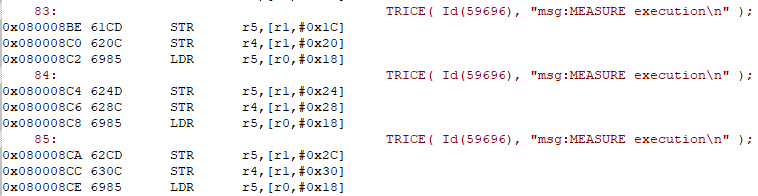
- Measurement: The blue SYSTICK clock counts backwards 6 clocks for each Trice macro (on an ARM M0+), what is less than 100 ns @64 MHz MCU clock:

A more realistic (typical) timing with target location and µs timestamps, critical section and parameters is shown here with the STM32F030 M0 core:
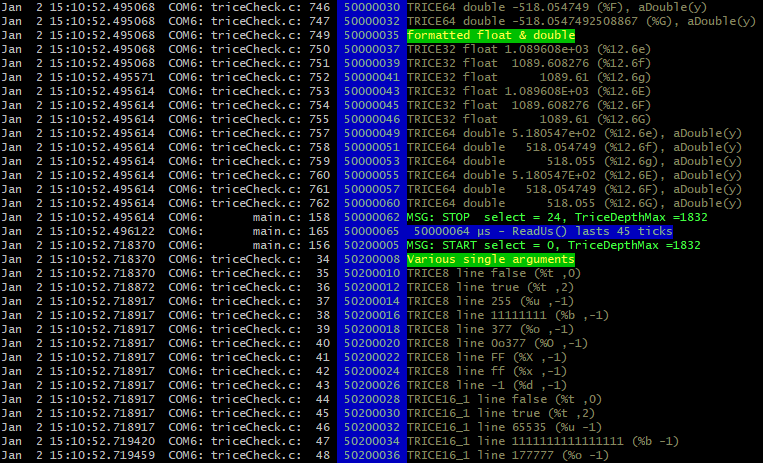
The MCU is clocked with 48 MHz and a Trice duration is about 2 µs, where alone the internal ReadUs() call is already nearly 1 µs long:
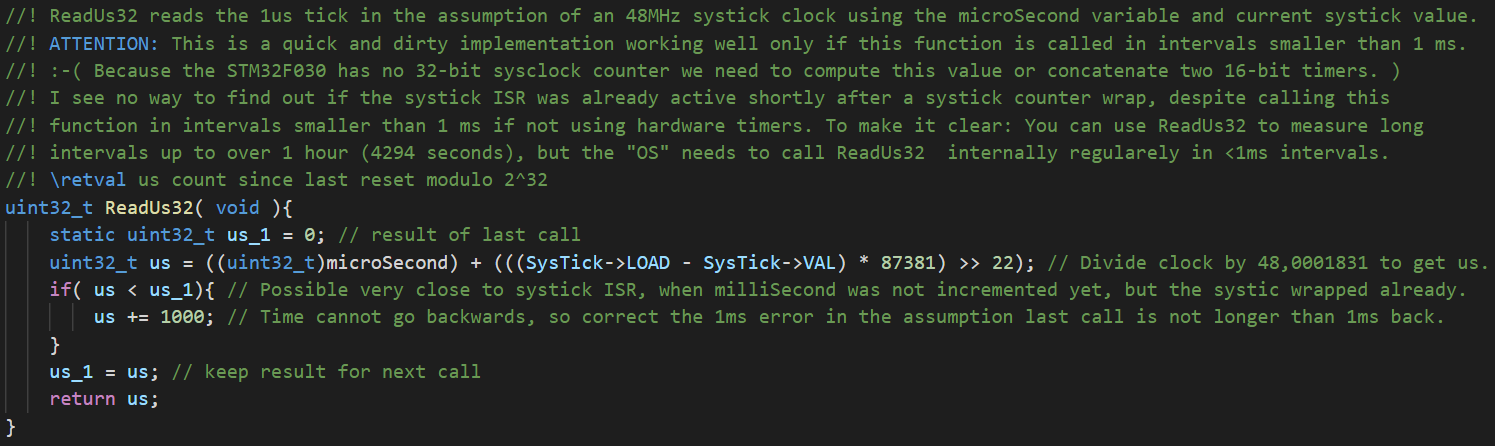
28.1. Target Implementation Options
All trice macros use internally this sub-macro:
#define TRICE_PUT(x) do{ *TriceBufferWritePosition++ = TRICE_HTOTL(x); }while(0); //! PUT copies a 32 bit x into the TRICE buffer.
The usual case is #define TRICE_HTOTL(x) (x). The uint32_t* TriceBufferWritePosition points to a buffer, which is codified and used with the Trice framing sub-macros TRICE_ENTER and TRICE_LEAVE depending on the use case.
28.1.1. Trice Use Cases TRICE_STATIC_BUFFER and TRICE_STACK_BUFFER - direct mode only
- Each single Trice is build inside a common buffer and finally copied inside the sub-macro
TRICE_LEAVE. - Disabled relevant interrupts between
TRICE_ENTERandTRICE_LEAVEare mantadory forTRICE_STATIC_BUFFER. - Usable for multiple non-blocking physical Trice channels but not recommended for some time blocking channels.
- A copy call is executed inside
TRICE_LEAVE.
- With appropriate mapping a direct write to physical output(s) is possible:
- RTT0 without extra copy.
- With
TRICE_DIRECT_SEGGER_RTT_32BIT_WRITEabout 100 MCU clocks do the whole work, what is within 1.5 us @ 64 MHz.
- With
- AUX without extra copy.
- Not (yet) supported UART transfer loop with polling. With 1MBit baud rate, 4-12 bytes would last 40-120 µs.
- RTT0 without extra copy.
28.1.2. Trice Use Case TRICE_DOUBLE_BUFFER - deferred mode, fastest Trice execution, more RAM needed
- Several trices are build in a half buffer.
- No stack used.
- Disabled interrupts between
TRICE_ENTERandTRICE_LEAVE. - Usable for multiple blocking and non-blocking physical Trice channels.
- No copy call inside
TRICE_LEAVEbut optionally an additional direct mode is supported.
28.1.3. Trice Use Case TRICE_RING_BUFFER - deferred mode, balanced Trice execution time and needed RAM
- Each single trices is build in a ring buffer segment.
- No stack used.
- Disabled interrupts between
TRICE_ENTERandTRICE_LEAVE. - Usable for multiple blocking and non-blocking physical Trice channels.
- No copy call inside
TRICE_LEAVEbut optionally an additional direct mode is supported. - Allocation call inside
TRICE_ENTER
28.2. A configuration for maximum Trice execution speed with the L432_inst example
-
To not loose any clocks, the function
SomeExampleTricesin triceExamples.c uses the upper case macroTRICEfor the first “🐁 Speedy Gonzales” Trices. -
The
triceConfig.hsettings are
#define TriceStamp16 (*DWT_CYCCNT) // @64MHz wraps after a bit more than 1ms (MCU clocks)
#define TriceStamp32 (*DWT_CYCCNT) // @64MHz -> 1 µs, wraps after 2^32 µs ~= 1.2 hours

#define TRICE_DEFERRED_UARTA 1
#define TRICE_UARTA USART2

#define TRICE_DEFERRED_OUTPUT 1
#define TRICE_BUFFER TRICE_DOUBLE_BUFFER

#define TRICE_PROTECT 0
#define TRICE_DIAGNOSTICS 0
#define TRICE_CYCLE_COUNTER 0
- Both time stamps use the debug watchdog counter running with the 64 MHz MCU clock.
- No direct output to not loose time during the Trice macro execution.
- Critical sections are disabled (default), so be careful where Trices are used.
- The Trice double buffer allows the Trice macros to write without checks.
- The Trice protection, diagnostics and cycle counter are disabled to not perform unneeded clocks.
- Additionally in file flags.mak the optimization is set to
C_FLAGS += -Ofast.
After running ./build.sh, executing ` arm-none-eabi-objdump.exe -D -S -l out.clang/triceExamples.o` shows:
out.clang/triceExamples.o:     file format elf32-littlearm


Disassembly of section .text.TriceHeadLine:

00000000 <TriceHeadLine>:
TriceHeadLine():
C:\Users\ms\repos\trice_wt_devel\examples\L432_inst/../exampleData/triceExamples.c:10
#include "trice.h"

//! TriceHeadLine emits a decorated name. The name length should be 18 characters.
void TriceHeadLine(char * name) {
	//! This is usable as the very first trice sequence after restart. Adapt it. Use a UTF-8 capable editor like VS-Code or use pure ASCII.
	TriceS("w: Hello! 👋🙂\n\n        ✨✨✨✨✨✨✨✨✨✨✨✨✨✨✨✨✨        \n        🎈🎈🎈🎈%s🎈🎈🎈🎈\n        🍃🍃🍃🍃🍃🍃🍃🍃🍃🍃🍃🍃🍃🍃🍃🍃🍃        \n\n\n", name);
   0:	f240 0100 	movw	r1, #0
   4:	4602      	mov	r2, r0
   6:	f2c0 0100 	movt	r1, #0
   a:	f643 70f1 	movw	r0, #16369	@ 0x3ff1
   e:	f7ff bffe 	b.w	0 <TriceS>

Disassembly of section .ARM.exidx.text.TriceHeadLine:

00000000 <.ARM.exidx.text.TriceHeadLine>:
   0:	00000000 	andeq	r0, r0, r0
   4:	00000001 	andeq	r0, r0, r1

Disassembly of section .text.SomeExampleTrices:

00000000 <SomeExampleTrices>:
SomeExampleTrices():
C:\Users\ms\repos\trice_wt_devel\examples\L432_inst/../exampleData/triceExamples.c:14
}

//! SomeExampleTrices generates a few Trice example logs and a burst of Trices.
void SomeExampleTrices(int burstCount) {
   0:	b5f0      	push	{r4, r5, r6, r7, lr}
   2:	af03      	add	r7, sp, #12
   4:	e92d 0700 	stmdb	sp!, {r8, r9, sl}
C:\Users\ms\repos\trice_wt_devel\examples\L432_inst/../exampleData/triceExamples.c:15
	TRICE(ID(0), "att:🐁 Speedy Gonzales A  32-bit timestamp\n");
   8:	f240 0100 	movw	r1, #0
   c:	f2c0 0100 	movt	r1, #0
  10:	680d      	ldr	r5, [r1, #0]
  12:	f240 0800 	movw	r8, #0
  16:	f2c0 0800 	movt	r8, #0
  1a:	4604      	mov	r4, r0
  1c:	6829      	ldr	r1, [r5, #0]
  1e:	f8d8 0000 	ldr.w	r0, [r8]
  22:	f06f 0212 	mvn.w	r2, #18
  26:	8041      	strh	r1, [r0, #2]
  28:	0c09      	lsrs	r1, r1, #16
  2a:	1cd3      	adds	r3, r2, #3
  2c:	8081      	strh	r1, [r0, #4]
  2e:	21c0      	movs	r1, #192	@ 0xc0
  30:	8003      	strh	r3, [r0, #0]
  32:	80c1      	strh	r1, [r0, #6]
C:\Users\ms\repos\trice_wt_devel\examples\L432_inst/../exampleData/triceExamples.c:16
	TRICE(ID(0), "att:🐁 Speedy Gonzales B  32-bit timestamp\n");
  34:	682b      	ldr	r3, [r5, #0]
  36:	1c96      	adds	r6, r2, #2
  38:	8143      	strh	r3, [r0, #10]
  3a:	0c1b      	lsrs	r3, r3, #16
  3c:	8106      	strh	r6, [r0, #8]
  3e:	8183      	strh	r3, [r0, #12]
  40:	81c1      	strh	r1, [r0, #14]
C:\Users\ms\repos\trice_wt_devel\examples\L432_inst/../exampleData/triceExamples.c:17
	TRICE(ID(0), "att:🐁 Speedy Gonzales C  32-bit timestamp\n");
  42:	682b      	ldr	r3, [r5, #0]
  44:	1c56      	adds	r6, r2, #1
  46:	8243      	strh	r3, [r0, #18]
  48:	0c1b      	lsrs	r3, r3, #16
  4a:	8206      	strh	r6, [r0, #16]
  4c:	8283      	strh	r3, [r0, #20]
  4e:	82c1      	strh	r1, [r0, #22]
C:\Users\ms\repos\trice_wt_devel\examples\L432_inst/../exampleData/triceExamples.c:18
	TRICE(ID(0), "att:🐁 Speedy Gonzales D  32-bit timestamp\n");
  50:	682b      	ldr	r3, [r5, #0]
  52:	8302      	strh	r2, [r0, #24]
  54:	0c1a      	lsrs	r2, r3, #16
  56:	8343      	strh	r3, [r0, #26]
  58:	8382      	strh	r2, [r0, #28]
  5a:	83c1      	strh	r1, [r0, #30]
  5c:	f64b 7ad4 	movw	sl, #49108	@ 0xbfd4
C:\Users\ms\repos\trice_wt_devel\examples\L432_inst/../exampleData/triceExamples.c:19
	TRICE(Id(0), "att:🐁 Speedy Gonzales E  16-bit timestamp\n");
  60:	682a      	ldr	r2, [r5, #0]
  62:	f6cb 7ad4 	movt	sl, #49108	@ 0xbfd4
  66:	f10a 1318 	add.w	r3, sl, #1572888	@ 0x180018
  6a:	6203      	str	r3, [r0, #32]
  6c:	8482      	strh	r2, [r0, #36]	@ 0x24
  6e:	84c1      	strh	r1, [r0, #38]	@ 0x26
C:\Users\ms\repos\trice_wt_devel\examples\L432_inst/../exampleData/triceExamples.c:20
	TRICE(Id(0), "att:🐁 Speedy Gonzales F  16-bit timestamp\n");
  70:	682a      	ldr	r2, [r5, #0]
  72:	f10a 1317 	add.w	r3, sl, #1507351	@ 0x170017
  76:	6283      	str	r3, [r0, #40]	@ 0x28
  78:	8582      	strh	r2, [r0, #44]	@ 0x2c
  7a:	85c1      	strh	r1, [r0, #46]	@ 0x2e
C:\Users\ms\repos\trice_wt_devel\examples\L432_inst/../exampleData/triceExamples.c:21
	TRICE(Id(0), "att:🐁 Speedy Gonzales G  16-bit timestamp\n");
  7c:	682a      	ldr	r2, [r5, #0]
  7e:	f10a 1316 	add.w	r3, sl, #1441814	@ 0x160016
  82:	6303      	str	r3, [r0, #48]	@ 0x30
  84:	8682      	strh	r2, [r0, #52]	@ 0x34
  86:	86c1      	strh	r1, [r0, #54]	@ 0x36
C:\Users\ms\repos\trice_wt_devel\examples\L432_inst/../exampleData/triceExamples.c:22
	TRICE(Id(0), "att:🐁 Speedy Gonzales H  16-bit timestamp\n");
  88:	682a      	ldr	r2, [r5, #0]
  8a:	f10a 1315 	add.w	r3, sl, #1376277	@ 0x150015
  8e:	8782      	strh	r2, [r0, #60]	@ 0x3c
  90:	f647 72e8 	movw	r2, #32744	@ 0x7fe8
C:\Users\ms\repos\trice_wt_devel\examples\L432_inst/../exampleData/triceExamples.c:23
	TRICE(id(0), "att:🐁 Speedy Gonzales I without timestamp\n");
  94:	f8a0 2040 	strh.w	r2, [r0, #64]	@ 0x40
  98:	f647 72e7 	movw	r2, #32743	@ 0x7fe7
C:\Users\ms\repos\trice_wt_devel\examples\L432_inst/../exampleData/triceExamples.c:24
	TRICE(id(0), "att:🐁 Speedy Gonzales J without timestamp\n");
  9c:	f8a0 2044 	strh.w	r2, [r0, #68]	@ 0x44
  a0:	f647 72e6 	movw	r2, #32742	@ 0x7fe6
C:\Users\ms\repos\trice_wt_devel\examples\L432_inst/../exampleData/triceExamples.c:25
	TRICE(id(0), "att:🐁 Speedy Gonzales K without timestamp\n");
  a4:	f8a0 2048 	strh.w	r2, [r0, #72]	@ 0x48
  a8:	f647 72e5 	movw	r2, #32741	@ 0x7fe5
C:\Users\ms\repos\trice_wt_devel\examples\L432_inst/../exampleData/triceExamples.c:22
	TRICE(Id(0), "att:🐁 Speedy Gonzales H  16-bit timestamp\n");
  ac:	6383      	str	r3, [r0, #56]	@ 0x38
  ae:	87c1      	strh	r1, [r0, #62]	@ 0x3e
C:\Users\ms\repos\trice_wt_devel\examples\L432_inst/../exampleData/triceExamples.c:23
	TRICE(id(0), "att:🐁 Speedy Gonzales I without timestamp\n");
  b0:	f8a0 1042 	strh.w	r1, [r0, #66]	@ 0x42
C:\Users\ms\repos\trice_wt_devel\examples\L432_inst/../exampleData/triceExamples.c:24
	TRICE(id(0), "att:🐁 Speedy Gonzales J without timestamp\n");
  b4:	f8a0 1046 	strh.w	r1, [r0, #70]	@ 0x46
C:\Users\ms\repos\trice_wt_devel\examples\L432_inst/../exampleData/triceExamples.c:25
	TRICE(id(0), "att:🐁 Speedy Gonzales K without timestamp\n");
  b8:	f8a0 104a 	strh.w	r1, [r0, #74]	@ 0x4a
C:\Users\ms\repos\trice_wt_devel\examples\L432_inst/../exampleData/triceExamples.c:26
	TRICE(id(0), "att:🐁 Speedy Gonzales L without timestamp\n");
  bc:	f8a0 204c 	strh.w	r2, [r0, #76]	@ 0x4c
  c0:	f8a0 104e 	strh.w	r1, [r0, #78]	@ 0x4e
TRice0():
C:\Users\ms\repos\trice_wt_devel\examples\L432_inst/../../src/trice.h:741
	Trice32m_0(tid);
	TRICE_UNUSED(pFmt)
}

...
- There are only 7 assembler instructions between two
TRICEmacros(around line 17). - The log output is:
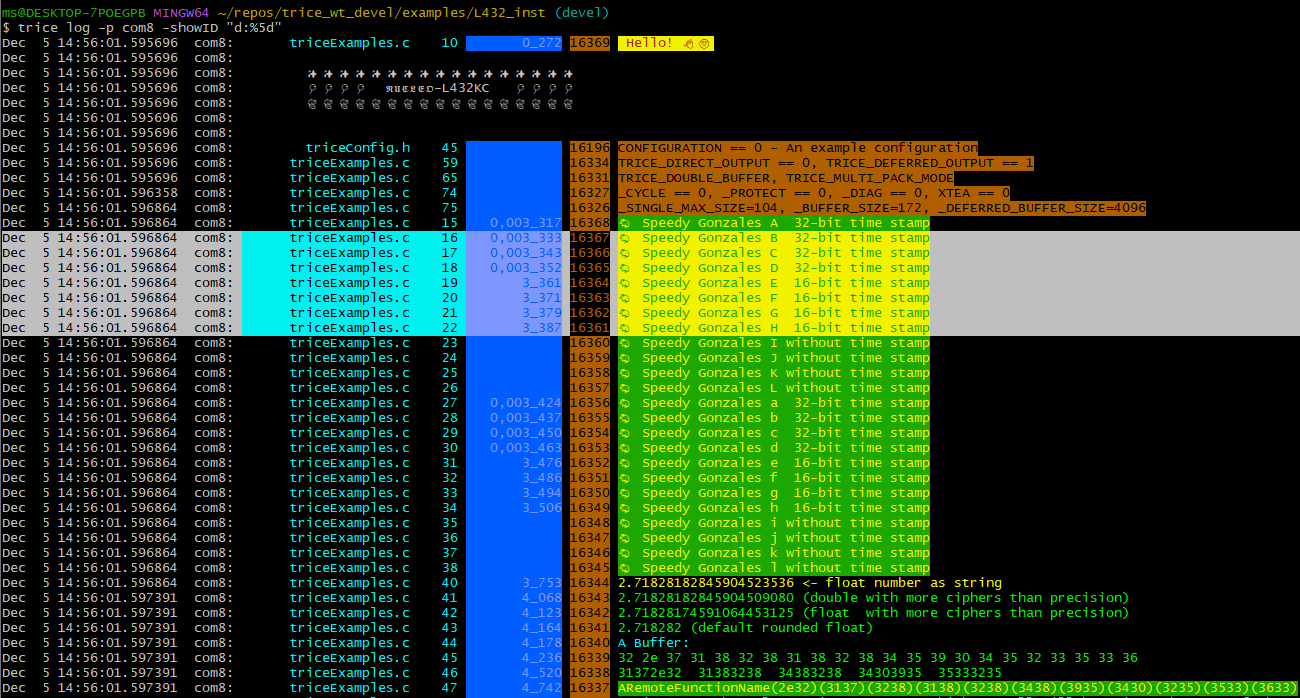
As you can see in the highlighted blue timestamp bar, typical 8-10 clocks are needed for one Trice macro. One clock duration @64MHz is 15.625 ns, so we need about 150 ns for a Trice. Light can travel about 50 meter in that time.
28.3. A configuration for normal Trice execution speed with the G0B1_inst example
- The
triceConfig.hsettings are
// hardware specific trice lib settings
#include "main.h"
#define TriceStamp16 TIM17->CNT     // 0...999 us
#define TriceStamp32 HAL_GetTick()  // 0...2^32-1 ms (wraps after 49.7 days)

#define TRICE_BUFFER TRICE_RING_BUFFER

// trice l -p JLINK -args="-Device STM32G0B1RE -if SWD -Speed 4000 -RTTChannel 0" -pf none  -d16 -ts ms
//#define TRICE_DIRECT_OUTPUT 1
//#define TRICE_DIRECT_SEGGER_RTT_32BIT_WRITE 1

// trice log -p com7 -pw MySecret -pf COBS
#define TRICE_DEFERRED_OUTPUT 1
#define TRICE_DEFERRED_XTEA_ENCRYPT 1
#define TRICE_DEFERRED_OUT_FRAMING TRICE_FRAMING_COBS
#define TRICE_DEFERRED_UARTA 1
#define TRICE_UARTA USART2

#include "cmsis_gcc.h"
#define TRICE_ENTER_CRITICAL_SECTION { uint32_t primaskstate = __get_PRIMASK(); __disable_irq(); {
#define TRICE_LEAVE_CRITICAL_SECTION } __set_PRIMASK(primaskstate); }
- The 16-bit timestamp counts the microseconds within 1 millisecond.
- The 32-bit timestamp counts the milliseconds.
- The ring buffer uses the RAM more effectively for the price of a bit speed.
- The encryption and framing has no influence on the Trice execution speed becuse this is done in the background.
- The critical section protects Trices in different tasks from each-other interruption and allows Trices inside interrupts parallel to normal usage.
- Per default are Trice protection, diagnostics and cycle counter active.
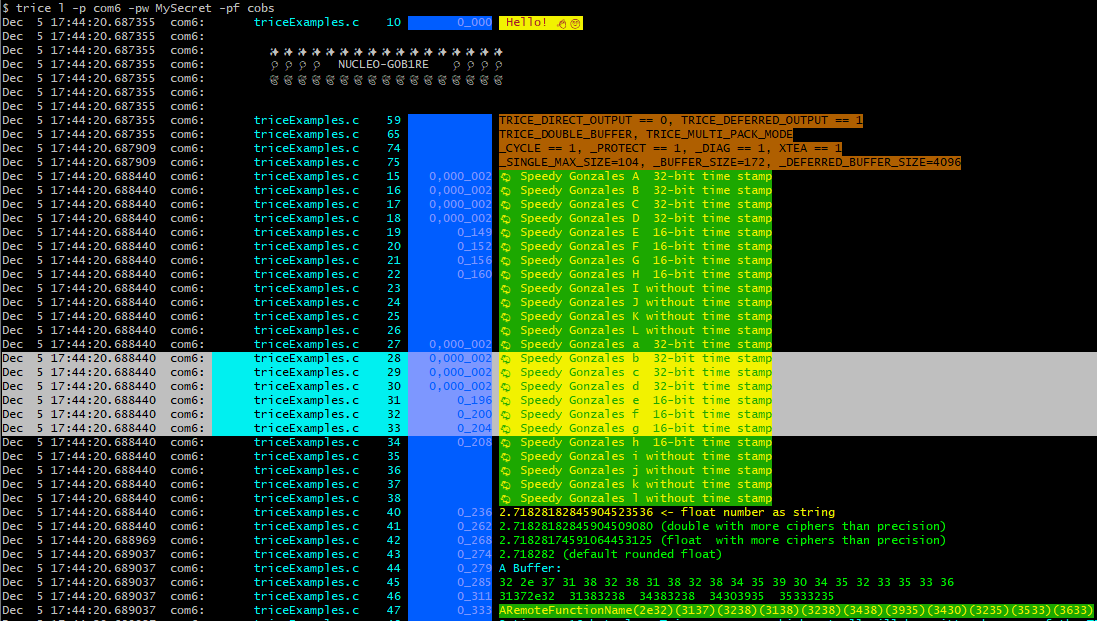
- A typical Trice duration is here 4 microseconds (with
-Ospeed) - Switcing the optimization to
-Ozcan result in typical 4-5 µs Trice execution time. - Additionally enabling the Trice direct out over Segger RTT has this impact:
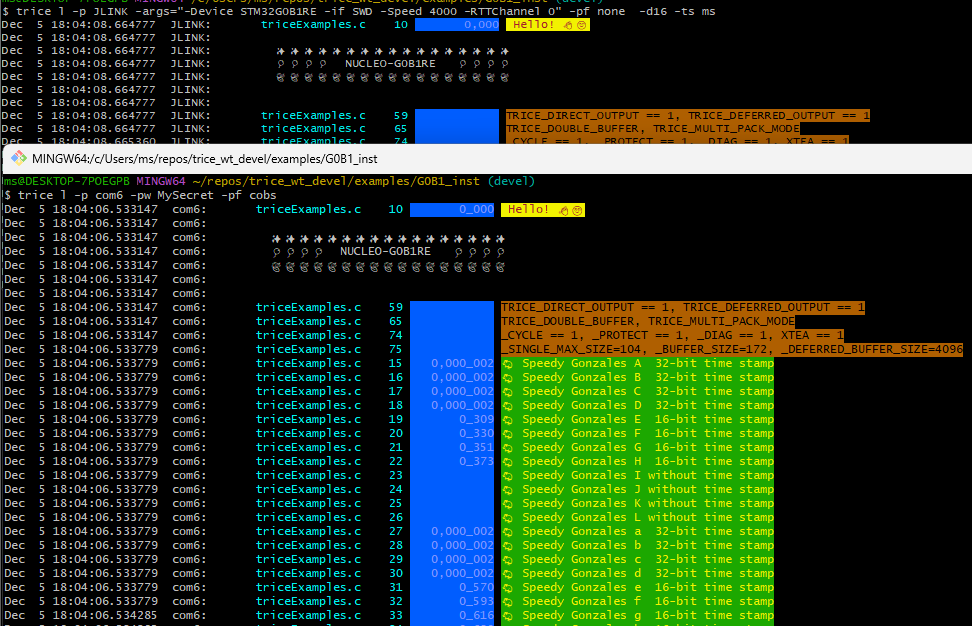
🛑 The Trice execution time is now over 20 microseconds❗
Still fast enough for many cases but you hopefully have a good knowledge now how to tune Trice best for your application.
29. Trice memory needs
Depending on your target configuration the needed space can differ:
29.1. F030_bare Size
./build.sh:
arm-none-eabi-size build/F030_bare.elf
   text    data     bss     dec     hex filename
   2428      12    1564    4004     fa4 build/F030_bare.elf
That is the basic size of an empty generated project just containing some drivers.
29.2. F030_inst Size with TRICE_OFF=1
./build.sh TRICE_OFF=1:
arm-none-eabi-size build/F030_inst.elf
   text    data     bss     dec     hex filename
   2428      12    1564    4004     fa4 build/F030_inst.elf
This is exactly the same result, proofing that TRICE_OFF 1 is working correctly.
29.3. F030_inst with ring buffer
./build.sh:
arm-none-eabi-size out/F030_inst.elf
   text    data     bss     dec     hex filename
   9416      28    2692   12136    2f68 out/F030_inst.elf
This is about 7 KB Flash and 1.2 KB RAM size for the Trice library and we see:
ms@DESKTOP-7POEGPB MINGW64 ~/repos/trice_wt_devel/examples/F030_inst (devel)
$ trice l -p com5 -ts16 "time:     #%6d" -hs off
com5:       triceExamples.c    12      # 65535  Hello! 👋🙂
com5:
com5:         ✨✨✨✨✨✨✨✨✨✨✨✨✨✨✨✨✨
com5:         🎈🎈🎈🎈  𝕹𝖀𝕮𝕷𝕰𝕺-F030R8   🎈🎈🎈🎈
com5:         🍃🍃🍃🍃🍃🍃🍃🍃🍃🍃🍃🍃🍃🍃🍃🍃🍃
com5:
com5:
com5:       triceExamples.c    61              TRICE_DIRECT_OUTPUT == 0, TRICE_DEFERRED_OUTPUT == 1
com5:       triceExamples.c    67              TRICE_DOUBLE_BUFFER, TRICE_MULTI_PACK_MODE
com5:       triceExamples.c    76              _CYCLE == 1, _PROTECT == 1, _DIAG == 1, XTEA == 0
com5:       triceExamples.c    77              _SINGLE_MAX_SIZE=104, _BUFFER_SIZE=172, _DEFERRED_BUFFER_SIZE=1024
com5:       triceExamples.c    29    0,031_804 🐁 Speedy Gonzales a  32-bit timestamp
com5:       triceExamples.c    30    0,031_646 🐁 Speedy Gonzales b  32-bit timestamp
com5:       triceExamples.c    31    0,031_488 🐁 Speedy Gonzales c  32-bit timestamp
com5:       triceExamples.c    32    0,031_330 🐁 Speedy Gonzales d  32-bit timestamp
com5:       triceExamples.c    33      # 31172 🐁 Speedy Gonzales e  16-bit timestamp
com5:       triceExamples.c    34      # 31012 🐁 Speedy Gonzales f  16-bit timestamp
com5:       triceExamples.c    35      # 30852 🐁 Speedy Gonzales g  16-bit timestamp
com5:       triceExamples.c    36      # 30692 🐁 Speedy Gonzales h  16-bit timestamp
com5:       triceExamples.c    42      # 30224 2.71828182845904523536 <- float number as string
com5:       triceExamples.c    43      # 29517 2.71828182845904509080 (double with more ciphers than precision)
com5:       triceExamples.c    44      # 29322 2.71828174591064453125 (float  with more ciphers than precision)
com5:       triceExamples.c    45      # 29145 2.718282 (default rounded float)
com5:       triceExamples.c    46      # 28969 A Buffer:
com5:       triceExamples.c    47      # 28790 32 2e 37 31 38 32 38 31 38 32 38 34 35 39 30 34 35 32 33 35 33 36
com5:       triceExamples.c    48      # 28076 31372e32  31383238  34383238  34303935  35333235
com5:       triceExamples.c    49      # 27430 ARemoteFunctionName(2e32)(3137)(3238)(3138)(3238)(3438)(3935)(3430)(3235)(3533)(3633)
com5:       triceExamples.c    50              5 times a 16 byte long Trice messages, which may not be written all if the buffer is too small:
com5:       triceExamples.c    52      # 26554 i=44444400 aaaaaa00
com5:       triceExamples.c    52      # 26342 i=44444401 aaaaaa01
com5:       triceExamples.c    52      # 26130 i=44444402 aaaaaa02
com5:       triceExamples.c    52      # 25918 i=44444403 aaaaaa03
com5:       triceExamples.c    52      # 25706 i=44444404 aaaaaa04
com5:       triceExamples.c    29    0,031_790 🐁 Speedy Gonzales a  32-bit timestamp
com5:       triceExamples.c    30    0,031_632 🐁 Speedy Gonzales b  32-bit timestamp
com5:       triceExamples.c    31    0,031_474 🐁 Speedy Gonzales c  32-bit timestamp
com5:       triceExamples.c    32    0,031_316 🐁 Speedy Gonzales d  32-bit timestamp
com5:       triceExamples.c    33      # 31158 🐁 Speedy Gonzales e  16-bit timestamp
com5:       triceExamples.c    34      # 30998 🐁 Speedy Gonzales f  16-bit timestamp
com5:       triceExamples.c    35      # 30838 🐁 Speedy Gonzales g  16-bit timestamp
com5:       triceExamples.c    36      # 30678 🐁 Speedy Gonzales h  16-bit timestamp
com5:       triceExamples.c    42      # 30210 2.71828182845904523536 <- float number as string
com5:       triceExamples.c    43      # 29503 2.71828182845904509080 (double with more ciphers than precision)
com5:       triceExamples.c    44      # 29308 2.71828174591064453125 (float  with more ciphers than precision)
com5:       triceExamples.c    45      # 29131 2.718282 (default rounded float)
com5:       triceExamples.c    46      # 28955 A Buffer:
com5:       triceExamples.c    47      # 28776 32 2e 37 31 38 32 38 31 38 32 38 34 35 39 30 34 35 32 33 35 33 36
com5:       triceExamples.c    48      # 28062 31372e32  31383238  34383238  34303935  35333235
com5:       triceExamples.c    49      # 27416 ARemoteFunctionName(2e32)(3137)(3238)(3138)(3238)(3438)(3935)(3430)(3235)(3533)(3633)
com5:       triceExamples.c    50              5 times a 16 byte long Trice messages, which may not be written all if the buffer is too small:
com5:       triceExamples.c    52      # 26540 i=44444400 aaaaaa00
com5:       triceExamples.c    52      # 26328 i=44444401 aaaaaa01
com5:       triceExamples.c    52      # 26116 i=44444402 aaaaaa02
com5:       triceExamples.c    52      # 25904 i=44444403 aaaaaa03
com5:       triceExamples.c    52      # 25692 i=44444404 aaaaaa04
com5:    triceLogDiagData.c    44              triceSingleDepthMax = 108 of 172 (TRICE_BUFFER_SIZE)
com5:    triceLogDiagData.c    67              TriceHalfBufferDepthMax = 388 of  512
com5:       triceExamples.c    29    0,031_344 🐁 Speedy Gonzales a  32-bit timestamp
com5:       triceExamples.c    30    0,031_186 🐁 Speedy Gonzales b  32-bit timestamp
29.4. F030_inst with ring buffer
./build.sh:
We need 600 bytes more Flash but could have less RAM used:
   text    data     bss     dec     hex filename
  10060      24    2688   12772    31e4 out/F030_inst.elf
ms@DESKTOP-7POEGPB MINGW64 ~/repos/trice_wt_devel/examples/F030_inst (devel)
$ trice l -p com5 -ts16 "time:     #%6d" -hs off
com5:       triceExamples.c    12      # 65535  Hello! 👋🙂
com5:
com5:         ✨✨✨✨✨✨✨✨✨✨✨✨✨✨✨✨✨
com5:         🎈🎈🎈🎈  𝕹𝖀𝕮𝕷𝕰𝕺-F030R8   🎈🎈🎈🎈
com5:         🍃🍃🍃🍃🍃🍃🍃🍃🍃🍃🍃🍃🍃🍃🍃🍃🍃
com5:
com5:
com5:       triceExamples.c    61              TRICE_DIRECT_OUTPUT == 0, TRICE_DEFERRED_OUTPUT == 1
com5:       triceExamples.c    69              TRICE_RING_BUFFER, TRICE_MULTI_PACK_MODE
com5:       triceExamples.c    76              _CYCLE == 1, _PROTECT == 1, _DIAG == 1, XTEA == 0
com5:       triceExamples.c    77              _SINGLE_MAX_SIZE=104, _BUFFER_SIZE=172, _DEFERRED_BUFFER_SIZE=1024
com5:       triceExamples.c    29    0,031_732 🐁 Speedy Gonzales a  32-bit timestamp
com5:       triceExamples.c    30    0,031_531 🐁 Speedy Gonzales b  32-bit timestamp
com5:       triceExamples.c    31    0,031_330 🐁 Speedy Gonzales c  32-bit timestamp
com5:       triceExamples.c    32    0,031_129 🐁 Speedy Gonzales d  32-bit timestamp
com5:       triceExamples.c    33      # 30928 🐁 Speedy Gonzales e  16-bit timestamp
com5:       triceExamples.c    34      # 30725 🐁 Speedy Gonzales f  16-bit timestamp
com5:       triceExamples.c    35      # 30522 🐁 Speedy Gonzales g  16-bit timestamp
com5:       triceExamples.c    36      # 30319 🐁 Speedy Gonzales h  16-bit timestamp
com5:       triceExamples.c    42      # 29808 2.71828182845904523536 <- float number as string
com5:       triceExamples.c    43      # 29058 2.71828182845904509080 (double with more ciphers than precision)
com5:       triceExamples.c    44      # 28821 2.71828174591064453125 (float  with more ciphers than precision)
com5:       triceExamples.c    45      # 28602 2.718282 (default rounded float)
com5:       triceExamples.c    46      # 28383 A Buffer:
com5:       triceExamples.c    47      # 28162 32 2e 37 31 38 32 38 31 38 32 38 34 35 39 30 34 35 32 33 35 33 36
com5:       triceExamples.c    48      # 27406 31372e32  31383238  34383238  34303935  35333235
com5:       triceExamples.c    49      # 26718 ARemoteFunctionName(2e32)(3137)(3238)(3138)(3238)(3438)(3935)(3430)(3235)(3533)(3633)
com5:       triceExamples.c    50              5 times a 16 byte long Trice messages, which may not be written all if the buffer is too small:
com5:       triceExamples.c    52      # 25757 i=44444400 aaaaaa00
com5:       triceExamples.c    52      # 25502 i=44444401 aaaaaa01
com5:       triceExamples.c    52      # 25247 i=44444402 aaaaaa02
com5:       triceExamples.c    52      # 24992 i=44444403 aaaaaa03
com5:       triceExamples.c    52      # 24737 i=44444404 aaaaaa04
com5:       triceExamples.c    29    0,031_746 🐁 Speedy Gonzales a  32-bit timestamp
com5:       triceExamples.c    30    0,031_545 🐁 Speedy Gonzales b  32-bit timestamp
com5:       triceExamples.c    31    0,031_344 🐁 Speedy Gonzales c  32-bit timestamp
com5:       triceExamples.c    32    0,031_143 🐁 Speedy Gonzales d  32-bit timestamp
com5:       triceExamples.c    33      # 30942 🐁 Speedy Gonzales e  16-bit timestamp
com5:       triceExamples.c    34      # 30739 🐁 Speedy Gonzales f  16-bit timestamp
com5:       triceExamples.c    35      # 30536 🐁 Speedy Gonzales g  16-bit timestamp
com5:       triceExamples.c    36      # 30333 🐁 Speedy Gonzales h  16-bit timestamp
com5:       triceExamples.c    42      # 29822 2.71828182845904523536 <- float number as string
com5:       triceExamples.c    43      # 29072 2.71828182845904509080 (double with more ciphers than precision)
com5:       triceExamples.c    44      # 28835 2.71828174591064453125 (float  with more ciphers than precision)
com5:       triceExamples.c    45      # 28616 2.718282 (default rounded float)
com5:       triceExamples.c    46      # 28397 A Buffer:
com5:       triceExamples.c    47      # 28176 32 2e 37 31 38 32 38 31 38 32 38 34 35 39 30 34 35 32 33 35 33 36
com5:       triceExamples.c    48      # 27420 31372e32  31383238  34383238  34303935  35333235
com5:       triceExamples.c    49      # 26732 ARemoteFunctionName(2e32)(3137)(3238)(3138)(3238)(3438)(3935)(3430)(3235)(3533)(3633)
com5:       triceExamples.c    50              5 times a 16 byte long Trice messages, which may not be written all if the buffer is too small:
com5:       triceExamples.c    52      # 25771 i=44444400 aaaaaa00
com5:       triceExamples.c    52      # 25516 i=44444401 aaaaaa01
com5:       triceExamples.c    52      # 25261 i=44444402 aaaaaa02
com5:       triceExamples.c    52      # 25006 i=44444403 aaaaaa03
com5:       triceExamples.c    52      # 24751 i=44444404 aaaaaa04
com5:    triceLogDiagData.c    44              triceSingleDepthMax = 108 of 172 (TRICE_BUFFER_SIZE)
com5:    triceLogDiagData.c    75              triceRingBufferDepthMax = 324 of 1024
com5:       triceExamples.c    29    0,031_188 🐁 Speedy Gonzales a  32-bit timestamp
com5:       triceExamples.c    30    0,030_987 🐁 Speedy Gonzales b  32-bit timestamp
29.5. A developer setting, only enabling SEGGER_RTT
./build.sh:
arm-none-eabi-size out/F030_inst.elf
   text    data     bss     dec     hex filename
   6656      16    2768    9440    24e0 out/F030_inst.elf
About 4 KB Flash needed and we see:
ms@DESKTOP-7POEGPB MINGW64 ~/repos/trice_wt_devel/examples/F030_inst (devel)
$ trice l -p jlink -args "-Device STM32F030R8 -if SWD -Speed 4000 -RTTChannel 0" -pf none -d16 -showID "deb:%5d"
Dec  6 16:14:38.276356  jlink:       triceExamples.c    12       65_535 16369  Hello! 👋🙂
Dec  6 16:14:38.276356  jlink:
Dec  6 16:14:38.276356  jlink:         ✨✨✨✨✨✨✨✨✨✨✨✨✨✨✨✨✨
Dec  6 16:14:38.276356  jlink:         🎈🎈🎈🎈  𝕹𝖀𝕮𝕷𝕰𝕺-F030R8   🎈🎈🎈🎈
Dec  6 16:14:38.276356  jlink:         🍃🍃🍃🍃🍃🍃🍃🍃🍃🍃🍃🍃🍃🍃🍃🍃🍃
Dec  6 16:14:38.276356  jlink:
Dec  6 16:14:38.276356  jlink:
Dec  6 16:14:38.276356  jlink:       triceExamples.c    61              16334 TRICE_DIRECT_OUTPUT == 1, TRICE_DEFERRED_OUTPUT == 0
Dec  6 16:14:38.276356  jlink:       triceExamples.c    63              16333 TRICE_STACK_BUFFER, TRICE_MULTI_PACK_MODE
Dec  6 16:14:38.276920  jlink:       triceExamples.c    76              16327 _CYCLE == 1, _PROTECT == 1, _DIAG == 1, XTEA == 0
Dec  6 16:14:38.277424  jlink:       triceExamples.c    77              16326 _SINGLE_MAX_SIZE=104, _BUFFER_SIZE=172, _DEFERRED_BUFFER_SIZE=1024
Dec  6 16:14:39.181228  jlink:       triceExamples.c    29    0,031_848 16356 🐁 Speedy Gonzales a  32-bit timestamp
Dec  6 16:14:39.181228  jlink:       triceExamples.c    30    0,031_292 16355 🐁 Speedy Gonzales b  32-bit timestamp
Dec  6 16:14:39.181228  jlink:       triceExamples.c    31    0,030_736 16354 🐁 Speedy Gonzales c  32-bit timestamp
Dec  6 16:14:39.181228  jlink:       triceExamples.c    32    0,030_180 16353 🐁 Speedy Gonzales d  32-bit timestamp
Dec  6 16:14:39.181228  jlink:       triceExamples.c    33       29_624 16352 🐁 Speedy Gonzales e  16-bit timestamp
Dec  6 16:14:39.181228  jlink:       triceExamples.c    34       29_066 16351 🐁 Speedy Gonzales f  16-bit timestamp
Dec  6 16:14:39.181228  jlink:       triceExamples.c    35       28_508 16350 🐁 Speedy Gonzales g  16-bit timestamp
Dec  6 16:14:39.181228  jlink:       triceExamples.c    36       27_950 16349 🐁 Speedy Gonzales h  16-bit timestamp
Dec  6 16:14:39.181228  jlink:       triceExamples.c    42       27_086 16344 2.71828182845904523536 <- float number as string
Dec  6 16:14:39.181228  jlink:       triceExamples.c    43       25_906 16343 2.71828182845904509080 (double with more ciphers than precision)
Dec  6 16:14:39.181798  jlink:       triceExamples.c    44       25_305 16342 2.71828174591064453125 (float  with more ciphers than precision)
Dec  6 16:14:39.181798  jlink:       triceExamples.c    45       24_727 16341 2.718282 (default rounded float)
Dec  6 16:14:39.181798  jlink:       triceExamples.c    46       24_148 16340 A Buffer:
Dec  6 16:14:39.181798  jlink:       triceExamples.c    47       23_578 16339 32 2e 37 31 38 32 38 31 38 32 38 34 35 39 30 34 35 32 33 35 33 36
Dec  6 16:14:39.181798  jlink:       triceExamples.c    48       22_394 16338 31372e32  31383238  34383238  34303935  35333235
Dec  6 16:14:39.181798  jlink:       triceExamples.c    49       21_295 16337 ARemoteFunctionName(2e32)(3137)(3238)(3138)(3238)(3438)(3935)(3430)(3235)(3533)(3633)
Dec  6 16:14:39.181798  jlink:       triceExamples.c    50              16200 5 times a 16 byte long Trice messages, which may not be written all if the buffer is too small:
Dec  6 16:14:39.182303  jlink:       triceExamples.c    52       19_555 16335 i=44444400 aaaaaa00
Dec  6 16:14:39.182303  jlink:       triceExamples.c    52       18_941 16335 i=44444401 aaaaaa01
Dec  6 16:14:39.182303  jlink:       triceExamples.c    52       18_327 16335 i=44444402 aaaaaa02
Dec  6 16:14:39.182834  jlink:       triceExamples.c    52       17_713 16335 i=44444403 aaaaaa03
Dec  6 16:14:39.182834  jlink:       triceExamples.c    52       17_099 16335 i=44444404 aaaaaa04
Dec  6 16:14:40.187121  jlink:       triceExamples.c    29    0,031_855 16356 🐁 Speedy Gonzales a  32-bit timestamp
Dec  6 16:14:40.187121  jlink:       triceExamples.c    30    0,031_299 16355 🐁 Speedy Gonzales b  32-bit timestamp
Dec  6 16:14:40.187121  jlink:       triceExamples.c    31    0,030_743 16354 🐁 Speedy Gonzales c  32-bit timestamp
Dec  6 16:14:40.187121  jlink:       triceExamples.c    32    0,030_187 16353 🐁 Speedy Gonzales d  32-bit timestamp
Dec  6 16:14:40.187121  jlink:       triceExamples.c    33       29_631 16352 🐁 Speedy Gonzales e  16-bit timestamp
Dec  6 16:14:40.187121  jlink:       triceExamples.c    34       29_073 16351 🐁 Speedy Gonzales f  16-bit timestamp
Dec  6 16:14:40.187121  jlink:       triceExamples.c    35       28_515 16350 🐁 Speedy Gonzales g  16-bit timestamp
Dec  6 16:14:40.187121  jlink:       triceExamples.c    36       27_957 16349 🐁 Speedy Gonzales h  16-bit timestamp
Dec  6 16:14:40.187121  jlink:       triceExamples.c    42       27_093 16344 2.71828182845904523536 <- float number as string
Dec  6 16:14:40.187121  jlink:       triceExamples.c    43       25_913 16343 2.71828182845904509080 (double with more ciphers than precision)
Dec  6 16:14:40.187121  jlink:       triceExamples.c    44       25_310 16342 2.71828174591064453125 (float  with more ciphers than precision)
Dec  6 16:14:40.187121  jlink:       triceExamples.c    45       24_730 16341 2.718282 (default rounded float)
Dec  6 16:14:40.187121  jlink:       triceExamples.c    46       24_149 16340 A Buffer:
Dec  6 16:14:40.187121  jlink:       triceExamples.c    47       23_577 16339 32 2e 37 31 38 32 38 31 38 32 38 34 35 39 30 34 35 32 33 35 33 36
Dec  6 16:14:40.187630  jlink:       triceExamples.c    48       22_391 16338 31372e32  31383238  34383238  34303935  35333235
Dec  6 16:14:40.187690  jlink:       triceExamples.c    49       21_290 16337 ARemoteFunctionName(2e32)(3137)(3238)(3138)(3238)(3438)(3935)(3430)(3235)(3533)(3633)
Dec  6 16:14:40.187690  jlink:       triceExamples.c    50              16200 5 times a 16 byte long Trice messages, which may not be written all if the buffer is too small:
Dec  6 16:14:40.187690  jlink:       triceExamples.c    52       19_546 16335 i=44444400 aaaaaa00
Dec  6 16:14:40.188195  jlink:       triceExamples.c    52       18_930 16335 i=44444401 aaaaaa01
Dec  6 16:14:40.188195  jlink:       triceExamples.c    52       18_314 16335 i=44444402 aaaaaa02
Dec  6 16:14:40.188195  jlink:       triceExamples.c    52       17_698 16335 i=44444403 aaaaaa03
Dec  6 16:14:40.188195  jlink:       triceExamples.c    52       17_082 16335 i=44444404 aaaaaa04
Dec  6 16:14:41.191648  jlink:    triceLogDiagData.c    21              16382 RTT0_writeDepthMax=325 (BUFFER_SIZE_UP=1024)
Dec  6 16:14:41.191648  jlink:    triceLogDiagData.c    44              16378 triceSingleDepthMax = 108 of 172 (TRICE_BUFFER_SIZE)
Dec  6 16:14:41.191648  jlink:       triceExamples.c    29    0,030_628 16356 🐁 Speedy Gonzales a  32-bit timestamp
Dec  6 16:14:41.191648  jlink:       triceExamples.c    30    0,030_072 16355 🐁 Speedy Gonzales b  32-bit timestamp
“🐁 Speedy Gonzales” needs about 500 MCU clocks.
29.6. A developer setting, only enabling SEGGER_RTT and without deferred output gives after running ./build.sh TRICE_DIAGNOSTICS=0 TRICE_PROTECT=0:
arm-none-eabi-size out/F030_inst.elf
   text    data     bss     dec     hex filename
   5796      16    2736    8548    2164 out/F030_inst.elf
That is nearly 1 KB less Flash needs.
The output:
ms@DESKTOP-7POEGPB MINGW64 ~/repos/trice_wt_devel/examples/F030_inst (devel)
$ trice l -p jlink -args "-Device STM32F030R8 -if SWD -Speed 4000 -RTTChannel 0" -pf none -d16 -showID "deb:%5d"
Dec  6 16:20:10.545274  jlink:       triceExamples.c    12       65_535 16369  Hello! 👋🙂
Dec  6 16:20:10.545274  jlink:
Dec  6 16:20:10.545274  jlink:         ✨✨✨✨✨✨✨✨✨✨✨✨✨✨✨✨✨
Dec  6 16:20:10.545274  jlink:         🎈🎈🎈🎈  𝕹𝖀𝕮𝕷𝕰𝕺-F030R8   🎈🎈🎈🎈
Dec  6 16:20:10.545274  jlink:         🍃🍃🍃🍃🍃🍃🍃🍃🍃🍃🍃🍃🍃🍃🍃🍃🍃
Dec  6 16:20:10.545274  jlink:
Dec  6 16:20:10.545274  jlink:
Dec  6 16:20:10.545274  jlink:       triceExamples.c    61              16334 TRICE_DIRECT_OUTPUT == 1, TRICE_DEFERRED_OUTPUT == 0
Dec  6 16:20:10.545274  jlink:       triceExamples.c    63              16333 TRICE_STACK_BUFFER, TRICE_MULTI_PACK_MODE
Dec  6 16:20:10.545890  jlink:       triceExamples.c    76              16327 _CYCLE == 1, _PROTECT == 0, _DIAG == 0, XTEA == 0
Dec  6 16:20:10.546396  jlink:       triceExamples.c    77              16326 _SINGLE_MAX_SIZE=104, _BUFFER_SIZE=172, _DEFERRED_BUFFER_SIZE=1024
Dec  6 16:20:11.448885  jlink:       triceExamples.c    29    0,031_859 16356 🐁 Speedy Gonzales a  32-bit timestamp
Dec  6 16:20:11.448885  jlink:       triceExamples.c    30    0,031_661 16355 🐁 Speedy Gonzales b  32-bit timestamp
Dec  6 16:20:11.448885  jlink:       triceExamples.c    31    0,031_463 16354 🐁 Speedy Gonzales c  32-bit timestamp
Dec  6 16:20:11.448885  jlink:       triceExamples.c    32    0,031_265 16353 🐁 Speedy Gonzales d  32-bit timestamp
Dec  6 16:20:11.448885  jlink:       triceExamples.c    33       31_067 16352 🐁 Speedy Gonzales e  16-bit timestamp
Dec  6 16:20:11.448885  jlink:       triceExamples.c    34       30_867 16351 🐁 Speedy Gonzales f  16-bit timestamp
Dec  6 16:20:11.448885  jlink:       triceExamples.c    35       30_667 16350 🐁 Speedy Gonzales g  16-bit timestamp
Dec  6 16:20:11.448885  jlink:       triceExamples.c    36       30_467 16349 🐁 Speedy Gonzales h  16-bit timestamp
Dec  6 16:20:11.549660  jlink:       triceExamples.c    42       29_961 16344 2.71828182845904523536 <- float number as string
Dec  6 16:20:11.549660  jlink:       triceExamples.c    43       29_141 16343 2.71828182845904509080 (double with more ciphers than precision)
Dec  6 16:20:11.549660  jlink:       triceExamples.c    44       28_897 16342 2.71828174591064453125 (float  with more ciphers than precision)
Dec  6 16:20:11.549660  jlink:       triceExamples.c    45       28_675 16341 2.718282 (default rounded float)
Dec  6 16:20:11.549660  jlink:       triceExamples.c    46       28_452 16340 A Buffer:
Dec  6 16:20:11.550166  jlink:       triceExamples.c    47       28_238 16339 32 2e 37 31 38 32 38 31 38 32 38 34 35 39 30 34 35 32 33 35 33 36
Dec  6 16:20:11.550247  jlink:       triceExamples.c    48       27_412 16338 31372e32  31383238  34383238  34303935  35333235
Dec  6 16:20:11.550247  jlink:       triceExamples.c    49       26_671 16337 ARemoteFunctionName(2e32)(3137)(3238)(3138)(3238)(3438)(3935)(3430)(3235)(3533)(3633)
Dec  6 16:20:11.550247  jlink:       triceExamples.c    50              16200 5 times a 16 byte long Trice messages, which may not be written all if the buffer is too small:
Dec  6 16:20:11.550754  jlink:       triceExamples.c    52       25_646 16335 i=44444400 aaaaaa00
Dec  6 16:20:11.550754  jlink:       triceExamples.c    52       25_389 16335 i=44444401 aaaaaa01
Dec  6 16:20:11.550754  jlink:       triceExamples.c    52       25_132 16335 i=44444402 aaaaaa02
Dec  6 16:20:11.551285  jlink:       triceExamples.c    52       24_875 16335 i=44444403 aaaaaa03
Dec  6 16:20:11.551285  jlink:       triceExamples.c    52       24_618 16335 i=44444404 aaaaaa04
Dec  6 16:20:12.453968  jlink:       triceExamples.c    29    0,031_859 16356 🐁 Speedy Gonzales a  32-bit timestamp
Dec  6 16:20:12.453968  jlink:       triceExamples.c    30    0,031_661 16355 🐁 Speedy Gonzales b  32-bit timestamp
“🐁 Speedy Gonzales” direct outout needs about 200 MCU clocks and not 500 as before.
29.7. Settings Conclusion
- 4-8 KB Flash and 1.2 KB RAM needed for the Trice library.
- The RAM size is mainly influenced by the configured buffer sizes.
- Switching off diagnostics and/or protection is ok for less memory needs and faster Trice execution after getting some experience with the project.
29.8. Legacy Trice Space Example (Old Version)
- STM32CubeMX generated empty default project:
Program Size: Code=2208 RO-data=236 RW-data=4 ZI-data=1636 - Same project with default
Triceinstrumentation:Program Size: Code=2828 RO-data=236 RW-data=44 ZI-data=1836 - Needed FLASH memory: 620 Bytes
- Needed RAM: 40 Bytes plus 200 Bytes for the 2 times 100 Bytes double buffer
- With increased/decreased buffers also more/less RAM is needed.
- With each additional Trice macro a few additional FLASH memory bytes, like 10 assembler instructions, are needed.
- No printf-like library code is used anymore.
- No format strings go into the target code anymore.
- In general Trice instrumentation reduces the needed memory compared to a printf-like implementation.
29.9. Memory Needs for Old Example 1
The following numbers are measured with a legacy encoding, showing that the instrumentation code can be even smaller.
| Program Size (STM32-F030R8 demo project) | trice instrumentation | buffer size | compiler optimize for time | comment |
|---|---|---|---|---|
| Code=1592 RO-data=236 RW-data= 4 ZI-data=1028 | none | 0 | off | CubeMX generated, no trice |
| Code=1712 RO-data=240 RW-data=24 ZI-data=1088 | core | 64 | off | core added without trices |
| Code=3208 RO-data=240 RW-data=36 ZI-data=1540 | TriceCheckSet() | 512 | off | TRICE_SHORT_MEMORY is 1 (small) |
| Code=3808 RO-data=240 RW-data=36 ZI-data=1540 | TriceCheckSet() | 512 | on | TRICE_SHORT_MEMORY is 0 (fast) |
- The core instrumentation needs less 150 bytes FLASH and about 100 bytes RAM when buffer size is 64 bytes.
- The about 50 trices in TriceCheckSet() allocate roughly 2100 (fast mode) or 1500 (small mode) bytes.
- trices are removable without code changes with
#define TRICE_OFF 1beforeincude "trice.h"on file level or generally on project level.
29.10. Memory Needs for Old Example 2
| Project | Compiler | Optimization | Link-Time-Optimization | Result | Remark |
|---|---|---|---|---|---|
| MDK-ARM_STM32F030_bareerated | CLANG v6.19 | -Oz | yes | Code=1020 RO-data=196 RW-data=0 ZI-data=1024 | This is the plain generated project without trice instrumentation. |
| MDK-ARM_STM32F030_instrumented | CLANG v6.19 | -Oz | yes | Code=4726 RO-data=238 RW-data=16 ZI-data=4608 | This is with full trice instrumentation with example messages. |
- The size need is less than 4 KB. See also Trice Project Image Size Optimization.
30. Trice Project Image Size Optimization
Modern compilers are optimizing out unused code automatically, but you can help to reduce trice code size if your compiler is not perfect.
30.1. Code Optimization -o3 or -oz (if supported)
For debugging it could be helpful to switch off code optimization what increases the code size. A good choice is -o1. See also
TRICE_STACK_BUFFER could cause stack overflow with -o0 optimization.
30.2. Compiler Independent Setting (a bit outdated)
Maybe the following is a bit unhandy but it decreases the code amount, build time and the image size.
-
For **X=8 16 32 64** and N=0…12 selectively set #define ENABLE_triceXfn_N1to ` 0for unused functions in project specific filetriceConfig.h`. -
For **X=8 16 32 64** and N=0…12 selectively set #define ENABLE_TriceXfn_N1to ` 0for unused functions in project specific filetriceConfig.h`. -
For **X=8 16 32 64** and N=0…12 selectively set #define ENABLE_TRiceXfn_N1to ` 0for unused functions in project specific filetriceConfig.h`.
When having lots of program memory simply let all values be 1. With specific linker optimization unused functions can get stripped out automatically.
It is possible to #define TRICE_SINGLE_MAX_SIZE 12 for example in triceConfig.h. This automaticaly disables all Trice messages with payloads > 8 bytes (Trice size is 4 bytes).
30.3. Linker Option –split-sections (if supported)
In ARM-MDK uVision Project -> Options -> C/C++ -> "One EFL section for each function" allows good optimization and getting rid of unused code without additional linker optimization. This leads to a faster build process and is fine for most cases. It allows excluding unused functions.
30.4. Linker Optimization -flto (if supported)
- To get the smallest possible image, do not use option
--split sections. - Use linker optimization alone.
- This increases the build time but reduces the image size significantly.
30.4.1. ARMCC Compiler v5 Linker Feedback
- In ARM-MDK uVision, when using ARMCC compiler v5, there is a check box
Project -> Options -> Target -> "Cross Module Optimization". - In ARMCC this works also with the lite version.
30.4.2. ARMCLANG Compiler v6 Link-Time Optimization
- In ARM-MDK uVision, when using ARMCLANG compiler v6, the check box
Project -> Options -> C/C++(AC6) -> "Link-Time Optimization"is usable to set the CLI-fltoswitch. - LTO is not possible with ARMCLANG6 lite: https://developer.arm.com/documentation/ka004054/latest.
30.4.3. GCC
With GCC use the -flto CLI switch directly.
30.4.4. LLVM ARM Clang
This compiler is much faster and creates the smallest images. Right now it uses the GCC libs and linker.
30.4.5. Other IDE´s and compilers
Please check the manuals and create a pull request or simply let me know.
30.5. Legacy STM32F030 Example Project - Different Build Sizes
30.5.1. ARMCC compiler v5
| Compiler | Linker | Result | Comment |
|---|---|---|---|
| o0 | Code=46942 RO-data=266 RW-data=176 ZI-data=4896 | very big | |
| o1 | Code=22582 RO-data=258 RW-data=168 ZI-data=4896 | ||
| o3 | Code=21646 RO-data=258 RW-data=168 ZI-data=4896 | ||
| o0 | split sections | Code= 7880 RO-data=268 RW-data=156 ZI-data=4892 | for debugging |
| o1 | split sections | Code= 5404 RO-data=260 RW-data=148 ZI-data=4892 | for debugging |
| o3 | split sections | Code= 4996 RO-data=260 RW-data=148 ZI-data=4892 | good balance |
| o0 | flto | Code= 8150 RO-data=266 RW-data=176 ZI-data=4896 | builds slower |
| o1 | flto | Code= 5210 RO-data=258 RW-data=148 ZI-data=4892 | builds slower |
| o3 | flto | Code= 4818 RO-data=258 RW-data=148 ZI-data=4892 | builds slower, smallest image |
31. Trice Tags, Color, and Weights
Tags label Trice messages on the host. They can control presentation, selection, ID assignment, and weight-based filtering without adding target runtime data because the tag is part of the format string stored in til.json.
Context Enrichment also uses tags as selectors: a matching -ce rule adds values to selected log messages.
31.1. How to use tags
Add a tag and a colon in front of a Trice format string:
trice("wrn:Motor temperature is %d C\n", temperature);
The Trice tool recognizes wrn, applies the Warning color, and removes the prefix when it is completely lower case. A mixed-case or uppercase prefix remains visible:
wrn:fox  -> fox
Wrn:fox  -> Wrn:fox
The colors, aliases, and weights are defined in lineTransformerANSI.go. The tag itself does not require a target-side enable switch. Use -pick or -ban to select complete tag groups during host logging. Tag-specific ID ranges can additionally assign and route target IDs.
Short aliases have one unambiguous meaning. For example W and w select Write, while wrn, WARN, and WARNING select Warning. Configurations created for older Trice versions should replace an ambiguous short alias with the intended explicit name before using it for -pick, -ban, -logLevel, or -IDRange.
It is possible to concatenate individually tagged fragments to produce output such as:
The source for this example is in triceCheck.c. For each such color change a separate Trice message is needed, because tags can only occur at the beginning of a format string.
31.2. Tag weights
Each tag group has one integer weight in the range 0..999. A larger value means greater importance. The weight belongs to the group and therefore applies to every alias in that group. It is independent of the group’s position in the tag table and independent of its color.
The following table lists the default weights defined in lineTransformerANSI.go. Re-assignment for logging using the CLI is possible: -ulabel warn:650.
| Group | Weight |
|---|---|
| Fatal | 800 |
| Critical | 750 |
| Emergency | 700 |
| Error, Assert, Alarm | 650 |
| Warning, Notice | 600 |
| Attention, Alert | 550 |
| INFO, Config | 500 |
| Time, Message, Read, Write, Receive, Transmit, Diag, Interrupt, Signal, Test, Default | 400 |
untagged |
400 |
| Microsecond, Millisecond, Second, DeltaTime | 350 |
| Debug | 300 |
| Trace | 200 |
| Verbose | 100 |
CYCLE_ERROR is a Trice tool diagnostic rather than an application tag. Its stored value does not define application-message priority.
31.3. Selecting tags and priority
Use the repeatable -pick option to display selected tag groups, or -ban to suppress selected groups. The two options are mutually exclusive. Separate names with colons or repeat the option:
trice log -pick err:wrn -pick notice
trice log -ban dbg -ban trace:verbose
Aliases select the complete group. -pick all selects every message and -pick off selects none; -ban all suppresses every message and -ban off suppresses none. Empty list entries and unknown names are command-line errors.
Use -logLevel with all, off, a registered tag or alias, or a numeric weight from 0 through 999. An application event passes when its tag group’s weight is greater than or equal to the threshold. A lower threshold therefore displays more messages:
trice log -logLevel info
trice log -logLevel 500
Both commands use the same threshold with the default INFO weight of 500. Unknown level names and numeric values outside 0..999 are rejected before the input channel is opened. Application messages without a recognized format-string tag use the built-in untagged group with default weight 400. -logLevel off suppresses all application events.
With the default weights, -logLevel info excludes Message and untagged events because their weight is 400. Use -logLevel msg or -logLevel 400 to include these groups and all higher-weight groups while still excluding Debug (300), Trace (200), and Verbose (100). Without a -logLevel option, the threshold defaults to all.
Use a threshold when the requirement is “Warning and everything more important”, including new user tags assigned sufficiently high weights. For example, trice log -ulabel motor:780 -logLevel wrn includes motor alongside Warning, Notice, Error, and higher-weight groups. Use -pick for a specific set of groups such as Receive and Transmit, regardless of their weights. Combining both expresses a selected subsystem or category set with a minimum priority.
These are host-side filters. They do not avoid target argument evaluation or reduce data already transmitted by the target. Target ID routing is configured separately as described in ID Routing; received raw bytes can still be kept in a binary logfile.
For a short capture to experiment with, run the PC feature tour and compare ./show_json.sh, ./show_json.sh -pick info, and ./show_json.sh -logLevel wrn. The G0B1 feature tour applies the same output choices to a board capture.
All -ulabel values are applied before -pick, -ban, and -logLevel are resolved. Option order therefore does not matter:
trice log -pick motor -ulabel motor:650
trice log -ulabel motor:650 -pick motor
-pick or -ban and -logLevel jointly decide whether each application event is displayed. An accepted event keeps its timestamps, source location, ID, prefix, suffix, and all lines of its text; a rejected event leaves none of these behind. For example, -pick err:wrn -logLevel err shows only Error events. A line assembled from several Trice calls contains only the accepted calls, including their accepted newline characters. The same decision also applies to visualization routing. Byte-oriented CHAR/DUMP chunks have no typed event boundary and retain their fragment-based selection behavior.
Each Trice call is one event. Accepted fragments are concatenated until an accepted newline arrives; a rejected newline does not finish the visible line. For example, the three calls msg:A, dbg:B\n, msg:C\n produce AC\n with either -pick msg or -logLevel msg using the default weights. A multi-line event is accepted or rejected as a whole, preserving its continuation indentation. At the end of buffered input, a remaining visible fragment is flushed with a newline.
Metadata columns belong to the first accepted event of each visible line. Target timestamp differences use the previous visible line’s first accepted event; rejected events and later fragments on the same line do not update that reference. -addNL appends a newline to every event, including one already ending in a newline; the latter produces an additional indented blank line. Without -addNL, an empty event produces no visible output, while an accepted newline-only event produces a blank line.
31.4. Decoder diagnostics
Decoder and transport diagnostics are tool output rather than application messages. Examples include an unknown Trice ID, an invalid COBS/TCOBS frame, an unsupported or truncated packet, and a cycle-counter mismatch. These diagnostics remain visible with restrictive -pick, -ban, and -logLevel off settings. They receive no application metadata, do not enter visualization routing, and are not assigned an application tag.
The translator keeps the diagnostic writer separate from the application line composer. The command currently directs both to its normal local output, while remote display receives application lines only. A machine-readable application sink must keep the separate diagnostic writer on a human-readable tool channel instead of inserting diagnostic text into records. Recoverable decoder diagnostics do not stop logging; writer and input errors retain their existing error handling. Binary recording occurs before decoding and is unaffected.
31.5. User-defined tags, weights, and colors
Use the repeatable -ulabel name, -ulabel name:weight, or -ulabel name:color option to register a new tag or change a known group’s weight or color for one command:
trice log -ulabel motor -ulabel sensor:150
trice insert -ulabel motor:250
trice bind -ulabel motor:250
trice log -ulabel motor:red:blue
trice log -ulabel msg:300 -ulabel msg:red:blue
A new tag without an explicit weight receives the final INFO weight after all -ulabel options have been processed. An explicit weight must be between 0 and 999, inclusive. The color must be exactly one of the tokens printed by trice generate -colors, such as red:blue. An unknown color is rejected with a hint to that command.
An existing name without either property leaves its group unchanged. An existing name with a weight changes the complete group, including every alias. The last explicit assignment wins:
-ulabel msg:150 -ulabel M:600 -ulabel msg
This results in weight 600 for the complete Message group. It does not create additional groups for msg or M.
Weight and color are independent. -ulabel msg:300 -ulabel msg:"yellow+h:green" gives every built-in Message alias (msg, message, MSG, MESSAGE, and the other aliases) weight 300 and the same color. Repeating either property changes only that property; the last value for each property wins. Free user labels are literal: -ulabel new:300 -ulabel NEW:400 creates two distinct labels with no user-defined alias relationship.
Each option accepts exactly one name. The old colon-separated name-list form is invalid. Empty names or values, unknown colors, weights outside 0..999, purely numeric names, all, and off are rejected before the command opens or changes its input and output files. A color token itself contains a colon between foreground and background.
For insert and bind, only the registered name participates in tag and -IDRange handling. Weight and color change no target data and are not stored in the source or til.json.
Command-specific user tags, weight overrides, and color overrides are discarded before a later command in the same process starts.
31.6. Untagged application events
The host assigns the built-in untagged group once to an application event whose stored format string has no recognized tag. This also applies to an empty prefix, an unknown prefix caused by a typo, or ordinary text containing a colon. For ID-based messages, classification uses the format string from the Trice ID lookup table rather than text supplied as a runtime value.
| Stored format string | Visible text with -color off |
|---|---|
Hello |
Hello |
untagged:Hello |
untagged:Hello |
mgs:blah |
mgs:blah |
msg:Hello |
msg:Hello |
The host never adds untagged: to visible application text. It appears only if the application supplied those characters. For example, trice("Hello") displays Hello with every palette, while an unknown prefix such as mgs:blah remains visible so a typo can be spotted. An explicitly written untagged: follows the usual presentation rules for lowercase tags: -color off keeps it, while -color none and default remove the tag from the visible text.
-pick untagged, -ban untagged, -logLevel, and statistics handle this group like other application tags. Its weight is independent of INFO and can be changed for one command with -ulabel untagged:150. An optional color such as -ulabel untagged:red:default still styles text output with -color default, without printing the group name. -color none and -color off leave it uncolored.
Decoder and transport diagnostics are not untagged application events. Byte-oriented CHAR and DUMP decoder chunks also receive no synthetic event tag because they do not identify individual application events. Classification changes neither source format strings, lookup-table entries, IDs, nor recorded raw bytes.
31.7. Event statistics
-tagStat counts successfully decoded application events by tag group, including untagged; -triceStat counts successfully decoded ID-based Trice events by ID. -stat prints both reports. These totals are recorded before -pick, -ban, -logLevel, and visualization routing, so they include events hidden from the text display. One call counts once even if it spans several output lines; several calls on one line count separately. Palette changes, metadata columns, and repeated report printing do not change the totals. Decoder diagnostics and malformed records are excluded. Formatted ID-less typeX0 records contribute to tag statistics but have no Trice ID to count. Byte-oriented CHAR/DUMP chunks have no event boundary and do not contribute to these event totals.
31.8. Output options
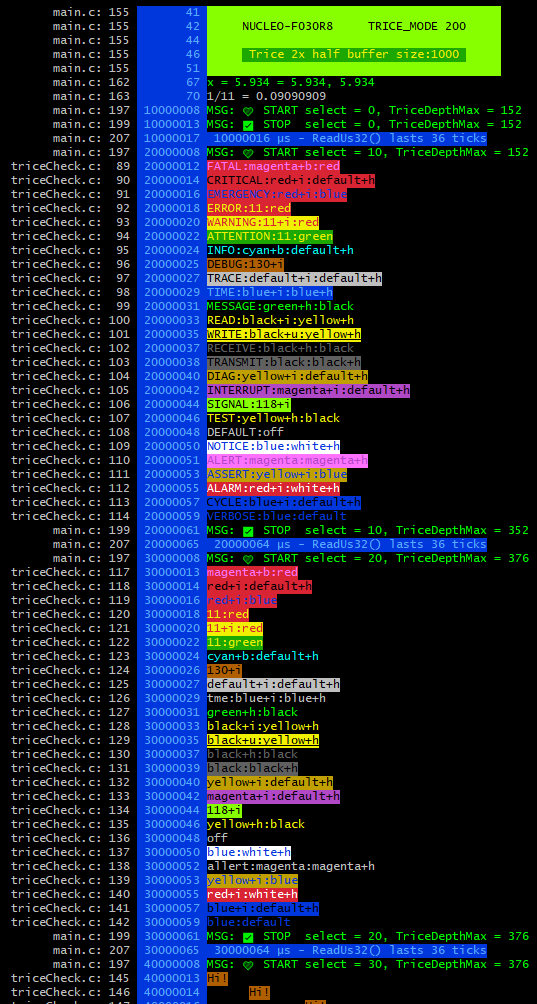
With -color default, recognized lower-case tag prefixes are removed and their configured colors are applied. With -color none, lower-case prefixes are removed without adding colors. With -color off, prefixes remain unchanged and no colors are added.
31.9. Check color alternatives
There are over 1000 foreground, background, and style combinations:
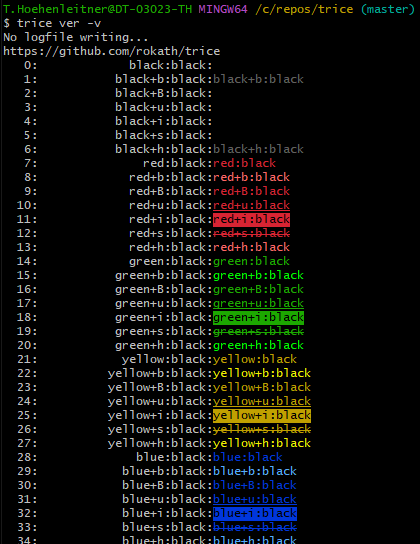
Run trice generate -colors to display them. Use -ulabel name:color for a per-command override. Modify lineTransformerANSI.go and rebuild the Trice tool with go install ./... or ./scripts/buildTriceTool.sh to change the built-in palette.
31.10. Color issues under Windows
If a Windows console displays ANSI escape sequences instead of colors, use a terminal with ANSI color support, such as Windows Terminal, Git Bash, or Alacritty. Additional background is available in Windows console with ANSI colors handling.
32. Structured Logging
Machine-readable output requires the standard TREX wire format. CHAR and DUMP do not provide suitable event boundaries and are rejected with -logFormat json or -logFormat kv.
Structured Logging adds named, typed values to a readable message. A regular Trice call is enough:
trice("info:Motor {motor_id}: {temperature_c:%.1f C}", motor_id, aFloat(temperature_c));
With motor_id = 3 and temperature_c = 87.5, the output depends on the selected format:
These three outputs use -li off -showID '' -hs off -ts off, so no optional host or target metadata appears.
tlog -logFormat text (default):
Motor 3: 87.5 C
tlog -logFormat json (NDJSON):
{"tag":"INFO","level":"INFO","message":"Motor 3: 87.5 C","fields":{"motor_id":3,"temperature_c":87.5}}
tlog -logFormat kv:
tag=INFO level=INFO message="Motor 3: 87.5 C" field.motor_id=3 field.temperature_c=87.5
Further output formats, such as CSV, could be added when needed.
The target continues to transmit the ID and values using the existing wire format. Field names are not transmitted as additional runtime arguments or payload; they reside in the dictionary on the host.
Scalar Trices with 8, 16, 32 or 64 bits and strings through triceS and triceN are supported. The target macros and their bit-width rules remain authoritative. Context Enrichment (bind -ce) can add supported structured fields; see Context Enrichment.
Try the PC Feature Tour or the G0B1 Feature Tour: both demonstrate named numeric and string fields and text, NDJSON and KV output. The PC tour requires no hardware and immediately produces a short binary capture.
Named fields are currently unavailable for buffer formats such as triceB. These repeat a printf placeholder for each buffer element, whereas a structured field describes one named value. The current field schema does not define whether a named buffer should appear as a numeric list, a byte sequence or text. Therefore, bind and insert reject trice8B("msg:{bytes:%02x}", bytes, 2) with an error. triceF does not support named fields either.
Buffer logging without a named field remains available: for 0x01 and 0x02, trice8B("msg:%02x ", bytes, 2) produces JSON {"tag":"MESSAGE","message":"01 02 "} without a fields object. For a fixed number of individually named values, use scalar Trices instead. Structured output of entire buffers requires a separate format and schema definition.
32.1. Placeholders and Names
| Format string syntax | Meaning |
|---|---|
{motor_id} |
Explicit field name, default display. |
{} |
Derive the name from the corresponding C argument. |
{plant.} |
Prefix the derived name with plant.. |
{:%.1f} |
Derived name and explicit display. |
{temperature:%.1f C} |
Explicit name and display. |
{: = %.1f C} |
Derived name and display. |
{motor_id:: %d, } |
Name motor_id, display : %d, . |
| `` | Literal opening and closing braces. |
The first colon separates the name from its display. The display may contain free text and further colons, but must contain exactly one supported format specifier. %% is not an additional value. Dynamic widths such as %*d are not allowed in a structured field.
Without an explicit display, %d is used. If the entire argument is wrapped in aFloat(...) or aDouble(...), the default is %f. There is no general C type inference: an unsigned value needs, for example, {counter:%u}, an address {address:%p}, and a string {text:%s}.
trice("info:{} {}", motor_id, aFloat(temperature_c));
trice("info:{plant.}", motor->temperature);
trice("info:{temperature:%.2f}", aFloat(read_temperature()));
triceS("info:{message:%s}", "motor ready");
triceN("info:{message:%s}", buffer, length);
Names can be derived from individual identifiers and simple member chains. Both motor.temperature and motor->temperature yield motor.temperature. The aFloat and aDouble wrappers are removed when deriving names. Expressions such as values[0], a+b or read_temperature() need an explicit name. Names consist of identifiers with optional dot-separated segments; whitespace within an identifier, empty segments and leading digits are invalid.
Canonical names must be unique within a call. {motor->id} and {motor.id} collide. However, motor and motor.id are two distinct, flat keys; dotted names do not create nested JSON objects.
Ordinary %... conversions and structured placeholders consume arguments together, from left to right:
trice("info:%u {temperature:%.1f} %x {last}", sequence, aFloat(temperature), flags, last);
Only temperature and last are exported as fields here. sequence and flags appear only in the message. Instrumentation checks missing or extra arguments and duplicate or malformed fields. Schema errors prevent publication of partial changes from the instrumentation run.
The new syntax for literal braces also applies in text mode:
trice("info:set=1, value={value}", value);
This produces set={1,2}, value=7 when value = 7. A backslash before a brace does not replace doubling it.
32.2. Field Types and Display
| Format specifier | Structured value |
|---|---|
%d, %i |
Signed integer of the Trice bit width. |
%u, %o, %O, %x, %X, %b |
Unsigned integer. The selected numeric base affects only the message. |
%f, %F, %e, %E, %g, %G |
Floating-point number; 32 bits with aFloat, 64 bits with aDouble. |
%c, %q, %U |
Character as a string; invalid Unicode code points become the replacement character. |
%t |
Boolean: zero is false, other values are true. |
%s |
String from triceS or triceN. |
%p |
Address in the form 0x...; does not imply the type of the referenced object. |
%% is a literal percent sign and creates neither a field nor an additional argument.
Supported C length modifiers such as %lu or %llX do not change these semantics; the Trice family determines the transmitted bit width. Precision, field width and display text affect only message. For example, {value:%.1f} displays 1.2 for a value of 1.25, while the field contains 1.25. Similarly, {text:%.3s} truncates only the message, not the exported string.
-unsigned=false does not change the meaning of structured unsigned fields either. It continues to control the corresponding classical text display.
Named string fields use %s; alternative classical string displays such as %x remain message text without a named field. A structured floating-point field in a 64-bit Trice requires aDouble(...); aFloat(...) is rejected there to prevent interpreting the transmitted bits as a double.
32.3. Instrumentation and Dictionary
Both bind and insert support structured templates. As before, clean removes inserted IDs and preserves the original template spelling. Source shorthand is not replaced with canonical field names.
trice bind -src app -genDir generated -til til.json -li li.json
Alternatively, for the Insert/Clean workflow:
trice insert -src app -genDir generated -til til.json -li li.json
trice clean -src app -til til.json -li li.json
Like the existing workflows, these examples require an initialized TIL. The usual build integration of Bind sidecars is still required.
The C test examples also demonstrate 8-, 16-, 32- and 64-bit values, different stamps, triceS/triceN, mixed placeholders and the aFloat()/aDouble() wrappers. Their integration tests verify text output after bind and insert, using the same CLI settings as the PC target tests. Names from motor.state and motorPtr->rpm appear canonically in the field registry as motor.state and motorPtr.rpm.
In til.json, the only schema fields remain Type and Strg. Strg contains all information needed for decoding, including derived names and floating-point defaults. For example,
trice("info:Motor {}: {} C", motor_id, aFloat(temperature_c));
is stored with a canonical Strg such as:
{"Type":"trice","Strg":"info:Motor {motor_id}: {temperature_c:%f} C"}
The actual spelling of Type still follows the respective instrumentation path. Schema identity remains Type + Strg. Renaming a field creates a new schema identity and therefore a different ID; historical TIL entries remain available for older firmware. Equivalent name spellings such as motor->temperature and motor.temperature retain the same canonical identity. Repeating unchanged runs creates no additional schemas. Generated local C format data contains the derived printf format string.
32.4. Output Formats and Event Boundaries
trice log and tlog support -logFormat text, -logFormat json and -logFormat kv, with -logFormat key-value as an alias for kv. Values are case-insensitive; the default remains text. The text-based remote display mode and test table output cannot be combined with machine-readable formats.
trice log -p FILEBUFFER -args capture.bin -pf TCOBSv1 -til til.json -li off -hs off -ts off -logFormat json
Framing and dictionary must match the capture. -logFormat kv reads the same capture as key/value output; text retains the existing text output.
-logFormat json produces NDJSON (JSON Lines): one JSON object followed by LF per accepted Trice event. There is no separate CLI value ndjson. KV also produces exactly one line per event. Partial calls are not combined, and multiline messages are not split into multiple events. An empty message is also an event. Newlines within the message are escaped.
Text prefixes, suffixes, colors, indentation, time-difference columns and -addNL do not decorate JSON/KV records. Actual metadata appears in separate fields instead. In JSON/KV mode, diagnostics and status messages go to stderr; stdout, -logfile and TCP log output contain application records. Write errors are returned to the caller.
-pick, -ban and -logLevel continue to select whole application events. Statistics count successfully decoded events before this selection. Visualization also follows selection; its existing restrictions, such as supported numeric single-line messages, still apply. After successful visualization, log=drop suppresses the entire normal record. Binary captures remain unfiltered and unaffected by the selected output format.
32.5. JSON and KV Contract
Every record contains tag and message. tag is the canonical name of a registered format string tag; alias lookup for this metadata field is case-insensitive. For example, inf:Hi and Inf:Hi both yield tag=INFO. If no registered tag matches, the value is untagged.
message takes the message content of text output without ANSI colors, outer metadata, text prefixes or suffixes. With -color none or default, only an exactly registered, entirely lowercase format string tag is removed: inf:Hi becomes Hi, whereas Inf:Hi remains Inf:Hi. An unknown prefix such as mgs:Hi also remains visible. With -color off, explicitly written tag prefixes remain, as in text mode. Trice never adds untagged: to message text: trice("Hi") yields message="Hi" and tag="untagged"; trice("mgs:Hi") yields message="mgs:Hi" and tag="untagged". Leading and trailing whitespace, empty messages and messages consisting only of whitespace are preserved.
A runtime string does not change tag classification: with triceS("{text:%s}", value) and a value starting with err:, tag remains untagged. Existing text output converts sequences such as \n and \t for display, including within runtime strings; message follows that display. The named field fields.text retains the transmitted string, except for outer whitespace.
An optional level is determined through a fixed alias table independent of colors and weights. Comparison is case-insensitive. For example, err, ERR and Error map to ERROR; warn, wrn and Warning map to WARNING. Supported canonical values are FATAL, CRITICAL, EMERGENCY, ERROR, WARNING, ATTENTION, INFO, DEBUG, TRACE, NOTICE, ALERT, ASSERT, ALARM and VERBOSE. A display-only tag such as msg or a freely defined user label receives no invented level. Alias lookup for tag does not change the existing tag registry or its filtering behavior; level classification remains independent of it as well.
In JSON, user fields reside under fields. Host and user fields therefore cannot overwrite each other: a user field named tag appears under fields.tag. User fields are emitted in template order. A record without exportable user fields has no empty fields object.
Integers remain JSON numbers, including the full 64-bit boundary values. Readers must use a sufficiently precise numeric type; converting every number to an IEEE-754 double may round large integers. Addresses are JSON strings such as "0x20001234". Non-finite floating-point values (NaN, +Inf, -Inf) are omitted as JSON fields; their text display remains in message. Other fields of the same event are preserved.
In KV, user fields are named field.<name> and also follow template order. Numbers, Booleans and addresses are unquoted; strings, characters and messages are always double-quoted. Quotes, backslashes, LF, CR and tabs are escaped. Non-finite floats appear in KV as NaN, +Inf or -Inf.
Outer whitespace is removed from other string values such as hs, file and named string fields. A named field containing only whitespace is emitted as an empty string. This trimming does not apply to message.
tag=INFO level=INFO message="Motor \"A\"\nready" field.message="Motor \"A\"\nready" field.address=0x20001234
32.6. Optional Metadata
| Field | Prerequisite and content |
|---|---|
id |
ID-based event and enabled -showID; numeric Trice ID without text padding. |
file, line |
Existing LI entry, enabled -li and -liFmt; only an available filename or a nonzero line number is emitted. |
ts16, ts32 |
Existing 16- or 32-bit target stamp and output enabled through -ts or the corresponding -ts16/-ts32 option. Each value is a string in its own CLI display format; an existing zero value is also emitted. |
ts16Delta, ts32Delta |
Enabled -ts16delta or -ts32delta option and a previous stamp of the same bit width. The first stamp has no delta field at all. Display follows the respective delta option. |
hs |
Enabled -hs; formatted host time string without trailing column padding. -hs off or none omits it. |
Target stamp values have no leading stamp tag such as time: or dt:, but retain configured additional text and units. Outer whitespace is removed. The four kinds remain separate: for example, ts16 may represent a temperature and ts32 a time. -ts0 and -ts0delta are text placeholders only and create no metadata fields.
For example, -ts off -ts16 'temp:%d C' -ts16delta 'step:%d C' with two successive 16-bit stamps of 8 and 11 first yields "ts16":"8 C" and then "ts16":"11 C","ts16Delta":"3 C". With -logFormat kv, these values appear as ts16="11 C" ts16Delta="3 C".
The fixed order is tag, optional level, message, then any available id, file, line, target stamp and delta, hs, and finally user fields. Missing metadata is omitted rather than simulated with null or substitute values. Formatted ID-less typeX0 events have no ID, TIL fields or target timestamps; they still receive tag, message and, where applicable, level and hs.
32.7. Field Registry
A successful bind or insert run produces trice-fields.txt, listing field names and their frequencies in the last successful run. -genDir selects the directory for both commands; the default is ./generated, relative to the invocation directory. For bind, the sidecar headers are stored there too. -buildDir and -bindDir are rejected.
       1 motor_id
       1 temperature_c
       4 motor.state
The count covers instrumented sites with that user field in the current invocation. The file is regenerated completely, without adding historical TIL fields. A run over part of the sources describes only that part; project-wide checks should therefore include all relevant sources. Cache hits are counted. Host metadata is excluded, but a field actually named tag by the user is included.
Sorting is by ascending count, then alphabetically by field name for equal counts. The line format is %8d %s\n; field names have no artificial length limit. A successful run without user fields creates an empty file. -dry-run publishes no new file and preserves an existing registry (trice-fields.txt).
33. Trice Context Enrichment
Context Enrichment (CE) adds extra values to selected Trice messages, such as task context, position or operating state. A CLI rule applies to all log sites with the matching selector prefix. This enables additional diagnostics for a build without extending every log site by hand.
The repeatable option has the same syntax for bind, insert and clean:
-ce 'selector:"format-extension"[, comma-free C-expression]...'
For example, -ce 'ctx7:", clock={}", clock' adds the value of clock, valid at that site, to trice(“msg:ctx7:hi\n”);. With clock == 42 and -color none, the message is hi, clock=42. The custom ctx7: remains in the source as a selection marker. It disappears from the final log when it is entirely lowercase. The trailing \n remains after the appended value. (*Note: {} could also be %d or %08x` in this example. The braces simply demonstrate that Structured Logging and Context Enrichment are orthogonal: they can be used independently or together.*)
| Command | Effect |
|---|---|
trice bind -ce … |
Extends generated sidecars; the Trice calls themselves remain unchanged. Supports direct sites uniquely addressable by source line. |
trice insert -ce … |
Writes the ID, extension and arguments into recognized source calls. Repeating the same rules does not add the extension again. |
trice clean -ce … |
Removes the matching CE extension using the same rules and cleans IDs according to the usual rules. Repetition is harmless. |
CE requires no global runtime context or push/pop calls on the target. Every executed record transmits its own additional values. CE is therefore independent of Structured Logging: an extension may use classical printf placeholders or also create named fields.
Two runnable applications demonstrate the same idea: in the PC example, bind -ce adds a cycle value at a shared log site. In the FreeRTOS example, derived directly from G0B1_inst, the same log site adds the identity of its calling task. Both examples also use triceS for a runtime string; CE does not append additional runtime arguments to string Trices.
33.1. Getting Started with Position and Speed
Start with a normally configured Bind project. ./generated (the default, relative to the invocation directory) must be on the compiler include path. These values are visible at the log site:
struct Position {
    int32_t x;
    int32_t y;
};
struct Position pos = {-444, 77};
float velocity = 33.33f;
The log site contains two freely chosen selector prefixes:
trice32("info:pos:speed:Moving sample={sample}\n", 3);
The Bind invocation adds position and speed:
trice bind -ce 'pos:", x={}, y={}", pos.x, pos.y' -ce 'speed:", m/s=%f", aFloat(velocity)'
The final template now contains:
info:Moving sample={sample}, x={pos.x}, y={pos.y}, m/s=%f\n
The transmitted values are the original 3, followed by pos.x, pos.y and the floating-point bit representation of velocity. With -color none, the message portion of text output is:
Moving sample=3, x=-444, y=77, m/s=33.330002
The same result could also be obtained with:
trice32("info:Moving sample={sample}\n", 3);
and this Bind invocation:
trice bind -ce 'info:", x={}, y={}, m/s=%f", pos.x, pos.y, aFloat(velocity)'
The decimal digits follow the 32-bit floating-point representation and %f; %.2f would display 33.33. JSON and KV contain the same message, including its trailing newline, as an escaped string. They also include the numeric fields sample, pos.x and pos.y. %f alone creates no named field; a rule such as speed:", m/s={speed:%.2f}", aFloat(velocity) can create one.
The CE examples in triceCheck.c immediately follow the Structured Logging examples. Their //exp: expectations describe the normal run without -ce. CE integration tests use the same calls and verify the actually transmitted values with the rules shown above.
33.2. Rules and Selectors
bind, insert for adding an extension, and clean for removing it use the same syntax. The resulting rule group at a log site must match completely in format and argument order:
-ce 'selector:"format-extension"[, comma-free C-expression]...'
The shell must pass the entire option value as one argument; the examples use single quotes for this. Extensions use the same C escapes and placeholders as a Trice format string. They are placed before a trailing \n in the original template, or at its end otherwise. Leading and trailing whitespace is preserved.
Selectors are looked up in the contiguous prefix sequence at the beginning of the format string, for example info:pos:speed:. Comparison is case-insensitive; known built-in tag aliases belong to the same group, such as warn and WARNING.
Thus -ce 'Wrn:", attempt={attempt}", 7' and -ce 'WARNING:", attempt={attempt}", 7' select the same log sites, even when their tag aliases use mixed spellings in the source:
trice("WARNING:Connection lost");
trice("wrn:Retrying");
Both calls receive the extension; WARNING: or wrn: retains its original spelling in the source. This alias resolution applies to log site selection with bind, insert and clean. The complete match of format and argument extensions for insert and clean is checked separately.
- Only configured selectors trigger CE. Without a matching rule, a prefix has no CE effect.
- A custom, entirely lowercase selector is removed from the final template when its rule is applied, but retained in the source.
pos:disappears from output;PoS:andPOS:remain visible and trigger the same rule. - Registered Trice tags and
-ulabelnames retain their prefixes in the final template. Normal rules apply to tag metadata and display: for example,-color offpreservesinfo:; CE does not remove this known tag. - Different selectors act in source order. Multiple rules for the same selector act in CLI order.
- If a selector occurs more than once at a site, including through an alias, its rule group is applied only once. During extension, the tool emits a warning for that site.
Thus info:pos:speed: adds position first and speed second, even if the CLI lists the speed rule first. The same name may serve as both a user label and a CE selector; -ulabel and -ce have separate purposes.
33.3. Reversible Workflow with insert and clean
Starting point in main.c:
trice("msg:ctx7:hi\n");
Insert:
trice insert -src main.c -ce 'ctx7:", clock={}", clock'
The call then looks like this (ID 1234 is only an example):
trice(iD(1234), "msg:ctx7:hi, clock={}\n", clock);
No ownership comments or additional CE metadata files are created. Recognition depends solely on the matching selector and the complete extension at the end of the format string and argument list. Whether that text was written by hand or by an earlier Insert invocation does not matter.
For this ID, til.json contains the canonical template msg:hi, clock={clock}\n. The source retains ctx7: and the original field spelling. The compiler receives the additional value; the decoder receives the matching schema. A second identical Insert invocation preserves the extension and ID.
Remove:
trice clean -src main.c -ce 'ctx7:", clock={}", clock'
The source then contains trice("msg:ctx7:hi\n"); again. Fixed argument counts are adjusted accordingly: removing one CE argument turns TRICE16_2(Id(1234), …) into TRICE16_1(Id(0), …). A generic fixed zero-argument form is written as trice0 or TRICE0; without ownership data, the historical spelling trice_0 cannot be distinguished. Usual Clean rules still apply to IDs: IDs of lowercase macro families are removed, while IDs of the corresponding uppercase variants are set to zero.
A complete match must occur at exactly the right position. For the rule above, , clock={} must end the format string, and clock must end the argument list. A trailing message \n remains after the extension. If the rule itself contains a trailing \n, that newline belongs to the extension and is removed with it. Format text, whitespace in the format and field spelling must match: {} and {clock} differ for this comparison. When comparing arguments, C comments are replaced with whitespace as during normal parsing, and outer whitespace is ignored; different expressions such as clock, readClock() or clock + 0 are not considered equal.
Even an apparently matching text ending is not a match if it belongs to an existing format conversion. With -ce 'ctx:"d"', the following format string ends in d, but that character is part of %d, the placeholder for x:
trice("ctx:value=%d", x);
clean -ce leaves the call unchanged: removing d would turn %d into a lone %. Instead, insert -ce appends a separate d, producing trice("ctx:value=%dd", x);.
Similarly, with -ce 'ctx:"%d", clock', the visible %d at the end of the next format string is not a value placeholder:
trice("ctx:value=%d %%d", clock);
The first %d prints clock; %%d prints the literal text %d and needs no additional argument. Although the last characters %d and the last argument clock seem to match the rule, they do not belong together here. clean -ce leaves the call unchanged. insert -ce adds its own placeholder and argument, producing trice("ctx:value=%d %%d%d", clock, clock);.
| State at the selected log site | insert -ce |
clean -ce |
|---|---|---|
| Complete format and argument extension present | Add nothing | Remove one complete extension |
| No complete match, including a partial match | Append the entire extension | Leave CE unchanged |
Normal ID processing occurs in both cases. When several rules match, the entire rule group is compared in application order. Individual matching parts are neither skipped nor removed separately. Repeated insert therefore adds nothing twice. clean removes at most one complete group per invocation; if two identical groups occur consecutively, a second Clean invocation can remove the second group too.
For example, this call is a partial match for the rule ctx7:", clock=%d", clock:
trice("msg:ctx7:hi, clock=%d\n", other);
The format suffix matches, but the last argument other does not. clean -ce leaves the CE part unchanged. insert -ce appends the complete extension:
trice(iD(1234), "msg:ctx7:hi, clock=%d, clock=%d\n", other, clock);
A subsequent insert now recognizes the complete match at the end. With the same rule, clean removes exactly the final , clock=%d and final argument clock; the previous partial match using other remains. Normal checks for valid Trice calls and unique structured field names still apply when appending to a partial match.
To replace an existing extension with another one, first remove the old matching group:
trice clean -src main.c -ce 'ctx7:", clock={}", clock'
trice insert -src main.c -ce 'ctx7:", clock={clock}", readClock()'
An insert or clean invocation without -ce performs only its normal ID task. It does not undo an existing CE extension. For full removal, supply the previous -ce options. Other options, such as -src, -til, -li and any Trice aliases, must match the project as in the normal workflow.
This handwritten call also contains a complete match:
trice("msg:ctx7:manual, clock={clock}\n", clock);
clean -ce 'ctx7:", clock={clock}", clock' removes the field and last argument. A corresponding insert -ce adds nothing. The call may be moved to another line or file; recognition depends neither on its previous location nor on build files.
insert -ce and clean -ce respect -src, -exclude and TRICE_INSERT_OFF/TRICE_INSERT_ON. CE does not modify Trice calls in ordinary C comments; existing ID processing of those examples remains in place. Files already bound through sidecar includes are not automatically converted to Insert. Use re-migration to trice insert for these files.
The CE path validates all selected files before publication and writes source, TIL, LI and the Insert field registry together, rolling back on write errors. -dry-run publishes nothing. With -ce, the experimental timestamp-only -cache is bypassed to prevent changed rules from mixing with old source copies. trice-fields.txt still describes the last successful Insert/Bind run; Clean creates no new field registry.
33.4. Expressions, Fields and Evaluation
Every CE expression must be comma-free, valid and visible at every selected log site. Suitable examples include pos.x, motor->speed, array[i], x + 1, aFloat(velocity) and condition ? a : b. getValue(a, b) and the comma operator are not allowed in the CLI list; calculate such results in a local variable beforehand. Each option value occupies one complete line; // comments are not allowed in expressions.
{} derives a field name from a simple expression: pos.x becomes pos.x, and motor->speed becomes motor.speed. More complex expressions require a name, for example ctx:", next={next}", x + 1. Classical printf placeholders and named fields can be mixed. Literal braces are written as ``. Duplicate field names in the final record are an error, including when one occurs in the source and another in a CE rule.
Original arguments precede additional CE arguments. Each additional expression is evaluated exactly once per actually executed call. A call that is not executed, or a build with TRICE_OFF or TRICE_CLEAN, does not evaluate it. CE adds no ordering guarantee between different C expressions; dependent side effects belong in separate statements before the call.
Scalar Trices still transmit at most twelve values of the same bit width. CE preserves bit width and stamp type and adjusts fixed arity, for example from TRice32_1 to TRice32_3. Floating-point values explicitly require aFloat(...) at 32 bits and aDouble(...) at 64 bits; there is no automatic conversion. 8-/16-bit Trices cannot transmit floating-point values. The compiler checks actual C types and identifier visibility.
String, buffer and other special Trice families receive no additional runtime arguments through CE. A text-only extension without additional values is possible if the final format remains valid for the original family, for example label:" online" on a triceS. Named buffer fields remain excluded, as in Structured Logging.
33.5. Using Global and Local Values
Global state values and functions available everywhere are often especially convenient:
trice insert -ce 'ctx7:", clock={clock}", readClock()'
Every selected log site must be able to call readClock(); its declaration must be known there. The value is read when the log call actually executes, not when the Trice tool runs. Without an executed log call, CE does not call the function either.
Local variables are also useful when all selected sites can use the same expression. For example, the rule -ce 'job:", job={job}", jobId' fits both functions:
void startJob(int jobId) {
    trice("info:job:start\n");
}

void finishJob(int jobId) {
    trice("info:job:finish\n");
}
The shared rule reads the local parameter of whichever function executes. There is no global jobId storage or mixing of different calls.
The following variant cannot use that same rule:
void startJob(int jobId) {
    trice("info:job:start\n");
}

void finishJob(int finishedJobId) {
    trice("info:job:finish\n");
}
jobId does not exist in finishJob. The compiler reports the missing name automatically; no additional CLI option is needed. Solutions include a consistent parameter name, a local helper value, separate selectors with appropriate rules, or a directly specified field: trice("info:finish, job={job}\n", finishedJobId);.
An ordinary helper function cannot access its caller’s local variables either. This also applies to static inline: inlining adds no visibility. Values must be passed as parameters:
static inline void logJob(int jobId) {
    trice("info:job:progress\n");
}

void worker(void) {
    int currentJob = 17;
    logJob(currentJob);
}
This limitation remains because CE produces ordinary C/C++ code. The Trice tool knows neither all types and declarations nor the preprocessor branches selected by the actual compiler. It checks syntax, schema and supported log forms itself; the compiler, already required for the build, checks exact visibility. A separate full compiler preprocessing pass solely to report errors earlier would unnecessarily complicate usage and builds.
33.6. Build, IDs and Generated Files
CE is applied before schema and ID determination. The ID follows the final Trice type and canonical template, including field names. A different expression with the same schema does not change the ID: ctx:", x={position}", pos.x may change to ctx:", x={position}", pos.y. Changes to the field name, format or final type follow the existing ID assignment rules instead. Historical TIL entries remain available for older firmware.
After every source or CE configuration change, rerun bind with the complete desired rule list and rebuild the firmware. Without -ce, the next Bind run produces normal schemas without CE again. Rules are not carried forward from earlier runs. The dictionary and generated firmware must belong together; changing only til.json cannot create additional target values.
Normal Bind setup steps, such as the initial sidecar include, still apply. CE itself writes neither the extension nor additional arguments into user log sites. Repeated runs with the same configuration preserve source, IDs and generated contents. trice-fields.txt counts final CE fields together with directly specified fields for the current run. -dry-run publishes no changes. Invalid rules, field conflicts and selected unsupported Bind sites are rejected before writes; publication failures use the existing Bind rollback.
generate -logC uses the final CE schemas from TIL. Bind sidecars provide the mapping; Insert uses explicit IDs in the source. Rules need not be supplied again:
trice generate -til til.json -genDir generated -logC triceLog.c
With Bind, stale or contradictory CE metadata causes an error; after changing a Trice call, first bind again with the desired rules. With Insert, the source may contain custom lowercase selectors in addition to the TIL template. Message, field schema and Trice type must match the explicit ID’s entry. For changed messages, rerun insert first; to replace a CE extension, use the workflow above: clean -ce, then insert -ce. The same source scope and TIL must be accessible; Bind also requires its sidecars in the corresponding build directory.
33.7. Supported Log Sites and Alternatives
bind -ce supports direct Trice calls uniquely addressable by file and source line, including within ordinary and static inline functions. This path requires no __COUNTER__. Multiline calls are also possible if no other Bind log site occupies their lines.
Selected wrapper macros and counter-rebase sites remain deferred. A typical error is:
main.c:42: error: CE requires a direct, line-addressable bind site. Search UM for "bind-limits".
The bind-limits section explains the cause and possible code adjustments without requiring compiler expertise. Suitable changes include separate source lines or ordinary functions with explicitly passed local values. Wrapper/rebase sites not selected by CE retain existing Bind behavior, including its compiler requirements.
insert -ce writes final arguments directly into each recognized log site. This avoids Bind selection through source lines or compiler counters. In particular, these calls can be extended with -ce 'ctx7:", clock={}", clock':
trice("msg:ctx7:first\n"); trice("msg:ctx7:second\n");

#define LOG_STATUS() trice("msg:ctx7:status\n")
For a wrapper, Insert extends the Trice call in the macro definition. Every later call to LOG_STATUS() uses this extension. clock must be visible at every expansion. This does not configure different rules per call site for the same wrapper; selectors belong to the recognized format string in its definition.
Parameters of such a wrapper can also be used:
#define LOG_JOB(jobId) trice("info:job:progress\n")

void worker(void) {
    LOG_JOB(17);
}
With insert -ce 'job:", job={job}", jobId', jobId is inserted directly into the definition and replaced with 17 during macro expansion. Normal macro rules remain unchanged; in particular, avoid arguments with mutually dependent side effects.
This requires a call with a known format string that the Trice parser can recognize. A definition such as #define LOG_ANY(format) trice(format) provides neither a static selector nor a complete schema. CE is not a general C preprocessor and does not promise support for arbitrary macro-assembled formats. An explicit Trice call or a function with a fixed format and passed values remains a simple alternative.
| Log form | bind -ce |
insert/clean -ce |
|---|---|---|
| Direct, uniquely addressable call, including in an inline function | Supported | Supported |
| Multiple direct calls on the same line | Rejected when selected by CE | Recognizable calls are extended individually |
| Wrapper definition with a static Trice format | Still rejected when selected by CE | The recognized definition is extended and restored |
| Local name missing at the actual expansion | Compiler error | Compiler error |
| String/buffer record with additional scalar CE arguments | Error before publication | Error before publication |
Why the Bind limitation remains despite a successful PoC: Existing counter rebasing placed expressions from different log sites into multiple C branches. The compiler checks even branches that are not executed. A local variable valid only on the left can therefore cause an artificial error on the right. The extended PoC selects the adapter during macro expansion and avoids this error for the tested cases. It requires an additional preprocessing pass with the actual compiler per translation unit and build configuration, plus matching generated mapping files.
This build effort has not been introduced as a production workflow. Also, __COUNTER__ is not available in every compiler and is neither a runtime counter nor a cycle counter. Even globally visible CE values therefore do not separately enable complex Bind sites. The uniform limitation is easy to explain and reject during Bind. insert/clean -ce requires neither this mapping nor this preliminary pass. Exact evidence, costs and open questions appear in the PoC appendix within this chapter.
33.8. Test Coverage
The rule and Bind tests check selectors, aliases, order, invalid rules, limits, stable IDs, configuration changes, the field registry and unchanged files after rejection or write errors. The Insert/Clean tests additionally cover complete and partial matches, format and argument suffix positions, multi-part rule groups, newlines, repetition, handwritten fields, comments, moved calls, exclusions and rollback after write errors. The CLI and target tests exercise both public workflows through generate -logC and actual target records to text/JSON/KV output.
Evidence for the production implementation covers Clang in C11 and C++17, clangd with a real compile configuration, 8/16/32/64-bit values, different stamp types and builds without __COUNTER__. It checks separate local scopes, once-only evaluation, TRICE_OFF, TRICE_CLEAN and understandable compiler/editor errors for missing identifiers. Insert additionally tests two log sites in separate local blocks on the same wrapper line and their complete removal. The editor check excludes only clangd’s SwapBinaryOperands refactoring action: Clangd 21 proposes overlapping edits within an explicit Id(...) for this action. Compiler diagnostics and missing-identifier errors remain checked. Other compilers are assessed separately in the PoC appendix.
Repeat the focused acceptance tests from the repository root:
TRICE_BIND_INTEGRATION=1 go test ./internal/id ./internal/args -run '^(TestBindContext|TestContextEnrichment|TestInsertCleanContext|TestSourceContext|TestContextInsertClean)' -count=1
33.9. Appendix: CE Feasibility Proofs
As of 27 September 2026, the isolated proof for direct Bind log sites passes. It is in context_enrichment_poc_test.go. The production option trice bind -ce has since been implemented on this foundation; usage and acceptance are described in this chapter. This appendix also contains the original rebase counterexample and the extended PoC for wrapper macros and counter rebasing. The latter informs a future decision and enables no additional production CE support.
33.9.1. Mechanism Under Test
The existing Bind descriptor contains both the ID and a macro to apply. At selected log sites, the PoC uses a generated adapter macro that accepts the original arguments and appends the context expressions. These expressions are evaluated only during expansion of the original Trice call, where they can access local variables.
For an originally argument-free log site, the adapter is equivalent to:
#define TRICE_CE_POC_SITE(ignoredImplementation, tid, format) \
    TRICE_INSERT_trice(tid, format, (x))
For calls with existing arguments, the adapter macro receives appropriate additional parameters. Each appears exactly once in the final call. Generic Trice macros determine arity from the extended argument list. For fixed-arity macros, the adapter selects the appropriate implementation, for example TRICE_INSERT_trice_1 for an extended trice_0 site.
The test first creates the extended template string and additional arguments solely in a private in-memory source view. Existing SubCmdIdBind runs on that view with the normal Structured Logging parser and ID assignment. The ID is therefore determined from the final schema. The compiler still sees unchanged user source and the generated sidecar with adapter macros. This is a test adapter for proving the architecture, not the production CE integration.
The fixture already contains the regular Bind sidecar include and a fixed file key. The test therefore checks the source preservation required by CE independently of initial Bind project setup.
33.9.2. Verified Behavior
| Case | Expected result | Evidence |
|---|---|---|
Argument-free trice |
Local x is transmitted as an additional value |
Binary record contains 7 |
Already parameterized trice |
Original value precedes CE value | Binary record contains 1, 1 |
| Simple expression | x + 1 is evaluated at the call site |
Binary record contains 8 |
| Fixed arity | trice_0 and trice_1 receive the appropriate final arity |
Binary records contain 7 and 22, 7 respectively |
| Inner block scope | Uses blockValue, visible only there |
Binary record contains 11 |
| Unselected log site | No additional values | Binary record remains argument-free |
| Side effects | Original and CE expressions are each evaluated exactly once | Two separate runtime counters equal 1 |
| Unexecuted call | No record or CE side effect | Seven records despite eight instrumented sites; CE counter remains 1 |
| TIL consistency | Final templates, arity, IDs and payload agree | Explicit template expectations and the actual Trice record parser/resolver |
| Repetition | Identical IDs and generated contents | Byte comparison of source, configuration, TIL, LI, sidecar and field registry after two PoC Bind runs |
| Invalid context | An invisible identifier is diagnosed | Compiler and clangd reject ceMissingLocal |
The runtime test uses the actual target macros and Trice library. Auxiliary output delivers the generated binary records to TriceParseRecord; TriceResolveLog checks them against a C metadata table generated from the final TIL. This also detects incorrect payload lengths or parameter counts. The PoC generates that C table directly from TIL; it does not test the public generate -logC workflow.
33.9.3. Compiler and Editor Diagnostics
The test compiles and runs the same fixture as C11 and C++17 with -Wall -Wextra -Werror. Library sources are compiled as C. For both language modes, it creates a compile_commands.json with the actual compiler arguments. clangd --check must load this database and complete without errors. The negative test additionally demonstrates that missing context identifiers remain visibly diagnosed.
Tested environment: macOS on ARM64, Apple Clang/Clang++ 21.0.0 and Apple clangd 21.0.0. Both language modes and negative diagnostic checks passed. This demonstrates the language-server path for clangd-based editors with the generated include directory and real compile configuration. Other language servers, IDE-specific parsers, GCC and MSVC were not tested in this direct-site proof.
33.9.4. Reproducing the Direct-Site Proof
Run from the repository root:
TRICE_BIND_INTEGRATION=1 go test ./internal/id -run '^TestContextEnrichmentPoC$' -count=1 -v
A GCC-/Clang-compatible C and C++ compiler and clangd must be in PATH. The focused test explicitly requires these tools. Without TRICE_BIND_INTEGRATION=1, it is skipped. All fixtures and build artifacts are created in a temporary test directory and removed afterwards. Existing repository workflows are not modified.
33.9.5. Relationship to Production Support
The proof covers the minimum cases from the CE chapter. It checks direct scalar 32-bit log sites with one site per physical line and the iD stamp type. PoC rules are fixed test data; the direct-site proof contains no CLI parser, complete selector/alias policy or production error validation.
The production implementation applies the transformation before schema/ID assignment and generates the sidecar extension persistently. Its first stage remains limited to direct sites uniquely addressable by source line. Additional Bind behavior tests and CLI/target tests check broader acceptance separately from the direct-site PoC: 8/16/32/64 bits, different stamp types, TRICE_OFF/TRICE_CLEAN, rule conflicts, configuration changes, multiline calls, inline functions and real compiler/editor runs without __COUNTER__. Four examples come from triceCheck.c; fourteen records in total pass through the public generate -logC resolver and Go decoder for text, JSON and KV. CE for wrapper macros and counter rebasing remains a separate follow-up task.
For supported source constructs and practical alternatives, see Bind Limits. The feasibility tests below do not enable CE for Bind wrappers or counter-rebase sites.
33.9.6. Counterexample for the Original Rebase Approach
On 27 September 2026, direct transfer of the adapter approach to counter rebasing was tested. The additional TestContextEnrichmentPoCRebaseScopeBoundary test shows a limitation: two log sites supported by Bind, on the same source line, occupy separate blocks and each use a variable visible only in that block. The normal Bind build passes. Inserting both CE expressions into their respective branches of the generated rebase dispatcher makes compilation fail on names belonging to the other scope.
The reason is ordinal selection in C: even an if branch not selected at runtime is checked by the compiler for valid identifiers. The affected expressions are valid at their intended log sites. The error would therefore be an invalid additional scope requirement imposed by instrumentation. The test expects and demonstrates precisely this failed extension; it is not a successful CE rebase acceptance test.
The direct-site proof remains valid. Simply appending CE arguments to rebase branches is insufficient for general CE support, however. On 27 September, the first implementation stage was therefore limited to direct Bind sites uniquely addressable by source line. Production CE rejects selected wrapper/rebase sites before modifying files and points to the explanation in the Reference Manual with Search UM for "bind-limits". Without a matching CE rule, existing Bind capabilities remain available. The additional architecture proof for complex CE sites was deferred; this counterexample alone does not establish that a later solution is impossible.
The counterexample can be reproduced separately:
TRICE_BIND_INTEGRATION=1 go test ./internal/id -run '^TestContextEnrichmentPoCRebaseScopeBoundary$' -count=1 -v
33.9.7. Extended PoC for Wrapper Macros and Counter Rebasing
Result: Selecting the CE adapter in the preprocessor eliminates the demonstrated problem with local variables from other scopes. The new context_enrichment_rebase_poc_test.go test demonstrates a working approach with an additional compiler preprocessing pass. It also contains a simpler special case: a wrapper with exactly one log site can be enriched without this pass and without __COUNTER__ if its line mapping is unambiguous. Both remain test code; bind -ce still rejects the previously excluded constructs.
How the Investigated Approach Works
With the existing C branching, expressions from all possible log sites reach the compiler. In the new PoC, macro expansion selects exactly one adapter. Only that adapter’s expressions appear in the final C/C++ code. A wrapper can therefore use branchLeft in its left branch and branchRight in its right branch without either name needing to exist in the other block.
The mapping requires a value that the preprocessor can use directly as part of a macro name. The existing relative calculation from __COUNTER__ and a C enum constant is unsuitable. The PoC therefore determines actual absolute counter values with the compiler being used:
- Existing Bind sets up the temporary test sources normally. A private source view receives CE extensions and goes through existing schema/ID assignment. The user source actually compiled retains its original Trice calls and wrapper definitions.
- The compiler preprocesses these sources with the actual language, target and preprocessor options. A file included only for the test emits a marker with the region and counter value for each rebase expansion.
- The test maps these markers to numeric definition/location descriptors and expansion order from the generated Bind sidecar. It does not guess IDs from format strings. This produces a header with exactly one macro per observed expansion.
- During normal compilation,
__COUNTER__selects this macro. It passes existing arguments and adds only the associated CE expressions. Existing rebase end checks remain active. An additional base-value check rejects a shifted mapping even if it would happen to hit another valid entry.
This preliminary pass is required per translation unit and concrete build configuration. Here, a translation unit is, for example, a .c or .cpp file together with its included headers. The same shared wrapper may therefore need different counter mappings for different translation units while retaining the same logical IDs.
Verified Cases
| Case | Verified result |
|---|---|
| Simple wrapper with one log site | CE at the call site works even with __COUNTER__ removed; an ordinary line descriptor suffices. |
| Wrapper with two log sites | Original values precede their CE values; generic and fixed arity work. |
| Repeated wrapper calls | The same logical IDs transmit different local context values from their callers. |
| Wrapper with separate branches | branchLeft and branchRight remain confined to their own blocks. |
| Two direct calls on the same line | Separate blocks with onlyLeft and onlyRight work without imposing visibility requirements from other scopes. |
| Unselected rebase sites | Existing records remain unchanged and have no additional values. |
| Side effects | Original and CE expressions are each evaluated exactly once per executed call. An unexecuted wrapper call has no effect. |
| Actual records | Eleven records are produced by the real target library, resolved against the final C TIL, and checked for IDs, parameter counts and all ordered values. |
| Repetition | Repeated private Bind generation preserves schema, IDs, region mapping and source. The same compiler pass reproduces the same mapping header. |
| Other counter uses before log sites | Additional uses at offsets 0, 1 and 7 change the mapping while IDs and expected records remain the same. |
| Stale mapping header | A normal build fails. In particular, a shift by one is detected even when it could otherwise hit an adjacent valid adapter. |
| Missing context identifier | The compiler and tested clangd variants report cePocMissingLocal as a real error. |
| Additional counter consumption in a CE expression | Rejected; the investigated preliminary pass assumes one counter per rebase expansion. |
TRICE_OFF and TRICE_CLEAN |
No records and no argument/CE evaluation, even without available __COUNTER__. |
Active rebase without __COUNTER__ |
Clear build error including Search UM for "bind-limits". The PoC claims no solution for this case. |
The runtime proof uses scalar 32-bit records with iD. It does not replace the broader bit-width/stamp acceptance of production CE and is not complete acceptance of every conceivable wrapper.
Compiler Matrix and Evidence Limits
On 27 September 2026, the following installed tool variants were tested:
| Tool and target | Language modes | Evidence |
|---|---|---|
| Apple Clang/Clang++ 21.0.0, macOS ARM64 | C99, C11, C17, C++11, C++17 | Preprocessing, compilation with -Wall -Wextra -Werror, linking and actual program execution passed. |
| ARM GNU Toolchain 13.3.Rel1, GCC/G++ 13.3.1, Cortex-M0/Thumb | C99, C11, C17, C++11, C++17 | Preprocessing and generation of real ARM object files with -Wall -Wextra -Werror passed; no execution on an MCU or emulator. |
| Same ARM GCC version, Cortex-M4/Thumb | C99, C11, C17, C++11, C++17 | Preprocessing and generation of real ARM object files passed; no target runtime claim. |
| All three configurations | C++20 | Existing Bind code fails even without experimental CE on an enum warning promoted by -Werror. With only that warning downgraded to warning status, the CE PoC passes; Clang includes runtime execution, ARM GCC produces object files. |
| Apple clangd 21.0.0 | Host C11 and host C++17 | Loads a real compile_commands.json including the experimental header. Valid sources are error-free; the deliberately missing identifier is diagnosed. |
This covers 18 combinations of toolchain/target and language mode, each with three initial counter states and additional negative and disabled-build cases. In this environment, the macOS gcc/g++ commands are Clang aliases and explicitly do not count as GCC evidence. Independent GCC evidence comes from the ARM cross-compiler. Native GCC variants are also included in the test matrix when available. MSVC, IAR, Arm Compiler/armclang and other language servers were not tested; their support cannot be inferred from these results.
The C++20 limitation comes from the existing rebase check: it subtracts values of different anonymous enum types. The test first demonstrates this with ordinary Bind, then uses only -Wno-error=deprecated-anon-enum-enum-conversion for Clang or -Wno-error=deprecated-enum-enum-conversion for GCC. This is explicitly not a successful strict C++20 build. Product code was not changed for the PoC. When simulating an unavailable __COUNTER__, the warning about undefining a built-in macro is also not treated as an error.
Implications for a Possible Implementation
The scope obstacle is solved for the tested cases; the cost of this approach is an additional compiler-dependent build step. A production decision must explicitly include this effort. The PoC provides neither such a workflow nor a new CLI option.
Before implementation, the following points in particular would need decisions or evidence:
- Integrating the preliminary pass into supported build systems, with the same defines, include paths, language modes and target options as the actual compilation.
- Separate mapping artifacts per translation unit and configuration, and reliable regeneration after relevant changes. Counter checks detect shifts but do not replace complete build dependency checking or protection against arbitrarily damaged artifacts.
- Behavior with precompiled headers, modules, additional counter uses in argument macros and other compiler families. The PoC makes no guarantees for these.
- If strict C++20 builds are a goal, a separate correction and acceptance of the existing enum rebase check.
- Deciding whether the simpler extension for uniquely addressable wrappers with one log site should be implemented independently of general CE rebasing first. The PoC proves this case without a counter preprocessing pass; enabling it in production remains a separate task.
A second compiler pass is therefore a demonstrated possibility, not a claim that no simpler approach could exist. The initial direct-site CE stage remains unchanged. This PoC does not investigate source transformation. The now available insert/clean -ce is implemented separately and described above with its own tests.
Repeating the Extended PoC
Run from the repository root:
TRICE_BIND_INTEGRATION=1 go test ./internal/id -run '^TestContextEnrichmentRebasePoC$' -count=1 -v
The test detects installed Clang/GCC C/C++ toolchains and ARM GCC itself, reports missing tools and compiler aliases, and installs nothing. At least one suitable C/C++ toolchain is required. Without TRICE_BIND_INTEGRATION=1, the compiler test is skipped. clangd is checked when available; a missing tool is explicitly reported. All source copies, experimental headers and build artifacts are created in temporary test directories. The production CLI, target headers and build scripts remain unchanged.
33.10. Approach and Boundaries
CE is optional build-time instrumentation: rules select log sites whose records contain additional runtime values. It introduces no general implicit context state. There are therefore no push/pop calls, task-local state or context handles requiring special management during task switches or interrupts.
Other logging systems offer related but differently structured concepts, such as Go slog.Logger.With, Microsoft ILogger.BeginScope, Serilog LogContext and Rust tracing spans. These references imply no Trice dependencies or compatibility guarantees.
34. Trice without UART
A very performant output path is RTT, if your MCU supports background memory access like the ARM-M ones.
Because the Trice tool needs only to receive, a single target UART-TX pin will do. But it is also possible to use a GPIO-Pin for Trice messages without occupying a UART resource.
- This slow path is usable because a Trice needs only few bytes for transmission.
-
You can transmit each basic trice (4 or 8 bytes) as bare message over one pin:
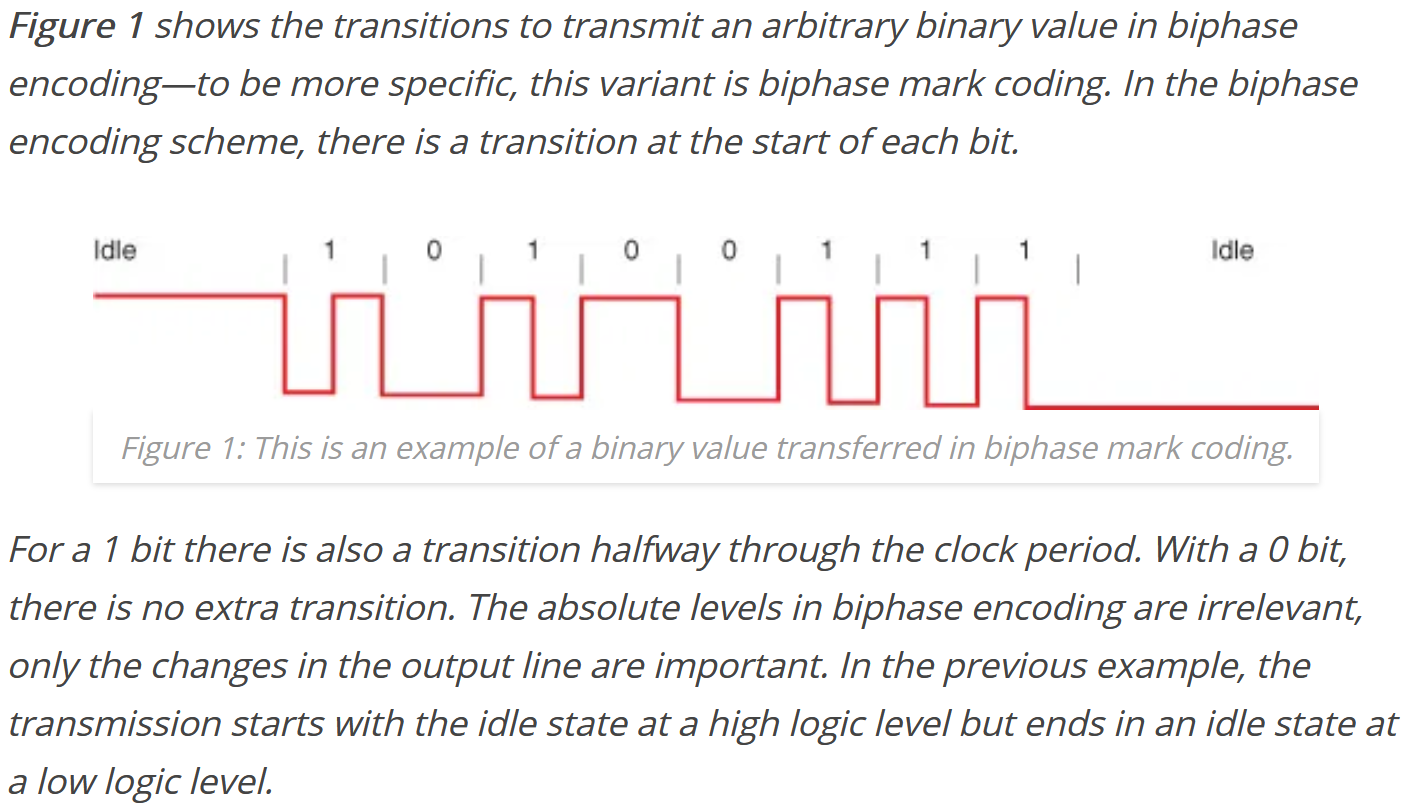
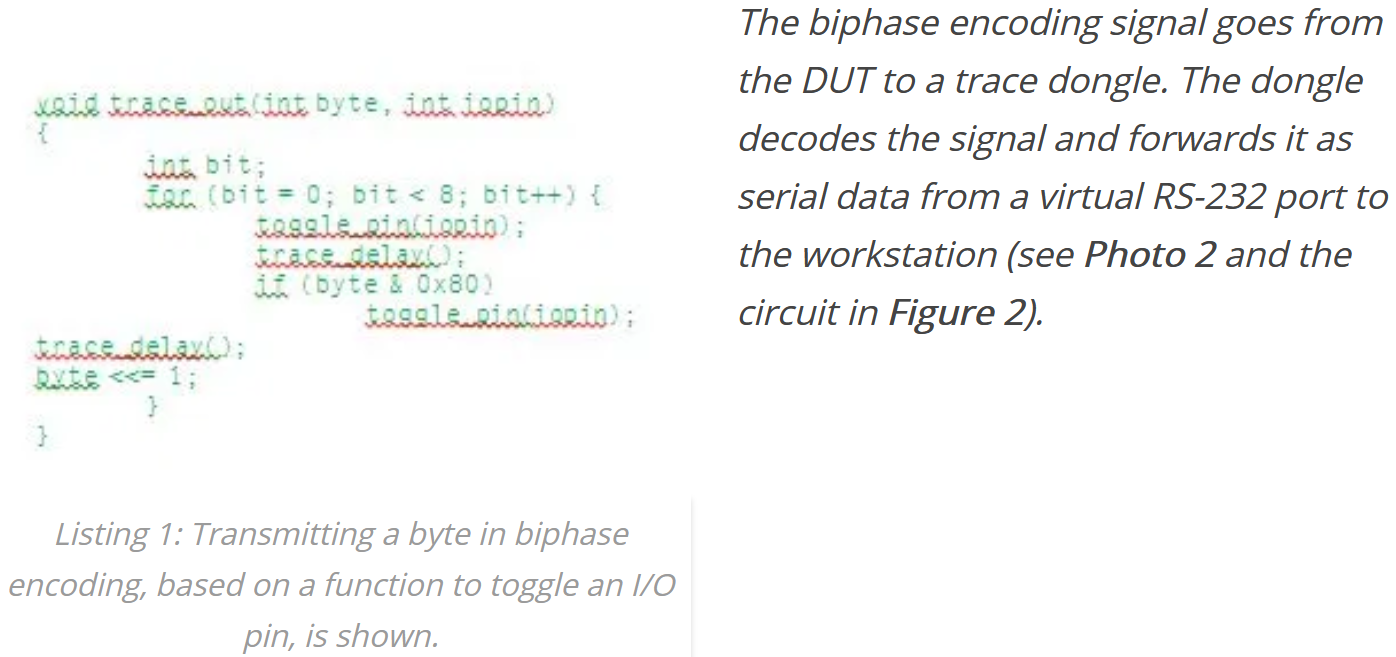
- The 2 images are taken from https://circuitcellar.com/cc-blog/a-trace-tool-for-embedded-systems/. See there for more information.
- As Trice dongle you can use any spare MCU board with an UART together with an FTDI USB converter.
- RTT is also a possible path to use - see Trice over RTT for options.
35. Trice over RTT
Allows Trice over the debug probe without using a pin or UART.
- RTT works good with a SEGGER J-Link debug probe but needs some closed source software components.
- Also ST-Link is usable for Trice logs, but maybe not parallel with debugging.
- Most investigations where done with a NUCLEO64-STM32F030R8 evaluation board which contains an on-board debug probe reflashed with a SEGGER J-Link OB software (see below).
- When using very high Trice loads over RTT for a long time, sometimes an on-board J-Link (re-flashed ST-Link) could get internally into an inconsistent state (probably internal buffer overrun), what needs a power cycle then.
- You could consider RTT over open-OCD as an alternative.
-
The default SEGGER up-buffer size is 1024 bytes, good for most cases. If not, adapt it in your triceConfig.h file AND in the SEGGER_RTT_Conf.h file: You need only one up-channel for Trice:
#define BUFFER_SIZE_UP (128) // "TRICE_DIRECT_BUFFER_SIZE" - Inside the triceDefaultConfig.h you can find some other settings recommended for the SEGGER_RTT_Conf.h file. You have to set them manually in the SEGGER_RTT_Conf.h because the SEGGER target sources do not include trice.h (and implicit triceDefaultConfig.h and triceConfig.h).
- Possible: Parallel usage of RTT direct mode with UART deferred mode. You can define
TRICE_UARTA_MIN_IDandTRICE_UARTA_MAX_IDinside triceConfig.h to log only a specific ID range over UARTA in deferred mode for example. (#446)
35.1. For the impatient (2 possibilities)
The default SEGGER tools only suport RTT channel 0.
35.1.1. Start JLink commander and connect over TCP
- JLink.exe →
connect ⏎ ⏎ S ⏎and keep it active.- You can control the target with
r[eset], g[o], h[alt]and use other commands too. 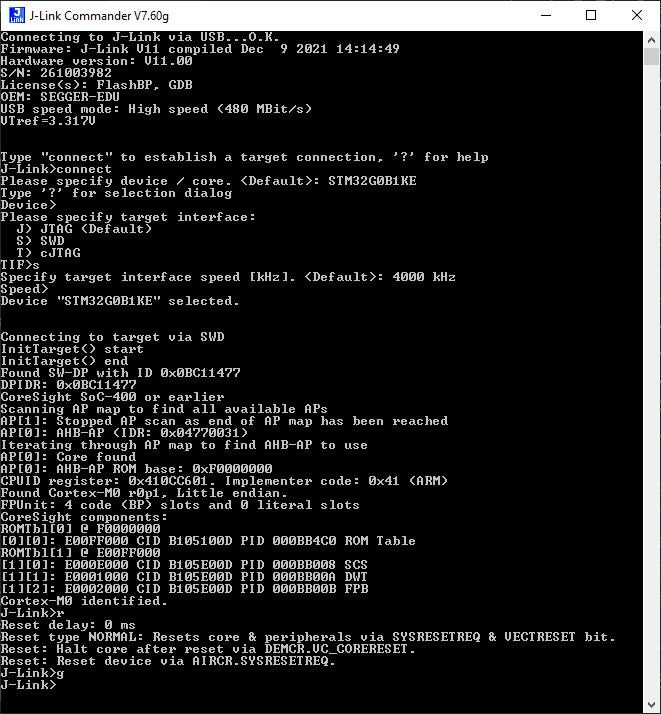
- You can control the target with
- Start in Git-Bash or something similar:
trice l -p TCP4 -args localhost:19021 - You may need a Trice tool restart after firmware reload.
<h5>Setup TCP4 server providing the trace data</h5>
This is just the SEGGER J-Link server here for demonstration, but if your target device has an TCP4 interface, you can replace this with your target server.
ms@DESKTOP-7POEGPB MINGW64 ~/repos/trice (main)
$ jlink
SEGGER J-Link Commander V7.92g (Compiled Sep 27 2023 15:36:46)
DLL version V7.92g, compiled Sep 27 2023 15:35:10

Connecting to J-Link via USB...O.K.
Firmware: J-Link STLink V21 compiled Aug 12 2019 10:29:20
Hardware version: V1.00
J-Link uptime (since boot): N/A (Not supported by this model)
S/N: 770806762
VTref=3.300V


Type "connect" to establish a target connection, '?' for help
J-Link>connect
Please specify device / core. <Default>: STM32G0B1RE
Type '?' for selection dialog
Device>
Please specify target interface:
  J) JTAG (Default)
  S) SWD
  T) cJTAG
TIF>s
Specify target interface speed [kHz]. <Default>: 4000 kHz
Speed>
Device "STM32G0B1RE" selected.


Connecting to target via SWD
InitTarget() start
SWD selected. Executing JTAG -> SWD switching sequence.
DAP initialized successfully.
InitTarget() end - Took 36.3ms
Found SW-DP with ID 0x0BC11477
DPv0 detected
CoreSight SoC-400 or earlier
Scanning AP map to find all available APs
AP[1]: Stopped AP scan as end of AP map has been reached
AP[0]: AHB-AP (IDR: 0x04770031)
Iterating through AP map to find AHB-AP to use
AP[0]: Core found
AP[0]: AHB-AP ROM base: 0xF0000000
CPUID register: 0x410CC601. Implementer code: 0x41 (ARM)
Found Cortex-M0 r0p1, Little endian.
FPUnit: 4 code (BP) slots and 0 literal slots
CoreSight components:
ROMTbl[0] @ F0000000
[0][0]: E00FF000 CID B105100D PID 000BB4C0 ROM Table
ROMTbl[1] @ E00FF000
[1][0]: E000E000 CID B105E00D PID 000BB008 SCS
[1][1]: E0001000 CID B105E00D PID 000BB00A DWT
[1][2]: E0002000 CID B105E00D PID 000BB00B FPB
Memory zones:
  Zone: "Default" Description: Default access mode
Cortex-M0 identified.
J-Link>
Now the TCP4 server is running and you can start the Trice tool as TCP4 client, which connects to the TCP4 server to receive the binary log data:
$ trice l -p TCP4 -args="127.0.0.1:19021" -til ../examples/G0B1_inst/til.json -li ../examples/G0B1_inst/li.json -d16 -pf none
In this G0B1_inst example we use the additional -d16 and -pf none switches to decode the RTT data correctly.
This is a demonstration and test for the -port TCP4 usage possibility. Using RTT with J-Link is more easy possible as shown in the next point.
35.1.2. Start using JLinkRTTLogger
- Start inside Git-Bash or something similar:
trice l -p JLINK -args "-Device STM32F030R8 -if SWD -Speed 4000 -RTTChannel 0"- Replace CLI details with your settings.
- For G0B1_inst:
trice l -p JLINK -args "-Device STM32G0B1RE -if SWD -Speed 4000 -RTTChannel 0" -d16 -pf none - You can add the
-verboseCLI switch for more details.
- You may not need a Trice tool restart after firmware reload.
35.1.3. JLinkRTTLogger Issue
- For some reason the RTT technique does not work well with Darwin (macOS) and also Linux right now. The problem seems to be that the JLinkRTTLogger app cannot work correctly in the background. But there is a workaround:
- Example 1:
- In one terminal run
JLinkRTTLogger -Device STM32G0B1RE -if SWD -Speed 4000 -RTTChannel 0 myLogFile.bin - and in another terminal execute
trice l -p FILE -args myLogFile.bin -pf none -d16.
- In one terminal run
- Example 2:
- Flash, start debugger and run to main()
- Terminal 1:
rm ./temp/trice.bin && JLinkRTTLogger -Device STM32G0B1RE -If SWD -Speed 4000 -RTTChannel 0 ./temp/trice.bin - Terminal 2:
touch ./temp/trice.bin && trice log -p FILE -args ./temp/trice.bin -prefix off -hs off -d16 -ts ms -i ../../demoTIL.json -li ../../demoLI.json -pf none - Continue to run in debugger
-
Terminal 1:
```bash th@P51-DebianKDE:~/repos/trice/examples/G0B1_inst$ rm ./temp/trice.bin && JLinkRTTLogger -Device STM32G0B1RE -If SWD -Speed 4000 -RTTChannel 0 ./temp/trice.bin SEGGER J-Link RTT Logger Compiled Dec 18 2024 15:48:21 (c) 2016-2017 SEGGER Microcontroller GmbH, www.segger.com Solutions for real time microcontroller applications
Default logfile path: /home/th/.config/SEGGER
Connected to: SEGGER J-Link ST-LINK S/N: 779220206
Searching for RTT Control Block…OK. 1 up-channels found: 0: Terminal Selected RTT Channel description: Index: 0 Name: Terminal Size: 1024 bytes.
Output file: ./temp/trice.bin
Getting RTT data from target. Press any key to quit. ————————————————————
Transfer rate: 0 Bytes/s Data written: 15.71 KB
* Terminal 2: ```bash th@P51-DebianKDE:~/repos/trice/examples/G0B1_inst$ touch ./temp/trice.bin && trice log -p FILE -args ./temp/trice.bin -prefix off -hs off -d16 -ts ms -i ../../demoTIL.json -li ../../demoLI.json -pf none triceExamples.c 12 0,000 Hello! 👋🙂 ✨✨✨✨✨✨✨✨✨✨✨✨✨✨✨✨✨ 🎈🎈🎈🎈 NUCLEO-G0B1RE 🎈🎈🎈🎈 🍃🍃🍃🍃🍃🍃🍃🍃🍃🍃🍃🍃🍃🍃🍃🍃🍃 triceExamples.c 61 TRICE_DIRECT_OUTPUT == 1, TRICE_DEFERRED_OUTPUT == 1 triceExamples.c 69 TRICE_RING_BUFFER, TRICE_MULTI_PACK_MODE triceExamples.c 76 _CYCLE == 1, _PROTECT == 1, _DIAG == 1, XTEA == 1 triceExamples.c 77 _SINGLE_MAX_SIZE=104, _BUFFER_SIZE=172, _DEFERRED_BUFFER_SIZE=2000 triceExamples.c 29 0:00:00,003 🐁 Speedy Gonzales a 32-bit timestamp triceExamples.c 30 0:00:00,003 🐁 Speedy Gonzales b 32-bit timestamp triceExamples.c 31 0:00:00,003 🐁 Speedy Gonzales c 32-bit timestamp triceExamples.c 32 0:00:00,003 🐁 Speedy Gonzales d 32-bit timestamp triceExamples.c 33 0,310 🐁 Speedy Gonzales e 16-bit timestamp triceExamples.c 34 0,328 🐁 Speedy Gonzales f 16-bit timestamp triceExamples.c 35 0,347 🐁 Speedy Gonzales g 16-bit timestamp triceExamples.c 36 0,365 🐁 Speedy Gonzales h 16-bit timestamp triceExamples.c 42 0,394 2.71828182845904523536 <- float number as string triceExamples.c 43 0,436 2.71828182845904509080 (double with more ciphers than precision) triceExamples.c 44 0,458 2.71828174591064453125 (float with more ciphers than precision) triceExamples.c 45 0,479 2.718282 (default rounded float) triceExamples.c 46 0,500 A Buffer: triceExamples.c 47 0,520 32 2e 37 31 38 32 38 31 38 32 38 34 35 39 30 34 35 32 33 35 33 36 triceExamples.c 48 0,562 31372e32 31383238 34383238 34303935 35333235 triceExamples.c 49 0,601 ARemoteFunctionName(2e32)(3137)(3238)(3138)(3238)(3438)(3935)(3430)(3235)(3533)(3633) triceExamples.c 50 3 times a 16 byte long Trice messages, which may not be written all if the buffer is too small: triceExamples.c 52 0,664 i=44444400 aaaaaa00 triceExamples.c 52 0,687 i=44444401 aaaaaa01 triceExamples.c 52 0,709 i=44444402 aaaaaa02 main.c 312 0:00:00,003 StartDefaultTask main.c 339 0:00:00,003 StartTask02:Diagnostics and TriceTransfer triceLogDiagData.c 21 RTT0_writeDepthMax=365 (BUFFER_SIZE_UP=1024) triceLogDiagData.c 44 triceSingleDepthMax = 96 of 172 (TRICE_BUFFER_SIZE) triceLogDiagData.c 75 triceRingBufferDepthMax = 0 of 2000 triceCheck.c 57 line 57 triceCheck.c 59 0:00:02,325 Hello World! triceCheck.c 61 0:00:02,405 This is a message without values and a 32-bit stamp. triceCheck.c 62 0,306 This is a message without values and a 16-bit stamp. triceCheck.c 63 This is a message without values and without stamp.- See also the configuration in ./examples/G0B1_inst/Core/Inc/triceConfig.h
- Example 1:
- If you install the
tmuxcommand your life gets esier by using a shell script like ./examples/G0B1_inst/RTTLogTmux.sh:
mkdir -p ./temp
rm -f ./temp/trice.bin
touch ./temp/trice.bin
tmux new -s "tricerttlog" -d "JLinkRTTLogger -Device STM32G0B1RE -If SWD -Speed 4000 -RTTChannel 0 ./temp/trice.bin"
trice log -p FILE -args ./temp/trice.bin -pf none -prefix off -hs off -d16 -ts16 "time:offs:%4d µs" -showID "deb:%5d" -i ../../demoTIL.json -li ../../demoLI.json -stat
tmux kill-session -t "tricerttlog"
-
Usage:
th@PaulPCdeb128KDE:~/repos/trice/examples/G0B1_inst$ ./RTTLogUnix.sh triceExamples.c 12 0,000 Hello! 👋🙂 ✨✨✨✨✨✨✨✨✨✨✨✨✨✨✨✨✨ 🎈🎈🎈🎈 NUCLEO-G0B1RE 🎈🎈🎈🎈 🍃🍃🍃🍃🍃🍃🍃🍃🍃🍃🍃🍃🍃🍃🍃🍃🍃 triceExamples.c 61 TRICE_DIRECT_OUTPUT == 1, TRICE_DEFERRED_OUTPUT == 1 triceExamples.c 69 TRICE_RING_BUFFER, TRICE_MULTI_PACK_MODE triceExamples.c 76 _CYCLE == 1, _PROTECT == 1, _DIAG == 1, XTEA == 1 triceExamples.c 77 _SINGLE_MAX_SIZE=104, _BUFFER_SIZE=172, _DEFERRED_BUFFER_SIZE=2000 triceExamples.c 29 0:00:00,002 🐁 Speedy Gonzales a 32-bit timestamp -
Hint: If you use RTTLogTmux.sh with Darwin (macOS), the “control-C” key combination seems not to work immediately. That is simply because the keyboard focus switches away after script start. Simply click into the terminal window again and then use “control-C” to terminate the Trice logging.
35.2. Segger Real Time Transfer (RTT)
- Prerequisite is a processor with memory background access support like ARM Cortex-M cores.
- If you can use a Segger J-Link or an STM ST-Link debug probe (ST Microelectronics eval boards have it) this is an easy and fast way to use Trice without any UART or other port.
- Detailed description can be found in document UM08001_JLink.pdf in chapter 16 which is part of https://www.segger.com/downloads/jlink/#J-LinkSoftwareAndDocumentationPack.
- Following examples are for Windows, but should work similar also on Linux and Darwin (macOS).
- Trice can use the Segger RTT protocol in different ways.
- Hardware paths:
- Use J-Link or J-Link OB (on-board). J-Link OB can be flashed to many ST Microelectronics evaluation boards (v2.0 link hardware) and for example is also usable with NXP and Atmel. For that you can also use a spare STM32 evaluation board (10 EUR) with jumper changes and breakout wires.
- Use ST-Link with gostlink. It uses only one USB endpoint so debugging and Trice output in parallel is not possible.
- Use some other Debug-Probe with target memory access (support welcome)
- RTT channel selection (on target and on host)
- RECOMMENDED:
trice l -p JLINKor shortertrice lfor STM32F030R8 (default port is JLINK) starts in background aJLinkRTTLogger.exewhich connects to J-Link and writes to a logfile which in turn is read by the Trice tool. On exit theJLinkRTTLogger.exeis killed automatically.- It expects a target sending messages over RTT channel 0 (zero). Chapter 16.3.3 in UM08001_JLink.pdf refers to “Up-Channel 1” but this maybe is a typo and probably a 0 is mend. The
JLinkRTTLogger.exemain advantage against other free available SEGGER tools is, that all bytes are transferred. Other SEGGER tools assume ASCII characters and useFF 00toFF 0Fas a terminal switch command and filter that out causing Trice data disturbances. - It should be possible to start several instances on on different targets using
-SelectEmuBySN <SN>inside the-argsTrice CLI switch. JLinkRTTLoggerbinaries for Linux & Darwin (macOS) can be found at https://www.segger.com/downloads/jlink/.
- It expects a target sending messages over RTT channel 0 (zero). Chapter 16.3.3 in UM08001_JLink.pdf refers to “Up-Channel 1” but this maybe is a typo and probably a 0 is mend. The
trice l -p STLINKstarts in background atrice/third_party/goST/stRttLogger.exewhich connects to ST-Link and writes to a logfile which in turn is read by the Trice tool. On exit thestRttLogger.exeis killed automatically. It expects a target sending messages over RTT channel 0 (other channels supported too but may not work).
It is possible to start several instances on different channels as well as on different targets. The source code is in https://github.com/bbnote/gostlink and should work also at least under Linux.
- If you have the choice, prefer J-Link. It allows parallel debugging and Trice output.
- The full
-argsstring is normally required and depends on the used device. Example:trice l -args="-Device STM32F070RB -if SWD -Speed 4000 -RTTChannel 0 -RTTSearchRanges 0x20000000_0x1000". The-RTTSearchRangespart is mostly optional. - Enter
trice h -logand read info for-argsswitch:
- RECOMMENDED:
- Hardware paths:
        -args string
        Use to pass port specific parameters. The "default" value depends on the used port:
        port "COMn": default="", use "TARM" for a different driver. (For baud rate settings see -baud.)
        port "J-LINK": default="-Device STM32F030R8 -if SWD -Speed 4000 -RTTChannel 0 -RTTSearchRanges 0x20000000_0x1000",
                The -RTTSearchRanges "..." need to be written without extra "" and with _ instead of space.
                For args options see JLinkRTTLogger in SEGGER UM08001_JLink.pdf.
        port "ST-LINK": default="-Device STM32F030R8 -if SWD -Speed 4000 -RTTChannel 0 -RTTSearchRanges 0x20000000_0x1000",
                The -RTTSearchRanges "..." need to be written without extra "" and with _ instead of space.
                For args options see JLinkRTTLogger in SEGGER UM08001_JLink.pdf.
        port "BUFFER": default="0 0 0 0", Option for args is any byte sequence.
         (default "default")
35.3. J-Link option
- Prerequisite is a SEGGER J-Link debug probe or a development board with an on-board J-Link option.
35.3.1. Convert Evaluation Board onboard ST-Link to J-Link
- Following steps describe the needed action for a ST Microelectronics evaluation board and windows - adapt them to your environment.
- It is always possible to turn back to the ST-Link OB firmware with the SEGGER
STLinkReflash.exetool but afterwards the ST-Link Upgrade tool should be used again to get the latest version.
<h5>First step (to do if some issues occur - otherwise you can skip it)</h5>
See also https://github.com/stlink-org/stlink
- Get & install STM32 ST-LINK utility
- Run from default install location
"C:\Program Files (x86)\STMicroelectronics\STM32 ST-LINKUtility\ST-LINK Utility\ST-LinkUpgrade.exe") - Enable checkbox
Change Typeand select radio buttonSTM32 Debug+Mass storage + VCP. TheSTM32Debug+ VCPwon´t be detected by Segger reflash utility.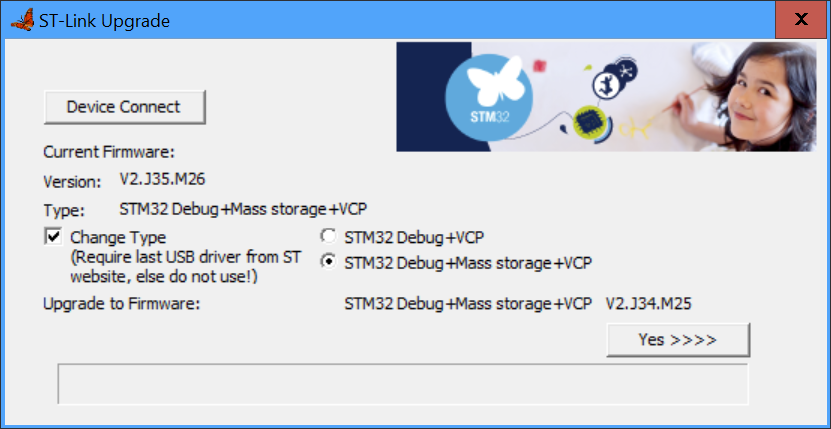
- Check Converting ST-LINK On-Board Into a J-Link
- Use
STLinkReflash.exeto convert NUCLEO from ST-Link on-board to J-Link on-board.STM32 Debug+ VCPwon´t be detected by Segger reflash utility.
35.3.2. Some SEGGER tools in short
- Download J-Link Software and Documentation Pack and install.
- You may need to add
C:\Program Files\SEGGER\JLinkto the %PATH% variable.
- You may need to add
- Tested with NUCLEO64-STM32F030R8 evaluation board.
- For example: Compile and flash
../examples/F030_instproject.- Check in ../examples/F030_inst/Core/Inc/triceConfig.h if
#define TRICE_RTT_CHANNEL 0is set as output option.
- Check in ../examples/F030_inst/Core/Inc/triceConfig.h if
JLink.exeis the SEGGER J-Link commander. It starts the J-Link driver/server and one can connect to it- Info found here:
- J-Link Commander can be started with different command line options for test and automation
- purposes. In the following, the command line options which are available for J-Link
- Commander are explained. All command line options are case insensitive.
- Command Explanation
- -AutoConnect Automatically start the target connect sequence
- -CommanderScript Passes a CommandFile to J-Link
- -CommandFile Passes a CommandFile to J-Link
- -Device Pre-selects the device J-Link Commander shall connect to
- -ExitOnError Commander exits after error.
- -If Pre-selects the target interface
- -IP Selects IP as host interface
- -JLinkScriptFile Passes a JLinkScriptFile to J-Link
- -JTAGConf Sets IRPre and DRPre
- -Log Sets logfile path
- -RTTTelnetPort Sets the RTT Telnetport
- -SelectEmuBySN Connects to a J-Link with a specific S/N over USB
- -SettingsFile Passes a SettingsFile to J-Link
- -Speed Starts J-Link Commander with a given initial speed
- Documentation: https://kb.segger.com/J-Link_Commander
- If you run successful
jlink -device STM32F030R8 -if SWD -speed 4000 -autoconnect 1the target is stopped.- To let in run you need manually execute
goas command in the open jlink window. - To automate that create a text file named for example
jlink.gocontaining thegocommand:echo go > jlink.goand do ajlink -device STM32F030R8 -if SWD -speed 4000 -autoconnect 1 -CommandFile jlink.go
- To let in run you need manually execute
- It is possible to see some output with Firefox (but not with Chrome?) for example:
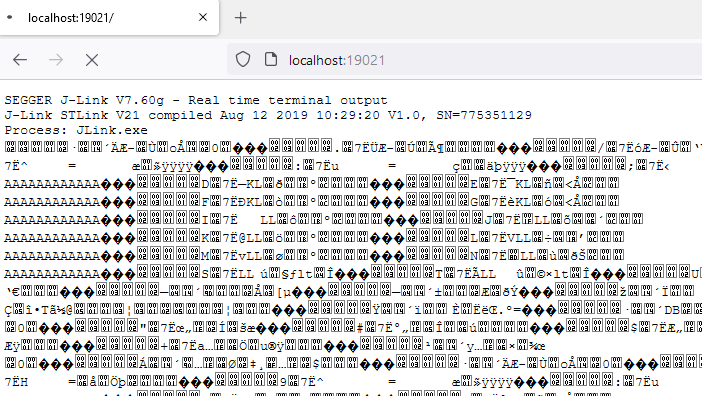 .
. - After closing the Firefox the Trice tool can connect to it too:
- Open a commandline and run:
trice log -port TCP4 -args localhost:19021- Trice output is visible
- With
halt andgo inside the Jlink window the MCU can get haltes and released - It is possible in parallel to debug-step with a debugger (tested with ARM-MDK)
- Open a commandline and run:
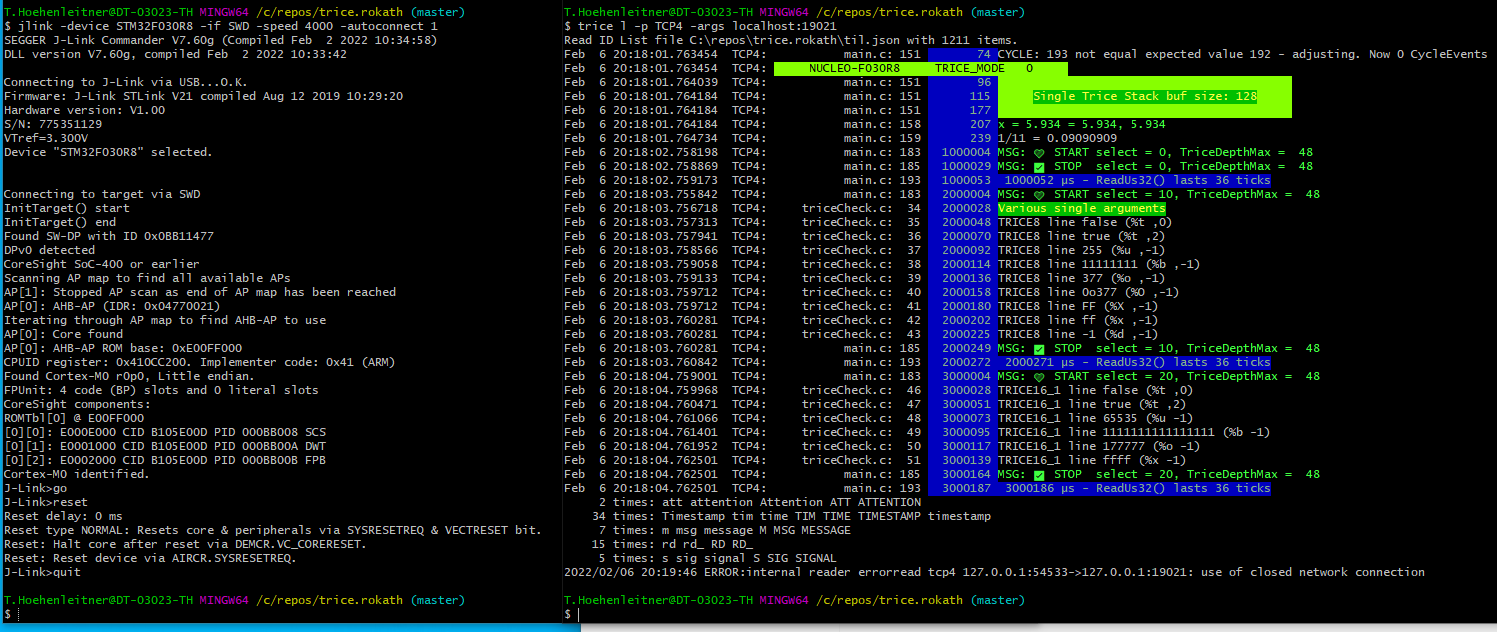
- PLUS:
- Works reliable.
- No file interface needed.
- Trice can connect over TCP localhost:19021 and display logs over RTT channel 0.
- The open
jlinkCLI can be handy to control the target:[r]eset, [g]o. [h]alt - No need to restart the Trice tool after changed firmware download.
- MINUS:
- Uses RTT up-channel 0 and therefore RTT up-channel 0 is not usable differently.
- No down-channel usable.
- Needs a separate manual start of the
jlinkbinary with CLI parameters.- I would not recommend to automate that too, because this step is needed only once after PC power on.
JLinkRTTLogger.exeis a CLI tool and connects via the SEGGER API to the target. It is usable for writing RTT channel 0 data from target into a file.- PLUS:
- Works reliable.
- Is automatable.
- Create file with raw log data:
JLinkRTTLogger.exe -Device STM32F030R8 -if SWD -Speed 4000 -RTTChannel 0 triceRaw.log- It is possible to evaluate this file offline:
trice l -p FILE -args triceRaw.log 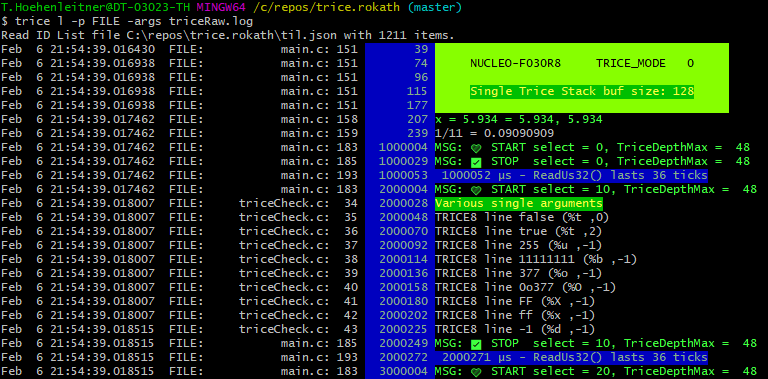
- It is possible to evaluate this file offline:
- No need to restart the Trice tool after changed firmware download.
- MINUS:
- Logs in a file, so the Trice tool needs to read from that file.
- Maybe cannot write in a file as background process on Darwin (macOS).
- The Trice tool can watch the output file and display the Trices: `trice log -port JLINK -args “-Device STM32F030R8 -if SWD -Speed 4000 -RTTChannel 0”
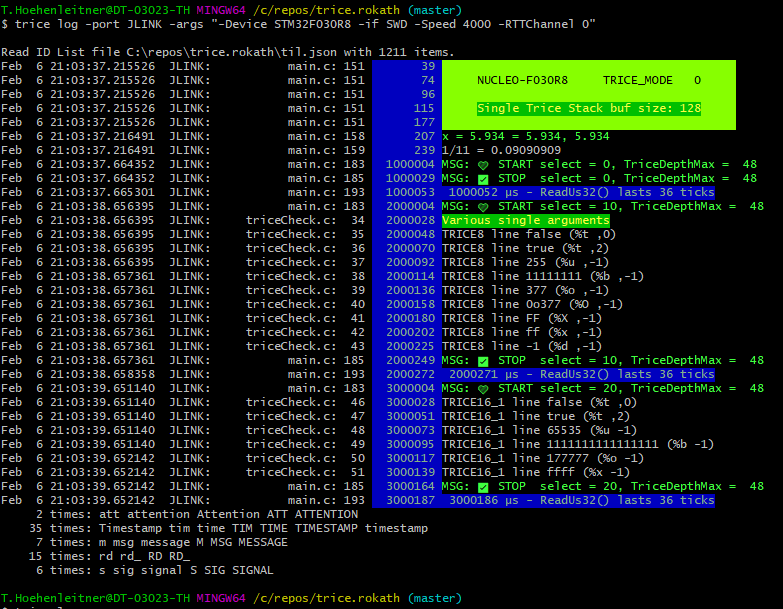
35.3.3. JLinkRTTClient.exe
JLinkRTTClient.execan be used for simple text transmitting to the target, it also displays strings from target coming over channel 0. It is not used by the Trice tool.- PLUS:
- Target stimulation with proprietary protocol over RTT down-channel 0 possible.
- MINUS:
- Unfortunately it cannot run separately parallel to stimulate the target with any proprietary protocol because it connects to localhost:19021 and therefore blockades the only one possible connection.
- PLUS:
35.3.4. JLinkRTTViewer.exe
JLinkRTTViewer.exeis a GUI tool and connects via the SEGGER API to the target. It expects ASCII codes and is not used by the Trice tool. The switching between the 16 possible terminals is done viaFF 00…FF 0F. These byte pairs can occur inside the Trice data.
35.4. Segger RTT
- The main advantages are:
- Speed
- No
TriceTransfer()nor any interrupt is needed in the background - No UART or other output is needed
- This is, because automatically done by SeggerRTT. This way one can debug code as comfortable as with
printf()but with all the TRICE advantages. Have a look here: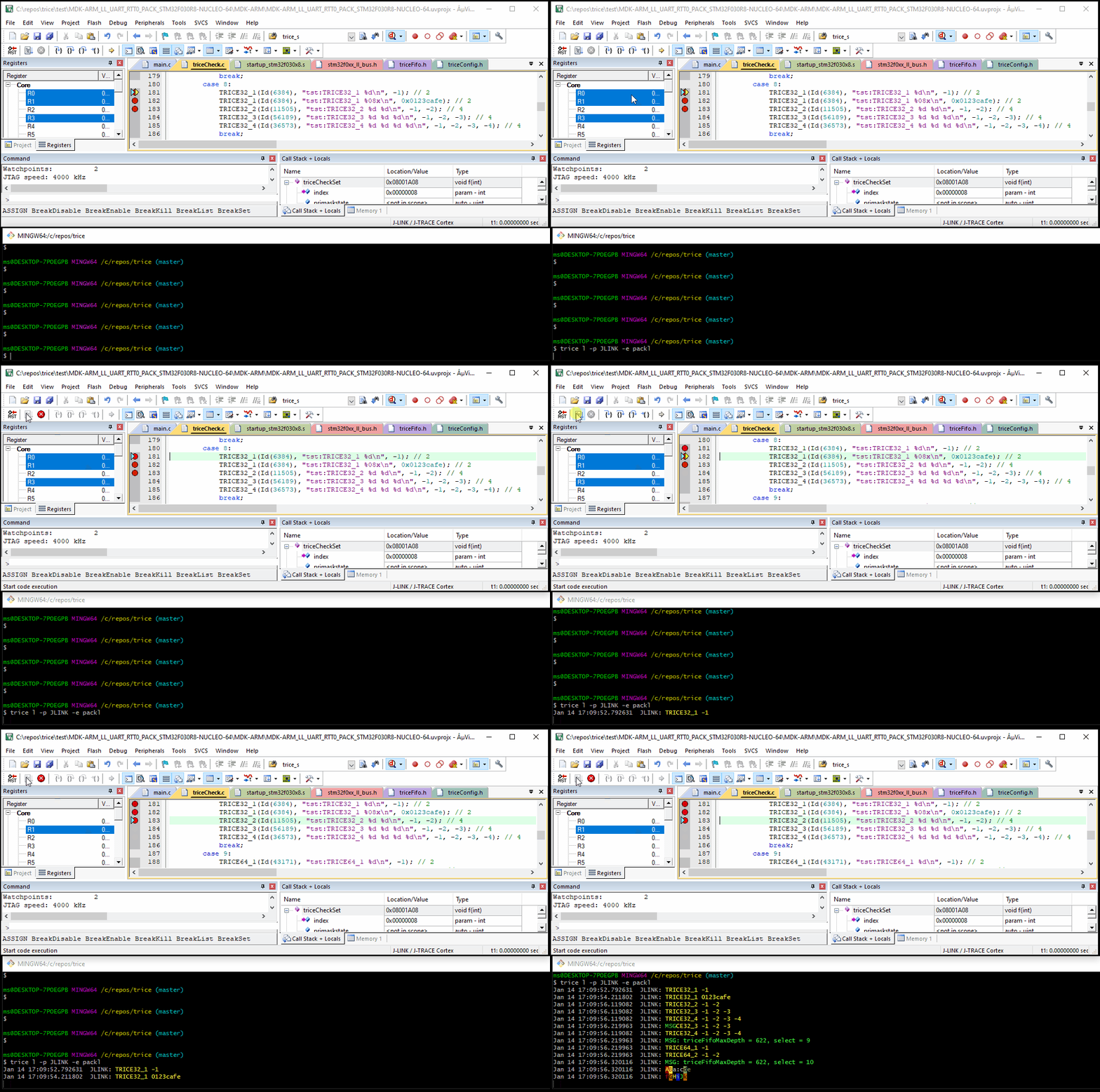
- Avoid Trice buffering inside target and write with TRICE macro directly into the RTT buffer (direct Trice mode =
#define TRICE_MODE 0inside triceConfig.h). -
Write the bytes per Trice directly (little time & some space overhead on target, but no changes on host side)

35.5. Segger J-Link SDK (~800 EUR) Option
- Segger offers a SeggerRTT SDK which allows to use more than just channel 0 and you can develop your own tooling with it.
- The
trice -port JLINKis ok for usage as is right now. However if you wish more comfort check here: - Question: How-to-access-multiple-RTT-channels
- “Developer pack used to write your own program for the J-Link. Please be sure you agree to the terms of the associated license found on the Licensing Information tab before purchasing this SDK. You will benefit from six months of free email support from the time that this product is ordered.”
- The main Segger J-Link SDK disadvantage beside closed source and payment is: One is not allowed to distribute binaries written with the SDK. That makes it only interesting for company internal automatization.
35.6. Additional Notes (leftovers)
Downloading RTT target packagefrom https://www.segger.com/products/debug-probes/j-link/technology/about-real-time-transfer/.- Read the manual UM08001_JLink.pdf.
- The stored RTT source package is SEGGER_RTT_V812a.zip. See Third-party packages and retained versions before changing target sources.
- Add
SEGGER_RTTI.cto target project
35.7. Further development
- Check OpenOCD!
- Use OpenOCD and its built-in RTT feature. OpenOCD then starts a server on localhost:17001 where it dumps all RTT messages.
- The GoST project offers a way bypassing JLINK. Used -port STLINK instead.
- Maybe
libusbtogether withlibjaylinkoffer some options too. - Checkout https://github.com/deadsy/jaylink.
-
"C:\Program Files (x86)\SEGGER\JLink\JMem.exe"shows a memory dump. - Go to https://libusb.info/
- -> Downloads -> Latest Windows Binaries
- extract
libusb-1.0.23(or later version)
libusb-1.0.23\examples\bin64> .\listdevs.exe
2109:2811 (bus 2, device 8) path: 6
1022:145f (bus 1, device 0)
1022:43d5 (bus 2, device 0)
0a12:0001 (bus 2, device 1) path: 13
1366:0105 (bus 2, device 10) path: 5
- Repeat without connected Segger JLink
libusb-1.0.23\examples\bin64> .\listdevs.exe
2109:2811 (bus 2, device 8) path: 6
1022:145f (bus 1, device 0)
1022:43d5 (bus 2, device 0)
0a12:0001 (bus 2, device 1) path: 13
- In this case
1366:0105 (bus 2, device 10) path: 5is missing, sovid=1366,did=0105as example - On Windows install WSL2. The real Linux kernel is needed for full USB access.
35.8. NUCLEO-F030R8 example
Info: https://www.st.com/en/evaluation-tools/nucleo-F030r8.html
35.8.1. RTT with original on-board ST-LINK firmware
#define TRICE_RTT_CHANNEL 0:- If you use a NUCLEO-F030R8 with the original ST-Link on board after firmware download enter:
trice l -p ST-LINK -args "-Device STM32F030R8 -if SWD -Speed 4000 -RTTChannel 0 -RTTSearchRanges 0x20000000_0x2000". After pressing the reset button output becomes visible: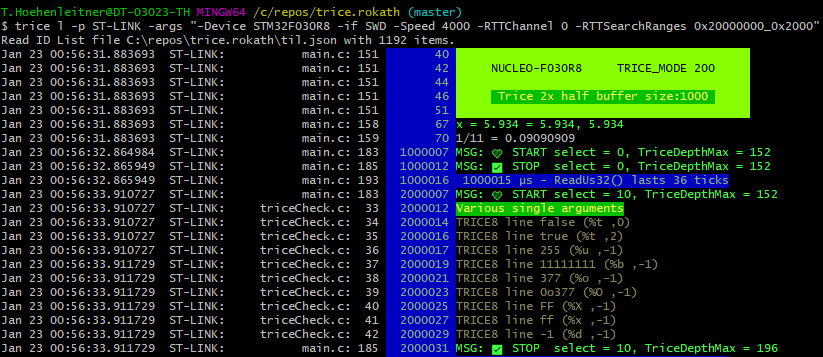
- It works with both ST-Link variants (with or without mass storage device.)
35.8.2. Change to J-LINK onboard firmware
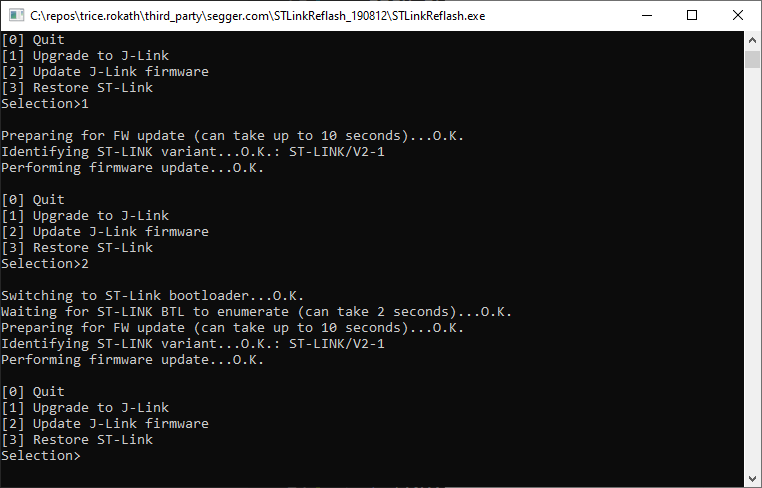
35.8.3. RTT with J-LINK firmware on-board
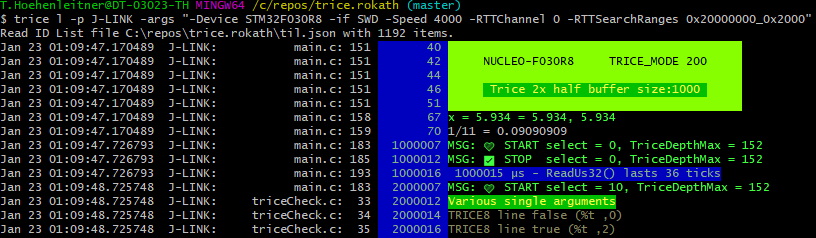
- Observations:
- When pressing the black reset button, you need to restart the Trice tool.
- When restarting the Trice tool, a target reset occurs.
- Other channel numbers than
0seam not to work for some reason.
35.9. Possible issues
- These boards seem not to work reliable with RTT over J-Link on-board firmware.
- NUCLEO-G071RB
- NUCLEO_G031K8
- After flashing back the ST-LINK OB firmware with the SEGGER tool, it is recommended to use the ST tool to update the ST-LINK OB firmware. Otherwise issues could occur.
35.10. OpenOCD with Darwin (macOS)
- OpenOCD on macOS works out of the box after installing it.
- When using VS code with Cortex-Debug you cannot use OpenOCD at the same time.
- The
openocd.cfgfile is taylored to the flashed on-board J-Link adapter.
Terminal 1:
brew install open-ocd
...
cd ./trice/examples/G0B1_inst
openocd -f openocd.cfg
Open On-Chip Debugger 0.12.0
Licensed under GNU GPL v2
For bug reports, read
    http://openocd.org/doc/doxygen/bugs.html
srst_only separate srst_nogate srst_open_drain connect_deassert_srst

Info : Listening on port 6666 for tcl connections
Info : Listening on port 4444 for telnet connections
Info : J-Link STLink V21 compiled Aug 12 2019 10:29:20
Info : Hardware version: 1.00
Info : VTarget = 3.300 V
Info : clock speed 2000 kHz
Info : SWD DPIDR 0x0bc11477
Info : [stm32g0x.cpu] Cortex-M0+ r0p1 processor detected
Info : [stm32g0x.cpu] target has 4 breakpoints, 2 watchpoints
Info : starting gdb server for stm32g0x.cpu on 3333
Info : Listening on port 3333 for gdb connections
Info : rtt: Searching for control block 'SEGGER RTT'
Info : rtt: Control block found at 0x20001238
Info : Listening on port 9090 for rtt connections
Channels: up=1, down=0
Up-channels:
0: Terminal 1024 0
Down-channels:

Info : Listening on port 6666 for tcl connections
Info : Listening on port 4444 for telnet connections
Terminal 2:
ms@MacBook-Pro G0B1_inst % trice l -p TCP4 -args localhost:9090  -pf none -d16
Nov 14 17:32:33.319451  TCP4:       triceExamples.c    10        0_000  Hello! 👋🙂
Nov 14 17:32:33.319463  TCP4:
Nov 14 17:32:33.319463  TCP4:         ✨✨✨✨✨✨✨✨✨✨✨✨✨✨✨✨✨
Nov 14 17:32:33.319463  TCP4:         🎈🎈🎈🎈  NUCLEO-G0B1RE   🎈🎈🎈🎈
Nov 14 17:32:33.319463  TCP4:         🍃🍃🍃🍃🍃🍃🍃🍃🍃🍃🍃🍃🍃🍃🍃🍃🍃
Nov 14 17:32:33.319463  TCP4:
Nov 14 17:32:33.319463  TCP4:
Nov 14 17:32:33.406455  TCP4:       triceExamples.c    16        0_037 2.71828182845904523536 <- float number as string
Nov 14 17:32:33.505116  TCP4:       triceExamples.c    17        0_087 2.71828182845904509080 (double with more ciphers than precision)
Nov 14 17:32:33.607518  TCP4:       triceExamples.c    18        0_117 2.71828174591064453125 (float  with more ciphers than precision)
Nov 14 17:32:33.707851  TCP4:       triceExamples.c    19        0_146 2.718282 (default rounded float)
Nov 14 17:32:33.807685  TCP4:       triceExamples.c    20        0_175 A Buffer:
Nov 14 17:32:33.908202  TCP4:       triceExamples.c    21        0_204 32 2e 37 31 38 32 38 31 38 32 38 34 35 39 30 34 35 32 33 35 33 36
Nov 14 17:32:34.007148  TCP4:       triceExamples.c    22        0_254 31372e32  31383238  34383238  34303935  35333235
Nov 14 17:32:35.007949  TCP4:       triceExamples.c    23        0_301 ARemoteFunctionName(2e32)(3137)(3238)(3138)(3238)(3438)(3935)(3430)(3235)(3533)(3633)
Nov 14 17:32:35.112304  TCP4:       triceExamples.c    24              100 times a 16 byte long Trice messages, which not all will be written because of the TRICE_PROTECT:
Nov 14 17:32:35.307567  TCP4:       triceExamples.c    26        0_379 i=44444400 aaaaaa00
Nov 14 17:32:35.408257  TCP4:       triceExamples.c    27    0,000_002 i=44444400 aaaaaa00
Nov 14 17:32:35.509022  TCP4:       triceExamples.c    26        0_441 i=44444401 aaaaaa01
Nov 14 17:32:35.609439  TCP4:       triceExamples.c    27    0,000_002 i=44444401 aaaaaa01
Nov 14 17:32:35.710201  TCP4:       triceExamples.c    26        0_504 i=44444402 aaaaaa02
...
35.11. SEGGER J-Link on Darwin (macOS)
TODO: Working example with SEGGER_RTT J-Link and Open OCD
35.12. Links
- USB over WSL2? (Maybe intersting for OpenOCD)
- https://kickstartembedded.com/2024/03/26/openocd-one-software-to-rule-debug-them-all/?amp=1
- https://mcuoneclipse.com/2021/10/03/visual-studio-code-for-c-c-with-arm-cortex-m-part-9-rtt/
36. Writing the Trice logs into an SD-card (or a user specific output)
- Enable
TRICE_DEFERRED_AUXILIARY8in your project specific triceConfig.h file. - Enabling
TRICE_DEFERRED_AUXILIARY8is possible parallel to any direct and/or deferred output. - The
TRICE_DEFERRED_OUT_FRAMINGvalue is used also for the deferred auxiliary writes. - Consider the value for
TRICE_DEFERRED_TRANSFER_MODE. TheTRICE_SINGLE_PACK_MODEwould trigger a file write function on each single Trice message. -
Provide a self-made function like this:
/// mySDcardWrite performs SD-card writing by appending to file myTriceLogs.bin. mySDcardWrite(const uint8_t* buf, size_t bufLen){ ... } /// Assign this function pointer accordingly. UserNonBlockingDeferredWrite8AuxiliaryFn = mySDcardWrite; - If the SD-card write is more effective using 32-bits chunks, consider
TRICE_DEFERRED_AUXILIARY32, what is recommended also if you use the encryption option.TRICE_DEFERRED_AUXILIARY32writes whole 32-bit words and pads the last word with zero bytes when needed.
- There maybe use cases for
TRICE_DIRECT_AUXILIARY8orTRICE_DIRECT_AUXILIARY32, but consider the max write time. - Placing the files til.json and li.json anto the SD-card as well might be meaninjful.
-
To decode myTriceLogs.bin later
trice log -port FILEBUFFER -args myTriceLogs.bin -hs off
Related issues/discussions: #253 #405 #425 #447 #537
37. Trice Target Code Implementation
37.1. TRICE Macro structure
37.1.1. TRICE_ENTER
- Optionally disable interrupts.
- Prepare
TriceBufferWritePositionand keep its initial value.
37.1.2. TRICE_PUT
- Use and increment
TriceBufferWritePosition.
37.1.3. TRICE_LEAVE
- Use
TriceBufferWritePositionand its initial value for data transfer - Optionally restore interrupt state.
37.2. TRICE_STACK_BUFFER
TRICE_ENTER: Allocate stackTRICE_LEAVE: Call TriceDirectOut()
37.3. TRICE_STATIC_BUFFER
- This is like
TRICE_STACK_BUFFERbut avoids stack allocation, what is better for many stacks. TRICE_ENTER: Set TriceBufferWritePosition to buffer start.TRICE_LEAVE: Call TriceDirectOut().
37.4. TRICE_DOUBLE_BUFFER
TRICE_ENTER: Keep TriceBufferWritePosition.TRICE_LEAVE: Optionally call TriceDirectOut().
37.5. TRICE_RING_BUFFER
TRICE_ENTER: Keep or wrap TriceBufferWritePosition and add offset.TRICE_LEAVE: Optionally call TriceDirectOut().
The TRICE_RING_BUFFER allocates incremental ring buffer space and each trice location is read by a deferred task.
37.6. Deferred Out
37.6.1. Double Buffer
- TriceTransfer
- TriceOut
- TriceNonBlockingWrite( triceID, enc, encLen );
37.6.2. Ring Buffer
- TriceTransfer
- lastWordCount = TriceSingleDeferredOut(addr);
- int triceID = TriceIDAndBuffer( pData, &wordCount, &pStart, &Length );
- TriceNonBlockingWrite( triceID, pEnc, encLen );
- lastWordCount = TriceSingleDeferredOut(addr);
37.6.3. Local Deferred Text Log
Local deferred logging keeps every time-critical Trice producer binary and
short, but turns complete records into plain text later on the target. A common
use is a low-priority FreeRTOS logging task which writes to UART, USB, a file,
or an existing application console without a host-side trice log process.
tasks and interrupts
        |
        | trice(...)
        v
ring or double buffer containing ordinary binary Trice records
        |
        | one background consumer
        v
TriceLog(applicationBuffer, applicationBufferSize)
        |
        v
application UART, USB, file, or console writer
TriceLog() and TriceTransfer() are alternative consumers of the same
deferred buffer. Never call both for one buffer. The producer-side wire format,
the normal host decoder, til.json, and existing trice insert/trice bind
workflows are unchanged.
Basic configuration
Applications set local-log options in their ordinary triceConfig.h. The
library defaults and the detailed description of every switch live in
src/triceLogDefaultConfig.h; applications do not copy or edit that file.
#define TRICE_BUFFER TRICE_RING_BUFFER
#define TRICE_DEFERRED_OUTPUT 1
#define TRICE_DIRECT_OUTPUT 0
#define TRICE_LOCAL_LOG 1
TRICE_DOUBLE_BUFFER is supported as an alternative. Producer tasks and
interrupts still only append compact records. Formatting begins when the
background consumer calls TriceLog().
Local formatting needs an ID-to-format table in the target build. First make
source IDs authoritative with either trice bind or legacy trice insert,
then generate a table containing only the currently selected sources:
trice bind -src <source> -til til.json
# Alternatively: trice insert -src <source> -til til.json

trice generate -src <source> -til til.json -logC
Repeat -src for additional files or directories. Bind sidecars are read from
./generated by default; specify -genDir for a different sidecar
directory. Bare -logC writes ./generated/til.c; -logC=build/til.c chooses an explicit location. -logC and -abc are separate generator modes and cannot be used
together.
The generated C file includes compile-time guards derived from its Trice type,
format string, and payload width. It therefore uses the same local-log switches
as the formatter. A disabled capability removes the affected format strings
from the compiled target image; regenerating til.c for every option change is
not required. Regeneration is required after source IDs, Trice types, or format
strings change.
Configuration switches
The switches are deliberately independent of any printf implementation. Their
names are similar to familiar nanoprintf choices where useful, but Trice neither
includes nanoprintf nor defines NANOPRINTF_* macros.
| Switch | Default | Effect when set to 1 |
|---|---|---|
TRICE_LOCAL_LOG |
0 |
Includes the local consumer and formatter. |
TRICE_LOCAL_LOG_USE_PRINTF_HOOK |
1 |
Declares and uses the runtime UserTriceLogPrintfFn hook. |
TRICE_LOCAL_LOG_USE_MINIMAL_FORMATTER |
1 |
Includes the separate exact %d/%x fallback. |
TRICE_LOCAL_LOG_USE_FIELD_WIDTH_FORMAT_SPECIFIERS |
1 |
Accepts fixed widths such as %8d, %02x, and %-12s. |
TRICE_LOCAL_LOG_USE_PRECISION_FORMAT_SPECIFIERS |
1 |
Accepts fixed precision such as %.3f and %.5s. |
TRICE_LOCAL_LOG_USE_FLOAT_FORMAT_SPECIFIERS |
1 |
Accepts %e, %E, %f, %F, %g, and %G through the hook. |
TRICE_LOCAL_LOG_USE_64_BIT_VALUES |
1 |
Includes 64-bit integer, buffer, and aDouble() paths. |
TRICE_LOCAL_LOG_USE_BINARY_FORMAT_SPECIFIERS |
0 |
Includes Trice’s internal %b conversion. |
TRICE_LOCAL_LOG_USE_ALT_FORM_FLAG |
1 |
Accepts #, including the internal %#b prefix. |
TRICE_LOCAL_LOG_USE_EXTENDED_FORMAT_SPECIFIERS |
0 |
Includes internal %O, %t, %p, and %q conversions. |
TRICE_LOCAL_LOG_USE_DYNAMIC_STRING_TRICES |
1 |
Includes bounded triceS and string-form triceN. |
TRICE_LOCAL_LOG_USE_BUFFER_TRICES |
0 |
Includes TRICE8_B through TRICE64_B. |
TRICE_LOCAL_LOG_USE_PREFIX_HOOK |
0 |
Declares and calls UserTriceLogPrefixFn before each message body. |
TRICE_LOCAL_LOG_USE_ANSI_COLORS |
0 |
Colors records which begin with a recognized Trice tag. |
TRICE_LOCAL_LOG_STRIP_LOWER_CASE_TAGS |
0 |
Removes a recognized all-lower-case tag and its first colon. |
TRICE_LOCAL_LOG_KEEP_DISABLED_IDS |
1 |
Keeps ID and shape metadata, but no string, for disabled generated entries. |
Every switch is Boolean and invalid values fail during preprocessing. Defaults preserve the original local-log integer, string, width, precision, float, and 64-bit capabilities. The newer binary, extended, buffer, and prefix paths are opt-in so an existing target does not acquire avoidable code or data.
TRICE_LOCAL_LOG_KEEP_DISABLED_IDS == 1 lets TriceLog() distinguish a known
ID whose formatter feature is off from an absent or obsolete ID. It returns
TRICE_LOG_ERR_FEATURE_DISABLED for the former. Set it to 0 for the smallest
table; such an ID then returns TRICE_LOG_ERR_ID because its row is absent.
Optional tag presentation
The two presentation switches are independent. With both set to 0, local
logging returns exactly the formatted record body as before. Enabling only
TRICE_LOCAL_LOG_STRIP_LOWER_CASE_TAGS changes msg:Hello to Hello, but
keeps MSG:Hello, Message:Hello, and unknown project:Hello prefixes. The
test is an exact match against a recognized built-in alias; arbitrary text
before a colon is never removed.
Enabling only TRICE_LOCAL_LOG_USE_ANSI_COLORS retains the tag and surrounds
the complete record body with its matching ANSI Select Graphic Rendition
sequence. Enabling both removes a recognized lower-case tag and colors the
remaining body. A reset is inserted before trailing CR and LF bytes in every
record. Color state therefore never crosses a TriceLog() call, even when
several tasks produce records or the consumer encounters an error. An optional
prefix hook remains outside the colored body.
The target alias and palette table is in src/triceLogAnsi.c. It intentionally
mirrors the established host hints in
internal/emitter/lineTransformerANSI.go instead of generating a target
dependency on Go. Reciprocal comments in those files identify the manual,
optional synchronization point. User-defined host labels and host log-level
filtering are not part of local presentation. Applications which compile an
explicit source list must add triceLogAnsi.c when either presentation switch
is enabled; source-wildcard builds already pick it up with the other Trice C
files.
ANSI bytes are ordinary output bytes. A compatible serial terminal interprets
them as colors, while a redirected file retains the escape sequences. Disable
the color switch for consumers which require plain text. When both presentation
switches are off, the separately compiled triceLogAnsi.c contributes neither
code nor its alias and palette strings, even without link-time optimization.
Selecting a printf implementation
The optional hook has the snprintf contract:
typedef int (*TriceLogPrintfFn_t)(
    char *buffer,
    size_t size,
    const char *format,
    ...);
When hook support is enabled, install the function before consuming records:
#include <stdio.h>
#include "trice.h"

UserTriceLogPrintfFn = snprintf;
Possible implementations include a system or C-library snprintf, newlib,
picolibc, nanoprintf, eyalroz/printf, and an snprintf-compatible adapter
around stb_sprintf. The hook must return the number of bytes which would have
been written without the final NUL, including when its destination is too
small. A negative hook result becomes TRICE_LOG_ERR_PRINTF.
Trice calls the hook once per ordinary scalar conversion. It does not build an
argument array. This keeps stack use independent of the number of values and
lets the user formatter handle its normal %d, %u, %x, or float path. The
following features are deliberately handled inside Trice and never delegated:
- bounded dynamic
%s, because the binary payload has a length but no required trailing NUL; %b, because it is not portable across printf implementations;%O,%t,%p, and%q, because Trice host semantics differ from standard C printf implementations;- repeated Buffer-Trice iteration and prefix placement.
The small internal formatter lives in triceLogMinimal.c, separately from the
record decoder. With TRICE_LOCAL_LOG_USE_MINIMAL_FORMATTER == 1, a null printf
hook supports only exact %d and lowercase %x. Set the option to 0 when an
external hook is always installed. The fallback then contributes no code even
without LTO. Literal text, %%, and enabled dynamic strings need neither
formatter implementation.
For nanoprintf, configure both layers consistently. For example, float output
needs both TRICE_LOCAL_LOG_USE_FLOAT_FORMAT_SPECIFIERS == 1 and
NANOPRINTF_USE_FLOAT_FORMAT_SPECIFIERS == 1. Trice’s field-width, precision,
64-bit, and alternative-form switches describe what records Trice retains and
accepts; the corresponding nanoprintf switches describe what the selected hook
can actually print. Trice’s internal %b does not require nanoprintf binary
support.
Formatter families
With a printf hook, ordinary fixed scalar Trices support %d, %i, %u,
%o, %x, %X, and %c. Constant flags, widths, and precisions are passed to
the hook when their Trice switches are enabled. Source integer length modifiers
are normalized to the long or long long argument supplied by Trice. Dynamic
* width or precision remains unsupported because it would consume an
additional argument which is not represented as a separate Trice value.
TRICE_LOCAL_LOG_USE_BINARY_FORMAT_SPECIFIERS adds %b. The formatter supports
fixed width, precision, zero padding, left alignment, and the 0b prefix for
%#b when the related switches are enabled.
TRICE_LOCAL_LOG_USE_EXTENDED_FORMAT_SPECIFIERS adds the established host
meanings:
%Oprints octal with a0oprefix;%tprintstrueorfalse;%pprints the transported fixed-width value as lowercase hexadecimal, not a C pointer;#adds0xlocally;- scalar
%qprints a quoted character and dynamic%qprints an escaped, quoted string.
TRICE_LOCAL_LOG_USE_DYNAMIC_STRING_TRICES accepts exactly one %s, or one
%q when extended formats are enabled, in a dynamic string record. The encoded
payload length is always the read boundary. An embedded NUL in an explicitly
sized triceN retains normal string semantics and ends visible text early.
Fixed width, precision, and left alignment are supported when enabled. Wide
strings and multiple dynamic conversions are rejected.
Buffer Trices use one scalar item conversion:
uint16_t samples[] = {1u, 0x2au, 0x1234u};
TRICE16_B("buffer:%04x \n", samples, 3u);
Text through the first colon is written once. The remainder, without its final newline, is repeated for each aligned payload element; one newline is appended after all elements. The configured item conversion and its payload width must also be enabled. The record stays at its ring- or double-buffer location while the elements are interpreted.
For floating point, retain the established source convention:
trice32("float:value=%.3f\n", aFloat(valueF));
trice64("float:value=%.9f\n", aDouble(valueD));
Trice reconstructs aFloat() from 32 payload bits and aDouble() from 64 bits,
then passes a promoted double to the hook. %f, %F, %e, %E, %g, and
%G are accepted. Float formats need hook support; aDouble() additionally
needs 64-bit support. The selected hook controls decimal rendering quality and
its Flash cost.
Dynamic function (F) and ABC records are not local text records and remain
unsupported. Other deliberate exclusions are %n, dynamic *, wide %lc and
%ls, byte-slice %x/% x formatting of dynamic string records, host
log-level filtering, user-defined host labels, and host-side location
presentation. These restrictions apply only to TriceLog() and its generated
target table; they do not remove the corresponding records or decoder behavior
from normal binary logging.
Optional prefix hook
An application can prepend presentation data without adding it to every format string:
#define TRICE_LOCAL_LOG_USE_PREFIX_HOOK 1

static int LocalPrefix(
    char *buffer,
    size_t size,
    uint16_t id,
    uint8_t stampBits,
    uint32_t stamp) {
    return snprintf(buffer, size, "[%u:%lu] ",
                    (unsigned)id, (unsigned long)stamp);
}

UserTriceLogPrefixFn = LocalPrefix;
The hook receives the parsed ID and raw stamp facts. It deliberately does not
assume that every stamp is time. It follows the same snprintf size contract;
a negative result becomes TRICE_LOG_ERR_PREFIX. A null hook produces no
prefix.
Calling TriceLog
One background task usually drains all complete records:
char text[160];
int length;

while ((length = TriceLog(text, sizeof(text))) > 0) {
    ApplicationTextWrite(text, (size_t)length);
}
The API contract is:
- A positive result is the number of visible bytes, excluding the final NUL.
- Zero means no complete printable record is available.
- A negative result is a
TRICE_LOG_ERR_*value fromtriceLog.h. maxlenis the complete destination capacity including the final NUL.- Every valid non-null destination with
maxlen > 0is NUL-terminated on every return path. - With
maxlen == 1, only an empty C string fits. A waiting non-empty record is consumed andTRICE_LOG_ERR_OUTPUT_TOO_SMALLis returned.
Invalid API arguments do not consume a record. Success and record-local errors consume exactly one complete record so the next call can progress. Structural corruption or conflicting metadata clears the queue because the next record boundary is not trustworthy. Unknown IDs, disabled features, insufficient output space, and formatter-hook errors consume only their current record.
There is no dynamic allocation. Payload data is interpreted at its current
deferred-buffer location and released only after formatting completes. The
application owns the separate text buffer and may immediately pass its first
length bytes to an existing writer.
Size-oriented configurations
A literal/string-oriented target without any printf code can use:
#define TRICE_LOCAL_LOG 1
#define TRICE_LOCAL_LOG_USE_PRINTF_HOOK 0
#define TRICE_LOCAL_LOG_USE_MINIMAL_FORMATTER 0
#define TRICE_LOCAL_LOG_USE_FIELD_WIDTH_FORMAT_SPECIFIERS 0
#define TRICE_LOCAL_LOG_USE_PRECISION_FORMAT_SPECIFIERS 0
#define TRICE_LOCAL_LOG_USE_FLOAT_FORMAT_SPECIFIERS 0
#define TRICE_LOCAL_LOG_USE_64_BIT_VALUES 0
An integer target can leave the exact %d/%x minimal formatter enabled and
disable the hook. A feature-rich console can enable hook, width, precision,
float, 64-bit, binary, extended, string, and buffer switches explicitly. The
two approaches can use the same generated til.c; its preprocessor guards
select only rows valid for the active triceConfig.h.
Examples
examples/PC_log is an immediately runnable
host program using the system snprintf and standard output. After a short
introductory sequence, it scans the complete shared
_test/testdata/triceCheck.c producer corpus and fails with the exact selector
and local-log error if an emitted record cannot be formatted.
examples/G0B1_log is an independent STM32G0B1
FreeRTOS project using nanoprintf in its background task and plain-text USART2
output. Its existing default and diagnostics tasks retain their CubeMX names,
priorities, and stack sizes; the default task scans the same shared producer
corpus while the diagnostics task drains it in the background. Both examples
explicitly configure and exercise dynamic strings, float, double,
Trice-specific conversions, and a Buffer Trice. Their target configurations
disable command/RPC and selector-0 transport families, and triceCheck.c
guards its two host-only dynamic-byte-string conversions with
TRICE_LOCAL_LOG; ordinary host-decoder and legacy test configurations remain
unchanged.
37.7. Direct Transfer
- TRICE_LEAVE
- TriceDirectWrite(triceSingleBufferStartWritePosition, wordCount);
- optional RTT32 with optional XTEAwithCOBS
- optional RTT8 with optional XTEAwithCOBS
- optional
- triceIDAndLen
- triceDirectEncode
- triceNonBlockingDirectWrite
- TriceDirectWrite(triceSingleBufferStartWritePosition, wordCount);
37.8. Possible Target Code Improvements
There have been 3 similar implementations for trice encode
static size_t triceDirectEncode(   uint8_t* enc, const uint8_t * buf, size_t len );
       size_t TriceDeferredEncode( uint8_t* enc, const uint8_t * buf, size_t len );

unsigned TriceEncryptAndCobsFraming32( uint32_t * const triceStart, unsigned wordCount ){
Now:
size_t TriceEncode( unsigned encrypt, unsigned framing, uint8_t* dst, const uint8_t * buf, size_t len ){
unsigned TriceEncryptAndCobsFraming32( uint32_t * const triceStart, unsigned wordCount ){
Currently there are 3 similar implementations for trice buffer reads
static size_t triceIDAndLen(    uint32_t* pBuf,               uint8_t** ppStart, int*      triceID );
static int    TriceNext(        uint8_t** buf,                size_t* pSize,     uint8_t** pStart,    size_t* pLen );
static int    TriceIDAndBuffer( uint32_t const * const pData, int* pWordCount,   uint8_t** ppStart,   size_t* pLength );
- The TriceID is only needed for routing and can go in a global variable just for speed.
- The source buffer should be
uint32_t const * const. - The destination should be given with
uint32_t * constand the return value is the trice netto size. For efficiency the result should be ready encoded.
//! \param pTriceID is filled with ID for routing
//! \param pCount is used for double or ring buffer to advance inside the buffer
//! \param dest provides space for the encoded trice
//! \param src is the location of the trice message we want encode
//! \retval is the netto size of the encoded trice data
size_t TriceEncode(int* pTriceID, unsigned int pCount, uint32_t * const dest, uint32_t const * const src );
- This function interface is used for all cases.
- First we use the existing code for implementation and then we clean the code.
38. Trice Similarities and Differences to printf Usage
38.1. Printf-like functions
…have a lot of things to do: Copy format string from FLASH memory into a RAM buffer and parse it for format specifiers. Also parse the variadic parameter list and convert each parameter according to its format specifier into a character sequences, what includes several divisions - costly function calls. Concatenate the parts to a new string and deliver it to the output, what often means copying again. A full-featured printf library consumes plenty space and processing time and several open source projects try to make it better in this or that way. Never ever call a printf-like function in time critical code, like an interrupt - it would crash your target in most cases.
The trice calls are usable inside interrupts, because they only need a few MCU clocks for execution. Porting legacy code to use it with the Trice library, means mainly to replace Printf-like function calls with trice function calls. See also chapter Legacy User Code Option Print Buffer Wrapping and Framing.
38.2. Trice IDs
- Each Trice caries a 14-bit nuber ID as replacement for the format string.
- This ID is automatically generated (controllable) and in the source code it is the first parameter inside the Trice macro followed by the format string and optional values.
- The user can decide not to spoil the code by having the IDs permanently in its source code, by just inserting them as a pre-compile step with
trice insertand removing them as a post-compile step withtrice clean.- The Trice cache makes this invisible to the build system, allowing full translation speed.
- The format string is not compiled into the target code. It goes together with the ID into a project specific reference list file til.json (example).
38.3. Trice values bit width
- No need to explicit express the value bit width.
- The default parameter width for the Trice macro is 32 bit. It is changeable to 8, 16 or 64-bit:
- Adapt
TRICE_DEFAULT_PARAMETER_BIT_WIDTHinsidetriceConfig.h. It influences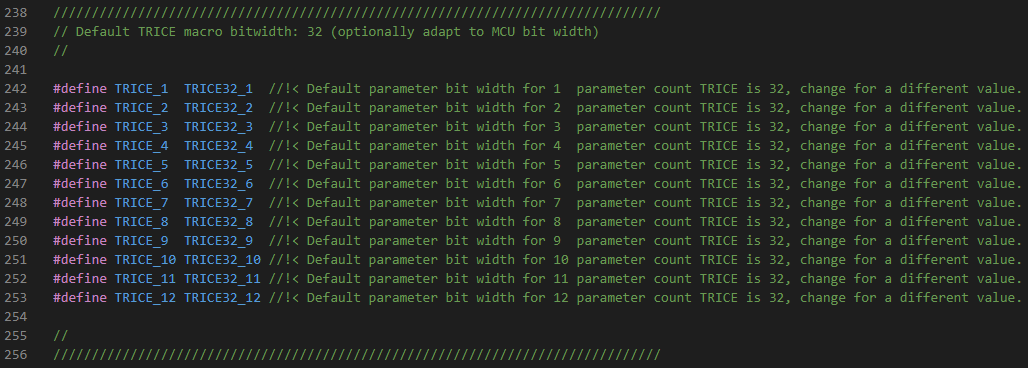
- Use
-defaultTRICEBitwidthswitch during logging when changing this value.
- Adapt
- The macros
trice8,trice16,trice32,trice64are usable too, to define the bit width explicit.- This leads for the smaller bit widths to less needed space and bandwidth. But when using the default package framing TCOBS, the influence is marginal because of the implicit compression.
- The fastest Trice macro execution is, when MCU bit width matches the macro bit width.
- The implicit TCOBS compression compacts the binary Trice data during the framing.
38.4. Many value parameters
- No need to explicit express the values count.
- Up to 12 values are supported directly. Example:
trice( "%p | %04x %04x %04x %04x %04x %04x %04x %04x %04x | %f\n", p, p[0], p[1], p[2], p[3], p[4], p[5], p[6], p[7], p[8], p[9], aFloat(x));- To support more than 12 values for each Trice macro, the Trice code on target and host is straightforward extendable up to a total payload of 32764 bytes.
- Each macro can be prolonged with the used parameter count, for example
TRICE8_3orTRICE_2to intense compile time checks.- This length code extension can be done automatically using
trice u -addParamCount. This is not needed anymore:
- This length code extension can be done automatically using
- The Trice tool compares the number of given format specifiers with the written parameters in a precimpile step to minimize the risk of runtime errors.
- There is no variadic values scanning during runtime. The C preprocessor does the work.
38.5. Floating Point Values
These types are mixable with integer types but need to be covered by converter function.
- float types use the
aFloat()function and need a minimal value bit width of 32, to secure correct data transfer.- Example:
float x = 7.2; trice( "%f", aFloat(x)); - double types use the
aDouble()function and need a value bit width of 64, to secure correct data transfer.- Example:
double y = 7.2; trice64( "float %f and double %f", aFloat(x), aDouble(y)); - Both functions are simple and fast:
// aFloat returns passed float value x as bit pattern in a uint32_t type.
static inline uint32_t aFloat( float x ){
    union {
        float f;
        uint32_t u;
    } t;
    t.f = x;
    return t.u;
}

// aDouble returns passed double value x as bit pattern in a uint64_t type.
static inline uint64_t aDouble( double x ){
    union {
        double d;
        uint64_t u;
    } t;
    t.d = x;
    return t.u;
}
38.6. Runtime Generated 0-terminated Strings Transfer with triceS
- The
%sformat specifier is supported by the Trice macro too but needs specific treatment. - Strings, known at compile time should be a part of a format string to reduce runtime overhead.
- Strings created at runtime, need a special
TRICE_S(ortriceS,TriceS,TRiceS) macro, which accepts exactly one type%sformat specifier. Generated strings are allowed to a size of 32764 bytes each, if the configured Trice buffer size is sufficient.- Example:
 char s[] = "Hello again!";
 triceS("A runtime string %20s\n", s);
Trice was designed mainly for speed. An universal trice like printf would cost too much runtime and destroy this main Trice advantage.
If you need several %s, like in
char* n = "Ann";
char* f = "Fox";
uint8_t dd = 22;
uint8_t mm = 11;
uint16_t yyyy = 1988;
// ...
print( "Name: %12s, Family: %s, Birthday %2u-%02u-%4u\n",  n, f, dd, mm, yyyy );
you can do:
// ...
triceS( "Name: %12s, ",  n );
triceS( "Family: %s, ", f );
trice( "Birthday %2u-%02u-%4u\n", dd, mm, yyyy );
or also
// ...
triceS( "Name: %12s, ",  n ); triceS( "Family: %s, ", f ); trice( "Birthday %2u-%02u-%4u\n", dd, mm, yyyy );
38.7. Runtime Generated counted Strings Transfer with triceN
- It is also possible to transfer a buffer with length n using the
TRICE_N(ortriceN,TriceN,TRiceN) macro. - This becomes handy for example, when a possibly not 0-terminated string in FLASH memory needs transmission:
triceN( "msg: FLASH string is %s", addr, 16 ); - There are also specific macros like
trice32Bortrice16F. Please look into triceCheck.c for usage or see the following.
38.8. Runtime Generated Buffer Transfer with triceB
- A buffer is transmittable with
TRICE_B(ortriceB,TriceB,TRiceB) and specifying just one format specifier, which is then repeated. Example:
  s = "abcde 12345"; // assume this as runtime generated string
  triceS( "msg:Show s with triceS: %s\n", s );
  len = strlen(s);
  triceN( "sig:Show s with triceN:%s\n", s, len );
  triceB( "dbg: %02x\n", s, len ); // Show s as colored code sequence in hex code.
  triceB( "msg: %4d\n", s, len ); // Show s as colored code sequence in decimal code.
This gives output similar to: 
Channel specifier within the TRICE_B format string are supported in Trice versions >= v0.66.0.
If the buffer is not 8 but 16, 32 or 32 bits wide, the macros TRICE8_B, TRICE16_B, TRICE32_B and TRICE64_B, are usable in the same manner.
38.9. Extended format specifier possibilities
- Because the format string is interpreted by the Trice tool written in Go, the Go capabilities partial usable.
38.9.1. Trice format specifier
- The Trice macros are used in C code.
- The format strings are interpreted by the Trice tool, which is written in Go.
- The C and Go format specifier are not equal but similar.
- Therefore, a Trice adaptation is internally performed.
38.9.2. Length modifier support
- Trice now accepts the common C length modifiers
hh,h,l,ll,j,z,t, andLtogether with the corresponding supported conversion specifiers. - This is useful for ordinary Trice macros as well as for buffer macros such as
TRICE8_B,TRICE16_B,TRICE32_B, andTRICE64_B. - The original C format string stays unchanged in the lookup data. Internally, the Trice tool normalizes only a temporary working copy so that the host side can format the values with Go.
- Therefore, these examples are accepted and decoded as expected:
%4ldbehaves like%4d%zubehaves like%u%02zxbehaves like%02x%02llxbehaves like%02x%04Lfbehaves like%04f
- The normalization keeps flags, field width, and precision. Only the C length modifier itself is removed from the host side working copy.
- Invalid combinations are not legalized by Trice. For example,
%LXis not treated as a valid integer format becauseLbelongs to floating-point conversions such as%Lf, not to%X.
38.9.3. Overview Table
| Format Specifier Type | C | Go | T | (T =Trice) | remark |
|---|---|---|---|---|
| signed decimal integer | d | d | d | Supported. |
| unsigned decimal integer | u | - | u | The Trice tool changes %u into %d and treats value as unsigned. |
| signed decimal integer | i | d | i | The Trice tool changes %i into %d and treats value as signed. |
| signed octal integer | - | o | o | With trice log -unsigned=false value is treated as signed. |
| unsigned octal integer | o | - | o | With trice log value is treated as unsigned. |
| signed octal integer with 0o prefix | - | O | O | With trice log -unsigned=false value is treated as signed. |
| unsigned octal integer with 0o prefix | - | - | O | With trice log value is treated as unsigned. |
| signed hexadecimal integer lowercase | - | x | x | With trice log -unsigned=false value is treated as signed. |
| unsigned hexadecimal integer lowercase | x | - | x | With trice log value is treated as unsigned. |
| signed hexadecimal integer uppercase | - | X | X | With trice log -unsigned=false value is treated as signed. |
| unsigned hexadecimal integer uppercase | X | - | X | With trice log value is treated as unsigned. |
| signed binary integer | - | b | b | With trice log -unsigned=false value is treated as signed. |
| unsigned binary integer | - | - | b | With trice log value is treated as unsigned. |
| decimal floating point, lowercase | f | f | f | aFloat(value)|aDouble(value) |
| decimal floating point, uppercase | - | F | F | aFloat(value)|aDouble(value) |
| scientific notation (mantissa/exponent), lowercase | e | e | e | aFloat(value)|aDouble(value) |
| scientific notation (mantissa/exponent), uppercase | E | E | E | aFloat(value)|aDouble(value) |
| the shortest representation of %e or %f | g | g | g | aFloat(value)|aDouble(value) |
| the shortest representation of %E or %F | G | G | G | aFloat(value)|aDouble(value) |
| a character as byte | c | - | c | Value can contain ASCII character. |
| a character represented by the corresponding Unicode code point | c | c | c | Value can contain UTF-8 characters if the C-File is edited in UTF-8 format. |
| a quoted character | - | q | q | Supported. |
| the word true or false | - | t | t | Supported. |
| a string | s | s | s | Use triceS macro with one and only one runtime generated string. |
| pointer address | p | p | p | Supported. |
| a double %% prints a single % | % | % | % | Supported. |
| Unicode escape sequence | - | U | - | Not supported. |
| value in default format | - | v | - | Not supported. |
| Go-syntax representation of the value | - | #v | - | Not supported. |
| a Go-syntax representation of the type of the value | - | T | - | Not supported. |
| nothing printed | n | - | - | Not supported. |
- Long story short: Use the
-unsigned=falseswitch when you like to see hex numbers and the like as signed values. - Look in triceCheck.c for exampe code producing this:
38.10. Unsupported printf format features
Trice supports the common printf-style format specifiers used for embedded logging. Some less common printf features are intentionally not supported yet, because they do not fit well into the current lightweight Trice argument handling model or because they introduce side effects that are unsuitable for logging.
This mainly concerns:
- dynamic field width with
*, for example%*d - dynamic precision with
*, for example%.*sor%*.*f - wide character and wide string formats such as
%lcand%ls - the
%nconversion specifier
38.10.1. Dynamic field width with *
In standard printf, a field width can either be fixed inside the format string or supplied dynamically.
Example with fixed width:
printf("%10d", value);
Example with dynamic width:
printf("%*d", width, value);
The * is not the value to be printed. It tells printf to consume an additional int argument from the argument list and to use that value as the field width. Therefore:
printf("%*d", 10, value);
behaves like:
printf("%10d", value);
A negative dynamic width has a special meaning and implies left-aligned output, similar to the - flag.
38.10.2. Dynamic precision with *
The same principle exists for precision.
Example with fixed precision:
printf("%.3f", value);
Example with dynamic precision:
printf("%.*f", precision, value);
Again, the * consumes an additional int argument. For strings this is often used to limit the maximum number of emitted characters:
printf("%.*s", maxLen, text);
38.10.3. Dynamic width and precision together
Both dynamic field width and dynamic precision can be used in the same conversion:
printf("%*.*f", width, precision, value);
This consumes three arguments:
int width;
int precision;
double value;
The important point is that each * consumes an additional int argument before the actual value argument. This means that %*.*f does not correspond to one runtime value only. It corresponds to int, int, double.
Trice is designed so that a format string usually maps to a compact and predictable sequence of transmitted values. Dynamic width and dynamic precision break that simple mapping because the * tokens are not visible output conversions, but they still consume additional arguments.
For that reason, Trice currently does not support these forms. Supporting them correctly would require the Trice format analysis to count and encode the hidden width and precision arguments in addition to the visible value arguments.
38.10.4. Wide character and wide string formats: %lc and %ls
The %lc and %ls conversions are valid C printf forms for wide character and wide string data.
They are not equivalent to %c and %s:
%cand%soperate on narrow character data%lcand%lsoperate on wide character data such aswchar_t
For Trice this matters because triceS and related string handling transport runtime buffers, but the Trice tool does not automatically know how a target represents wide characters internally.
Without additional target-specific metadata, the host side would not know:
- whether
wchar_ton the target is 16 bit or 32 bit - which byte order is used
- which encoding semantics should be assumed for the transported code units
Therefore, simply removing the l and treating %lc like %c or %ls like %s would not be correct. That would silently change the meaning of the original C format string and could decode the payload differently from what the target-side C code actually describes.
For that reason, Trice currently does not support %lc and %ls. Proper support would require extra target-side type or encoding information so that the host can decode the transported data in an unambiguous and portable way.
38.10.5. The special %n conversion specifier
The %n specifier is fundamentally different from ordinary printf conversions.
Most conversions produce output:
printf("%d", value);
printf("%s", text);
printf("%f", number);
The %n specifier prints nothing. Instead, it writes the number of characters printed so far into the object pointed to by the corresponding argument.
Example:
int count = 0;

printf("abc%nxyz", &count);
The visible output is:
abcxyz
After the call, count contains 3, because three characters were printed before %n was reached.
Depending on the length modifier, %n expects different pointer types:
printf("%n",   &i);   // int *
printf("%hn",  &s);   // short *
printf("%hhn", &c);   // signed char *
printf("%ln",  &l);   // long *
printf("%lln", &ll);  // long long *
This means %n is not a pure logging conversion. It has a side effect because it writes to memory.
38.10.6. Security implications of %n
The %n specifier is also relevant for format-string security.
This is unsafe when userInput is not trusted:
printf(userInput);
If userInput contains format specifiers, printf interprets them. If it contains %n, printf expects a pointer argument and writes through it. If no valid pointer was actually passed, this can cause undefined behavior, memory corruption, or a crash. In more serious cases, uncontrolled format strings can become a security vulnerability.
The correct way to print uncontrolled text is:
printf("%s", userInput);
Because %n writes to memory and is strongly associated with format-string vulnerabilities, many coding standards and safety-oriented code bases discourage or forbid it.
38.10.7. Why Trice does not support %n
Trice is a logging and tracing system. Its purpose is to transfer compact log information from the target to the host, where it is decoded into readable text.
The %n specifier does not fit this model for several reasons:
%nproduces no log output.%nwrites to target memory through a pointer argument.- The written value depends on the number of characters formatted so far.
- Trice intentionally avoids full target-side formatting in order to remain small and fast.
- Supporting
%nwould introduce a side effect into what should be a side-effect-free logging operation. %nhas known security implications when format strings are not fully controlled.
For these reasons, Trice currently does not support %n.
This is intentional. Trice log statements should describe data to be logged, not modify application memory as a side effect of formatting.
38.11. UTF-8 Support
This is gratis, if you edit your source files containing the format strings in UTF-8:
The target does not even “know” about that, because it gets only the Trice IDs.
38.12. Switch the language without changing a bit inside the target code
Once the til.json list is done the user can translate it in any language and exchanging the list switches to another language. This is nowadays a simple AI agent task.
38.13. Format tags prototype specifier examples
This syntax is supported: %[flags][width][.precision][length]
- Because the interpretation is done inside the Trice tool written in Go these all should work:
%-d%064b%+9.3f%+#012.12g%+'#012.12E%e%9.f
39. Trice ABC - Asynchronous Broadcast Commands
Trice ABC adds command-style communication to normal Trice records. The API is intentionally small and meant as a building block.
The TriceAbc example demonstrates ABC communication with COBS framing and without encryption. Its node configurations define the framing explicitly; when experimenting with a different transport setup, update the sender, receiver and logging options together.
ABC means:
- Asynchronous: the sender emits a record and continues.
- Broadcast: zero, one, or several receivers may observe the same record.
- Commands: selected receivers may execute locally compiled handlers.
The key idea is the generated ID/function-pointer list on the receiver:
sender source
  trice8C("cmd:setLeds", &mask, 1)
        |
        | trice insert
        v
til.json
  ID <-> "cmd:setLeds"
        |
        | trice generate -i til.json -abc device_abc
        v
device_abc.c
  { ID, 8, setLeds }
        |
        | receive runtime
        v
TriceParseRecord() -> TriceResolveAbc() -> TriceDispatchAbc() -> setLeds(&rx)
Only the Trice ID, optional ABC stamp, and optional payload are transferred. The command string stays in the TIL data and is used during receiver-code generation.
39.1. Quick use

- Enable sending and/or receiving in
triceConfig.h:
#define TRICE_TX_ABC_SUPPORT 1 // needed for ABC send macros
#define TRICE_RX_ABC_SUPPORT 1 // needed for ABC receive/dispatch
Sending and receiving are independent. A device may be send-only, receive-only, or both.
- Send a command with an ABC macro:
#include "trice.h"

void SetLeds(uint8_t mask) {
    trice8C("cmd:setLeds", &mask, 1);
}
- Insert IDs into the sources and TIL file:
trice insert -til til.json -li li.json -src ./project_src
- Generate the receiver selection/header pair and table:
trice generate -i til.json -abc ./device_abc
This creates:
device_abc.h   generated once, then user-owned receiver selection header
device_abc.c   generated table, regenerated from til.json and device_abc.h
- Edit
device_abc.hand keep only the commands this target shall receive:
#ifndef DEVICE_ABC_H_
#define DEVICE_ABC_H_

#include "triceRx.h"

#ifdef __cplusplus
extern "C" {
#endif

void setLeds(const triceRx_t* rx);

#ifdef __cplusplus
}
#endif

#endif /* DEVICE_ABC_H_ */
- Implement the selected handlers:
#include <stdint.h>
#include "device_abc.h"

static uint8_t boardLeds;

void setLeds(const triceRx_t* rx) {
    if (rx == 0 || rx->payloadBytes != 1u) {
        return;
    }
    boardLeds = rx->payload[0];
}
- Feed decoded Trice records to the receive runtime:
triceRx_t rx;
int used = TriceParseRecord(&rx, record, recordLen);

if (used > 0 && TriceResolveAbc(&rx, triceAbc, triceAbcElements) == TRICE_RX_RESULT_OK) {
    (void)TriceDispatchAbc(&rx);
}
triceRx parses already deframed and decrypted Trice records. UART, RTT, file, socket, COBS, TCOBS, and encryption handling stay outside this small receive core.
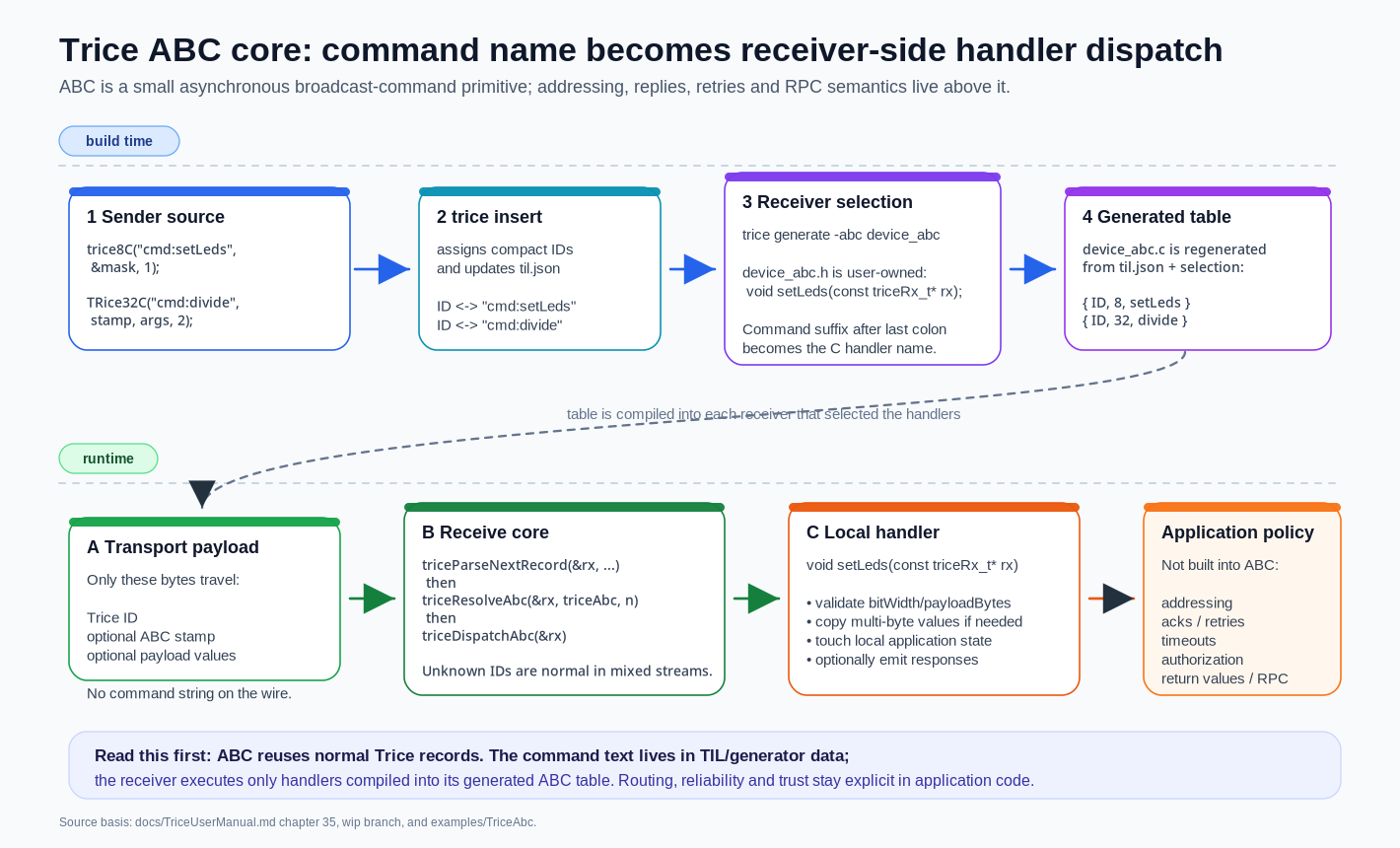
39.2. ABC macro families
The suffix C means command. The optional number in the macro name is the payload element width.
| no stamp | 16-bit stamp | 32-bit stamp | payload element width |
|---|---|---|---|
triceC |
TriceC |
TRiceC |
no payload |
trice8C |
Trice8C |
TRice8C |
8-bit |
trice16C |
Trice16C |
TRice16C |
16-bit |
trice32C |
Trice32C |
TRice32C |
32-bit |
trice64C |
Trice64C |
TRice64C |
64-bit |
Examples:
triceC("cmd:motorStop"); // no stamp, no value

uint16_t seq16 = NextSeq16();
TriceC("cmd:getLeds", seq16); // 16-bit stamp, no value

uint32_t unixTime = BoardTime();
trice32C("cmd:setTime", &unixTime, 1); // no stamp, one 32-bit value

int16_t step[] = { -50, 0, 300, 0 };
TRice16C("cmd:motorStep", 0x12345678, step, 4); // 32-bit stamp, 4 16-bit values
For stamped ABC macros, the explicit ABC stamp follows the command string and precedes the payload arguments.
ABC stamps are application-defined correlation values. They are not automatically generated Trice timestamps. Pass TriceStamp16 or TriceStamp32 explicitly if a real timestamp is desired.
TriceC("cmd:sample", TriceStamp16);
TRiceC("cmd:sample", TriceStamp32);
39.3. Command names and handler names
The ABC command name is written where a normal Trice format string would stand. Treat it as a command name, not as a printf format string.
triceC("cmd:motorStop");
trice32C("cmd:setTime", &unixTime, 1);
Everything before the last colon is tag/grouping text. The generator uses the part after the last colon as C handler name:
cmd:motorStop       -> motorStop
cmd:deviceA:sample  -> sample
abc:LedsState       -> LedsState
The prefixes are not ABC addresses. They are useful for readable TIL data, filtering, grouping, and examples.
The final command part must be a valid C identifier. Do not add a trailing newline to ABC command strings.
39.4. Receiver selection and generated table
trice generate -abc target creates target.h and target.c in -genDir (default ./generated). The header is user-owned after its first creation: edit and version it to select the commands compiled into that target. The repository ignores generated C files but leaves this editable header visible to Git. An explicit target path such as -abc path/target keeps its existing location relative to the TIL directory.
The generator regenerates the C table from the intersection of:
- ABC entries found in
til.json, and - active handler declarations found in
device_abc.h.
A command present in til.json but not declared in device_abc.h is ignored by this receiver. A declaration without a matching TIL entry is a build/configuration issue.
Generated device_abc.c has the essential shape:
#include "device_abc.h"

const triceAbc_t triceAbc[] = {
    /* id, bitWidth, function pointer */
    { 5150u, 8u, setLeds },
    { 4818u, 0u, getLeds },
};

const unsigned triceAbcElements = sizeof(triceAbc) / sizeof(triceAbc[0]);
Do not edit device_abc.c. Implement the selected handlers in normal application code. Missing handler implementations fail as normal linker errors.
39.5. Receive runtime contract
The common receive API is in src/triceRx.h and src/triceRx.c.
Use TriceParseRecord() to parse one decoded Trice record. It fills a triceRx_t:
uint16_t id;              // Trice ID
uint8_t  bitWidth;        // payload element width after resolution
uint8_t  stampBits;       // 0, 16, or 32
uint32_t stamp;           // application-defined ABC stamp
const uint8_t* payload;   // points into caller-owned input buffer
uint16_t payloadBytes;    // payload byte count
The payload is not copied. Do not store rx->payload beyond the lifetime of the input buffer unless the handler copies the data.
TriceResolveAbc() looks up the parsed ID in the generated triceAbc[] table and attaches the resolved bit width and function pointer to rx.
TriceDispatchAbc() validates the payload size against the resolved bit width and calls the selected handler. Unknown IDs are normal in mixed streams and can be ignored.
For simple one-record receive paths, TriceAbcOnReceive(pBuf, len) is available as a convenience wrapper. Stream receivers should usually parse records explicitly, advance by the positive consumed byte count, and decide per record whether it is ABC, normal log traffic, counted typeX0 traffic, or unknown traffic.
39.6. Handler payload handling
Handlers get only const triceRx_t*. Application state must come from normal program context.
Use rx->bitWidth, rx->payloadBytes, and rx->payload to interpret the payload. For multi-byte values, prefer copying from the byte buffer instead of casting the pointer (alignment).
#include <string.h>

void setTime(const triceRx_t* rx) {
    uint32_t t;

    if (rx == 0 || rx->bitWidth != 32u || rx->payloadBytes != sizeof(t)) {
        return;
    }

    memcpy(&t, rx->payload, sizeof(t));
    BoardSetTime(t);
}
Use the configured Trice transfer order consistently if payload values are exchanged between different endian architectures.
39.7. Responses
ABC has no built-in response model. A handler may send no response, one response, or several responses.
A common pattern is:
// request
TriceC("cmd:getLeds", seq16);

// response from interested receiver
TRice8C("abc:LedsState", responseStamp32, &leds, 1);
The response is just another Trice message. It may be a normal log message or another ABC command. Use stamps to correlate responses with requests.
39.8. What ABC is not
ABC is not RPC by itself.
ABC does not define:
- addressed delivery,
- exactly-one receiver semantics,
- acknowledgements,
- retries,
- timeouts,
- authorization,
- discovery,
- routing,
- quorum logic,
- waiting for a return value.
Build these policies above ABC when needed.
ABC is also not remote code execution. A receiver can execute only handlers already compiled into the firmware and selected by its generated ABC table.
39.9. Example: examples/TriceAbc
The host-native demo shows ABC without embedded hardware.
Run it from the example directory:
cd examples/TriceAbc
./build.sh
./demo.sh

The demo uses BcSim as a small byte bus. It transports bytes only; the Trice-specific logic is in NodeLib and the node programs.
The build script demonstrates the full workflow:
trice insert ...
trice generate -i ../../demoTIL.json -abc NodeLib/nodeAbc
trice generate -i ../../demoTIL.json -src . -logC=NodeLib/til.c
It produces:
NodeLib/nodeAbc.h   shared user-owned ABC selection header
NodeLib/nodeAbc.c   shared generated ABC table
NodeLib/til.c       compact generated log metadata for normal-log resolving
The demo nodes have different roles:
N1_tx,N2_tx: send ABC commands.N3_bi,N7_bi,N8_bi,N9_bi: send and receive.N4_rx,N5_rx,N6_rx: receive only.N6_rxandN7_bi: additionally resolve normal Trice log traffic.
The demo commands include:
cmd:setLedscmd:getLedscmd:setKeycmd:logStatecmd:divideabc:LedsStateabc:DivideResult
cmd:getLeds and cmd:divide show request/response behavior built above ABC. The stamped requests use low stamp bits as a small responder bitmap in the demo. That is application policy, not ABC core behavior.
The shared runtime flow is:
normal Trice macro / ABC macro
-> TriceWriteDevice()
-> BcSim byte bus
-> COBS frame collector
-> TriceParseRecord()
-> TriceResolveAbc() / TriceResolveLog()
-> node handler or demo log printer
The example intentionally parses once and then decides whether the record is ABC, normal log traffic, counted typeX0 traffic, or unknown traffic. This is the recommended style for mixed receive streams.
An example log snippet:
...
N3_tx: ABC-> cmd:setLeds(0c)
N6_rx: log:tick=203
N6_rx: log:from=3 phase=3
N6_rx: log:text=N3 bidirectional
N6_rx: x0 3 bytes: 33 34 35
N6_rx: leds=[ ** ]
N7_bi: log:tick=203
N7_bi: log:from=3 phase=3
N7_bi: log:text=N3 bidirectional
N7_bi: x0 3 bytes: 33 34 35
N7_bi: leds=[ ** ]
N5_rx: x0 3 bytes: 33 34 35
N5_rx: leds=[ ** ]
...
The broadcast simulation abc.bus log starts with:
# BcSim traffic log
# bc.bus is a pure binary byte stream. This text log is diagnostic only.
# offset and len are decimal values. Bytes are hexadecimal %02x values.
# offset len device dir status bytes
# -------- ---- ------------ --- -------------------- --------------------------------
0 10 N3_bi TX trice 06 d2 53 c0 04 c8 01 01 01 00
10 14 N3_bi TX trice 06 54 55 c0 08 03 01 01 01 01 01 01 01 00
24 22 N3_bi TX trice 15 99 53 c0 10 4e 33 20 62 69 64 69 72 65 63 74 69 6f 6e 61 6c 00
46 6 N3_bi TX trice 02 02 03 30 31 00
0 52 N8_bi RX poll 06 d2 53 c0 04 c8 01 01 01 00 06 54 55 c0 08 03 01 01 01 01 01 01 01 00 15 99 53 c0 10 4e 33 20 62 69 64 69 72 65 63 74 69 6f 6e 61 6c 00 02 02 03 30 31 00
0 52 N6_rx RX poll 06 d2 53 c0 04 c8 01 01 01 00 06 54 55 c0 08 03 01 01 01 01 01 01 01 00 15 99 53 c0 10 4e 33 20 62 69 64 69 72 65 63 74 69 6f 6e 61 6c 00 02 02 03 30 31 00
...
With tlog.sh one can see the Trice logs as well:
th@Thomass-MacBook-Pro-7 TriceAbc % ./tlog.sh
Jul 27 22:26:51.574387 FILEBUFFER: N3_bi/main.c 14 log:(from node=N3_bi) tick=200
Jul 27 22:26:51.574475 FILEBUFFER: N3_bi/main.c 18 log:(from node=N3_bi) from=3 phase=0
Jul 27 22:26:51.574491 FILEBUFFER: N3_bi/main.c 22 log:(from node=N3_bi) text=N3 bidirectional
Jul 27 22:26:51.574503 FILEBUFFER: typeX0 buffer: [48 49]
Jul 27 22:26:51.574729 FILEBUFFER: N3_bi/main.c 14 log:(from node=N3_bi) tick=201
Jul 27 22:26:51.574773 FILEBUFFER: N3_bi/main.c 18 log:(from node=N3_bi) from=3 phase=1
Jul 27 22:26:51.574921 FILEBUFFER: N3_bi/main.c 22 log:(from node=N3_bi) text=N3 bidirectional
Jul 27 22:26:51.574942 FILEBUFFER: typeX0 buffer: [49 50 51]
Jul 27 22:26:51.574952 FILEBUFFER: N3_bi/main.c 50 0_103 cmd:getLeds
Jul 27 22:26:51.574964 FILEBUFFER: NodeLib/node.c 654 0_103 abc:LedsState(00)
...
Jul 27 22:26:51.576238 FILEBUFFER: N3_bi/main.c 22 log:(from node=N3_bi) text=N3 bidirectional
Jul 27 22:26:51.576246 FILEBUFFER: typeX0 buffer: [59 60 61]
Jul 27 22:26:51.576254 FILEBUFFER: N3_bi/main.c 102 0,000_103 cmd:getLeds
Jul 27 22:26:51.576262 FILEBUFFER: NodeLib/node.c 656 0,000_103 abc:LedsState(80)
Jul 27 22:26:51.576271 FILEBUFFER: NodeLib/node.c 656 0,000_103 abc:LedsState(80)
Jul 27 22:26:51.576279 FILEBUFFER: NodeLib/node.c 656 0,000_103 abc:LedsState(80)
Jul 27 22:26:51.576287 FILEBUFFER: N2_tx/main.c 14 log:(from node=N2_tx) tick=107
Jul 27 22:26:51.576296 FILEBUFFER: N2_tx/main.c 18 log:(from node=N2_tx) from=2 phase=0
Jul 27 22:26:51.576304 FILEBUFFER: N2_tx/main.c 22 log:(from node=N2_tx) text=N2 sends data
Jul 27 22:26:51.576312 FILEBUFFER: typeX0 buffer: [39 41 43 45 47]
Jul 27 22:26:51.576320 FILEBUFFER: N2_tx/main.c 62 0_102 cmd:getLeds
Jul 27 22:26:51.576328 FILEBUFFER: NodeLib/node.c 654 0_102 abc:LedsState(80)
Jul 27 22:26:51.576337 FILEBUFFER: NodeLib/node.c 654 0_102 abc:LedsState(80)
th@Thomass-MacBook-Pro-7 TriceAbc %
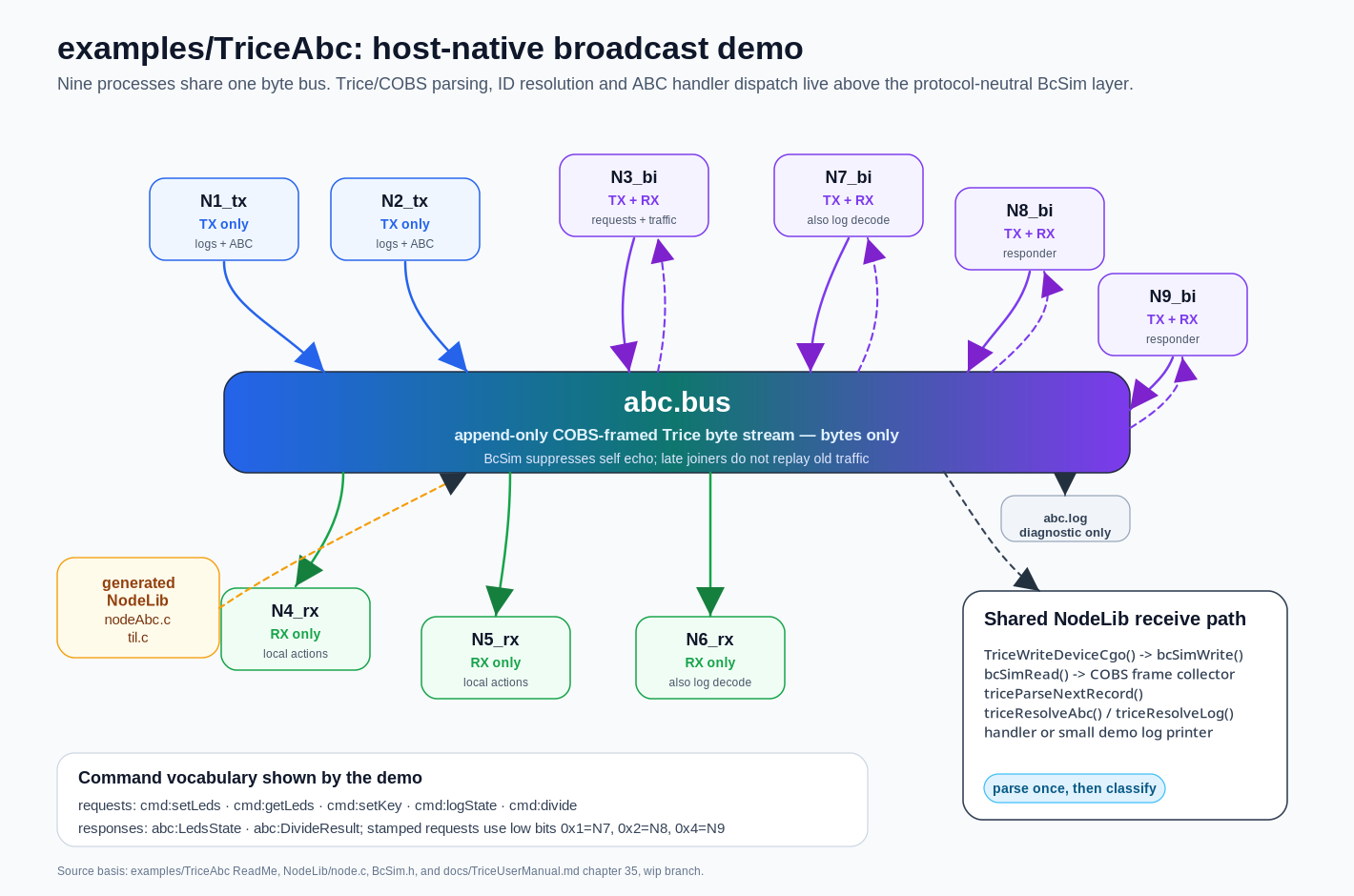
39.9.1. ABC Demo Layout, Startup, and Runtime Policy
The host-native example requires Bash and a C compiler (gcc, clang, or cc); CC selects a compiler explicitly. Its build script uses TRICE_BIN if supplied, otherwise Go when available, or trice in PATH. It builds nine executables below build (.exe on Windows), inserts IDs before generating the tables, and runs trice clean on exit after a successful insert. NodeLib/til.c is regenerated for the selected source roots and is not a checked-in source. NodeLib/nodeAbc.h is the shared user-owned command selection, so preserve it when cleaning generated files.
The layout separates BcSim (reusable protocol-neutral transport), BcSimChk (standalone random-byte check), NodeLib (shared Trice runtime and generated tables), and the nine node directories. tx, rx, and bi describe bus capability, not command vocabulary. N1_tx/N2_tx emit logs, counted typeX0 buffers, and commands; N3_bi also receives and replies; N4_rx/N5_rx execute commands only; N6_rx adds received log presentation; N7_bi combines replies and log presentation; N8_bi/N9_bi reply without the normal-log printer.
demo.sh starts receive-capable nodes first, then pure transmitters. A BcSim participant joins at the current end of the bus and does not replay earlier traffic. Runtime files are abc.bus (binary framed stream), abc.log (human hex log), and abc.bus.lock/ (writer lock). They are separate from BcSimChk’s bc.* files. abc.console.lock/ keeps each complete node or shell status line together; the console lock waits rather than falling back to interleaved writes. A killed lock owner may require manual cleanup after all participants stop.
The command shapes and effects are intentionally small:
| Command | Payload and effect |
|---|---|
cmd:setLeds |
One 8-bit mask; update the local simulated LED bar. |
cmd:getLeds |
No payload; every other bidirectional node can answer abc:LedsState with an 8-bit mask. Receive-only nodes cannot reply. |
cmd:setKey |
Counted 8-bit byte buffer; store a local key. |
cmd:logState |
No payload; local printf side effect, without a Trice/ABC response. |
cmd:divide |
Two 32-bit floats; bidirectional nodes answer abc:DivideResult with one float. |
Unstamped requests broadcast, so several identical-looking replies are expected. For stamped getLeds and divide, the demo’s application policy uses low bits 0x0001, 0x0002, and 0x0004 to select N7_bi, N8_bi, and N9_bi. N3_bi demonstrates one and multiple selected responders. Replies retain stamp width and value. This is demonstration routing above ABC, not a built-in addressing protocol.
The node-local triceConfig.h files select TX, ABC RX, normal-log resolution, and direct output. Transmitting nodes select TRICE_DIRECT_OUT_FRAMING TRICE_FRAMING_COBS, for example in N3_bi/triceConfig.h; the shared NodeLib/node.c collects and decodes COBS frames. All participants must agree on framing. The former separate triceRxConfig.h is no longer present. NodeLib implements the real generated handlers once; runtime canSend decides whether a node replies, avoiding forwarding wrappers in each node.
The host bridge preserves the normal send macros through TriceWriteDevice(). A persistent input buffer splits COBS frames at zero delimiters, keeps the incomplete tail, then iterates logical records inside each decoded frame. It skips record-alignment bytes only when the expected bytes are zero. Parsing happens once, followed by ABC, normal-log, typeX0, or unknown-record dispatch; TriceAbcOnReceive() is not the primary demo entry point. Selector-0 buffers have no ID or TIL lookup and are displayed as raw bytes. Nodes without normal-log resolution show ignored IDs; the small generated-til.c log printer is not a replacement for the Go host decoder and has no source-location column.
Self-written bus ranges are filtered, so a node does not receive its own frames or display its own logs as received traffic. nodeSleepMs() handles shared pacing. Process-local TRICE_ENTER_CRITICAL_SECTION hooks cannot protect a multi-process console; NodeLib’s separate console lock does that. Each node formats a full line before acquiring the lock. LED output uses * for on and space for off, for example:
N4_rx: leds=[** * ]
N6_rx: key=bravo7 leds=[*** ]
N7_bi: abc:DivideResult=3.140000
N6_rx: log:tick=4
N7_bi: x0 5 bytes: 10 11 12 13 14
39.10. BcSim Broadcast Byte-Stream Simulator
BcSim is a standalone C module: several PC processes append to a shared local file and poll bytes written by others. It knows nothing about IDs, framing, encryption, packet boundaries, source addresses, commands, or handlers. bc.bus contains exactly the supplied bytes, with no inserted name, timestamp, length, or metadata; optional bc.log is human-readable diagnostic output only.
Each process owns one BcSim_t. bcSimOpen() opens a local view and starts reading at the current end of the bus. bcSimWrite() appends bytes and remembers its own written offset ranges; bcSimRead() filters those ranges from subsequent reads; bcSimClose() closes the view and resets state. Filtering by offsets rather than byte contents preserves identical data legitimately sent by different processes or repeated by one process.
Writers serialize through an atomically created bc.bus.lock/ directory: acquire lock, obtain file size, append, remember the [start,end) range, optionally append the TX log line, then remove the lock. Competing writers retry until the timeout. Reads normally take no writer lock and may see partial data, which the higher stream layer must buffer. Define BCSIM_READ_USES_LOCK 1 for deterministic reads under the same writer lock.
The public API is:
int bcSimOpen(BcSim_t* io, const char* busPath,
const char* logPath, const char* deviceName);
int bcSimRead(BcSim_t* io, uint8_t* p, size_t max, const char* status);
int bcSimWrite(BcSim_t* io, const uint8_t* p, size_t n, const char* status);
void bcSimClose(BcSim_t* io);
The three integer-returning functions return a non-negative byte count or a negative BCSIM_ERR_* value. The log starts with a header, then one TX/RX line per event: right-aligned decimal offsets and lengths without leading zeros, device, direction, optional status, and space-separated two-digit lowercase hexadecimal bytes.
# BcSim traffic log
# bus file: bc.bus
# Columns: offset, len, device, direction, status, bytes
0 12 A TX tx-0 35 6a 11 8e ...
12 12 B RX poll-1 35 6a 11 8e ...
Try the transport alone, without Trice tables:
cd examples/TriceAbc/BcSimChk
./demo.sh
Its build script compiles main.c and ../BcSim/BcSim.c; CC and CFLAGS allow experiments, such as CFLAGS='-DBCSIM_READ_USES_LOCK=1' ./build.sh. The demo starts four participants with random byte blocks and shows bc.log and a bus hex dump. The reusable library files are BcSim_config.h, BcSim.h, and BcSim.c; BcSimChk is not needed by applications reusing the transport.
This is a local demonstration medium, not high-performance IPC or a real embedded link. The bus grows until removed, only finitely many self-write ranges are remembered, and a restarted process cannot identify a previous instance’s writes. A killed writer can leave a lock directory requiring cleanup. Network filesystems may not offer the same atomic directory and visibility behavior as local filesystems.
39.11. Host tests
_test/abc_tx_host checks the transmit side. It compiles a small C fixture with ABC TX support, emits selected triceC, TriceC, TRiceC, trice8C, trice16C, and trice32C calls, and compares the produced bytes with fixed fixtures. It verifies wire format generation only; it does not use a receiver table.
_test/abc_rx_host checks the receive side against the production src/triceRx.c runtime and a generated device_abc pair. The tests cover selected IDs, unknown IDs, no-payload records, 8/16/32/64-bit payloads, 16/32-bit stamps, malformed payload lengths, truncated records, nested dispatch, long-count payload encoding, log-resolution coexistence, and one-record-at-a-time stream consumption.
Together, these tests document the current ABC boundary: transmit macros create normal Trice records, the generated table maps selected IDs to handlers, and the receive runtime parses/resolves/dispatches one decoded record at a time.
39.12. Building RPC-like protocols on top
Use ABC as the transport primitive and define the RPC policy in the application.
A minimal RPC-like pattern is:
- Define request commands, for example
rpc:getValue. (requester) - Define response commands, for example
rpc:getValueResult. (a receiver acting as “requester” in a response) - Put a correlation value into the 16-bit or 32-bit ABC stamp.
- Encode arguments in the payload.
- Let the receiver validate the payload, execute local code, and send a response (
rpc:getValueResult) with the same or derived stamp. - Let the requester also be an ABC receiver and keep a pending-request table.
- Implement timeout, retry, duplicate handling, authorization, and addressing at application level.
For addressed RPC over a broadcast bus, put the destination into the stamp or payload and let non-matching receivers ignore the command. ABC itself still broadcasts the record.
39.13. Security boundary
ABC receiving allows incoming Trice records to trigger selected local application handlers. Do not enable ABC receive processing on untrusted inputs without an application-level trust model.
Typical protections are:
- enable ABC receive only on trusted transports,
- filter by time to avoid burst attacks,
- validate every payload,
- add authentication or encryption around the transport,
- compile out
TRICE_RX_ABC_SUPPORTwhere it is not needed.
39.14. Summary
ABC turns selected Trice IDs into asynchronous broadcast commands.
The small core is:
ABC send macro
-> Trice ID in til.json
-> generated *_abc.h selection
-> generated *_abc.c ID/function-pointer table
-> user handler(const triceRx_t* rx)
Everything else, including addressing, responses, reliability, retries, authorization, and RPC semantics, belongs to the application layer above ABC.
Using Trice ABC for the same (remote) handler from different devices assigns different IDs to the same handler. This way one can consider a Trice ABC ID as senders address and the activated handler has access over the passed triceRx_t pointer to it.
40. Development Environment Setup
- Trice is usable with any C-compiler for any processor type, bit width and endianness. The example projects here are STM32 ones but illustrate how to setup Trice.
- The examples folder contains some instrumented example projects together with bare counterparts. Comparing a bare project with its intrumented counterpart gives a quick overview what needs to be done to get started.
40.1. Common Information
- All used tools are Open Source (despite the ARM-Keil µVision IDE, for new projects VS Code is a better choice).
- All provided information is just as example and needs adaptation to your needs.
- There is no need to setup the environment in the given order.
40.2. Important to know
The ARM-Keil µVision IDE does sometimes not recognize external file modifications. That means for example: After editing main.c by adding a trice( "Hi!\n" ) and executing trice insert as pre-compile step it could happen, that an updated trice( iD(12345), "Hi!\n" ) was inserted and correct compiled but the update in main.c is not shown. Simply close and reopen main.c before editing again. This seems to be a ARM-Keil µVision IDE “feature” or be caused Windows not signaling a file change.
40.3. Animation
(The trice IDs occur just during the compilation.)

40.4. Setup Linux PC - Example with Debian12 - KDE Desktop
40.4.1. Basic setup
- Add yourself to the sudo group:
su
apt install sudo
adduser <your_user_name> sudo
exit
- Logout and login.
- Install and verify:
groups
sudo apt update
sudo apt upgrade
sudo apt install build-essential
make --version
gcc --version
git --version
git config --global user.email "you@example.com"
git config --global user.name "Your Name"
40.4.2. GitHub
- Create github account.
-
Create ssh pair:
ssh-keygen -t ed25519 - Add ssh key to your github account.
-
Clone Trice repository:
cd ~ mkdir repos cd repos git clone git@github.com:rokath/trice.git
40.4.3. VS Code
- Download VS Code from https://code.visualstudio.com/.
-
Install VS Code (adapt to downloaded version) and start it inside the Trice folder:
sudo apt update sudo apt upgrade sudo apt install ~/Downloads/code_1.96.2-1734607745_amd64.deb code .
Open the repository root to use the shared Go launch configurations.
Install the Go extension and its debugger tools first. The configurations use
${workspaceFolder} rather than a particular checkout location. UART and TCP
entries ask for the serial port or RTT endpoint at launch; these are VS Code
input variables.
The G0B1 and L432 hardware entries use the root demoTIL.json and demoLI.json,
which belong to those instrumented examples. Build and flash the corresponding
example before connecting. The G0B1 UART entry matches its encrypted COBS output
at 115200 baud with password MySecret; the RTT entries match unframed direct
output with doubled IDs. TCP4 expects that same G0B1 RTT stream forwarded by a
server, normally at localhost:17001. These settings do not apply to arbitrary
firmware or captures: use the ID/location tables and framing from that firmware.
The generate entry creates generated/til.c from the current G0B1 main source;
run the example’s bind/build step first so that its sidecars and ID table agree.
The insert/clean entries operate on that main source and update the root tables;
they are maintenance commands, not log viewers. Already bound code follows the
normal insert/clean ownership rules. The test entry runs one existing bind test.
For a hardware-free decoder session, select trice l -p DUMP: its retained
capture uses testTIL.json/testLI.json and includes a missing cycle-counter value
194, so one cycle-error diagnostic is expected. Entries whose captures, source
folders or command variants no longer exist have been removed.
When opening a G0B1 example itself, its C/C++ configuration finds
arm-none-eabi-gcc through PATH. Start VS Code from an environment containing
the installed ARM compiler and install the C/C++ and Makefile Tools extensions.
Only USE_HAL_DRIVER and STM32G0B1xx are supplied as project defines; builtin
defines are queried from the compiler with -mcpu=cortex-m0plus rather than
copied from an older version or inferred for the compiler’s default CPU.
IntelliSense uses gcc-arm instead of the host platform’s default architecture.
The shared JetBrains settings retain the CLion CMake review host, project inspections and XML spelling dictionary. Choose the host toolchain locally; workspace layout and personal state are ignored. IDE launch, serial/RTT connections and indexing still need checking in your installed IDE and hardware environment; parsing the templates alone cannot establish those results.
40.4.4. Go
-
Download the Go language from https://go.dev/doc/install and install:
cd ~/Downloads sudo rm -rf /usr/local/go && sudo tar -C /usr/local -xzf go1.23.4.linux-amd64.tar.gzExtend PATH variable with
/usr/local/go/bin:~/go/binfor example by by adding a file like/etc/profile.d/gopath.sh:su sudo echo export PATH='$PATH':/usr/local/go/bin:/home/<your_user_name>/go/bin > /etc/profile.d/gopath.sh exit -
Logout, login and compile Trice:
th@P51-DebianKDE:~/repos$ go version go version go1.23.4 linux/amd64 th@P51-DebianKDE:~/repos$ cd trice th@P51-DebianKDE:~/repos/trice$ go install ./cmd/... go: downloading github.com/spf13/afero v1.9.5 go: downloading github.com/kr/pretty v0.1.0 go: downloading go.bug.st/serial v1.6.0 go: downloading github.com/mgutz/ansi v0.0.0-20200706080929-d51e80ef957d go: downloading github.com/rokath/cobs v0.0.0-20230425030040-4ebbe9b903b9 go: downloading github.com/rokath/tcobs v0.9.1 go: downloading golang.org/x/crypto v0.31.0 go: downloading github.com/fsnotify/fsnotify v1.6.0 go: downloading github.com/pkg/errors v0.9.1 go: downloading golang.org/x/sys v0.28.0 go: downloading golang.org/x/text v0.21.0 go: downloading github.com/kr/text v0.1.0 go: downloading github.com/mattn/go-colorable v0.1.13 go: downloading github.com/creack/goselect v0.1.2 go: downloading github.com/mattn/go-isatty v0.0.19 th@P51-DebianKDE:~/repos/trice$ trice version version=devel, built 2025-01-04 16:29:30.51921408 +0100 CET th@P51-DebianKDE:~/repos/trice$ go test ./... go: downloading github.com/tj/assert v0.0.3 go: downloading github.com/stretchr/testify v1.8.4 go: downloading github.com/udhos/equalfile v0.3.0 go: downloading github.com/pmezard/go-difflib v1.0.0 go: downloading gopkg.in/yaml.v3 v3.0.1 go: downloading github.com/davecgh/go-spew v1.1.1 ? github.com/rokath/trice/internal/do [no test files] ? github.com/rokath/trice/internal/translator [no test files] ? github.com/rokath/trice/pkg/ant [no test files] ok github.com/rokath/trice/cmd/trice 1.014s ok github.com/rokath/trice/internal/args 0.009s ok github.com/rokath/trice/internal/charDecoder 0.005s ok github.com/rokath/trice/internal/com 0.005s ok github.com/rokath/trice/internal/decoder 0.005s ok github.com/rokath/trice/internal/dumpDecoder 0.006s ok github.com/rokath/trice/internal/emitter 0.006s ok github.com/rokath/trice/internal/id 2.744s ok github.com/rokath/trice/internal/keybcmd 0.006s ok github.com/rokath/trice/internal/link 0.006s ok github.com/rokath/trice/internal/receiver 0.007s ok github.com/rokath/trice/internal/trexDecoder 0.008s ok github.com/rokath/trice/pkg/cipher 0.006s ok github.com/rokath/trice/pkg/endian 0.002s ok github.com/rokath/trice/pkg/msg 0.005s ok github.com/rokath/trice/pkg/tst 0.003s th@P51-DebianKDE:~/repos/trice$ th@P51-DebianKDE:~/repos/trice$ gcc --version gcc (Debian 12.2.0-14) 12.2.0 Copyright (C) 2022 Free Software Foundation, Inc. This is free software; see the source for copying conditions. There is NO warranty; not even for MERCHANTABILITY or FITNESS FOR A PARTICULAR PURPOSE. th@P51-DebianKDE:~/repos/trice$ ./scripts/testAll.sh Sa 4. Jan 16:33:57 CET 2025 This can take several minutes ... ? github.com/rokath/trice/internal/do [no test files] ok github.com/rokath/trice/cmd/trice 1.013s ok github.com/rokath/trice/internal/args 0.007s ok github.com/rokath/trice/internal/charDecoder 0.004s ok github.com/rokath/trice/internal/com 0.004s ok github.com/rokath/trice/internal/decoder 0.003s ok github.com/rokath/trice/internal/dumpDecoder 0.004s ok github.com/rokath/trice/internal/emitter 0.003s ? github.com/rokath/trice/internal/translator [no test files] ? github.com/rokath/trice/pkg/ant [no test files] ok github.com/rokath/trice/internal/id 2.742s ok github.com/rokath/trice/internal/keybcmd 0.004s ok github.com/rokath/trice/internal/link 0.004s ok github.com/rokath/trice/internal/receiver 0.005s ok github.com/rokath/trice/internal/trexDecoder 0.005s ok github.com/rokath/trice/pkg/cipher 0.004s ok github.com/rokath/trice/pkg/endian 0.002s ok github.com/rokath/trice/pkg/msg 0.004s ok github.com/rokath/trice/pkg/tst 0.004s ok github.com/rokath/trice/_test/be_dblB_de_tcobs_ua 144.000s ok github.com/rokath/trice/_test/be_staticB_di_xtea_cobs_rtt32 143.927s ok github.com/rokath/trice/_test/dblB_de_cobs_ua 144.006s ok github.com/rokath/trice/_test/dblB_de_multi_cobs_ua 143.824s ok github.com/rokath/trice/_test/dblB_de_multi_nopf_ua 144.087s ok github.com/rokath/trice/_test/dblB_de_multi_tcobs_ua 144.100s ok github.com/rokath/trice/_test/dblB_de_multi_xtea_cobs_ua 143.928s ok github.com/rokath/trice/_test/dblB_de_multi_xtea_tcobs_ua 144.034s ok github.com/rokath/trice/_test/dblB_de_nopf_ua 142.399s ok github.com/rokath/trice/_test/dblB_de_tcobs_ua 142.520s ok github.com/rokath/trice/_test/dblB_de_xtea_cobs_ua 142.526s ok github.com/rokath/trice/_test/dblB_de_xtea_tcobs_ua 142.246s ok github.com/rokath/trice/_test/dblB_di_nopf_rtt32__de_cobs_ua 281.643s ok github.com/rokath/trice/_test/dblB_di_nopf_rtt32__de_multi_cobs_ua 281.201s ok github.com/rokath/trice/_test/dblB_di_nopf_rtt32__de_multi_tcobs_ua 281.518s ok github.com/rokath/trice/_test/dblB_di_nopf_rtt32__de_tcobs_ua 281.536s ok github.com/rokath/trice/_test/dblB_di_nopf_rtt32__de_xtea_cobs_ua 279.814s ok github.com/rokath/trice/_test/dblB_di_nopf_rtt8__de_cobs_ua 280.173s ok github.com/rokath/trice/_test/dblB_di_nopf_rtt8__de_multi_cobs_ua 280.095s ok github.com/rokath/trice/_test/dblB_di_nopf_rtt8__de_multi_tcobs_ua 279.693s ok github.com/rokath/trice/_test/dblB_di_nopf_rtt8__de_tcobs_ua 291.037s ok github.com/rokath/trice/_test/ringB_de_cobs_ua 140.861s ok github.com/rokath/trice/_test/ringB_de_multi_tcobs_ua 140.802s ok github.com/rokath/trice/_test/ringB_de_multi_xtea_cobs_ua 141.037s ok github.com/rokath/trice/_test/ringB_de_multi_xtea_tcobs_ua 149.046s ok github.com/rokath/trice/_test/ringB_de_nopf_ua 149.114s ok github.com/rokath/trice/_test/ringB_de_tcobs_ua 149.121s ok github.com/rokath/trice/_test/ringB_de_xtea_cobs_ua 149.089s ok github.com/rokath/trice/_test/ringB_de_xtea_tcobs_ua 149.164s ok github.com/rokath/trice/_test/ringB_di_cobs_rtt32__de_tcobs_ua 288.603s ok github.com/rokath/trice/_test/ringB_di_cobs_rtt8__de_tcobs_ua 288.569s ok github.com/rokath/trice/_test/ringB_di_nopf_rtt32__de_tcobs_ua 278.409s ok github.com/rokath/trice/_test/ringB_di_nopf_rtt32__de_xtea_cobs_ua 278.493s ok github.com/rokath/trice/_test/ringB_di_nopf_rtt8__de_tcobs_ua 278.301s ok github.com/rokath/trice/_test/ringB_di_tcobs_rtt32__de_tcobs_ua 278.462s ok github.com/rokath/trice/_test/ringB_di_xtea_cobs_rtt32__de_xtea_cobs_ua 278.590s ok github.com/rokath/trice/_test/special_for_debug 0.129s ok github.com/rokath/trice/_test/special_protect_dblB_de_tcobs_ua 0.130s ok github.com/rokath/trice/_test/stackB_di_nopf_aux32 139.984s ok github.com/rokath/trice/_test/stackB_di_nopf_aux8 139.358s ok github.com/rokath/trice/_test/stackB_di_nopf_rtt32 139.366s ok github.com/rokath/trice/_test/stackB_di_nopf_rtt8 143.107s ok github.com/rokath/trice/_test/stackB_di_xtea_cobs_rtt8 141.896s ok github.com/rokath/trice/_test/staticB_di_nopf_aux32 141.398s ok github.com/rokath/trice/_test/staticB_di_nopf_aux8 141.677s ok github.com/rokath/trice/_test/staticB_di_nopf_rtt32 141.779s ok github.com/rokath/trice/_test/staticB_di_nopf_rtt8 141.609s ok github.com/rokath/trice/_test/staticB_di_tcobs_rtt32 141.487s ok github.com/rokath/trice/_test/staticB_di_tcobs_rtt8 141.559s ok github.com/rokath/trice/_test/staticB_di_xtea_cobs_rtt32 139.048s Script run 1300 seconds. th@P51-DebianKDE:~/repos/trice$
40.4.5. Gitkraken (or other GUI for git)
-
Gitkraken download from https://www.gitkraken.com/download and Install:
mv ./gitkraken-amd64.deb /tmp; sudo apt install /tmp/gitkraken-amd64.deb
40.4.6. arm-none-eabi toolchain (or other target system compiler)
sudo apt install gcc-arm-none-eabi
sudo apt install binutils-arm-none-eabi
sudo apt install gdb-arm-none-eabi
sudo apt install openocd
arm-none-eabi-gcc --version
arm-none-eabi-gcc (15:12.2.rel1-1) 12.2.1 20221205
Copyright (C) 2022 Free Software Foundation, Inc.
This is free software; see the source for copying conditions. There is NO
warranty; not even for MERCHANTABILITY or FITNESS FOR A PARTICULAR PURPOSE.
- See installed toolchain:
ls -l /usr/bin/ | grep arm-none-eabi
-rwxr-xr-x 1 root root 1033504 Feb 28 2023 arm-none-eabi-addr2line
-rwxr-xr-x 2 root root 1066088 Feb 28 2023 arm-none-eabi-ar
-rwxr-xr-x 2 root root 2095024 Feb 28 2023 arm-none-eabi-as
-rwxr-xr-x 2 root root 1514496 Dec 22 2022 arm-none-eabi-c++
-rwxr-xr-x 1 root root 1032992 Feb 28 2023 arm-none-eabi-c++filt
-rwxr-xr-x 1 root root 1514496 Dec 22 2022 arm-none-eabi-cpp
-rwxr-xr-x 1 root root 43640 Feb 28 2023 arm-none-eabi-elfedit
-rwxr-xr-x 2 root root 1514496 Dec 22 2022 arm-none-eabi-g++
-rwxr-xr-x 2 root root 1514496 Dec 22 2022 arm-none-eabi-gcc
-rwxr-xr-x 2 root root 1514496 Dec 22 2022 arm-none-eabi-gcc-12.2.1
-rwxr-xr-x 1 root root 35376 Dec 22 2022 arm-none-eabi-gcc-ar
-rwxr-xr-x 1 root root 35376 Dec 22 2022 arm-none-eabi-gcc-nm
-rwxr-xr-x 1 root root 35376 Dec 22 2022 arm-none-eabi-gcc-ranlib
-rwxr-xr-x 1 root root 749664 Dec 22 2022 arm-none-eabi-gcov
-rwxr-xr-x 1 root root 585688 Dec 22 2022 arm-none-eabi-gcov-dump
-rwxr-xr-x 1 root root 610328 Dec 22 2022 arm-none-eabi-gcov-tool
-rwxr-xr-x 1 root root 1104256 Feb 28 2023 arm-none-eabi-gprof
-rwxr-xr-x 4 root root 1709968 Feb 28 2023 arm-none-eabi-ld
-rwxr-xr-x 4 root root 1709968 Feb 28 2023 arm-none-eabi-ld.bfd
-rwxr-xr-x 1 root root 24982344 Dec 22 2022 arm-none-eabi-lto-dump
-rwxr-xr-x 2 root root 1054720 Feb 28 2023 arm-none-eabi-nm
-rwxr-xr-x 2 root root 1180744 Feb 28 2023 arm-none-eabi-objcopy
-rwxr-xr-x 2 root root 1867744 Feb 28 2023 arm-none-eabi-objdump
-rwxr-xr-x 2 root root 1066120 Feb 28 2023 arm-none-eabi-ranlib
-rwxr-xr-x 2 root root 973400 Feb 28 2023 arm-none-eabi-readelf
-rwxr-xr-x 1 root root 1033280 Feb 28 2023 arm-none-eabi-size
-rwxr-xr-x 1 root root 1037504 Feb 28 2023 arm-none-eabi-strings
-rwxr-xr-x 2 root root 1180744 Feb 28 2023 arm-none-eabi-strip
- For some reason
sudo apt install gdb-arm-none-eabigives the messageNote, selecting 'gdb-multiarch' instead of 'gdb-arm-none-eabi'and arm-none-eabi-gdb is not installed afterwards.
Recommended complete Arm GNU Toolchain
For the Trice bare-metal examples, use a complete, internally consistent toolchain containing GCC, GNU Binutils, Newlib, and Newlib-Nano. The official Arm GNU Toolchain installation guide covers matching packages for Linux, macOS, and Windows. Select the package for the host platform whose target name ends in arm-none-eabi, and verify its accompanying SHA-256 file before installing it.
Arm GNU Toolchain 15.3.Rel1 is the currently tested version for the Trice GCC example builds. It reports:
arm-none-eabi-gcc (Arm GNU Toolchain 15.3.Rel1 (Build arm-15.149)) 15.3.1 20260627
GNU assembler (Arm GNU Toolchain 15.3.Rel1 (Build arm-15.149)) 2.45.1.20260126
Install new releases side by side instead of replacing a working toolchain immediately. Prepend the selected installation’s bin directory to PATH for the current shell or configure it permanently using the host operating system’s normal environment-variable settings. On Linux and macOS, an unpacked archive can be selected temporarily as follows:
toolchain_dir="$HOME/opt/arm-gnu-toolchain-15.3.rel1"
export PATH="$toolchain_dir/bin:$PATH"
On Windows, keep versioned installations side by side and prepend the selected
bin directory for the current terminal. See
Inventory, select, and remove compiler versions.
Make the selection persistent only after it passes the tests. Do not combine
GCC, as, libraries, or specifications from different toolchain installations.
Check which installation is active and whether the required runtime files are present:
command -v arm-none-eabi-gcc
command -v arm-none-eabi-as
arm-none-eabi-gcc --version
arm-none-eabi-as --version
arm-none-eabi-gcc -print-file-name=nano.specs
arm-none-eabi-gcc -print-file-name=libnosys.a
Use where.exe instead of command -v in a Windows command prompt. The last two commands must print resolved paths. Output containing only nano.specs or libnosys.a means that the active installation is incomplete.
On macOS, brew install --cask gcc-arm-embedded installs an official complete Arm package, but the cask can lag behind the newest Arm release. In contrast, the Homebrew formula installed by brew install arm-none-eabi-gcc builds GCC with --without-headers and installs GCC plus libgcc, but not Newlib/Newlib-Nano. A newer GCC version number from that formula therefore does not make it a complete replacement for the official package used by these examples.
GNU assembler unable to rebuffer file warning
The G0B1 build requests assembler listings with -Wa,-a,.... While generating such a listing, GNU as reopens and rereads source text associated with the temporary compiler-generated assembly file. A diagnostic such as
ccXXXX.s: Warning: unable to rebuffer file: path/to/source.c
means that this second source-file read returned fewer bytes than expected. It is an assembler-listing diagnostic, not a C-language warning. The object and executable may still have been generated correctly, but the Trice full test intentionally treats every warning as a failure.
The warning was observed once with Arm GNU Toolchain 15.2.Rel1 on macOS and did not recur when the identical G0B1 build was repeated. The complete test with 15.3.Rel1, including the G0B1 X0 matrix and listing generation, completed without warnings. This establishes the warning as intermittent; it does not prove that 15.3.Rel1 contains a specific fix for it.
If the warning occurs:
- Keep listing generation and strict warning checks enabled.
- Confirm the active GCC and assembler paths and versions with the commands above.
- Ensure that no editor, generator, formatter, synchronization tool, or parallel build step rewrites the named source file while
asis running. - Repeat the affected build once with the complete 15.3.Rel1 package.
- If it is reproducible, retain the complete compiler command, tool versions, source file, and generated listing and report the case as a GNU Binutils or Arm GNU Toolchain issue.
40.4.7. J-Link (if needed)
- Download and install from https://www.segger.com/downloads/jlink/#J-LinkSoftwareAndDocumentationPack
sudo apt install ~/Downloads/JLink_Linux_V812_x86_64.deb
- Logout & login & check:
th@P51-DebianKDE:~/Downloads$ JLinkRTTLogger -?
SEGGER J-Link RTT Logger
Compiled Dec 18 2024 15:48:21
(c) 2016-2017 SEGGER Microcontroller GmbH, www.segger.com
Solutions for real time microcontroller applications
Default logfile path: /home/th/.config/SEGGER
------------------------------------------------------------
Available options:
-Device <devicename>
-If <ifname>
-Speed <speed>
-USB <SN>
-IP <SN>
-RTTAddress <RTTAddress>
-RTTSearchRanges "<Rangestart> <RangeSize>[, <Range1Start> <Range1Size>, ...]
"-RTTChannel <RTTChannel>
-JLinkScriptFile <PathToScript>
<OutFilename>
Shutting down... Done.th@P51-DebianKDE:~/Downloads$
40.4.8. Beyond Compare (if no other diff tool)
- Download and install from https://www.scootersoftware.com
40.5. Setup Windows PC Example
Setting up a PC is for Linux mostly straightforward but Windows PCs are more problematic. The steps shown here are just one example.
- Create folder
reposin your home directory.- Clone all repositories here.
- Create
C:\binfolder.- When installing toolchains, put them here then and avoid spaces in created paths.
- Add
C:\binto PATH variable at the beginning.- This allows to copy tools like
trice.exesimply intoC:\bin.
- This allows to copy tools like
- Install “Git for windows” from https://git-scm.com/downloads/ to get the neat git bash.
- Select the Standalone Installer. This gives you useful context menu entries in the Windows explorer.
- BTW: For managing git repositories I like https://www.gitkraken.com/. Its free of charge for open source programs.
- Install VS-Code
- This is my favorite editor with many optional Add-Ons. It is used for debugging as well.
- Install Go if you wish to compile Go programs.
go test ./...should succeed in a terminal window.- Some Go tests use CGO and therefore additionally need a Windows host C compiler. This is not the ARM compiler used for the embedded examples. See Choose the right Windows compiler.
- Setup J-Link if you use this debug probe as hardware or software (see below).
- Install SEGGER J-Link Software and Documentation Pack
- Install Make for Windows and add its installation bin folder location to the PATH variable.
40.5.1. Choose the right Windows compiler
Three different compiler roles occur in this repository. A higher GCC version number does not make one role a replacement for another:
| Role | Command or target | Used for | Recommended source |
|---|---|---|---|
| ARM bare-metal GCC cross-toolchain | arm-none-eabi-gcc; target arm-none-eabi |
Firmware and scripts/_210_gcc_example_builds_all_workflows.sh |
Official Arm GNU Toolchain installation guide; choose a Windows package ending in arm-none-eabi |
| Windows host GCC | gcc; target such as x86_64-w64-mingw32 or i686-w64-mingw32 |
CGO and native Windows C tests | Optional MinGW-w64 distribution, for example WinLibs |
| Clang frontend | clang; use --target=arm-none-eabi for firmware |
Optional ARM firmware builds and, when correctly configured, native host tests | Official LLVM releases |
WinLibs is a third-party distribution of upstream GCC and MinGW-w64 for
Windows. Its GCC 16.1 packages are Windows host compilers, not
arm-none-eabi-gcc. They cannot build the ARM examples or replace the Arm GNU
Toolchain. WinLibs is useful only when a Windows host GCC is needed. Normally
choose its Win64 x86_64 build for a 64-bit Go installation; a Win32 package
reports i686-w64-mingw32. Use go env GOARCH to check the Go architecture;
amd64 normally needs the Win64 host compiler.
Do not infer the compiler target from the download page, folder name, or
--version alone. Check it explicitly:
arm-none-eabi-gcc -dumpmachine # must print: arm-none-eabi
gcc -dumpmachine # host GCC normally prints: x86_64-w64-mingw32
clang --target=arm-none-eabi -dumpmachine
For example, a C:\bin\mingw32\bin\gcc.exe reporting GCC 16.1 and
i686-w64-mingw32 is an optional 32-bit Windows host compiler. The executable
needed by Step 12 is named arm-none-eabi-gcc.exe and comes from a separate
Arm GNU Toolchain installation.
At the time of writing, GCC 16.1 is the newest upstream GCC major release and WinLibs offers it as its current Windows host build. The current official Arm GNU Toolchain version can differ because Arm publishes an integrated cross-toolchain on its own release schedule. Use the version identified as tested in Recommended complete Arm GNU Toolchain for the ARM examples; do not select a host GCC merely because its GCC number is higher.
40.5.2. Setup Trice
- from inside folder
reposclone trice repo withgit clone https://github.com/rokath/trice.git. - Run
go install ./cmd/trice/...from folderrepos/trice.
OR
- Download the latest release archive and extract.
- Put trice binary into C:\bin.
- Put trice/src into
reposif you want access the trice library code from several projects and have it only once.- Alternatively copy it into your project.
40.5.3. Setup ARM Environment Example
-
Fast lane: Go to https://sourceforge.net/projects/ezwinports/files/, download ans extract make-4.4.1-without-guile-w32-bin.zip. Put the make.exe file somewhere in you $PATH.
-
OR open the Windows Powershell and:
ms@PaulPCWin11 MINGW64 ~/repos/trice/examples (devel)
$ winget install ezwinports.make
The `msstore` source requires that you view the following agreements before using.
Terms of Transaction: https://aka.ms/microsoft-store-terms-of-transaction
The source requires the current machine's 2-letter geographic region to be sent to the backend service to function properly (ex. "US").
Do you agree to all the source agreements terms?
[Y] Yes [N] No: Y
Found ezwinports: make [ezwinports.make] Version 4.4.1
This application is licensed to you by its owner.
Microsoft is not responsible for, nor does it grant any licenses to, third-party packages.
Downloading https://downloads.sourceforge.net/project/ezwinports/make-4.4.1-without-guile-w32-bin.zip
██████████████████████████████ 383 KB / 383 KB
Successfully verified installer hash
Extracting archive...
Successfully extracted archive
Starting package install...
Path environment variable modified; restart your shell to use the new value.
Command line alias added: "make"
Successfully installed
ms@PaulPCWin11 MINGW64 ~/repos/trice/examples (devel)
- Check:
$ make --version
GNU Make 4.4.1
Built for Windows32
Copyright (C) 1988-2023 Free Software Foundation, Inc.
License GPLv3+: GNU GPL version 3 or later <https://gnu.org/licenses/gpl.html>
This is free software: you are free to change and redistribute it.
There is NO WARRANTY, to the extent permitted by law.
- Use the official Arm GNU Toolchain installation guide
to select a Windows package whose name ends in
arm-none-eabi. -
Prefer a ZIP package for testing versions side by side. Verify the published checksum and extract each version to its own directory, for example:
C:\bin\ArmGNUToolchain-13.2.Rel1 C:\bin\ArmGNUToolchain-15.3.Rel1 - Do not merge or copy files between toolchain directories. Compiler, assembler, linker, Newlib, specifications, and DLLs must stay from the same package.
- Do not uninstall the previous working version before the new version passes the tests. Select one version for the current terminal as described in Inventory, select, and remove compiler versions.
- Keep
C_INCLUDE_PATHunset globally. The repository setup derives the ARM headers needed by Clang from the selectedarm-none-eabi-gcc; a global ARM include path can break CGO and other host builds. -
Verify the complete selected toolchain in Git Bash:
type -a arm-none-eabi-gcc type -a arm-none-eabi-as arm-none-eabi-gcc -dumpmachine arm-none-eabi-gcc --version arm-none-eabi-as --version arm-none-eabi-gcc -print-file-name=nano.specs arm-none-eabi-gcc -print-file-name=libnosys.aThe target must be
arm-none-eabi. The last two commands must print absolute paths inside the selected installation, not onlynano.specsorlibnosys.a.
- In terminal
brew install arm-none-eabi-gcc - Restart terminal
- In teminal
arm-non-eabi-gcc --versiondeliversarm-none-eabi-gcc (GCC) 14.2.0 - In terminal
brew install arm-none-eabi-clang - Restart terminal
- In teminal
clang -target arm-none-eabi --versiondelivers:Apple clang version 15.0.0 (clang-1500.3.9.4) Target: arm-none-unknown-eabi Thread model: posix InstalledDir: /Library/Developer/CommandLineTools/usr/bin - In terminal
brew install arm-none-eabi-gdb - In terminal
brew install --cask gcc-arm-embedded -
In terminal to get objcopy:
brew install binutils echo 'export PATH="/usr/local/opt/binutils/bin:$PATH"' >> ~/.zshrc source ~/.zshrc
<h5>Install ARM Clang (optional)</h5>
With the ARM Clang you get quicker compilation runs and smaller images.
- You need to install ARM GCC as well to use ARM Clang for the embedded examples.
- Clang supplies the compiler frontend, but it does not supply the ARM C library, target headers, linker, or debugger.
- The repository setup script derives the required ARM header locations from
arm-none-eabi-gccand exports them throughCLANG_SYS_INCLUDES. - Keep
C_INCLUDE_PATHunset globally. A global value can leak ARM headers into host builds and CGO tests.
- Download a Windows x64 package from the official
LLVM releases.
Install versions side by side, for example
C:\bin\LLVM-22.1.6. - Select the intended version temporarily in
PATH; do not uninstall other Clang installations merely to hide them. - Verify the ARM frontend explicitly with
clang --target=arm-none-eabi --versionandclang --target=arm-none-eabi -dumpmachine.- The reported target must be
arm-none-unknown-eabi. - A plain
clang --versionreports the default host target and therefore does not verify the ARM build configuration.
- The reported target must be
On Windows, a globally visible clang is also detected by some Go regression tests as a host C compiler. LLVM does not include a Windows C runtime or its standard headers. Therefore, a host Clang installation must use one of these runtime setups:
- MSVC target: Install the Visual Studio C++ Build Tools and a Windows SDK. This is the native Microsoft setup, but it is a comparatively large installation.
-
GNU target: Install a matching 64-bit MinGW-w64 distribution, such as TDM-GCC, and make its
bindirectory available inPATH. If Clang otherwise defaults to the MSVC target, createclang.cfgnext toclang.execontaining:--target=x86_64-w64-windows-gnuExplicit embedded options such as
--target=arm-none-eabistill override this host default.
Check the host installation before running the Go test suite:
printf '#include <string.h>\n' | clang -std=c99 -fsyntax-only -x c -
The command must finish without diagnostics. An error such as fatal error: 'string.h' file not found means that the compiler executable exists, but its matching host C runtime headers are not configured. Do not add ARM include directories globally to work around that host error.
<h5>Check Project Makefile (if it already exists)</h5>
- Do not hard-code a global
C_INCLUDE_PATHor mix paths from different ARM toolchain versions in the Makefile. - Select the intended ARM GCC and Clang
bindirectories in the terminal before invokingmake. The repository setup script then computesCLANG_SYS_INCLUDESfrom the active complete ARM GCC installation. make versionshould give output like this:
$ make version
/c/bin/ArmGNUToolchain/bin/arm-none-eabi-gcc
arm-none-eabi-gcc (Arm GNU Toolchain 12.3.Rel1 (Build arm-12.35)) 12.3.1 20230626
Copyright (C) 2022 Free Software Foundation, Inc.
This is free software; see the source for copying conditions. There is NO
warranty; not even for MERCHANTABILITY or FITNESS FOR A PARTICULAR PURPOSE.
/c/bin/ArmClang/bin/clang --target=arm-none-eabi
clang version 17.0.0
Target: arm-none-unknown-eabi
Thread model: posix
InstalledDir: C:\bin\ArmClang\bin
The paths and versions must match the installations selected in the current terminal.
40.5.4. Inventory, select, and remove compiler versions
An extracted ZIP toolchain is usually not registered as an installed Windows application. Therefore no single Windows dialog lists every compiler. Inspect both command resolution and likely installation directories before changing anything.
In PowerShell, list every matching executable visible through Path:
Get-Command arm-none-eabi-gcc,gcc,clang -All -ErrorAction SilentlyContinue |
Format-Table Name,Source
where.exe arm-none-eabi-gcc
where.exe gcc
where.exe clang
arm-none-eabi-gcc -dumpmachine
gcc -dumpmachine
clang --version
[Environment]::GetEnvironmentVariable('Path', 'User') -split ';'
[Environment]::GetEnvironmentVariable('Path', 'Machine') -split ';'
Get-ChildItem C:\bin -Directory
In Git Bash, use:
type -a arm-none-eabi-gcc
type -a gcc
type -a clang
arm-none-eabi-gcc -dumpmachine
gcc -dumpmachine
clang --version
printf '%s\n' "$PATH" | tr : '\n'
where.exe and type -a show all visible duplicates in search order. The first
entry is executed. winget list and Windows Installed apps provide an
additional list of registered installers, but they do not include manually
extracted archives.
Install compiler versions side by side and test a selection in a fresh terminal
before modifying the persistent user Path. For example, select Arm GNU
Toolchain 15.3.Rel1 for only the current PowerShell session:
$savedPath = $env:Path
$env:Path = 'C:\bin\ArmGNUToolchain-15.3.Rel1\bin;' + $savedPath
where.exe arm-none-eabi-gcc
arm-none-eabi-gcc -dumpmachine
arm-none-eabi-gcc --version
# Restore the session when the test is complete.
$env:Path = $savedPath
The equivalent Git Bash commands are:
saved_path=$PATH
export PATH="/c/bin/ArmGNUToolchain-15.3.Rel1/bin:$saved_path"
hash -r
type -a arm-none-eabi-gcc
arm-none-eabi-gcc -dumpmachine
arm-none-eabi-gcc --version
# Restore the session when the test is complete.
export PATH="$saved_path"
hash -r
Use the same pattern for Clang or host GCC by prepending that version’s bin
directory. Start from a fresh terminal for each comparison so that a path from
the previous test cannot leak into the next one. Shell command caches are
cleared by hash -r in Git Bash. Do not put several directories containing the
same compiler command permanently in Path; their order otherwise becomes an
implicit and easily missed version switch.
After selecting ARM GCC, test the known serial baseline and then the desired parallelism from the repository root:
MAKE_JOBS=-j1 ./scripts/_210_gcc_example_builds_all_workflows.sh
MAKE_JOBS=-j4 ./scripts/_210_gcc_example_builds_all_workflows.sh
Record type -a arm-none-eabi-gcc, both tool versions, MAKE_JOBS, and the
temp/log/_5*_test_gcc_*.log files with every comparison. Windows exit
code -1073741819 is 0xC0000005 (STATUS_ACCESS_VIOLATION): a compiler
process crashed; it is not a normal C diagnostic. If -j1 succeeds but a
bounded parallel build crashes, preserve the evidence and compare another
complete official Arm GNU Toolchain before concluding that source code or job
count is the root cause.
Remove an old compiler only after all of the following are true:
- A new terminal resolves every command to the intended replacement.
- The relevant ARM, CGO, and Clang tests pass with that replacement.
- Neither the user nor machine
Path, a Makefile,clang.cfg, IDE setting, or debugger configuration refers to the old directory. - The old package name, version, source URL, and checksum have been recorded so that the setup can be reproduced.
Use Installed apps or the package manager that installed a registered
toolchain. For a manually extracted archive, first remove its Path entry,
open a new terminal, repeat the inventory commands, and only then delete that
one version directory. Keep at least one complete arm-none-eabi toolchain;
ARM Clang needs its target headers and libraries. Keep one Windows host compiler
when CGO tests require it. A 32-bit i686-w64-mingw32 WinLibs installation is
normally unnecessary when Go and the required host builds are all 64-bit, but
verify that no project depends on 32-bit output before removing it.
40.5.5. Setup STM32
<h5>Generate Base Project</h5>
- Install and start STM32CubeMX code generator.
- Board-Selector -> STM32G0B1KE
orSTM32L432KC` or … - (Auto-)Initialize with default values.
- Clock-Generation -> Change PLL *N from “X 16” to “X 32” to get 64 MHz clocks.
- Running at max clock speed and using
WFEinstructions in wait loops is slightly more energy efficient.
- Running at max clock speed and using
- Project Manager
- Project
- Set Project Name
- Select Project Location
- Toolchain / IDE -> Select Makefile
- Code Generator
- Select “Copy only the necessary library files”.
- Advanced Settings
- Switch from HAL to LL at least for UART
- Project
- Generate Code as Makefile project
<h5>Update NUCLEO Onboard Debugger (other ST evaluation boards too)</h5>
(https://www.st.com/en/development-tools/stsw-link007.html)
This step is recommended before re-flashing with the J-Link onboard debugger software.
- Connect STM evaluation board over USB
- Start ST-Link Upgrade (trice\third_party\st.com or look for a newer version at STM.).
- Device Connect
- Upgrade Firmware (select version with mass storage option)
- Selecting the other option, would not allow to update with the SEGGER STLinkReflash tool.
- Close
40.5.6. Setup Onboard J-Link on NUCLEO (other ST evaluation boards too)
(https://www.segger.com/products/debug-probes/j-link/models/other-j-links/st-link-on-board/)
Using the J-Link onboard debugger software allows parallel debugging and RTT usage.
Unfortunately this is not possible with v3 onboard debugger hardware! But you can use a J-Link hardware instead. Also it is possible to use a v2 onboard debugger from a different evaluation board or a “Bluepill” Development Board Module with ARM Cortex M3 processor”.
- Start STLinkReflash (trice\third_party\segger.com)
- Accept and Accept
- 1: Upgrade to J-Link
- 0: Quit
- Download, extract & start https://raw.githubusercontent.com/rokath/trice/main/third_party/segger.com/STLinkReflash_190812.zip
- Re-Flash onboard debugger.
- You can undo this step anytime.
- Re-Flash onboard debugger.
40.5.7. Setup VS-Code
- Start VS Code
- Install Go rich language support if you want to use Go as well (not needed for ARM debugging).
- Install “Cortex Debug” extension.
- Open the generated project directory.
- Click on Run and Debug.
- Click Generate launch.json and select “Cortex Debug”
- Open and edit .vscode/launch.json
- change “executable” value into: “./build/STM32G0B1KE_generated.elf” (example)
- add lines:
"device": "STM32G0B1KE",or"STM32L432KC"or …"svdFile": "./STM32G0B1KE.svd",or"./STM32L4x2.svd"or …"runToMain": true
- Set the commas right.
- Latest SVD Files can be found here: https://www.st.com/content/st_com/en/search.html#q=svd-t=resources-page=1
- Download file
STM32G0B1.svdfrom https://www.st.com/resource/en/svd/stm32G0_svd.zip (example)- Alternatively copy it from
"C:\ST\STM32CubeIDE_1.13.1\STM32CubeIDE\plugins\com.st.stm32cube.ide.mcu.productdb.debug_2.1.0.202306151215\resources\cmsis\STMicroelectronics_CMSIS_SVD\STM32G0B1.svd"if you have the STM32CubeIDE installed. - Download file
STM32L4x2.svdfrom https://www.st.com/resource/en/svd/stm32l4_svd.zip (example)
- Alternatively copy it from
- Installing the Cortex Debug extension allow you to debug the target code.
40.6. Makefile with Clang too
- After STM32 CubeMX code generation the Makefile was edited and spitted.
- STM32 CubeMX code generation accepts the edited Makefile, so re-generation is no issue.
- It modifies the settings according to the changes.
40.7. Download Locations
40.7.1. Clang
https://releases.llvm.org/download.html -> https://github.com/llvm/llvm-project/releases/ (example)
The LLVM download supplies Clang and its builtin headers. It does not supply the target C runtime:
- ARM builds additionally need the ARM GNU toolchain headers and libraries.
- Windows host builds need either an MSVC/Windows SDK installation or a matching MinGW-w64 runtime.
40.7.2. GCC
- ARM firmware: official
Arm GNU Toolchain installation guide;
select a Windows package ending in
arm-none-eabi. - Windows host and CGO tests only: a MinGW-w64 host distribution such as WinLibs.
These downloads are not interchangeable. Confirm the target with
-dumpmachine after selecting the compiler.
40.8. Install Locations
Do not use locations containing spaces, like C:\Program Files. Take C:\bin
for example. This avoids trouble caused by spaces inside path names.
Keep roles and versions distinguishable. For example, use
C:\bin\ArmGNUToolchain-15.3.Rel1 for arm-none-eabi-gcc,
C:\bin\LLVM-22.1.6 for Clang, and C:\bin\WinLibs-GCC-16.1-x86_64
for a MinGW-w64 host compiler. A compiler executable in Path is not sufficient
by itself; its matching standard headers, libraries, support programs, and DLLs
must also remain in the same installation.
40.9. Environment Variables
Prepend only the currently selected compiler’s bin directory to Path.
Prefer a temporary terminal selection while comparing versions. If the
selection is made persistent, place it before other directories containing the
same command and verify it from a new terminal with where.exe or type -a.
See
Inventory, select, and remove compiler versions.
The debugger path can be added independently, for example
C:\Program Files\SEGGER\JLink or a versioned JLink_V... directory.
40.10. Build command
- Clang:
makeor to get it fastermake -j. - GCC:
make GCC.
40.11. Run & Debug
- In terminal after
makeclick Run&Debug & click green triangle.
40.12. Logging
- In terminal type
make log. This executes the command in project folder:
trice l -p JLINK -args="-Device STM32G0B1RE -if SWD -Speed 4000 -RTTChannel 0" -pf none -ts ms -d16 (example)
40.13. Setting up a new project
- Copy this project folder under a new name like
myAwesomeNewProjector name it as you like. - Make a temporary folder
myTempand generate with STM CubeMX the base project. - Copy the *.ioc file from
myTemptomyAwesomeNewProjectand name it to the project name. - Compare
myTemp\MakefilewithmyAwesomeNewProject\Makefileand overwrite/extend inmyAwesomeNewProject\Makefilethe relevant settings, mainly the filenames, include path settings and DEFINES. - Replace all generated files in
myAwesomeNewProjectwith the ones inmyTemp - Replace the *.svd file if the MCU is different. You can find it in the internet.
- Run
make -j8insidemyAwesomeNewProjectto check if all is ok. - Open the copied *ioc file inside
myAwesomeNewProjectand re-generate and re-build to check. - Compare the relevant files like
main.cwith the starting project and edit accordingly. - Adapt
.vscode/launch.jsonto the used MCU. - Than the awesome new project should be ready to go for development.
40.14. Third-party packages and retained versions
The third_party directory stores optional transport tools, terminal software, vendor documentation, and reference source snapshots. It is not a list of mandatory installations. The example projects contain their required target sources, including configured RTT sources where used; building them does not require extracting these ZIPs. Select additional host tools only for the transport you intend to use. The packages below are stored versions, not a statement that they are current or compatible with every host.
| Stored archive | Contents and retained role |
|---|---|
| cobs-c-0.5.0.zip and cobs-c-version_1.0.zip | Craig McQueen’s COBS/COBS-R source snapshots, both with LICENSE.txt and README.rst. They are comparison/reference sources, not the COBS files compiled from src. No active build extracts either version; the reason a manual user may still need both is unconfirmed, so both are retained. |
| cJSON-1.7.15.zip | cJSON source snapshot with its MIT LICENSE and README. No active Trice build or structured-log output depends on this ZIP. Its original/manual use is unconfirmed; retaining it does not introduce a JSON dependency. |
| SEGGER_RTT_V812a.zip | RTT target sources, configuration, examples, README, and LICENSE.md. It is a source reference for the 8.12a RTT files stored in src; the archive is not extracted by normal builds. |
| JLinkRTTLogger.zip | Windows JLinkRTTLogger.exe and JLinkARM.dll, retained for the optional J-Link transport. No version manifest or license file is bundled in this ZIP; its exact version and redistribution provenance are unconfirmed. |
| STRTTLogger.zip | Windows stRttLogger.exe and libusb-1.0.dll, retained for optional ST-Link RTT logging. The earlier repository notes identify phryniszak/strtt and gostlink as related sources. The ZIP has no license or version manifest; that relationship does not verify the exact binary build. |
| STLinkReflash_190812.zip | Windows STLinkReflash.exe and JLinkARM.dll for the documented onboard ST-Link/J-Link conversion. Retained as a dated vendor utility; the ZIP has no license or version manifest. |
| en.stsw-link007_V2-37-26.zip | ST-Link firmware upgrade package with Windows and Java/native platform tools. Its README lists V2J37S7/V2J37M26 and STLINK-V3 V3J7M2 firmware. Retained for the documented upgrade/conversion setup. |
| stsw-link007.zip | Earlier upgrade package whose README lists V2J24S4/V2J24M11 firmware and older host prerequisites. It is a distinct legacy snapshot, not a duplicate of the V2-37-26 package. The continuing need for that old version is unconfirmed, so it is retained without recommending it as the default. |
| en.stsw-link009_v2.0.2.zip | Stored Windows USB driver package. Its README identifies Windows 7/8/10 and 32/64-bit support. It is an optional driver reference, not a verified claim of support for newer Windows versions. |
| Alacritty.zip | A single Windows Alacritty.exe. Earlier repository notes identify it as the renamed Alacritty-v0.7.2-portable.exe from Alacritty. No version/license manifest is bundled; the exact binary provenance is unconfirmed. It is an optional ANSI-capable terminal, not a Trice build dependency. |
For automatic RTT capture, the host tool resolves JLinkRTTLogger or
stRttLogger through PATH; it does not automatically unpack or locate these
ZIPs under third_party. For example, on Windows, extract a selected logger
and its accompanying DLL into the same directory and add that directory to
PATH. Installing the appropriate vendor package is another way to provide
the logger. See Trice over RTT for the capture workflow and
onboard probe conversion
for the device-specific setup. No probe firmware is changed by a Trice build.
The stored J-Link manual and online-manual snapshot are offline vendor references. Their chapter numbers and platform details belong to those copies. The J-Link download page, RTT page, and ST website provide the original vendor context.
Preserve the copyright and license notices supplied with source snapshots;
the Trice MIT license does not replace third-party terms. Replacing RTT
sources in src or an example is a separate, reviewed vendor update, including
its configuration and target validation. An archive’s age or lack of an active
build reference alone does not authorize its removal. No archive contents,
vendor sources, or Drivers/Middlewares directories are changed by this
inventory.
41. Example Projects without and with Trice Instrumentation
| Project Name | Description |
|---|---|
| F030_bare | This is a minimal STM32CubeMX generated Makefile project adapted to Clang and GCC. It serves as a reference for diff to F030_inst so see quickly the needed instrumentation steps you need for your own project. |
| F030_inst | This is a minimal STM32CubeMX generated Makefile project adapted to Clang and GCC and afterward instrumented with the Trice library. Compare it with F030_bare to see quickly how to instrument your project. |
| G0B1_bare | This is a minimal FreeRTOS STM32CubeMX generated Makefile project adapted to Clang and GCC. |
| G0B1_inst | This is a minimal FreeRTOS STM32CubeMX generated Makefile project adapted to Clang and GCC and afterward instrumented with the Trice library. |
| PC_features | Small PC capture with structured fields, CE, tags, runtime strings, timestamps, and text/JSON/KV decoder scripts. |
| G0B1_features | A copy of G0B1_inst showing CE task handles from two FreeRTOS tasks and matching decoder scripts. |
| L432_bare | This is a minimal FreeRTOS STM32CubeMX generated Makefile project extended to compile also with Clang trying to perform minimal changes. It produces some warnings, because it is not finetuned. The L432_inst project is then a next step performable. |
| L432_inst | This is a minimal FreeRTOS STM32CubeMX generated Makefile project adapted to Clang and GCC and afterward instrumented with the Trice library. |
41.1. Minimal PC Demos: Direct and Deferred
The two programs under demo use the same binary output channel in two modes. direct writes each record immediately to build/log.bin; deferred first stores records in a ring buffer and drains it through TriceTransfer(). Both compile the repository’s src directly, without copying a library or requiring a separate build system.
Put trice and a C compiler named cc or gcc in PATH, then use a POSIX shell (Git Bash on Windows):
cd demo
LC_ALL=C sh ./demo.sh
The script binds both programs once, builds and runs deferred followed by direct, and decodes both captures using trice log -p FILEBUFFER. Calling it through sh works even though its versioned file has no executable bit; alternatively, use chmod +x demo.sh before ./demo.sh. LC_ALL=C makes the source glob’s lowercase selection predictable. tlog is not required. The optional prerequisite checks near the start of the script can be enabled; the script installs nothing. On Windows the executables receive the .exe suffix automatically.
Ignoring optional location/prefix columns, the messages are:
Hello from deferred mode.
Deferred value=42.
Hello from direct mode.
Direct value=42.
The layout separates project data from generated outputs:
demo/til.json, demo/li.json shared, persistent project ID/location tables
demo/generated/ generated sidecars and field registry
demo/deferred/main.c deferred application
demo/deferred/triceConfig.h deferred configuration
demo/deferred/build/ executable and log.bin
demo/direct/main.c direct application
demo/direct/triceConfig.h direct configuration
demo/direct/build/ executable and log.bin
Binding uses the defaults til.json, li.json, and generated relative to demo. On the first bind, a missing generated #include "trice_main_c_K...h" is inserted automatically; users neither invent nor maintain its name. The compiler’s ../src/[a-z]*.c glob is intended to exclude the uppercase vendor source SEGGER_RTT.c, so these demos need no RTT configuration. Inspect the selected source list if a locale causes that glob to include the vendor file.
Compare direct/main.c and deferred/main.c: the latter explicitly transfers until its ring buffer is empty. Change the value 42, rerun the script, and compare the two decoded logs. The shared workflow is maintained only in demo.sh.
41.2. PC Feature Tour
The PC program emits a short capture.bin for the normal host decoder. It groups Structured Logging, a runtime string, Context Enrichment (CE), tags, an untagged message, a buffer record, and both target-stamp widths in one editable application.
With trice and cc or gcc in PATH, run:
cd examples/PC_features
./build_and_run.sh
./show_text.sh
./show_json.sh
./show_kv.sh
./check_output.sh
The build script binds local IDs and applies -ce 'ctx:", cycle={cycle:%u}", pc_sample_phase'. The shared emit_sample call therefore gains a cycle field without editing its Supply {voltage_mv:%u} format. The device name uses TriceS because CE does not append runtime arguments to string Trices. til.json and li.json are versioned project tables; the capture, executable, and generated headers are build outputs. Rebuild after changing the source or CE rule.
| Feature | Source to edit | Observable result |
|---|---|---|
| Numeric fields and runtime string | emit_sample and the device-name TriceS |
JSON fields.voltage_mv and fields.device; the device is pump A. |
| CE at one shared call site | info:ctx: and pc_sample_phase |
Supply readings contain cycle=7 and cycle=11. |
| Built-in and custom tags | wrn:, dbg:, sensor: |
Warning threshold filters events; sensor has weight 450 in the show scripts. |
| Two stamp widths | TRice16 for Phase, Trice8 for Humidity, and TRice32 for Supply |
Phase has a 32-bit stamp; Humidity has a 16-bit stamp. |
| Stamp delta | Two Supply calls | Second 32-bit stamp is 125 ms, with a 25 ms delta. |
| Untagged message and buffer | Last calls in main |
Message A message without a tag, metadata tag untagged, and bytes 41 00 ff . |
The text, JSON, and KV scripts append your extra arguments to their trice log command:
./show_json.sh -logLevel wrn
./show_text.sh -pick info
./show_json.sh -ulabel sensor:650 -logLevel wrn
./show_text.sh -tagStat
The first retains Warning and higher weights; the third raises sensor so it also passes that threshold. JSON produces one object per event (NDJSON). Tag statistics count decoded groups, including events hidden by filters. For a complete macro/format corpus see triceCheck.c; for live plotting see the data producers, and for local formatting see the local-log examples.
41.2.1. Updating the PC Tour’s Output Checks
check_output.sh checks concrete values from main.c, the CE rule, and the show-script options. After editing any of those, rebuild, inspect JSON and KV output, update the corresponding shell case pattern, and run the check again. Keep each check tied to an observable result. If a feature is removed, deliberately replace or remove its assertion rather than leaving a commented-out check and a misleading PASS message.
Macro capitalization chooses stamp width: trice... has no target stamp, Trice... has 16 bits, and TRice... has 32 bits. Changing Trice16(...) to TRice16(...) changes the stamp, not the 16-bit payload value. The -ts16 and -ts32 options change display only. In this tour the 16-bit stamp represents a sample phase; the 32-bit stamp counts milliseconds. Adding stamped events can change subsequent ts16Delta or ts32Delta expectations. JSON displays a source newline as the two characters \n, which shell patterns must match literally.
41.3. G0B1 Feature Tour
G0B1_features is a direct copy of G0B1_inst with a short tour in its two existing FreeRTOS tasks. The original hardware configuration remains in place; the large TriceCheck loop is omitted to make task records easy to find. Its companion is the hardware-free PC feature tour.
With trice, GNU Make, and the Arm GNU toolchain in PATH:
cd examples/G0B1_features
./demo_build.sh
./check_build.sh
The build script binds this copy and its shared exampleData producers into a private til.json, applying -ce 'ctx:", task={task:%p}", osThreadGetId()'. The call in LogFeatureSample executes from both tasks, so the records have different task handles at the same C call site. The neighboring triceS transports the worker name. Edit Core/Src/main.c to experiment with the named sample and load_pct fields, 16-/32-bit stamps, Warning, untagged text, buffer output, and the custom sensor: tag.
check_build.sh verifies the generated task adapter and the string, field, stamp, tag, and buffer entries; it needs no board. It is a compiler/build check, not evidence that firmware ran on an MCU.
Flash out.gcc/G0B1.elf using the original board setup. In a separate terminal capture RTT channel 0 with J-Link:
mkdir -p temp
JLinkRTTLogger -Device STM32G0B1RE -If SWD -Speed 4000 -RTTChannel 0 temp/trice.bin
Stop the logger once startup records have arrived, then decode the saved capture:
./show_text.sh
./show_json.sh
./show_kv.sh
./show_json.sh -pick info
./show_kv.sh -logLevel wrn
The text, JSON, and KV decoder scripts expect this project’s til.json and accept extra trice log arguments. They use 16-bit stamps as microseconds and 32-bit stamps as milliseconds; JSON is NDJSON. The custom tag has weight 450. Rebuild and recapture after editing calls or CE rules. A board and J-Link are required for capture, but an existing temp/trice.bin can be decoded without hardware.
41.4. Local Logging Example Projects
These applications demonstrate local deferred text logging: producers remain binary and short; one background consumer formats records on the target. TriceLog() and TriceTransfer() must never consume the same deferred buffer together.
41.4.1. PC Local Logging
The PC application uses a ring buffer, system snprintf, and standard output. With trice and cc or gcc in PATH:
cd examples/PC_log
./build_and_run.sh
The script binds the application and shared triceCheck.c corpus, generates build/til.c with trice generate -logC, compiles against ../../src, and runs the result. Sidecars are in generated; the table and executable are in build. No serial connection, RTT/J-Link installation, or host decoder is needed. A startup sequence shows integers, a runtime %s, string width/precision, aFloat(), aDouble(), Trice-specific conversions, and a buffer; the shared corpus then runs line by line.
The explicit switches in triceConfig.h are a readable full-feature configuration. Command/RPC and selector-0 cases are disabled only for local logging; the two host-only dynamic-string byte-dump forms are likewise guarded only by TRICE_LOCAL_LOG, preserving ordinary corpus users.
41.4.2. G0B1 FreeRTOS Local Logging
The independent G0B1_log copy retains the original CubeMX setup, task names, priorities, and stack sizes. With trice and the Arm GNU toolchain in PATH:
cd examples/G0B1_log
./build.sh
The build script binds the application and shared corpus, generates build/til.c, and builds out.gcc/G0B1_log.elf; Bind sidecars remain in generated. The default task executes the corpus. The idle diagnostics task StartTask02 alone calls TriceLog() with nanoprintf and may block while transmitting already formatted text:
tasks and interrupts -> binary Trice ring buffer
-> idle StartTask02 -> TriceLog + nanoprintf
-> USART2 text at 115200 baud
Producer contexts neither call printf nor wait for USART2. Connect the USART2 virtual COM port to a serial terminal at 115200 baud. At runtime no trice log, TIL file, or binary host decoder is needed. The startup feature set matches the PC local-log example, including runtime strings, bounded string formatting, float/double, special conversions, and a buffer.
Both configurations enable ANSI colors and strip recognized all-lower-case tags independently. Set TRICE_LOCAL_LOG_USE_ANSI_COLORS to 0 for plain redirected text; an ANSI-capable terminal is required to display colors. TRICE_LOCAL_LOG_STRIP_LOWER_CASE_TAGS separately controls retaining tags. Floating-point nanoprintf support increases target code size; integer/string-only applications can disable both the corresponding nanoprintf options and Trice local-log options. See configuration switches and formatter hooks and the local-log integration tests for their behavior and limits.
41.5. Shared Example Producers
The C files under examples/exampleData are shared producer sources used by several installed examples; this is not a standalone application. A Bind scan can generate sidecars for included shared producers even when an application does not invoke their demo functions at runtime. The large triceCheck.c corpus is separate and supplies the PC target tests and installed local-log examples.
41.6. Nucleo-F030R8 Examples
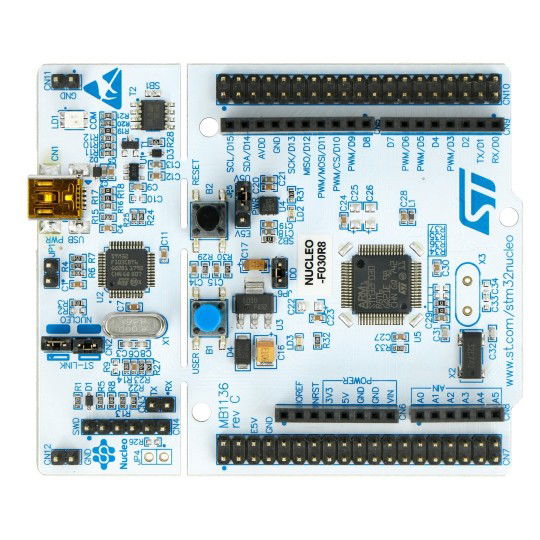
41.6.1. F030_bare
Folder: ../examples/F030_bare/
This is a STMCubeMX generated project without Trice instrumentation for easy compare with F030_inst to figure out the needed changes to set up trice.
Steps performed as potential guide:
- Install STM32CubeMX to
C:\SMT32SubeMX. - Select NUCLEO-F030R8 board.
- Initialize with default values.
- Optionally set system clock to 32MHz for faster target timestamps.
- Optionally set UART baud rate to 115200.
- Mantadory set UART data bits including parity to 9.
- Enable USART2 global interrupt.
- In Project Manager Project:
- Set toolchain folder location to
E:\repos\trice\examples\F030_bare\. - Set project name to
F030_bare. - Set toolchain / IDE to
Makefile.
- Set toolchain folder location to
- In Project Manager Code Generator:
- Select “Copy only the necessary library files”.
- In Project Manager Advanced Settings:
- In Driver Selector change all to LL.
- Generate Code
- Start VS Code and open folder F030_bare with it.
- Start a terminal and type
make. The output should be similar to:
PS E:\repos\trice\examples\F030_bare> make -j
mkdir build
arm-none-eabi-gcc -c -mcpu=cortex-m0 -mthumb -DUSE_FULL_LL_DRIVER -DHSE_VALUE=8000000 -DHSE_STARTUP_TIMEOUT=100 -DLSE_STARTUP_TIMEOUT=5000 -DLSE_VALUE=32768 -DHSI_VALUE=8000000 -DLSI_VALUE=40000 -DVDD_VALUE=3300 -DPREFETCH_ENABLE=1 -DINSTRUCTION_CACHE_ENABLE=0 -DDATA_CACHE_ENABLE=0 -DSTM32F030x8 -ICore/Inc -IDrivers/STM32F0xx_HAL_Driver/Inc -IDrivers/CMSIS/Device/ST/STM32F0xx/Include -IDrivers/CMSIS/Include -Og -Wall -fdata-sections -ffunction-sections -g -gdwarf-2 -MMD -MP -MF"build/main.d" -Wa,-a,-ad,-alms=build/main.lst Core/Src/main.c -o build/main.o
...
arm-none-eabi-gcc -x assembler-with-cpp -c -mcpu=cortex-m0 -mthumb -DUSE_FULL_LL_DRIVER -DHSE_VALUE=8000000 -DHSE_STARTUP_TIMEOUT=100 -DLSE_STARTUP_TIMEOUT=5000 -DLSE_VALUE=32768 -DHSI_VALUE=8000000 -DLSI_VALUE=40000 -DVDD_VALUE=3300 -DPREFETCH_ENABLE=1 -DINSTRUCTION_CACHE_ENABLE=0 -DDATA_CACHE_ENABLE=0 -DSTM32F030x8 -ICore/Inc -IDrivers/STM32F0xx_HAL_Driver/Inc -IDrivers/CMSIS/Device/ST/STM32F0xx/Include -IDrivers/CMSIS/Include -Og -Wall -fdata-sections -ffunction-sections -g -gdwarf-2 -MMD -MP -MF"build/startup_stm32F030x8.d" startup_stm32F030x8.s -o build/startup_stm32F030x8.o
arm-none-eabi-gcc build/main.o build/stm32f0xx_it.o build/stm32f0xx_ll_gpio.o build/stm32f0xx_ll_pwr.o build/stm32f0xx_ll_exti.o build/stm32f0xx_ll_usart.o build/stm32f0xx_ll_rcc.o build/stm32f0xx_ll_dma.o build/stm32f0xx_ll_utils.o build/system_stm32f0xx.o build/sysmem.o build/syscalls.o build/startup_stm32F030x8.o -mcpu=cortex-m0 -mthumb -specs=nano.specs -TSTM32F030R8Tx_FLASH.ld -lc -lm -lnosys -Wl,-Map=build/F030_bare.map,--cref -Wl,--gc-sections -o build/F030_bare.elf
C:/bin/ArmGNUToolchain/bin/../lib/gcc/arm-none-eabi/13.2.1/../../../../arm-none-eabi/bin/ld.exe: warning: build/F030_bare.elf has a LOAD segment with RWX permissions
arm-none-eabi-size build/F030_bare.elf
text data bss dec hex filename
2428 12 1564 4004 fa4 build/F030_bare.elf
arm-none-eabi-objcopy -O ihex build/F030_bare.elf build/F030_bare.hex
arm-none-eabi-objcopy -O binary -S build/F030_bare.elf build/F030_bare.bin
PS E:\repos\trice\examples\F030_bare>
- Install VS Code Cortex-Debug extension.
- Create a launch.json file inside the .vscode subfolder and edit it to get
{
// Use IntelliSense to learn about possible attributes.
// Hover to view descriptions of existing attributes.
// For more information, visit: https://go.microsoft.com/fwlink/?linkid=830387
"version": "0.2.0",
"configurations": [
{
"name": "Cortex Debug",
"cwd": "${workspaceFolder}",
"executable": "./build/F030_bare.elf",
"request": "launch",
"type": "cortex-debug",
"runToEntryPoint": "main",
"servertype": "jlink",
"device": "STM32F030R8",
"svdFile": "./STM32F030R8.svd",
"runToMain": true
}
]
}
- Download STM32G030.svd or get it from the STMCubeIDE installation folder if you want to install this Eclipse IDE as well, but IMHO you do not need it.
- You may need to extract and install the STM32 USB drivers. You can find them also in
./third_party/st.com/en.stsw-link009_v2.0.2.zip. - It is assumed, that you converted the OB ST-Link to an OB J-Link already. See Convert Evaluation Board onboard ST-Link to J-Link for details.
- Press the Debug-Button or “CTRL+SHIFT+D” and start debugging.
Hint
- During the code generation, the CubeMX tool did not copy
syscalls.candsysmem.cbut added them to the Makefile. This seems to be a STM32CubeMX “feature”.- You do not need these files for the example project, but you can add them manually to avoid some warnings or extend the code with:
__weak int _close(void) { return -1; } __weak int _lseek(void) { return -1; } __weak int _read (void) { return -1; } __weak int _write(void) { return -1; }
- You do not need these files for the example project, but you can add them manually to avoid some warnings or extend the code with:
41.6.2. F030_inst
Folder: ../examples/F030_inst/
This is a working example with deferred encrypted out over UART. By uncommenting 2 lines in triceConfig.h, you get also parallel direct out over RTT. For setup see Trice over RTT and adapt steps from F030_bare.
Intrumenting:
- Extend the Makefile with the information you get from comparing the Makefile here and in ../F030_bare/.
- Add build.sh and clean.sh.
- Copy and adapt
Config/SEGGER_RTT_Conf.hfrom the stored SEGGER_RTT_V812a.zip to ./Core/Inc/ if creating a new project. Existing examples already contain their configuration; see Third-party packages and retained versions. - Copy and adapt a file triceConfig.h to ./Core/Inc/. You can choose from another example project or one of the test folders.
- Create 2 empty files:
touch til.json li.jsoninside ./ - Run
build.sh. This should build all. - Add
#include "trice.h"to main.c and to stm32f0xx_it.c and edit these files according to diff. -
Add to
int main( void )someTrice( "..." );messages. - Run
trice sto determine the relevant comport. -
You can have this output:
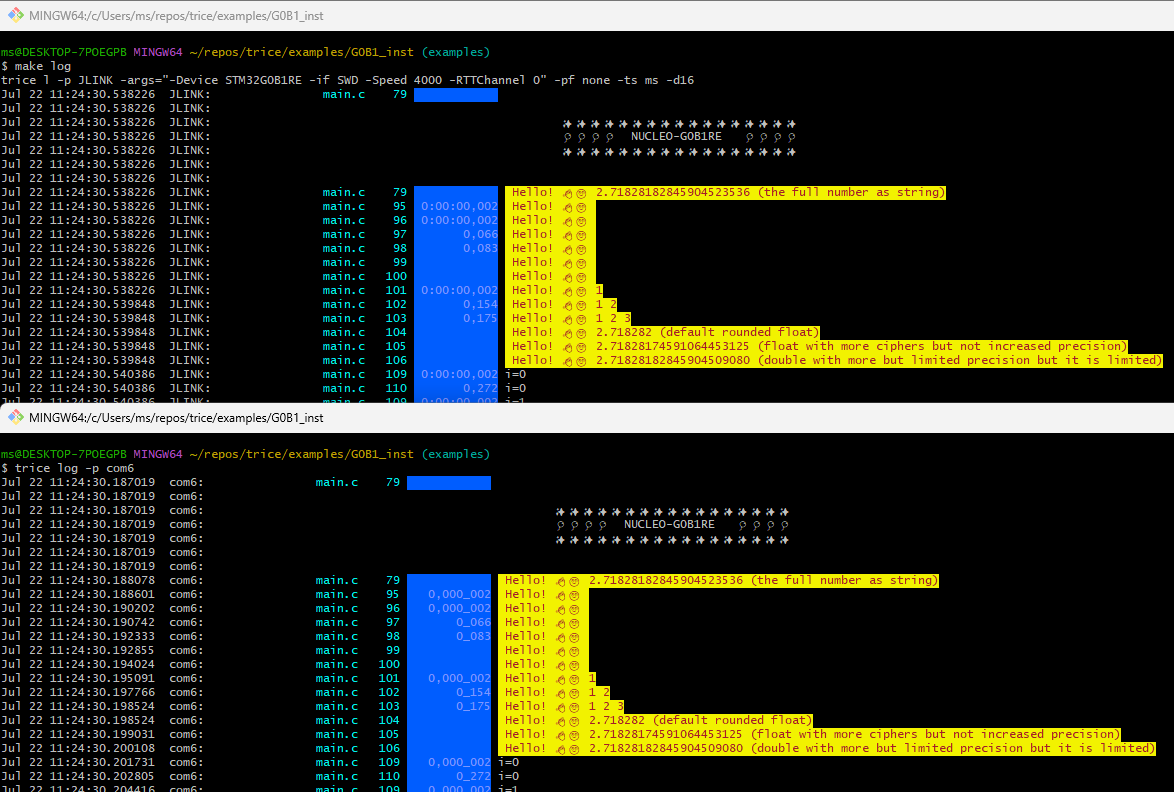
- The Trices with 16-bit timestamps are about 150 clocks away from each other. @32MHz this is a time of less 5 µs.
41.7. Nucleo-G0B1 Examples
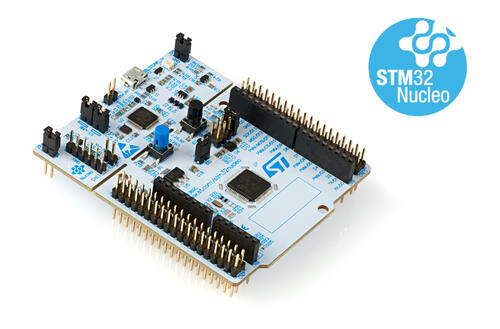
41.7.1. G0B1_bare
Folder: ../examples/G0B1_bare/
<h5>G0B1_bare Description</h5>
- This is a working example with CLang and also GCC.
- This is a STMCubeMX generated project. It was then manually adapted to Clang.
- It is without TRICE instrumentation for easy compare with ../G0B1_inst to figure out the needed changes to set up trice.
- See and adapt steps from F030_bare.
- Then add/modify the files to reach this folder layot.
41.7.2. G0B1_inst
Folder: ../examples/G0B1_inst/
This is an example with direct out without framing over RTT and deferred out in TCOBS framing over UART.
- See and adapt steps from G0B1_bare.
- The steps are similar to the steps in F030_bare.
- See comments in triceConfig.h and commandlines in screenshot.
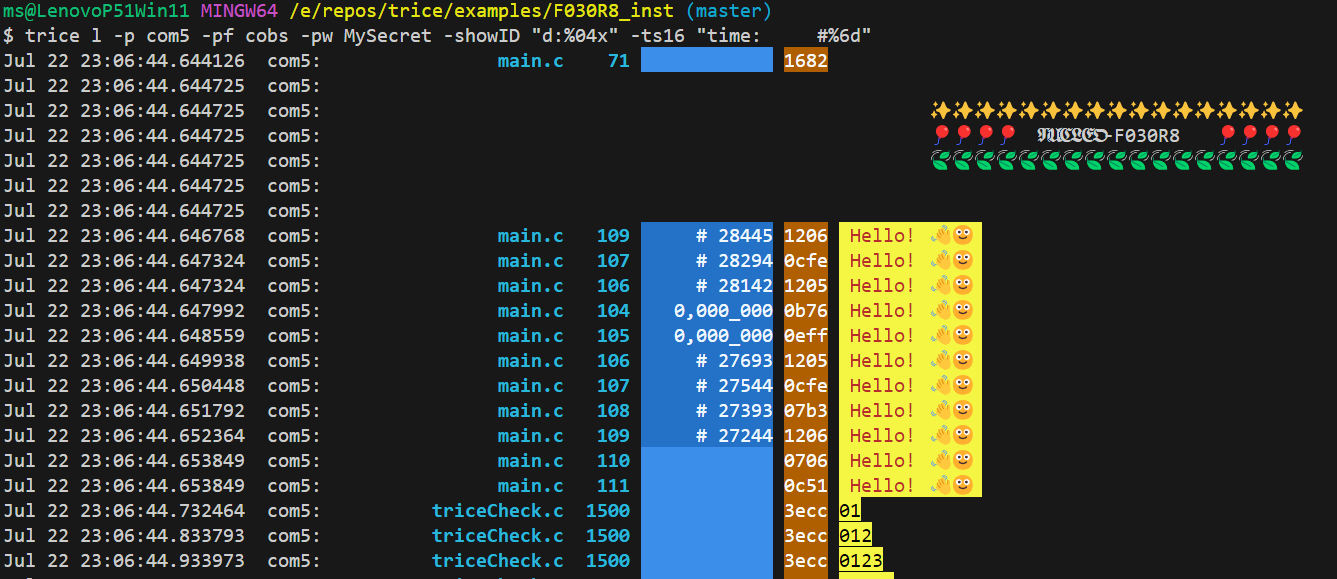
41.8. Nucleo-L432KC Examples

41.8.1. L432_bare
Folder: ../examples/L432_bare/
- This example is without Trice istrumentation and serves for comparing with L432_inst to see the needed instrumentation steps quickly.
- This is a STMCubeMX generated project.
- See and adapt steps from F030_bare example.
- It was then manually adapted additionally to Clang.
- It was additionally configured for FreeRTOS.
41.8.2. L432_inst
Folder: ../examples/L432_inst/
- This is the with Trice instrumented example project L432_bare.
- It is for easy compare to figure out the needed setup changes.
- See and adapt steps in F030_bare.
- Then add/modify the files to reach this folder layout.
Build:
Run ./build.sh for configuration 0 or ./build.sh CONFIGURATION=34 for example.
Deferred Mode for max Speed
The stamps are MCU clocks here, so 🐁 Speedy Gonzales lasts 9 processor clocks here.
ms@DESKTOP-7POEGPB MINGW64 ~/repos/trice_wt_devel/examples/L432_inst (devel)
$ trice l -p com8 -hs off -prefix off
triceExamples.c 10 0_272 Hello! 👋🙂
✨✨✨✨✨✨✨✨✨✨✨✨✨✨✨✨✨
🎈🎈🎈🎈 𝕹𝖀𝕮𝕷𝕰𝕺-L432KC 🎈🎈🎈🎈
🍃🍃🍃🍃🍃🍃🍃🍃🍃🍃🍃🍃🍃🍃🍃🍃🍃
triceConfig.h 369 CONFIGURATION == 34 - UART, no cycle counter, no critical sections.
triceExamples.c 45 TRICE_DIRECT_OUTPUT == 0, TRICE_DEFERRED_OUTPUT == 1
triceExamples.c 51 TRICE_DOUBLE_BUFFER, TRICE_MULTI_PACK_MODE
triceExamples.c 60 _CYCLE == 0, _PROTECT == 0, _DIAG == 0, XTEA == 0
triceExamples.c 61 _SINGLE_MAX_SIZE=512, _BUFFER_SIZE=580, _DEFERRED_BUFFER_SIZE=4096
triceExamples.c 15 0,000_731 🐁 Speedy Gonzales
triceExamples.c 16 0,000_745 🐁 Speedy Gonzales
triceExamples.c 17 0,000_754 🐁 Speedy Gonzales
triceExamples.c 18 0,000_763 🐁 Speedy Gonzales
triceExamples.c 19 0,000_772 🐁 Speedy Gonzales
triceExamples.c 20 0,000_781 🐁 Speedy Gonzales
triceExamples.c 21 0,000_790 🐁 Speedy Gonzales
triceExamples.c 22 0,000_799 🐁 Speedy Gonzales
triceExamples.c 24 0_981 2.71828182845904523536 <- float number as string
triceExamples.c 25 1_230 2.71828182845904509080 (double with more ciphers than precision)
triceExamples.c 26 1_268 2.71828174591064453125 (float with more ciphers than precision)
triceExamples.c 27 1_296 2.718282 (default rounded float)
triceExamples.c 28 1_310 A Buffer:
triceExamples.c 29 1_348 32 2e 37 31 38 32 38 31 38 32 38 34 35 39 30 34 35 32 33 35 33 36
triceExamples.c 30 1_603 31372e32 31383238 34383238 34303935 35333235
triceExamples.c 31 1_799 ARemoteFunctionName(2e32)(3137)(3238)(3138)(3238)(3438)(3935)(3430)(3235)(3533)(3633)
triceExamples.c 32 10 times a 16 byte long Trice messages, which not all will be written because of the TRICE_PROTECT:
triceExamples.c 34 2_072 i=44444400 aaaaaa00
triceExamples.c 34 2_119 i=44444401 aaaaaa01
triceExamples.c 34 2_166 i=44444402 aaaaaa02
- The used evaluation board is delivered with an on-board ST-Link software for debugging.
- This was changed to an on-board J-Link software for better debugging and RTT support.
- See Trice over RTT about that.
<h5>Using RTT with on-board J-Link and JLinkRTTLogger</h5>
- You need to install the “J-Link Software and Documentation pack” for yout OS.
- ./Core/Inc/triceConfig.h contains example Trice log commands.
<h5>Using RTT with on-board J-Link and OpenOCD</h5>
<h6>With Windows not possible</h6>
- OpenOCD does not support the installed JLink driver.
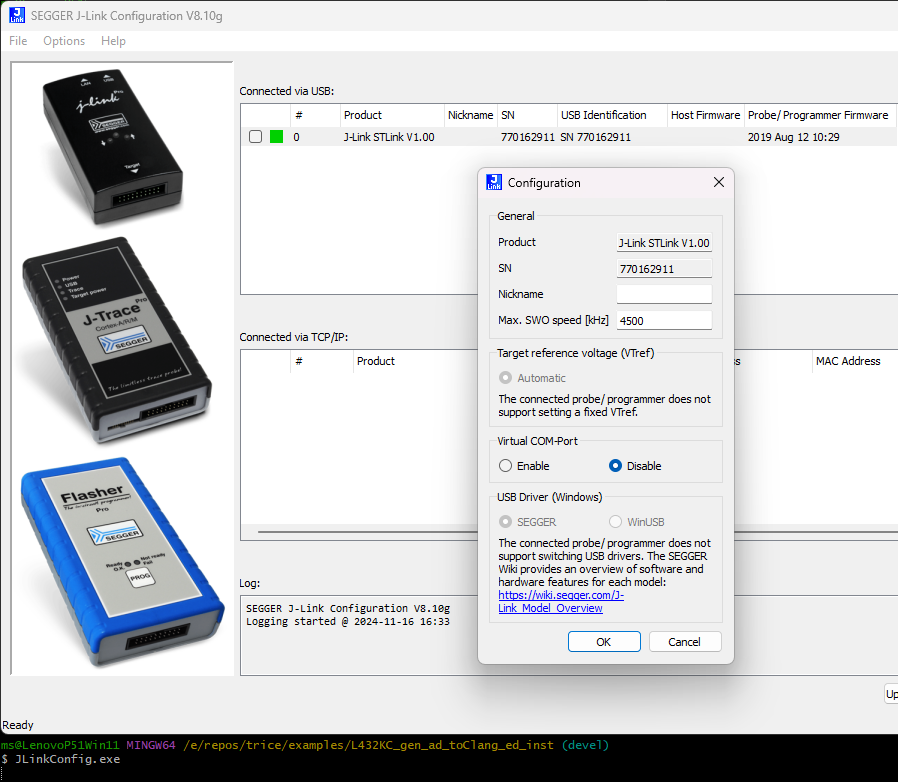
- Changing to the WinUSB buld device driver is here not supported :-(
- See OpenOCD with Darwin in Trice over RTT
<h5>Using RTT with on-board ST-Link and OpenOCD</h5>
Terminal 1:
ms@LenovoP51Win11 MINGW64 /e/repos/trice/examples/L432_inst (devel)
$ openocd -f STLinkOpenOCD.cfg
Open On-Chip Debugger 0.12.0 (2024-09-16) [https://github.com/sysprogs/openocd]
Licensed under GNU GPL v2
libusb1 d52e355daa09f17ce64819122cb067b8a2ee0d4b
For bug reports, read
http://openocd.org/doc/doxygen/bugs.html
Info : The selected transport took over low-level target control. The results might differ compared to plain JTAG/SWD
Info : clock speed 100 kHz
Info : STLINK V2J24M11 (API v2) VID:PID 0483:374B
Info : Target voltage: 72.811768
Info : [stm32l4x.cpu] Cortex-M4 r0p1 processor detected
Info : [stm32l4x.cpu] target has 6 breakpoints, 4 watchpoints
Info : [stm32l4x.cpu] Examination succeed
Info : [stm32l4x.cpu] starting gdb server on 3333
Info : Listening on port 3333 for gdb connections
Info : rtt: Searching for control block 'SEGGER RTT'
Info : rtt: Control block found at 0x2000145c
Info : Listening on port 9090 for rtt connections
Channels: up=1, down=3
Up-channels:
0: Terminal 1024 0
Down-channels:
0: Terminal 16 0
Info : Listening on port 6666 for tcl connections
Info : Listening on port 4444 for telnet connections
Terminal2:
ms@LenovoP51Win11 MINGW64 /e/repos/trice/examples/L432_inst (devel)
$ trice l -p TCP4 -args localhost:9090 -pf none -d16
Nov 16 20:38:12.376056 TCP4: triceExamples.c 10 1_595 Hello! 👋🙂
Nov 16 20:38:12.376056 TCP4:
Nov 16 20:38:12.376056 TCP4: ✨✨✨✨✨✨✨✨✨✨✨✨✨✨✨✨✨
Nov 16 20:38:12.376056 TCP4: 🎈🎈🎈🎈 𝕹𝖀𝕮𝕷𝕰𝕺-L432KC 🎈🎈🎈🎈
Nov 16 20:38:12.376056 TCP4: 🍃🍃🍃🍃🍃🍃🍃🍃🍃🍃🍃🍃🍃🍃🍃🍃🍃
Nov 16 20:38:12.376056 TCP4:
Nov 16 20:38:12.376056 TCP4:
Nov 16 20:38:13.891033 TCP4: triceExamples.c 16 43_439 2.71828182845904523536 <- float number as string
Nov 16 20:38:14.874024 TCP4: triceExamples.c 17 44_949 2.71828182845904509080 (double with more ciphers than precision)
Nov 16 20:38:15.692614 TCP4: triceExamples.c 18 45_802 2.71828174591064453125 (float with more ciphers than precision)
Nov 16 20:38:16.323665 TCP4: triceExamples.c 19 46_536 2.718282 (default rounded float)
<h5>Using On-board ST-Link and VS-Code Cortex-Debug Extension</h5>
- https://www.st.com/resource/en/user_manual/um2576-stm32cubeide-stlink-gdb-server-stmicroelectronics.pdf
- Downloaded and installed
en.stm32cubeprg-win64-v2-17-0.zipen.st-link-server-v2-1-1.zip- PATH variable extended with
C:\Program Files (x86)\STMicroelectronics\stlink_server - Copied
- From: “C:\Program Files (x86)\STMicroelectronics\stlink_server\stlinkserver.exe”
- To: “C:\Program Files (x86)\STMicroelectronics\stlink_server\ST-LINK_gdbserver.exe”
- PATH variable extended with
- Download st-util from github.com
- Unpack to
C:\bin\stlink-1.8.0-win32and addC:\bin\stlink-1.8.0-win32\binto path - Copy
C:\bin\stlink-1.8.0-win32\Program Files (x86)\stlinktoC:\Program Files (x86)\stlink - Get
C:\bin\libusb-1.0.27 - Copy
C:\bin\libusb-1.0.27\MinGW64\dll\libusb-1.0.dlltoC:\bin\stlink-1.8.0-win32\bin\libusb-1.0.dllms@LenovoP51Win11 MINGW64 /e/repos/trice/examples/L432_inst (devel) $ st-util.exe st-util 1.8.0 libusb: info [get_guid] no DeviceInterfaceGUID registered for 'USB\VID_056A&PID_5105\5&1140C04&0&10' libusb: info [get_guid] no DeviceInterfaceGUID registered for 'USB\VID_056A&PID_5105&MI_01\6&13339912&0&0001' libusb: info [get_guid] no DeviceInterfaceGUID registered for 'USB\VID_058F&PID_9540\5&1140C04&0&11' libusb: info [get_guid] no DeviceInterfaceGUID registered for 'USB\VID_8087&PID_0A2B\5&1140C04&0&14' libusb: info [get_guid] no DeviceInterfaceGUID registered for 'USB\ROOT_HUB30\4&20F1DF2E&0&0' libusb: info [get_guid] no DeviceInterfaceGUID registered for 'USB\VID_0765&PID_5010\5&1140C04&0&13' libusb: info [get_guid] no DeviceInterfaceGUID registered for 'USB\VID_0483&PID_374B&MI_01\6&224DEA1D&0&0001' libusb: info [get_guid] no DeviceInterfaceGUID registered for 'USB\VID_5986&PID_111C&MI_00\6&104790C2&0&0000' libusb: info [get_guid] no DeviceInterfaceGUID registered for 'USB\VID_046D&PID_C534\5&1140C04&0&6' libusb: info [get_guid] no DeviceInterfaceGUID registered for 'USB\VID_0483&PID_374B&MI_02\6&224DEA1D&0&0002' libusb: info [get_guid] no DeviceInterfaceGUID registered for 'USB\VID_0483&PID_374B\066CFF515570514867145144' libusb: info [get_guid] no DeviceInterfaceGUID registered for 'USB\VID_138A&PID_0097\72FA8C531499' libusb: info [get_guid] no DeviceInterfaceGUID registered for 'USB\VID_056A&PID_5105&MI_00\6&13339912&0&0000' libusb: info [get_guid] no DeviceInterfaceGUID registered for 'USB\VID_046D&PID_C534&MI_01\6&C944391&0&0001' libusb: info [get_guid] no DeviceInterfaceGUID registered for 'USB\VID_046D&PID_C534&MI_00\6&C944391&0&0000' libusb: info [get_guid] no DeviceInterfaceGUID registered for 'USB\VID_5986&PID_111C\200901010001' 2024-11-17T22:20:05 INFO common.c: STM32L41x_L42x: 48 KiB SRAM, 256 KiB flash in at least 2 KiB pages. 2024-11-17T22:20:05 INFO gdb-server.c: Listening at *:4242... Receive signal 0. Exiting...(Last line after
CTRL-C)
42. Trice Generate
For a compact, readable copy of the ID dictionaries, run trice generate -onelineJSON -til til.json -li li.json. This writes til.oneline.json and li.oneline.json in -genDir (default ./generated) as complete JSON objects with one ID entry per line. In the LI copy, each entry shows Line before File. The original files remain authoritative and unchanged; rerun the command after updating them. Use -li off to export only the TIL copy. Missing or invalid requested input files cause an error without replacing either copy. This option cannot be combined with -logC or -abc.
42.1. Colors
Support for finding a color style:
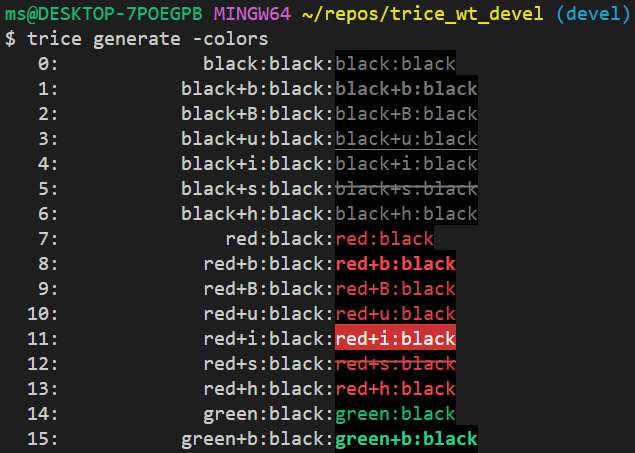
See Check Alternatives chapter.
42.2. C-Code
To generate a compact C metadata table for current target-side Trice sites, first run trice insert or trice bind and then run trice generate -src <source> -logC[=<output.c>]. Multiple -src options are accepted. Explicit Insert IDs and numeric Bind sidecar descriptors are validated against the selected TIL; no ID is guessed from a matching format string. Historical TIL entries that are absent from the selected sources are omitted without changing the TIL itself. Bind sidecars are read from ./generated by default; specify -genDir for a different directory. Bare -logC writes ./generated/til.c; an explicit output path takes precedence. -logC and -abc are alternative generation modes and cannot be combined.
Commented Trice calls with explicit Insert IDs remain selectable. An ID-free call that exists only in a C comment has no Bind preprocessor site and therefore no exact sidecar ID; -logC reports it instead of guessing or silently omitting it. Use trice insert for such retained commented calls, give the commented example an explicit authoritative ID, or exclude that source from this generated table.
// SPDX-License-Identifier: MIT
#include "triceRx.h"
const triceLog_t triceLog[] = {
/* Trice type ( extended ) */ /* id, bitWidth, paramCount, format-string */
/* trice ( trice_0 ) */ { 1000u, 32u, 0u, "ready\n" },
/* trice ( trice32_2 ) */ { 1001u, 32u, 2u, "value=%d hex=%x\n" },
};
const unsigned triceLogElements = sizeof(triceLog) / sizeof(triceLog[0]);
42.3. C#-Code
The current trice generate command does not provide a C# source generator. C# applications can read the generated til.json as input to their own decoder or use the Trice host tool to produce text, JSON, or KV output.
42.4. Generating a Trice ABC Function Pointer List
Use -abc=<target> to generate the target-specific ABC receive selection and table files:
trice generate -i til.json -abc=deviceX
Run from the project directory. This creates generated/deviceX.h if it does not exist, otherwise uses it as the user-edited selection input. It always regenerates generated/deviceX.c from til.json and the active declarations in generated/deviceX.h. -genDir changes the generated directory; an explicit target path such as -abc=custom/deviceX keeps that path. For the workflow and examples see Trice ABC - Asynchronous Broadcast Commands.
43. Testing the Trice Library C-Code for the Target
43.1. General info
This folder is per default named to _test to avoid VS Code slow down. Also, when running go test ./..., the tests in the _test folder are excluded, because they take a long time. Run ./scripts/testAll.sh to include them.
The main aim of these tests is to automatic compile and run the target code in different compiler switch variants avoiding manual testing this way.
scripts/testAll.sh quick performs the standard Bind compiler matrices and focused CE/SL checks for both Bind and Insert/Clean. scripts/testAll.sh full also runs the complete legacy Insert/Clean and extended compiler matrices; its duration depends strongly on the host. The runner orders short checks before long matrices and shows a hardware-independent percentage of expected relative test work. On an interactive terminal, a spinner changes in place every few seconds during a long step; it does not add repeated log lines or claim a time-based ETA.
Each result line shows the elapsed time for that script before its name, with right-aligned minutes and seconds: [24/26 | ~ 76.7%] ( 4m 30s) _620_test_l432_configs.sh: PASS. The format is (%3dm%3ds); four hours appear as (240m 0s). This measures elapsed time including any preparation and restoration performed by the script, not accumulated CPU time or time since the entire suite started. The same column appears for WARN, FAIL and ABORTED, and is saved in temp/log/testAll_summary.log. The interactive spinner updates the current script’s elapsed time in place.
Both selections include step 515, which runs the existing compiler-to-decoder CE/SL checks and the feature examples:
| Check | Evidence |
|---|---|
TestContextEnrichmentTargetToDecoder and TestContextInsertCleanTargetToDecoder |
Real C/C++ records, text/JSON/KV output, structured fields, stamps, reversible Insert/Clean, disabled logging and exactly-once argument evaluation. |
TestContextEnrichmentPoC and TestContextEnrichmentPoCRebaseScopeBoundary |
Retained proofs for direct callsites and the scope limitation of the existing Rebase dispatcher. |
| PC feature example | Runtime string, fields, stamps/deltas, CE, tag filtering and KV output from the built example. |
| G0B1 feature example | Firmware build, task-context adapter, runtime-string and structured-field metadata, nonempty ELF/HEX/BIN artifacts. This does not execute the firmware on an MCU. |
The compiler/decoder checks require Go, Clang, Clang++ and clangd. The examples require the current repository’s trice tool, Git and tar; the PC example needs cc or gcc, and G0B1 needs Make and ARM GNU GCC/objcopy/size with its bare-metal libraries. In quick, an unavailable group is explicitly skipped and the runner shows WARN. In full, missing tools make this step fail. A selected Go test that reports SKIP, or fails to report its named PASS, is also an error. This prevents an empty test selection from appearing to validate the features. The shared Library CI workflow invokes this same step in full mode.
The example checks run in a fresh copy under temp/log/logging-features.*. It contains the current bytes of tracked sources, including uncommitted source edits, and the same relative layout as the checkout. Existing captures, generated directories and object files are not reused or modified. Successful copies are removed; failed copies remain for inspection. Details are written to temp/log/_515_test_logging_features.log. Run just this acceptance step from the repository root with:
./scripts/_480_test_build_trice_tool.sh
./scripts/_515_test_logging_features.sh full
The larger experimental CE Rebase/Wrapper proof remains a separate, explicit investigation. It does not establish productive support for those constructs. To rerun it with the locally available compiler variants:
TRICE_BIND_INTEGRATION=1 go test ./internal/id -run '^TestContextEnrichmentRebasePoC$' -count=1 -v
It reports unavailable compiler variants and optional clangd evidence; missing variants are not platform acceptance. Ordinary Go unit/coverage runs continue to cover SL parser/renderer behavior; step 515 selects only the additional compiler checks instead of repeating those suites.
The PC matrix uses four independent configuration processes by default. Set TRICE_PC_TEST_JOBS=1 for serial execution or choose another positive limit. ID preparation and source restoration remain sequential. A failing configuration stops at its first mismatch. testAll.sh continues with the remaining configurations and test steps by default (--no-stop), but the final result remains FAIL if any check failed. Use --stop to stop after the first failure; cancellation always stops the run. Failure summaries include source references, expected/actual output and the detailed log path.
For example, from the repository root:
TRICE_PC_TEST_JOBS=4 ./scripts/_640_test_pc_targets_bind.sh full
TRICE_PC_TEST_JOBS=1 TRICE_PC_TEST_MODE=line-by-line ./scripts/_630_test_pc_targets_insert.sh full
The second command explicitly selects the diagnostic single-expectation path. Normal runs use TRICE_PC_TEST_MODE=auto: bulk where packet boundaries are preserved, single-expectation decoding for unframed or special configurations. All expectations remain enabled.
The L432 matrix builds all 101 configurations (CONFIGURATION=0 through 100). It prepares the shared Bind state once and builds configurations concurrently, each with make -j1. The default concurrency follows the online CPU count; on Windows it uses the bounded budget from the shared build setup, which prefers physical cores. If detection fails, the matrix uses four jobs. Set TRICE_L432_TEST_JOBS=1 for serial execution or choose another positive limit; this limits the total number of simultaneous compiler/linker commands, even when MAKE_JOBS normally requests unlimited parallelism. For example, to limit a run to four jobs from the repository root:
TRICE_L432_TEST_JOBS=4 ./scripts/_620_test_l432_configs.sh
Every invocation uses fresh, separate object directories for every configuration. All code-generation options, source files and ELF/HEX/BIN targets remain enabled; there is no reuse of potentially stale objects after a header, configuration, workflow or compiler change. The matrix skips the expensive assembler .lst text listings (GCC_LISTINGS=0); compiler warnings and errors remain enabled. Ordinary build.sh CONFIGURATION=N builds still generate listings for manual inspection. Existing examples/L432_inst/out.gcc builds remain untouched by the matrix. Full compiler logs stay in temp/log/l432.*/config-N.log. Successful temporary build outputs are removed to save disk space; failed or interrupted outputs are retained beside their logs.
The matrix reports each configuration’s result, prints compiler error excerpts and gives the command to reproduce a failure. Under testAll.sh, the selected --no-stop or --stop policy applies. A directly invoked L432 matrix stops after a failed batch by default; use TRICE_TEST_NO_STOP=1 to finish the remaining configurations. Already started jobs finish before source restoration. Cancellation terminates the compiler processes too and prevents further configurations from starting. The managed wrapper above restores the initial source and metadata state on success, failure and cancellation; a direct examples/L432_inst/all_configs_build.sh invocation performs the same Bind preparation as build.sh and leaves sources in Bind state.
- Partial tests:
- In
./examplesyou can build the target examples with./buildAllTargets_TRICE_ON.shor./buildAllTargets_TRICE_OFF.sh. - In
./examples/L432_instthe scriptall_configs_build.shtranslates many different configurations.
- In
For the user it could be helpful to start with a triceConfig.hfile from here and to adapt the Trice tool command line from the matching cgo_test.go if no close match in the examples folder was found.
43.2. How to run the tests
- Host compiler prerequisites:
- CGO and host-side target-code tests need a working host C compiler, not only a compiler executable in
PATH. - On Windows, TDM-GCC or another matching MinGW-w64 GCC installation can provide the host compiler and C runtime.
- Some Go regression tests execute every supported compiler found in
PATH, includingclang. If Clang is visible, verify it first withprintf '#include <string.h>\n' | clang -std=c99 -fsyntax-only -x c -. - Keep
C_INCLUDE_PATHunset globally so ARM cross-compiler headers do not leak into host and CGO builds.
- CGO and host-side target-code tests need a working host C compiler, not only a compiler executable in
- From the repository root, execute
go clean -cacheafter editing C files if CGO tests appear to reuse precompiled files. - Normal tests use an overlay for the shared CGO test files. If you deliberately need to renew IDs and generated test files after editing
./examplesor_test, review the wider effects of./scripts/_330_renew_ids_and_refresh_tests.shand usekeepHistoryto preserve the existing ID tables. - To run direct Go tests from the repository root, use a repo-local Go cache if needed:
GOCACHE="$PWD/.gocache" go test ./...on POSIX shells, or$env:GOCACHE = "$PWD/.gocache"; go test ./...in PowerShell. The.gocache/folder is ignored by Git. - To run the tests manually
cdinto_testand executetrice insert -i ../demoTIL.json -li ../demoLI.jsonand thengo test ./...from there. It is more convenient to runscripts/_230_legacy_insert_ids.shfrom the Trice root folder. - It is convenient to run
scripts/testAll.shfrom the Trice root folder to perform this. scripts/testAll.shcreates its local helper artifacts inside the ignored./temp/logfolder. The versioneddemoTIL.jsonanddemoLI.jsonfiles in the repository root stay available as example reference files. WhenGOCACHEis unset,scripts/testAll.shalso uses the ignored repo-local cache folder./.gocache.- A script name beginning with
_marks an internal helper or an individually runnable test step. Its three-digit prefix groups the flatscriptsfolder:100–250are shared workflow helpers,260–330are maintenance helpers, and400–640are tests ordered broadly from short checks to long compiler matrices. - It is possible to start the tests individually, but for some the default
-timeout 30smaybe too short.
43.3. Tests Details
All folders despite testdata are test folders and the name tf is used as a place holder for them in this document.
To exclude a specific folder temporary, simply rename it to start with an underscore _tf.
The tf are serving for target code testing in different configuration variants on the host machine. The file ./testdata/triceCheck.c is the main file for most tests and serves also as example usage.
_test/testdata/cgoPackage.go is the common main for the generated_cgoPackage.go files and contains the common test code.
The folders tf are Go packages just for tests. They all have the same package name cgot and are not included into the trice tool. The different cgot packages are independent and could have any names. They do not see each other and are used for target code testing independently. When the tests are executed for each package, a separate test binary is build and these run parallel.
The tf/triceConfig.h files differ and correspondent to the tf/cgo_test.go files in the same folder. On test execution, the ./testdata/*.c files are compiled into the trice test executable together with the trice sources ../src using the tf/triceConfig.h file.
The individual tests collect the expected results (//exp: result) together with the line numbers into a slice to execute the test loop on it. The triceLogTest function gets the triceLog function as parameter.
triceLogTest iterates over the results slice and calls for each line the C-function triceCheck. Then the line specific binary data buffer is passed to the triceLog parameter function which “logs” the passed buffer into an actual result string which in turn is compared with the expected result.
The bulk path still executes each C test site. It collects binary output and starts the host logger once per output channel, then compares every expected text range with its source line. This avoids repeated logger initialization. Finite replay inputs finish when their buffered records are drained; they do not wait for a fixed timeout after each expectation.
Framed direct and deferred channels are collected separately. Configurations that previously transferred after every test site retain that transfer schedule, so small target buffers cannot overflow merely because host decoding is batched. Existing deferred bulk tests retain their multi-site transfer schedule to exercise buffering. Unframed configurations keep the single-expectation path because concatenation can lose packet boundaries or change padding interpretation. Successful bulk runs are not repeated completely line by line.
Each configuration has its own output.log below temp/log/pc-<workflow>.<run>/. On a bulk mismatch, the original binary and text output are saved there, and the worker reruns that configuration line by line. A passing diagnostic rerun does not clear the bulk failure: it points to an interaction involving framing, buffering or state. The reported source line is the first divergent expectation, which may follow the actual cause. Expected and actual strings show escaped control characters; nearby text helps identify shifts. The failure report also gives a reproduction command, which requires the same prepared ID state and compiler include paths. Run directories are retained for diagnosis; subsequent runs use a new directory.
The testdata\cgoPackage.go file contains a variable testLines = n, which limits the amount of performed trices for each test case to n. Changing this value will heavily influence the test duration. The value -1 is reserved for testing all test lines.
43.4. How to add new test cases
- Choose a test folder similar to the intended test and copy it under a new descriptive name like
newTest. - Add the new package to the test-folder list in
scripts/_330_renew_ids_and_refresh_tests.shif it should receive refreshed generated test files. - Edit files
newTest/triceConfig.handnewTest/cgo_test.goin a matching way. - Run
go test ./_test/newTestfrom the repository root.
43.5. Test Internals
The ./trice/_test/testdata/*.c and ./trice/src/*.c are compiled together with the actual cgot package into one single Trice test binary, resulting in as many test binaries as there are test folders. Calling its TeCEFunction(s) causes the activation of the Trice statement(s) inside triceCheck.c. The ususally into an embedded device compiled Trice code generates a few bytes according to the configuration into a buffer. These bytes are transmitted usually in real life over a (serial) port or RTT. In the tests here, this buffer is then read out by the Trice tool handler function according to the used CLI switches and processed to a log string using the til.json file. This string is then compared to the expected string for the activated line.
Each tf is a Go package, which is not part of any Go application. They are all named cgot and are only used independently for testing different configurations. The tf/generated_cgoPackage.go file is identical in all tf. Its master is _test/testdata/cgoPackage.go. The test worker overlays the master during normal test runs. The maintenance script ./scripts/_330_renew_ids_and_refresh_tests.sh copies the master into the listed packages, but also renews IDs and clears ID history by default; use keepHistory only when you deliberately run that wider maintenance workflow.
The test specific target code configuration is inside tf/trice.Config.h and the appropriate Trice tool CLI switches are in tf/cgo_test.go.
When running go test ./tf, a Trice tool test executable is build, using the Trice tool packages and the tf package cgot, and the function TestLogs is executed. Its internal closure triceLog contains the Trice tool CLI switches and is passed to the ccgot package function triceLogTest together with the number of testLines and the trice mode (directTransfer or deferrerdTransfer).
During the test, the file triceCheck.c is scanned for lines like
break; case __LINE__: TRice( iD(3537), "info:This is a message without values and a 32-bit stamp.\n" ); //exp: time: 842,150_450default: info:This is a message without values and a 32-bit stamp.
Some C-code lines contain Trice statements and comments starting with //exp: followed by the expected Trice tool output for that specific line. The Go teCEFunction collects these outputs in a slice together with the line numbers. Then for each found line number the execution of the Go function func triceCheck(n int) takes part, which in turn calls the CGO compiled C-function TriceCheck(n). The now activated Trice C-code writes the generated trice bytes in a between C and Go shared buffer using the C-function TriceWriteDeviceCgo. After returning from the Go function func triceCheck(n int) and optionally calling TriceTransfer in deferred mode the Trice tool triceLog() function converts the Trice buffer bytes to the log string and compares the result with the expected data. The between Go and C shared buffer limits the executed Trices per line to one, because they use the same buffer from the beginning. This could be done better with an increment to allow several trices in one single line.
Because each test runs a different configuration, all possible combinations are testable.
43.6. Test Results
ms@DESKTOP-7POEGPB MINGW64 ~/repos/trice (main)
$ ./scripts/testAll.sh
Thu, Dec 12, 2024 4:51:26 PM
This can take several minutes ...
? github.com/rokath/trice/internal/decoder [no test files]
? github.com/rokath/trice/internal/do [no test files]
? github.com/rokath/trice/internal/translator [no test files]
? github.com/rokath/trice/pkg/ant [no test files]
ok github.com/rokath/trice/cmd/trice 1.392s
ok github.com/rokath/trice/internal/args 0.415s
ok github.com/rokath/trice/internal/charDecoder 0.298s
ok github.com/rokath/trice/internal/com 15.845s
ok github.com/rokath/trice/internal/dumpDecoder 0.339s
ok github.com/rokath/trice/internal/emitter 0.326s
ok github.com/rokath/trice/internal/id 3.088s
ok github.com/rokath/trice/internal/keybcmd 0.233s
ok github.com/rokath/trice/internal/link 0.196s
ok github.com/rokath/trice/internal/receiver 0.246s
? github.com/rokath/trice/internal/translator [no test files]
? github.com/rokath/trice/pkg/ant [no test files]
ok github.com/rokath/trice/cmd/trice 1.392s
ok github.com/rokath/trice/internal/args 0.415s
ok github.com/rokath/trice/internal/charDecoder 0.298s
ok github.com/rokath/trice/internal/com 15.845s
ok github.com/rokath/trice/internal/dumpDecoder 0.339s
ok github.com/rokath/trice/internal/emitter 0.326s
ok github.com/rokath/trice/internal/id 3.088s
ok github.com/rokath/trice/internal/keybcmd 0.233s
ok github.com/rokath/trice/internal/link 0.196s
ok github.com/rokath/trice/internal/receiver 0.246s
ok github.com/rokath/trice/internal/trexDecoder 0.264s
ok github.com/rokath/trice/pkg/cipher 0.230s
ok github.com/rokath/trice/pkg/endian 0.161s
ok github.com/rokath/trice/internal/args 0.415s
ok github.com/rokath/trice/internal/charDecoder 0.298s
ok github.com/rokath/trice/internal/com 15.845s
ok github.com/rokath/trice/internal/dumpDecoder 0.339s
ok github.com/rokath/trice/internal/emitter 0.326s
ok github.com/rokath/trice/internal/id 3.088s
ok github.com/rokath/trice/internal/keybcmd 0.233s
ok github.com/rokath/trice/internal/link 0.196s
ok github.com/rokath/trice/internal/receiver 0.246s
ok github.com/rokath/trice/internal/trexDecoder 0.264s
ok github.com/rokath/trice/pkg/cipher 0.230s
ok github.com/rokath/trice/pkg/endian 0.161s
ok github.com/rokath/trice/internal/id 3.088s
ok github.com/rokath/trice/internal/keybcmd 0.233s
ok github.com/rokath/trice/internal/link 0.196s
ok github.com/rokath/trice/internal/receiver 0.246s
ok github.com/rokath/trice/internal/trexDecoder 0.264s
ok github.com/rokath/trice/pkg/cipher 0.230s
ok github.com/rokath/trice/pkg/endian 0.161s
ok github.com/rokath/trice/pkg/msg 0.157s
ok github.com/rokath/trice/pkg/tst 0.261s
ok github.com/rokath/trice/_test/be_dblB_de_tcobs_ua 123.142s
ok github.com/rokath/trice/_test/be_staticB_di_xtea_cobs_rtt32 123.159s
ok github.com/rokath/trice/internal/trexDecoder 0.264s
ok github.com/rokath/trice/pkg/cipher 0.230s
ok github.com/rokath/trice/pkg/endian 0.161s
ok github.com/rokath/trice/pkg/msg 0.157s
ok github.com/rokath/trice/pkg/tst 0.261s
ok github.com/rokath/trice/_test/be_dblB_de_tcobs_ua 123.142s
ok github.com/rokath/trice/_test/be_staticB_di_xtea_cobs_rtt32 123.159s
ok github.com/rokath/trice/pkg/msg 0.157s
ok github.com/rokath/trice/pkg/tst 0.261s
ok github.com/rokath/trice/_test/be_dblB_de_tcobs_ua 123.142s
ok github.com/rokath/trice/_test/be_staticB_di_xtea_cobs_rtt32 123.159s
ok github.com/rokath/trice/_test/dblB_de_cobs_ua 122.964s
ok github.com/rokath/trice/_test/dblB_de_multi_cobs_ua 123.308s
ok github.com/rokath/trice/_test/be_dblB_de_tcobs_ua 123.142s
ok github.com/rokath/trice/_test/be_staticB_di_xtea_cobs_rtt32 123.159s
ok github.com/rokath/trice/_test/dblB_de_cobs_ua 122.964s
ok github.com/rokath/trice/_test/dblB_de_multi_cobs_ua 123.308s
ok github.com/rokath/trice/_test/dblB_de_cobs_ua 122.964s
ok github.com/rokath/trice/_test/dblB_de_multi_cobs_ua 123.308s
ok github.com/rokath/trice/_test/dblB_de_multi_cobs_ua 123.308s
ok github.com/rokath/trice/_test/dblB_de_multi_nopf_ua 123.244s
ok github.com/rokath/trice/_test/dblB_de_multi_nopf_ua 123.244s
ok github.com/rokath/trice/_test/dblB_de_multi_tcobs_ua 123.109s
ok github.com/rokath/trice/_test/dblB_de_multi_tcobs_ua 123.109s
ok github.com/rokath/trice/_test/dblB_de_multi_xtea_cobs_ua 123.213s
ok github.com/rokath/trice/_test/dblB_de_multi_xtea_tcobs_ua 123.001s
ok github.com/rokath/trice/_test/dblB_de_multi_xtea_cobs_ua 123.213s
ok github.com/rokath/trice/_test/dblB_de_multi_xtea_tcobs_ua 123.001s
ok github.com/rokath/trice/_test/dblB_de_nopf_ua 123.092s
ok github.com/rokath/trice/_test/dblB_de_multi_xtea_tcobs_ua 123.001s
ok github.com/rokath/trice/_test/dblB_de_nopf_ua 123.092s
ok github.com/rokath/trice/_test/dblB_de_tcobs_ua 122.324s
ok github.com/rokath/trice/_test/dblB_de_nopf_ua 123.092s
ok github.com/rokath/trice/_test/dblB_de_tcobs_ua 122.324s
ok github.com/rokath/trice/_test/dblB_de_tcobs_ua 122.324s
ok github.com/rokath/trice/_test/dblB_de_xtea_cobs_ua 123.149s
ok github.com/rokath/trice/_test/dblB_de_xtea_tcobs_ua 122.883s
ok github.com/rokath/trice/_test/dblB_de_xtea_cobs_ua 123.149s
ok github.com/rokath/trice/_test/dblB_de_xtea_tcobs_ua 122.883s
ok github.com/rokath/trice/_test/dblB_di_nopf_rtt32__de_cobs_ua 246.703s
ok github.com/rokath/trice/_test/dblB_de_xtea_tcobs_ua 122.883s
ok github.com/rokath/trice/_test/dblB_di_nopf_rtt32__de_cobs_ua 246.703s
ok github.com/rokath/trice/_test/dblB_di_nopf_rtt32__de_cobs_ua 246.703s
ok github.com/rokath/trice/_test/dblB_di_nopf_rtt32__de_multi_cobs_ua 247.125s
ok github.com/rokath/trice/_test/dblB_di_nopf_rtt32__de_multi_tcobs_ua 246.862s
ok github.com/rokath/trice/_test/dblB_di_nopf_rtt32__de_tcobs_ua 246.531s
ok github.com/rokath/trice/_test/dblB_di_nopf_rtt32__de_xtea_cobs_ua 247.072s
ok github.com/rokath/trice/_test/dblB_di_nopf_rtt8__de_cobs_ua 246.639s
ok github.com/rokath/trice/_test/dblB_di_nopf_rtt8__de_multi_cobs_ua 246.599s
ok github.com/rokath/trice/_test/dblB_di_nopf_rtt8__de_multi_tcobs_ua 247.114s
ok github.com/rokath/trice/_test/dblB_di_nopf_rtt8__de_tcobs_ua 246.851s
ok github.com/rokath/trice/_test/ringB_de_cobs_ua 123.578s
ok github.com/rokath/trice/_test/ringB_de_multi_tcobs_ua 123.517s
ok github.com/rokath/trice/_test/ringB_de_multi_xtea_cobs_ua 123.497s
ok github.com/rokath/trice/_test/ringB_de_multi_xtea_tcobs_ua 123.379s
ok github.com/rokath/trice/_test/ringB_de_nopf_ua 123.555s
ok github.com/rokath/trice/_test/ringB_de_tcobs_ua 123.300s
ok github.com/rokath/trice/_test/ringB_de_xtea_cobs_ua 123.487s
ok github.com/rokath/trice/_test/ringB_de_xtea_tcobs_ua 123.846s
ok github.com/rokath/trice/_test/ringB_di_cobs_rtt32__de_tcobs_ua 247.400s
ok github.com/rokath/trice/_test/ringB_di_cobs_rtt8__de_tcobs_ua 247.202s
ok github.com/rokath/trice/_test/ringB_di_nopf_rtt32__de_tcobs_ua 247.204s
ok github.com/rokath/trice/_test/ringB_di_nopf_rtt32__de_xtea_cobs_ua 246.818s
ok github.com/rokath/trice/_test/ringB_di_nopf_rtt8__de_tcobs_ua 247.006s
ok github.com/rokath/trice/_test/ringB_di_tcobs_rtt32__de_tcobs_ua 247.000s
ok github.com/rokath/trice/_test/ringB_di_xtea_cobs_rtt32__de_xtea_cobs_ua 246.872s
ok github.com/rokath/trice/_test/special_protect_dblB_de_tcobs_ua 0.444s
ok github.com/rokath/trice/_test/stackB_di_nopf_aux32 123.819s
ok github.com/rokath/trice/_test/stackB_di_nopf_aux8 123.830s
ok github.com/rokath/trice/_test/stackB_di_nopf_rtt32 123.912s
ok github.com/rokath/trice/_test/stackB_di_nopf_rtt8 123.976s
ok github.com/rokath/trice/_test/stackB_di_xtea_cobs_rtt8 123.719s
ok github.com/rokath/trice/_test/staticB_di_nopf_aux32 123.553s
ok github.com/rokath/trice/_test/staticB_di_nopf_aux8 123.551s
ok github.com/rokath/trice/_test/staticB_di_nopf_rtt32 123.596s
ok github.com/rokath/trice/_test/staticB_di_nopf_rtt8 123.618s
ok github.com/rokath/trice/_test/staticB_di_tcobs_rtt32 123.177s
ok github.com/rokath/trice/_test/staticB_di_tcobs_rtt8 123.353s
ok github.com/rokath/trice/_test/staticB_di_xtea_cobs_rtt32 123.126s
real 10m31.130s
user 0m0.000s
sys 0m0.015s
ms@DESKTOP-7POEGPB MINGW64 ~/repos/trice (main)
$
43.7. Special tests
43.8. Test Cases
43.8.1. Folder Naming Convention
| Folder Name Part | Meaning |
|---|---|
testdata |
This is no test folder. It contains data common to all tests. |
_... |
Folder starting with an undescore _ are excluded when go test ./... is executed. |
_di_ |
direct mode |
_de_ |
deferred mode |
special_ |
a test, not using ./testdata/triceCheck.c |
staticB_ |
static buffer, direct mode only possible |
stackB_ |
stack buffer, direct mode only possible |
ringB_ |
ring buffer, deferred mode and optional parallel direct mode |
dblB_ |
double buffer, deferred mode and optional parallel direct mode |
_rtt8_ |
(simulated) SEGGER_RTT byte transfer |
_rtt32_ |
(simulated) SEGGER_RTT word transfer |
__ |
direct and deferred mode together |
_xtea_ |
with encryption, otherwise without encryption |
_tcobs |
TCOBS package framing |
_cobs |
COBS package framing |
_nopf |
no package framing |
_multi_ |
Usually each Trice is handled separately. In multi mode, groups of available Trices are framed together. |
_ua |
simulated UART A output (for deferred modes) |
44. Test Issues
Test folders starting with ERROR_ have issues. These cases are usable on the target. These tests fail for an unknown reason. Probably it is a test implementation issue. Especially when XTEA is used in one output but not in the other, the tests fail.
45. Add-On Hints
45.1. Trice on LibOpenCM3
- This is a OpenCM3_STM32F411_Nucleo Contribution from kraiskil.
- See also pull request #269.
- It is here because the code need some re-work to be compatible with Trice version 1.0.
LibOpenCM3 is a hardware abstraction library for many microcontrollers.
This is an exampe using STM’s STM32F411 Nucleo board.
--> This code uses a legacy Trice version and needs adaptation!
45.1.1. Prerequisites
- Suitable ARM GCC cross compiler (
arm-none-eabi-gcc) found in your system’s PATH - GNU Make, or compatible
- Environment variable
OPENCM3_DIRpoints to the base install of libopencm3. This is e.g. the libopencm3 source directory, if you also built it in the source directory. - OpenOCD
45.1.2. triceConfig.h
/*! \file triceConfig.h
\author Thomas.Hoehenleitner [at] seerose.net
LibOpenCM3 adapatation by Kalle Raiskila.
*******************************************************************************/
#ifndef TRICE_CONFIG_H_
#define TRICE_CONFIG_H_
#ifdef __cplusplus
extern "C" {
#endif
#include <stdint.h>
#include <libopencm3/cm3/cortex.h>
#include <libopencm3/stm32/gpio.h>
#include <libopencm3/stm32/usart.h>
// Local (to this demo) time keeping functions
#include "time.h"
#define TRICE_UART USART2 //!< Enable and set UART for serial output.
// The alternative, TRICE_RTT_CHANNEL is not available with OpenCM3
// #define TRICE_RTT_CHANNEL 0
// Timestamping function to be provided by user. In this demo from time.h
#define TRICE_TIMESTAMP wallclock_ms() // todo: replace with TRICE_TREX_ENCODING stuff
// Enabling next 2 lines results in XTEA TriceEncryption with the key.
// #define TRICE_ENCRYPT XTEA_KEY( ea, bb, ec, 6f, 31, 80, 4e, b9, 68, e2, fa, ea, ae, f1, 50, 54 ); //!< -password MySecret
// #define TRICE_DECRYPT //!< TRICE_DECRYPT is usually not needed. Enable for checks.
// #define TRICE_BIG_ENDIANNESS //!< TRICE_BIG_ENDIANNESS needs to be defined for TRICE64 macros on big endian devices. (Untested!)
//
///////////////////////////////////////////////////////////////////////////////
///////////////////////////////////////////////////////////////////////////////
// Predefined trice modes: Adapt or creeate your own trice mode.
//
#ifndef TRICE_MODE
#error Define TRICE_MODE to 0, 200 or 201
#endif
//! Direct output to UART or RTT with cycle counter. Trices inside interrupts forbidden. Direct TRICE macro execution.
//! This mode is mainly for a quick tryout start or if no timing constrains for the TRICE macros exist.
//! Only a putchar() function is required - look for triceBlockingPutChar().
//! UART Command line similar to: `trice log -p COM1 -baud 115200`
//! RTT needs additional tools installed - see RTT documentation.
//! J-LINK Command line similar to: `trice log -args="-Device STM32G071RB -if SWD -Speed 4000 -RTTChannel 0 -RTTSearchRanges 0x20000000_0x1000"`
//! ST-LINK Command line similar to: `trice log -p ST-LINK -args="-Device STM32G071RB -if SWD -Speed 4000 -RTTChannel 0 -RTTSearchRanges 0x20000000_0x1000"`
#if TRICE_MODE == 0 // must not use TRICE_ENCRYPT!
#define TRICE_STACK_BUFFER_MAX_SIZE 128 //!< This minus TRICE_DATA_OFFSET the max allowed single trice size. Usually ~40 is enough.
#ifndef TRICE_ENTER
#define TRICE_ENTER \
{ /*! Start of TRICE macro */ \
uint32_t co[TRICE_STACK_BUFFER_MAX_SIZE >> 2]; /* Check TriceDepthMax at runtime. */ \
uint32_t* TriceBufferWritePosition = co + (TRICE_DATA_OFFSET >> 2);
#endif
#ifndef TRICE_LEAVE
#define TRICE_LEAVE \
{ /*! End of TRICE macro */ \
unsigned tLen = ((TriceBufferWritePosition - co) << 2) - TRICE_DATA_OFFSET; \
TriceOut(co, tLen); \
} \
}
#endif
#endif // #if TRICE_MODE == 0
//! Double Buffering output to RTT or UART with cycle counter. Trices inside interrupts allowed. Fast TRICE macro execution.
//! UART Command line similar to: `trice log -p COM1 -baud 115200`
//! RTT Command line similar to: `trice l -args="-Device STM32F030R8 -if SWD -Speed 4000 -RTTChannel 0 -RTTSearchRanges 0x20000000_0x1000"`
#if TRICE_MODE == 200
#ifndef TRICE_ENTER
#define TRICE_ENTER TRICE_ENTER_CRITICAL_SECTION //! TRICE_ENTER is the start of TRICE macro. The TRICE macros are a bit slower. Inside interrupts TRICE macros allowed.
#endif
#ifndef TRICE_LEAVE
#define TRICE_LEAVE TRICE_LEAVE_CRITICAL_SECTION //! TRICE_LEAVE is the end of TRICE macro.
#endif
#define TRICE_HALF_BUFFER_SIZE 1000 //!< This is the size of each of both buffers. Must be able to hold the max TRICE burst count within TRICE_TRANSFER_INTERVAL_MS or even more, if the write out speed is small. Must not exceed SEGGER BUFFER_SIZE_UP
#define TRICE_SINGLE_MAX_SIZE 100 //!< must not exeed TRICE_HALF_BUFFER_SIZE!
#endif // #if TRICE_MODE == 200
//! Double Buffering output to UART without cycle counter. No trices inside interrupts allowed. Fastest TRICE macro execution.
//! Command line similar to: `trice log -p COM1 -baud 115200`
#if TRICE_MODE == 201
#define TRICE_CYCLE_COUNTER 0 //! Do not add cycle counter, The TRICE macros are a bit faster. Lost TRICEs are not detectable by the trice tool.
#define TRICE_ENTER //! TRICE_ENTER is the start of TRICE macro. The TRICE macros are a bit faster. Inside interrupts TRICE macros forbidden.
#define TRICE_LEAVE //! TRICE_LEAVE is the end of TRICE macro.
#define TRICE_HALF_BUFFER_SIZE 2000 //!< This is the size of each of both buffers. Must be able to hold the max TRICE burst count within TRICE_TRANSFER_INTERVAL_MS or even more, if the write out speed is small. Must not exceed SEGGER BUFFER_SIZE_UP
#define TRICE_SINGLE_MAX_SIZE 800 //!< must not exeed TRICE_HALF_BUFFER_SIZE!
#endif // #if TRICE_MODE == 201
//
///////////////////////////////////////////////////////////////////////////////
///////////////////////////////////////////////////////////////////////////////
// Headline info
//
#ifdef TRICE_HALF_BUFFER_SIZE
#define TRICE_BUFFER_INFO \
do { \
TRICE32(Id(0), "att: Trice 2x half buffer size:%4u ", TRICE_HALF_BUFFER_SIZE); \
} while (0)
#else
#define TRICE_BUFFER_INFO \
do { \
TRICE32(Id(0), "att:Single Trice Stack buf size:%4u", TRICE_SINGLE_MAX_SIZE + TRICE_DATA_OFFSET); \
} while (0)
#endif
//! This is usable as the very first trice sequence after restart. Adapt and use it or ignore it.
#define TRICE_HEADLINE \
TRICE0(Id(0), "s: \n"); \
TRICE8(Id(0), "s: NUCLEO-F411RE TRICE_MODE %3u \n", TRICE_MODE); \
TRICE0(Id(0), "s: \n"); \
TRICE0(Id(0), "s: "); \
TRICE_BUFFER_INFO; \
TRICE0(Id(0), "s: \n"); \
TRICE0(Id(0), "s: \n");
//
///////////////////////////////////////////////////////////////////////////////
///////////////////////////////////////////////////////////////////////////////
// Compiler Adaptation
//
#if defined(__GNUC__) /* gnu compiler ###################################### */
#define TRICE_INLINE static inline //! used for trice code
#define ALIGN4 //!< align to 4 byte boundary preamble
#define ALIGN4_END __attribute__((aligned(4))) //!< align to 4 byte boundary post declaration
//! TRICE_ENTER_CRITICAL_SECTION saves interrupt state and disables Interrupts.
#define TRICE_ENTER_CRITICAL_SECTION \
{ \
uint32_t old_mask = cm_mask_interrupts(1); \
{
//! TRICE_LEAVE_CRITICAL_SECTION restores interrupt state.
#define TRICE_LEAVE_CRITICAL_SECTION \
} \
cm_mask_interrupts(old_mask); \
}
#else
#error unknown compliler
#endif // compiler adaptations ##################################################
//
///////////////////////////////////////////////////////////////////////////////
///////////////////////////////////////////////////////////////////////////////
// Optical feedback: Adapt to your device.
//
TRICE_INLINE void ToggleOpticalFeedbackLED(void) {
// The only user controllable LED available on the
// Nucleo is LD2, on port A5. This is set up in main.c
gpio_toggle(GPIOA, GPIO5);
}
//
///////////////////////////////////////////////////////////////////////////////
///////////////////////////////////////////////////////////////////////////////
// UART interface: Adapt to your device.
//
#ifdef TRICE_UART
//! Check if a new byte can be written into trice transmit register.
//! \retval 0 == not empty
//! \retval !0 == empty
//! User must provide this function.
TRICE_INLINE uint32_t triceTxDataRegisterEmpty(void) {
uint32_t reg = USART_SR(TRICE_UART);
return (reg & USART_SR_TXE);
}
//! Write value v into trice transmit register.
//! \param v byte to transmit
//! User must provide this function.
TRICE_INLINE void triceTransmitData8(uint8_t v) {
usart_send_blocking(TRICE_UART, v);
ToggleOpticalFeedbackLED();
}
//! Allow interrupt for empty trice data transmit register.
//! User must provide this function.
TRICE_INLINE void triceEnableTxEmptyInterrupt(void) {
usart_enable_tx_interrupt(TRICE_UART);
}
//! Disallow interrupt for empty trice data transmit register.
//! User must provide this function.
TRICE_INLINE void triceDisableTxEmptyInterrupt(void) {
usart_disable_tx_interrupt(TRICE_UART);
}
#endif // #ifdef TRICE_UART
///////////////////////////////////////////////////////////////////////////////
// Default TRICE macro bitwidth: 32 (optionally adapt to MCU bit width)
//
#define TRICE_1 TRICE32_1 //!< Default parameter bit width for 1 parameter count TRICE is 32, change for a different value.
#define TRICE_2 TRICE32_2 //!< Default parameter bit width for 2 parameter count TRICE is 32, change for a different value.
#define TRICE_3 TRICE32_3 //!< Default parameter bit width for 3 parameter count TRICE is 32, change for a different value.
#define TRICE_4 TRICE32_4 //!< Default parameter bit width for 4 parameter count TRICE is 32, change for a different value.
#define TRICE_5 TRICE32_5 //!< Default parameter bit width for 5 parameter count TRICE is 32, change for a different value.
#define TRICE_6 TRICE32_6 //!< Default parameter bit width for 6 parameter count TRICE is 32, change for a different value.
#define TRICE_7 TRICE32_7 //!< Default parameter bit width for 7 parameter count TRICE is 32, change for a different value.
#define TRICE_8 TRICE32_8 //!< Default parameter bit width for 8 parameter count TRICE is 32, change for a different value.
#define TRICE_9 TRICE32_9 //!< Default parameter bit width for 9 parameter count TRICE is 32, change for a different value.
#define TRICE_10 TRICE32_10 //!< Default parameter bit width for 10 parameter count TRICE is 32, change for a different value.
#define TRICE_11 TRICE32_11 //!< Default parameter bit width for 11 parameter count TRICE is 32, change for a different value.
#define TRICE_12 TRICE32_12 //!< Default parameter bit width for 12 parameter count TRICE is 32, change for a different value.
//
///////////////////////////////////////////////////////////////////////////////
#ifdef __cplusplus
}
#endif
#endif /* TRICE_CONFIG_H_ */
45.1.3. main.c
/*
* Demo to test/show TRICE usage in a libopencm3
* environment.
*/
#include <libopencm3/cm3/systick.h>
#include <libopencm3/stm32/gpio.h>
#include <libopencm3/stm32/exti.h>
#include <libopencm3/stm32/usart.h>
#include <libopencm3/stm32/rcc.h>
#include <libopencm3/cm3/nvic.h>
#include <stdint.h>
void msleep(uint32_t delay);
uint32_t wallclock_ms(void);
#include "trice.h"
static void hardware_setup(void)
{
/* Set device clocks from opencm3 provided preset.*/
const struct rcc_clock_scale *clocks = &rcc_hsi_configs[RCC_CLOCK_3V3_84MHZ];
rcc_clock_setup_pll( clocks );
/* Set up driving the LED connected to port A, pin 5. */
rcc_periph_clock_enable(RCC_GPIOA);
gpio_mode_setup(GPIOA, GPIO_MODE_OUTPUT, GPIO_PUPD_NONE, GPIO5);
/* User-button is connected to port C, pin 13. Set up button push
* to cause an interrupt. */
gpio_mode_setup(GPIOC, GPIO_MODE_INPUT, GPIO_PUPD_NONE, GPIO13);
rcc_periph_clock_enable(RCC_SYSCFG); // clock for the EXTI handler
nvic_enable_irq(NVIC_EXTI15_10_IRQ);
exti_select_source(EXTI13, GPIOC);
exti_set_trigger(EXTI13, EXTI_TRIGGER_FALLING);
exti_enable_request(EXTI13);
/* USART2 is connected to the nucleo's onboard ST-Link, which forwards
* it as a serial terminal over the ST-Link USB connection.
* This UART is given to the Trice data. */
rcc_periph_clock_enable(RCC_USART2);
usart_set_baudrate(USART2, 115200);
usart_set_databits(USART2, 8);
usart_set_stopbits(USART2, USART_STOPBITS_1);
usart_set_mode(USART2, USART_MODE_TX);
usart_set_parity(USART2, USART_PARITY_NONE);
usart_set_flow_control(USART2, USART_FLOWCONTROL_NONE);
// Enable UART2 interrupts in the system's interrupt controller
// but do NOT enable generating interrupts in the UART at this
// time. Let Trice enable them with triceEnableTxEmptyInterrupt()
nvic_enable_irq(NVIC_USART2_IRQ);
//usart_enable_tx_interrupt(USART2);
usart_enable(USART2);
/* Configure USART TX pin only. We don't get any input via the TRICE
* channel, so the RX pin can be left unconnected to the USART2 */
gpio_mode_setup(GPIOA, GPIO_MODE_AF, GPIO_PUPD_NONE, GPIO2);
gpio_set_af(GPIOA, GPIO_AF7, GPIO2);
/* Enable systick at a 1mS interrupt rate */
systick_set_reload(84000);
systick_set_clocksource(STK_CSR_CLKSOURCE_AHB);
systick_counter_enable();
systick_interrupt_enable();
}
//////////////////////////
// Time handling utilities
static volatile uint32_t system_millis;
/* "sleep" for delay milliseconds */
void msleep(uint32_t delay)
{
uint32_t wake = system_millis + delay;
while (wake > system_millis);
}
uint32_t wallclock_ms(void)
{
return system_millis;
}
//////////////////////////
// Interupt handlers
// These are weak symbols in libopencm3
// that get overridden here.
// Trice USART
void usart2_isr(void)
{
#if TRICE_MODE == 200
triceServeTransmit();
#endif
}
// External interrupts on pins 10-15, all ports.
// Only PC13 (User button on Nucleo) is enabled in this program.
void exti15_10_isr(void)
{
exti_reset_request(EXTI13);
#if TRICE_MODE == 200
TRICE(Id(0), "Button press at, %d\n", system_millis);
#endif
}
// Systick timer set to 1ms
void sys_tick_handler(void)
{
system_millis++;
#if TRICE_MODE == 200
// Start sending what is currently in the Trice transmit buffer
triceTriggerTransmit();
#endif
}
int main(void)
{
hardware_setup();
TRICE_HEADLINE;
while (1) {
msleep(1000);
// Depending on mode, either print this string to
// UART (mode 0), or the Trice write buffer (mode 200).
TRICE(Id(0), "Hello, TRICE, %d\n", 42);
// TRICE("") with a string parameter only is problematic.
// See discussion on https://github.com/rokath/trice/issues/279
// TRICE0("") works in either case
#ifdef __STRICT_ANSI__
// if compiled with e.g. --std=c99
TRICE0(Id(0), "Hello, TRICE\n");
#else
TRICE(Id(0), "Hello, TRICE\n");
TRICE0(Id(0), "Hello, TRICE0()\n");
#endif
#if TRICE_MODE == 200
// Swap Trice transmit/write ping-pong buffers.
// Stuff printed with TRICE() since the last
// call to TriceTransfer() will be sent once
// triceTriggerTransmit() is called.
TriceTransfer();
#endif
}
return 0;
}
45.1.4. nucleo-f411re.ld
/* Use the LibOpenCM3-provided defaults for the linker details.
*/
MEMORY
{
rom (rx) : ORIGIN = 0x08000000, LENGTH = 512K
ram (rwx) : ORIGIN = 0x20000000, LENGTH = 128K
}
INCLUDE cortex-m-generic.ld
45.1.5. Makefile
# Makefile for compiling the Trice demo on LibOpenCM3
# for STM32F411-Nucleo boards
CC=arm-none-eabi-gcc
C_FLAGS=-O0 -std=c99 -ggdb3
C_FLAGS+=-mthumb -mcpu=cortex-m4 -mfloat-abi=hard -mfpu=fpv4-sp-d16
C_FLAGS+=-Wextra -Wshadow -Wimplicit-function-declaration -Wredundant-decls -Wmissing-prototypes -Wstrict-prototypes
C_FLAGS+=-fno-common -ffunction-sections -fdata-sections -MD -Wall -Wundef
C_FLAGS+=-DSTM32F4 -I/home/kraiskil/stuff/libopencm3/include
# These two are for trice.h and triceConfig.h
C_FLAGS+=-I../../pkg/src/ -I.
LFLAGS=-L${OPENCM3_DIR}/lib -lopencm3_stm32f4 -lm -Wl,--start-group -lc -lgcc -lnosys -Wl,--end-group
LFLAGS+=-T nucleo-f411re.ld
LFLAGS+=--static -nostartfiles
LFLAGS+=-Wl,-Map=memorymap.txt
all: direct_mode.elf irq_mode.elf
.PHONY: flash clean
# Annotate Trice-enabled code.
# trice does this annotation in-place, so here we take
# a copy before running trice.
# I.e. write TRICE macros in foo.c, and this will generate
# the TRICE( Id(1234) .. ) macros into foo.trice.c
%.trice.c: %.c til.json
cp -f $< $<.bak
trice update
cp -f $< $@
cp -f $<.bak $<
# trice expects this file to exist, can be empty.
til.json:
touch til.json
direct_mode.elf: main.trice.c ../../pkg/src/trice.c
${CC} ${C_FLAGS} $^ -o $@ ${LFLAGS} -DTRICE_MODE=0
flash_direct_mode: direct_mode.elf
openocd -f interface/stlink-v2.cfg -f target/stm32f4x.cfg -c "program direct_mode.elf verify reset exit"
irq_mode.elf: main.trice.c ../../pkg/src/trice.c
${CC} ${C_FLAGS} $^ -o $@ ${LFLAGS} -DTRICE_MODE=200
flash_irq_mode: irq_mode.elf
openocd -f interface/stlink-v2.cfg -f target/stm32f4x.cfg -c "program irq_mode.elf verify reset exit"
clean:
@rm -f *.elf til.json main.trice.c
45.1.6. Usage
- Run
make direct_mode.elfto compile with Trice mode 0. - Run
make flash_direct_modeto program the board. - Run trice:
trice l -p /dev/ttyACM0.
45.2. Get all project files containing Trice messages
We check the location information file. Every Trice is registered here.
cat demoLI.json | grep '"File":' | sort | uniq
"File": "_test/_ringB_protect_de_tcobs_ua/TargetActivity.c",
"File": "_test/special_dblB_de_tcobs_ua/TargetActivity.c",
"File": "_test/special_for_debug/TargetActivity.c",
"File": "_test/special_protect_dblB_de_tcobs_ua/TargetActivity.c",
"File": "_test/testdata/triceCheck.c",
"File": "examples/F030_inst/Core/Src/stm32f0xx_it.c",
"File": "examples/G0B1_inst/Core/Src/main.c",
"File": "examples/G0B1_inst/Core/Src/stm32g0xx_it.c",
"File": "examples/L432_inst/Core/Inc/triceConfig.h",
"File": "examples/L432_inst/Core/Src/main.c",
"File": "examples/L432_inst/Core/Src/stm32l4xx_it.c",
"File": "examples/exampleData/triceExamples.c",
"File": "examples/exampleData/triceLogDiagData.c",
45.3. Building a trice library?
The triceConfig.h is mandatory for the trice code. It controls which parts of the trice code are included. There is no big advantage having a trice library, because it would work only with unchanged settings in the project specific triceConfig.h. Once the trice source files are translated, their objects are rebuilt automatically and only when the triceConfig.h is changed. So only the linker has a bit less to do when it finds a trice library compared to a bunch of trice objects. But does that influence the build time heavily?
The triceConfig.h is the only part of the trice sources which should be modified by the users. It is ment to be a individual part of the user projects. The examples folder shows the usage.
45.4. Possible Compiler Issue when using Trice macros without parameters on old compiler or with strict-C settings
If you encounter a compilation error on trice( "hi"); for example, but not on trice( "%u stars", 5 );, this is probably caused by the way your compiler interprets variadic macros. Simply change to trice0( "hi"); or change your compiler settings. See issue #279 for more details. If your project needs to be translated with strict-C settings for some reason, you have to use the trice0 macros when no values exist for the Trice macros.
46. Trice And Legacy User Code
When it comes to use legacy sources together with Trice, there are several ways doing so, which do not exclude each other:
- Legacy User Code Option Separate Physical Output Channel
- Legacy User Code Option Trice Adaptation Edits
- Legacy User Code Option Print Buffer Wrapping and Framing
- Legacy User Code Option Trice Aliases Adaptation
46.1. Legacy User Code Option Separate Physical Output Channel
Advantages:
- No user code adaptation at all needed.
- Code can mix user prints and Trices.
Disadvantages:
- A 2nd physical output is needed.
- The log output goes to one or the other app, what may result in a partial sequence information loss.
- Suboptimal result for target image size and speed, because the legacy user code still prints and transmits strings.
Details:
- The legacy user code output drives a terminal app and the Trice output feeds the Trice binary data into the Trice tool.
46.2. Legacy User Code Option Trice Adaptation Edits
Advantages:
- This is the most straight forward method.
- Optimal result for target image size and speed.
Disadvantages:
- No mixed user prints and Trices.
- Legacy code gets changed, needs new testing and is not usable parallel in other existing projects anymore.
- Error prone, even when done KI supported.
- Max 12 integers/floats OR a single runtime generated string in one Trice possible, otherwise splitting into several Trices is needed.
float xvalues need wrapping withaFloat(x).double xneeds wrapping withaDouble(x).int64anddoubleneedtrice64instead oftriceor generally use 64-bit widthtrice.
- Not applicable for a large legacy code basis.
- It is (probably) already tested code.
- It is maybe used “as is” in other projects.
- It needs a lot of manual editing work. -> This nowadays is expected to be easier with AI.
Details:
- All exising user prints are replaced with appropriate Trice macros according chapter Trice Similarities and Differences to printf Usage.
- When using 64-bit as default Trice bit width, more RAM is used compared to 32-bit, but in combination with the default TCOBS compressing framing the transmitted Trice packets do not increase much compared to 32-bit width.
46.3. Legacy User Code Option Print Buffer Wrapping and Framing
Trice >= v1.1 feature, see also issue #550
Advantages:
- Code can mix user prints and Trices.
- Legacy code stays unchanged and is usable parallel in other existing projects.
Disadvantages:
- Suboptimal result for target image size and speed, because the legacy user code still prints and transmits strings.
- The reserved case, both Binary Encoding stamp selector bits are 0, is not available anymore for additional use cases.
- The log output may have a partial sequence information loss.
Details:
The Trice binary encoding uses states 1, 2, 3 of the 4 states, the 2 Binary Encoding stamp selector bits can have. They located in the starting uint16_t ID value to encode the Trice (time) stamp size. If both bits are zero (state 0), the Trice tool can interpret the incoming data buffer according to a passed CLI switch; in this special case just printing it as string.
If the Trice library and the user print both write to the same output, an easy modification would be, to prepend the user print output with a 2-byte count as long its size is < 16383, so that the 2 most significant bits are zero. Additionally, the this way counted buffer needs the same buffer framing as the Trice binary data.
46.4. Legacy User Code Option Trice Aliases Adaptation
Trice >= v1.1 feature, see also accepted pull requests #533 and #536
Advantages:
- Code can mix user prints and Trices.
- Legacy code stays unchanged or mainly unchanged and is usable parallel in other existing projects.
- Nearly optimal result for target image size and speed.
- No special wrapping and need to use the Binary Encoding stamp selector bits state 0 for this.
- Especially, when adapting user specific ASSERT macros with
-salias(see below), even their strings are compiled into the Target image, only in error cases the strings are printed and transmitted.
Disadvantages:
- The legacy user code could partially still print and transmit strings, especially when
floatordoubleare used.
Details:
This cool functionality was contributed by @srgg in pull requests (PR) #533 and #536 (to be considered as one PR only). It allows code integration containing user specific log statements into Trice instrumented projects without the need to rename the user specific log statements.
In the assumption, most user printi statements having only up to 12 integers, those user prints could get covered by adding -alias printi to the trice insert and trice clean commands.
The user printi statements containing floats, doubles, strings could get simply renamed into user prints and then -salias prints will cover them too. That, of course, is a legacy user code change, but it allows to use this slightly modified legacy user code parallel in other projects.
Yes, user printi and user prints need to be defined too. See ./_test/alias_dblB_de_tcobs_ua/triceConfig.h/triceConfig as a simple example and its usage in ./_test/alias_dblB_de_tcobs_ua/TargetActivity.c
This technique allows also to cover legacy user code specific ASSERT macros, as shown in ./_test/aliasassert_dblB_de_tcobs_ua/triceConfig.h and used in the tests ./_test/aliasassert_dblB_de_tcobs_ua/TargetActivity.c.
Despite of these 2 CGO tests the real-world example ./examples/G0B1_inst shows the usage too.
The following sub-chapters are mainly written by @srgg as accompanying documentation to its pull requests.
46.4.1. PR533 Doc
46.4.2. PR533 Summary
This PR introduces support for treating user-defined macros as aliases to trice and triceS within the Trice CLI toolchain. The goal is to enable project-specific logging macros to be processed just like built-in Trice macros — including ID generation, decoding, and binary format support — without requiring projects to directly call trice() or triceS() in their source code.
PR leverages the -exclude source feature added in #529.
46.4.3. PR533 Motivation
Trice uses a source-scanning and ID generation approach, where the toolchain scans for trice(...) and triceS(...) calls, injects numeric trace IDs, and builds a mapping database. However, it currently only supports built-in(hardcoded) macros and allows only global on/off control via compile-time flags.
This makes it difficult to:
- Adopt custom naming conventions (
DBG(),APP_LOG(),MON(), etc.). - Redirect trace/logging behavior to other backends (e.g., MicroSD, raw printf, no-op).
- Change behavior per module or configuration without losing Trice tooling support.
46.4.4. What This PR533 Adds
CLI-level aliasing: Developers can now declare custom macros to be treated as trice or triceS equivalents. These user-defined macros will be recognized during scanning, ID injection, and decoding.
46.4.5. PR533 Example
print_macro.h:
#ifndef TRICE_OFF
#define DEBUG_PRINT(...) trice(__VA_ARGS__)
#define DEBUG_PRINT_S(...) triceS(__VA_ARGS__)
#else
#define DEBUG_PRINT(...) Serial.println(__VA_ARGS__)
#define DEBUG_PRINT_S(...) Serial.printf(__VA_ARGS__)
#endif
example.c:
#include "trice.h"
#include "print_macro.h"
void setup() {
Serial.begin(115200);
while (!Serial) {
delay(10);
}
// Add code here to initialize whatever Trice sender TCP/UDP/UART, etc.
// No argument
DEBUG_PRINT("DEBUG_PRINT test: no args\n");
char* str = "Test string";
DEBUG_PRINT_S("DEBUG_PRINT_S test: %s\n", str);
}
PR533 Check with Trice
Insert trice IDs:
trice insert -alias DEBUG_PRINT -salias DEBUG_PRINT_S -exclude ./print_macro.h -v
Flash the MCU and run the trice receiver on your host machine to receive probes (cli command is config and receiver dependent), for UDP4, it can be:
trice log -p UDP4 -v -pf none
PR533 Check without Trice:
Clean trice IDs, if any:
trice clean -alias DEBUG_PRINT -salias DEBUG_PRINT_S -exclude ./print_macro.h -v
Flash with -DTRICE_OFF.
46.4.6. PR536 Doc
What This PR536 Adds
This is a follow-up to #533. It enforces the consistent use of the “%s” format in all triceS aliases and fixes that behavior in the newly added test case.
The following simplified example reflects a real use case where custom macros wrap formatting logic:
#define CUSTOM_PRINT_S(id, fmt, ....) triceS(id, "%s", format_message(fmt, ##__VA_ARGS__))
PR536 - The Problem Statement
Determining the Strg argument reliably is challenging due to:
- The unrestricted flexibility of macros (which I would like to preserve and utilize).
- Trice core’s limited parsing, which relies on regular expressions.
For instance, custom macros like these show the variability:
CUSTOM_ASSERT(false, "Message: %s", msg);
CUSTOM_ASSERT(false, "Message without args");
CUSTOM_ASSERT(false);
Improving this would likely require Clang integration—adding complexity (e.g., full build flags, complete source context)—whereas Trice’s current regex-based approach remains lightweight and simple to use.
PR536 Implementation Details:
matchTrice() was re-implemented to improve robustness. It now:
- Locates the macro or alias name followed by (.
- Finds the matching closing parenthesis, correctly handling nested structures.
- Parses the arguments within.
This approach simplifies the logic and allows the parser to skip invalid or partial matches without aborting, enabling continued scanning of the file for valid constructs.
46.4.7. Alias Example Project
To use the Alias technique with examples/G0B1_inst the following adaptations were made:
- Copied file ./examples/G0B1_inst/Core/Inc/nanoprintf.h from https://github.com/charlesnicholson/nanoprintf
- Created file ./examples/G0B1_inst/Core/Inc/triceCustomAliases.h to cover the user code specific
CUSTUM_PRINTandCUSTUM_ASSERT. -
Core/Src/main.c:
/* Private includes ----------------------------------------------------------*/ /* USER CODE BEGIN Includes */ - #include "trice.h" + #include "triceCustomAliases.h" #include <limits.h> // INT_MAX /* USER CODE END Includes */ ... /* USER CODE BEGIN 2 */ #if !TRICE_OFF LogTriceConfiguration(); SomeExampleTrices(3); - #endif + /* Some Custom Trice Alias Examples */ + const int theRightAnswer = 42; + const int theFaCEFoundAnswer = 24; + const char* theQuestion = "What could be the answer to the Ultimate Question of + Life, the Universe, and Everything?"; + + // Some Trice custom alias examples + CUSTOM_PRINT("CUSTOM_PRINT example: the right answer is: %d\n", theRightAnswer); + + // Assert with condition + CUSTOM_ASSERT(theFaCEFoundAnswer == theRightAnswer); + + // Assert with condition and a message: This works too, but triggers a clang + compiler warning, we cannot suppress. + CUSTOM_ASSERT(theFaCEFoundAnswer == theRightAnswer, (char*)theQuestion ); // + https://stackoverflow.com/questions/52692564/+ how-can-i-disable-format-security-error-with-clang + + // Assert with condition and a message and some extra message arguments + CUSTOM_ASSERT(theFaCEFoundAnswer == theRightAnswer, (char*)"'%s' Am, it is %d", + (char*)theQuestion, theRightAnswer); + #endif /* USER CODE END 2 */ - After flashing:
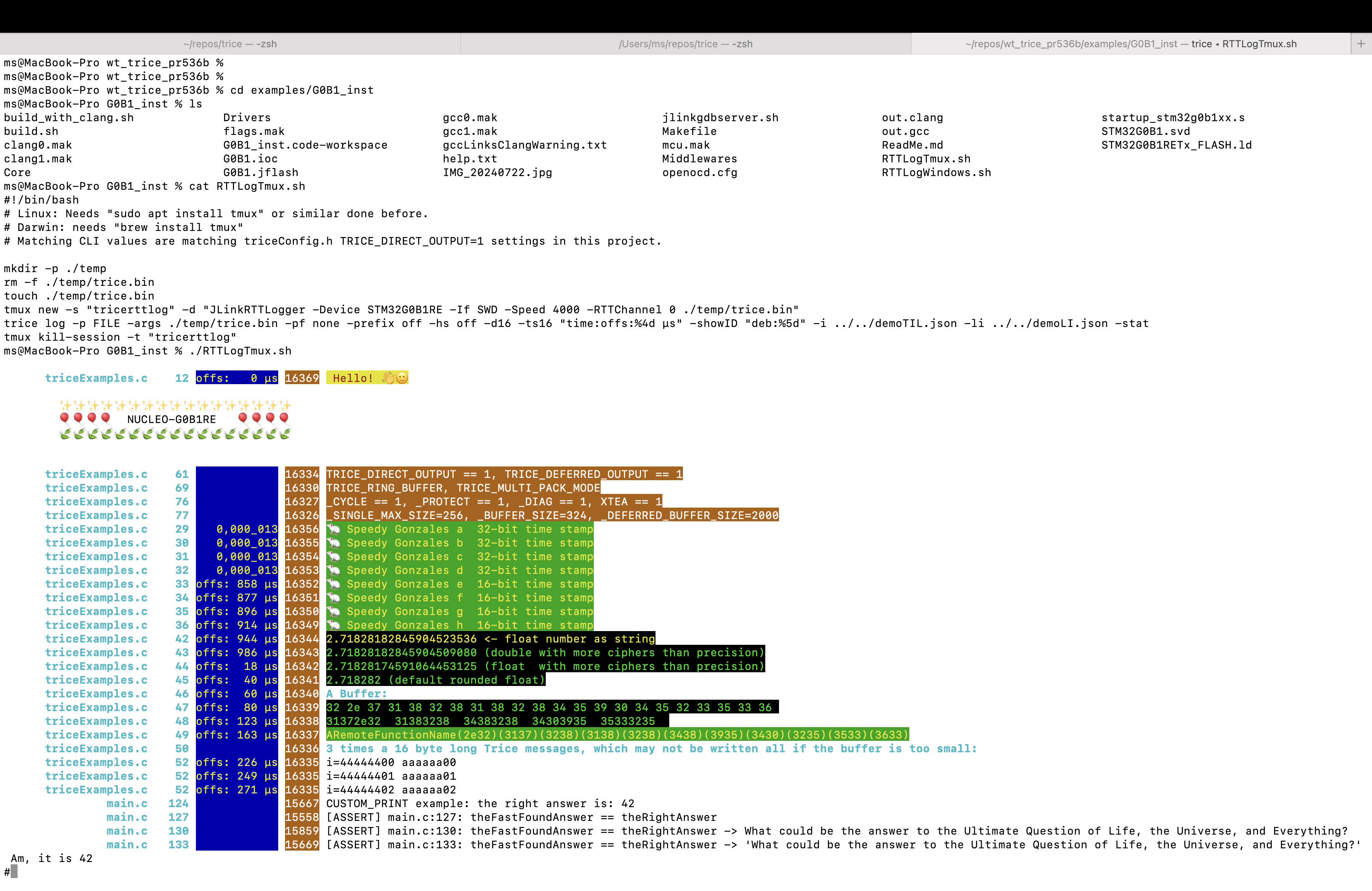
47. Future Development
47.1. Further Context Enrichment Variants
Context Enrichment supports direct Bind log sites and reversible source extensions with insert/clean. Bind rejects selected CE sites in wrapper macros or counter-rebase regions. Use an ordinary function, put direct calls on separate source lines, or use insert/clean as described under bind-limits.
47.2. Improving the Trice Tool Internal Parser (not planned right now)
47.2.1. Trice Internal Log Code Short Description
Trice v1.0 Code
Hint: To follow this explanation with the debugger, you can open in VSCode the trice folder, klick the Run & Debug Button or press CTRL-SHIFT-D, select
trice l -p DUMPand set a breakpoint atfunc main()in ./cmd/trice/main.go or directly intranslator.Translate./internal/translator/translator.go.
- In file ./internal/args/handler.go function
logLoopcallsreceiver.NewReadWriteCloserand passes the createdrwcobject totranslator.Translate.- There
rwcis used to create an appropriate decode objectdecpassed todecodeAndComposeLoop, which usesfunc (p *trexDec) Read(b []byte) (n int, err error)then, doing the byte interpretation.
- Finally
n += p.sprintTrice(b[n:]) // use param infois called doing the conversion.- Read returns a single Trice conversion result or a single error message in b[:n] or 0 and is called again and again.
- The returned Trice conversion result is the Trice format string with inserted values, but no timestamp, color or location information. The target timestamp, for this single Trice is hold in
decoder.TargetTimestamp. It is used only when a new log line begins, what is the normal case. If a Trice format string ends not with a newline, the following Trice gets part of the same log line and therefore its target timestamp is discarded. Also additional data like the location information only displayed for the first Trice in a log line containing several Trices. Because the color is inherent to the Trice tag and needs no display space it is attached to the following Trices in a log line as well.- The after
Readfollowingemitter.BanOrPickFiltercould remove the Read result.- If something is to write, the location information is generated if a new line starts and passed to the with
sw := emitter.New(w)created objectsw.WriteStringmethod which internally keeps a slice of type[]stringcollecting all parts of an output line.- The line
p.Line = append(p.Line, ts, p.prefix, sx)adds host timestampts, the buildp.prefixand the “printed Trice” (sxis here just the location information) to the line slice.- In the next step the stored target timestamp
decoder.TargetTimestampis printed into a string and added to the Trice line.- Optionally the Trice ID follows, if desired.
- The in a string printed Trice follows now and if the
sw.WriteStringmethod detects a\nat its end, the configured line suffix (usually"") follows andp.completeLine()is called then. It passes the line (slice of strings) top.lw.WriteLine(p.Line), which adds color, prints to the output device and clears the sw.Line slice for the next line.
Disadvantages of Trice v1.0 Implementation
- The Reader can only return a single Trice, because its byte interface cannot distinguish between Trices anymore.
- The field order (prefix, host stamp, location information, target stamp optional ID, format string, suffix) is hardcoded.
- Trices with several newlines inside the format string cannot deal with tags after an (internal) line break (newline)
- Binary parser needs to hold internal location after one Trice was decoded.
- Only one target timestamp value in a global variable.
- Line writing is not straight forward understandable.
Aims for a better implementation
- Read should parse the binary data only and return a Trice struct slice.
- Cycle errors?
- Each Trice struct gets printed in a string.
- The printed string then is split into several strings, which all get the same stamp information or space fields.
- Finally we have a slice of such structs: hs, ts, loc, idString, format string.
- The format string has no newline inside anymore, but has one at the end (usually) or not.
- The struct slice is cyclically passed to a line writer, which writes one line if it can find a format string ending with a newline.
47.3. Using Trice on Servers
A server can ingest and analyze Trice streams from devices. Using Trice as the server application’s own logger is a separate use case and needs evidence of a practical benefit. Claims about speed, energy use, storage, and additional compression require measurements with equivalent retained information.
48. Working with the Trice Git Repository
| Action | Command |
|---|---|
| Get a local repository copy. | git clone github.com/rokath/trice.git trice |
| Show current folder | pwd |
| Show repository status. | git status |
| Clean the repo, if needed. | git stash push |
| Show all branches. | git branch -a |
| Switch to main. | git switch main |
| Fetch a pull request as new branch PRIDa. | git fetch origin pull/ID/head:PRIDa |
| List worktree. | git worktree list |
| Add to worktree. | git worktree add ../trice_wt_PRIDa PRIDa |
| Add branch dev to worktree | git worktree add ../trice-dev dev |
| Rstore the repo if needed. | git stash pop |
| Change to new folder. | cd ../trice_wt_PRIDa |
| Show repository status. | git status |
| Test pull request. | ./scripts/testAll.sh full |
| Show repository status. | git status |
| Clean pull request. | git restore . |
| Change to previous folder. | cd - |
| Delete worktree branch. | git worktree remove ../trice_wt_PRIDa |
| Delete git branch. | git branch -d PRIDa |
| Log last 3 commits in branch maste | git log -3 main |
| Checkout by hash | git checkout <hash> |
| One Liner Log until shortly before v1.0.0 | git log --graph --decorate --all --pretty=format:'%C(bold yellow)%h%Creset %C(bold green)%ad%Creset %C(bold cyan)%d%Creset %C(white)%s%Creset' --date=format:'%Y-%m-%d %H:%M' --since 2025-04-01 |
One Liner Log for branch devel |
git log --graph --decorate devel --pretty=format:'%C(bold yellow)%h%Creset %C(bold green)%ad%Creset %C(bold cyan)%d%Creset %C(white)%s%Creset' --date=format:'%Y-%m-%d %H:%M' |
| One Liner Log with author | git log --graph --decorate --all --pretty=format:'%C(bold yellow)%h%Creset %C(bold green)%ad%Creset %C(bold blue)%an%Creset %C(bold cyan)%d%Creset %C(white)%s%Creset' --date=format:'%Y-%m-%d %H:%M' |
| New worktree detached branch for compare | git worktree add --detach ../trice_9995fdc4b 9995fdc4b |
| Add a special commit worktree | ./AddWorktreeFromGitLogLineData.sh <commit-hash> <YYYY-MM-DD> <HH:MM> |
| Create a bunch of worktrees | ./AddWorktreesBetween.sh "<since-date>" "<until-date>" or ./AddWorktreesBetween.sh <older-hash> <newer-hash> |
Delete all trice_* worktrees |
cd ~/repos && rm trice_* && cd trice && git worktree prune && git worktree list |
Delete all trice_* branches |
git branch -D `git branch \| grep -E 'trice_'` |
| Show all opencommit parameter | oco config describe |
| Show some config settings | oco config get OCO_MODEL && oco config get OCO_PROMPT_MODULE && oco config get OCO_EMOJI |
48.1. Install opencommit on macOS
🧰 Prerequisites
Before you begin, make sure you have:
- Install Homebrew first if you don’t have it.
- Git: Check if Git is installed:
git --versionIf not, install the Xcode Command Line Tools:xcode-select --install
- Node.js and npm
OpenCommit runs on Node.js. Check with:node -vandnpm -vIf not installed:brew install node - An OpenAI API key (or compatible provider like OpenRouter, see below).
🔑 Step 1 — Get Your OpenAI API Key
- Go to https://platform.openai.com
- Log in (or sign up) using your email, Google, Microsoft, or Apple account.
- Navigate to your API Keys page: 👉 https://platform.openai.com/account/api-keys
- Click “Create new secret key”.
- Give it a name (e.g.,
opencommit-mac) and copy it immediately.
It will look like this:sk-proj-1a2b3c4d5e6f...⚠️ You’ll only see it once — store it securely (e.g., 1Password, Bitwarden).
⚙️ Step 2 — Install OpenCommit
- Run the following in your Terminal:
npm install -g opencommitYou may see warnings about deprecated dependencies — those are safe to ignore. - Once installed, check:
opencommit --version
🔧 Step 3 — Set Up Your API Key on macOS
- Add your key as an environment variable:
export OPENAI_API_KEY="sk-proj-your-key-here" - To make it permanent, add it to your shell configuration file (
~/.zshrc):echo 'export OPENAI_API_KEY="sk-proj-your-key-here"' >> ~/.zshrc source ~/.zshrc - Verify that it’s active:
echo $OPENAI_API_KEYIf it prints your key (or the beginning of it), you’re good.
⚙️ Step 4 — Optional Configuration
- You can customize OpenCommit’s behavior by setting additional environment variables, for example:
export OCO_LANG="en" # or "de", "fr", etc.
export OCO_MODEL="gpt-5" # or another model like "gpt-4-turbo"
export OCO_PROMPT_MODULE="conventional"
export OCO_EMOJI=true
Add these to your ~/.zshrc for persistence.
🚀 Step 5 — Use OpenCommit
- Go to a Git repository:
cd /path/to/your/repo - Stage your changes:
git add . - Run OpenCommit:
opencommit - It will analyze your staged changes and automatically generate a commit message.
Example:🔍 Analyzing changes... ✅ Commit message generated: feat(api): add endpoint for user authentication
🔁 Step 6 — (Optional) Install Git Hook
- To have OpenCommit run automatically every time you commit:
npx opencommit install-hook - Now every time you run
git commit, OpenCommit will propose a commit message for you.
🧩 Step 7 — Troubleshooting
If OpenCommit says:
- “Missing API key” → Check that
$OPENAI_API_KEYis set (echo $OPENAI_API_KEY). - “Unauthorized” → Verify your key is valid or not expired.
- “Cannot find opencommit command” → Reinstall globally with
npm install -g opencommit.
48.2. Install opencommit on Windows
🧭 Overview
OpenCommit is a tool that uses AI (like GPT models) to automatically generate meaningful Git commit messages based on your code changes.
This guide explains how to install and configure OpenCommit on Windows step by step.
⚙️ Prerequisites
- Before installing OpenCommit, make sure you have:
- Git installed 👉 Download and install from https://git-scm.com/download/win
- Verify installation by running in PowerShell or CMD:
git --version - Node.js and npm (Node Package Manager) installed 👉 Download from https://nodejs.org/en (LTS version recommended).
- Verify:
node -v npm -v - An OpenAI API key (for GPT access) 👉 Get it from https://platform.openai.com/account/api-keys
🪄 Installation Steps
1. Install OpenCommit Globally
- Open a terminal (PowerShell or CMD) and run:
npm install -g opencommit - Verify installation:
opencommit --versionIf you get an error like “opencommit not recognized”, restart your terminal or ensure your npm global path is in your system PATH environment variable.
2. Configure the API Key
- Set your OpenAI API key as an environment variable permanently:
- Press Win + R, type SystemPropertiesAdvanced, and press Enter.
- Click Environment Variables…
- Under User variables, click New, and add:
- Variable name: OPENAI_API_KEY
- Variable value: your_api_key_here
- You can also customize OpenCommit’s behavior by setting additional environment variables, for example:
OCO_LANG="en" # or "de", "fr", etc. OCO_MODEL="gpt-4o" # or another model like "gpt-4-turbo" OCO_PROMPT_MODULE="conventional" OCO_EMOJI=true- Click OK on all windows.
- Then restart PowerShell.
3. (Optional) Configure Defaults
- You can set up default parameters in your Git repository or globally:
opencommit config- Follow the interactive prompts to define:
- Default model (e.g., gpt-3.5-turbo)
- Commit style
- Language
- Follow the interactive prompts to define:
🚀 Usage
- Once installed, simply run:
opencommit. This will:- Analyze your staged changes (git diff –cached)
- Generate an AI-powered commit message
- Ask for confirmation before committing
- You can also use:
opencommit --no-verifyto skip confirmation and commit directly.
🔧 Troubleshooting
- Issue Solution
- opencommit: command not found Ensure npm global bin path is added to your Windows PATH (e.g., C:\Users<YourUser>\AppData\Roaming\npm).
- Error: Missing OPENAI_API_KEY Set your OpenAI API key as shown above.
- Model too slow / API errors Try setting a smaller model: opencommit config –model gpt-3.5-turbo.
✅ Example
git add .
oco
Output:
Generated commit message:
...
49. Trice Maintenance
49.1. Trice Project structure (Files and Folders)
| cmd/clang-filter | ReadMe |
| cmd/trice | Trice tool command Go sources |
| demoLI.json | location information example |
| demoTIL.json | Trice ID list example |
dist/ |
local distribution files folder created by GoReleaser |
| docs | documentation folder with link forwarding |
| examples/ | example target projects |
| scripts/_310_refresh_trice_user_manual.sh | Trice Reference Manual Maintenance (or any *.md file) |
| scripts/gitAddWorktreeFromGitLogLineData.sh | helper to get easy a git worktree folder from any git hash for easy folder compare, see inside |
| scripts/gitAddWorktreesBetween.sh | helper to get easy git worktree folders from any time range |
| scripts/gitLogWithBranches.sh | helper to get easy a history view |
| go.mod | Go modules file |
| go.sum | Go modules sums |
| index.md | Jekyll index site for README.md |
| internal/ | Trice tool internal Go packages |
| pkg/ | Trice tool common Go packages |
| scripts/_330_renew_ids_and_refresh_tests.sh | renew all ID data |
| src/ | C sources for trice instrumentation -> Add to target project |
temp/ |
ignored local workspace for binary logfiles and other runtime artifacts like scripts/testAll.sh helper files under ./temp/log |
testAll.log |
ignored local output of the last ./scripts/testAll.sh run |
| scripts/testAll.sh | run all tests |
| third_party/ | external components |
| trice_bindIDs_in_examples_and_test_folder.sh | run the canonical Trice Bind workflow |
| scripts/_240_legacy_clean_ids.sh | Cleaning the Sources Activating the Trice Cache |
| scripts/_120_setup_trice_environment.sh | Cleaning the Sources Activating the Trice Cache |
| scripts/_230_legacy_insert_ids.sh | Cleaning the Sources Activating the Trice Cache |
49.2. 📁 The .github Folder — Purpose and Contents
GitHub automatically recognizes and uses everything contained inside the .github/ directory. This folder defines how the project behaves on GitHub: issue templates, automated workflows, labels, code scanning, greetings, and release automation. Details:
49.2.1. 📁 .github Root
It contains issue templates, labels, workflow automation, code scanning, linting, and the CI/CD release pipeline.
- ISSUE_TEMPLATE/ Used to create structured bug reports and feature requests.
- FUNDING.yml Enables the GitHub “Sponsor” button.
- labeler.yml configuration file consumed by actions/labeler. It defines the labeling rules.
- Because labeler.yml is configuration and not an executable workflow, it is placed directly under .github/, not under .github/workflows/.
- The actions/labeler action expects .github/labeler.yml as the default configuration path, which is why this layout is standard and correct.
- This is intentional and follows GitHub Actions conventions.
- .github/workflows/label.yml is a workflow. It defines when and how the GitHub Action runs (triggers, permissions, runner, action reference).
- .github/labeler.yml is not a workflow. It is a configuration file consumed by actions/labeler. It defines the labeling rules.
- .github/workflows/ Contains GitHub Actions automation
49.2.2. 📂 .github/workflows — GitHub Actions Workflows
The .github/workflows/ folder contains YAML descriptions for various actions, which will be triggered automatically on certain events or are started manually. Every yml file in this directory defines an automated process. These processes run on GitHub’s servers (CI/CD).
- README.md: Documentation specifically for the /workflows folder.
- Can be useful for contributors who want to understand or modify CI behaviors. Each workflow defines its own triggers and permissions in its YAML file. Depending on the workflow, it runs on pushes, pull requests, a schedule, a manual request, or a call from another workflow. The directory contains no separate icon or properties metadata for configuring these workflows.
49.2.3. GitHub Action clang-format.yml - Check C Code Formatting
- Local Action (developer machine): ./scripts/_280_format_c_code.sh - adjust all C files excluding .clang-format-ignore according rule set in .clang-format.
The file ./scripts/_280_format_c_code.sh is used to auto-format the Trice code.
File .clang-format
Contributor: @Sazerac4
Sazerac4 commented Aug 29, 2024: I have a code formatter when I make changes to my application but I would like to keep the style of the library when modifying. I couldn’t find a code formatter, is there a tool used? If not, I propose this to provide one as an example by using clang-format.
## I have created a default style : clang-format -style=llvm -dump-config > .clang-format ## Then format the code: find ./src -name '*.c' -o -name '*.h'| xargs clang-format-18 -style=file -iThe style of the example does not correspond to the original one. Configurations are necessary for this to be the case. Tags can be placed to prevent certain macros from being formatted
int formatted_code; // clang-format off void unformatted_code ; // clang-format on void formatted_code_again;I have tuned some settings for clang-format :
* IndentWidth: 4 // original code size indentation * ColumnLimit: 0 // avoid breaking long line (like macros) * PointerAlignment: Left // like original files (mostly)With preprocessor indentation, the result is a bit strange in some cases. It’s possible with the option IndentPPDirectives (doc).
Staying as close as possible to a default version (LLVM in this case) makes it easier to regenerate the style if necessary.
See also: https://github.com/rokath/trice/pull/487#issuecomment-2318003072
File .clang-format-ignore:
Contributor: @Sazerac4
Sazerac4 commented Aug 30, 2024: I have added .clang-format-ignore to ignore formatting for specific files
File .editorconfig:
Contributor: @Sazerac4
The
.editorconfigfile allows to better identify the basic style for every files. (endline, charset, …). It is a file accepted by a wide list of IDEs and editors : link This addition is motivated by forgetting the end of line in the .gitattributes file.File .gitattributes
Contributor: @Sazerac4
With the
.gitattributesfile avoid problems with “diff” and end of lines. Here is an article that presents the problem.To fill the
.gitattributes, I used the command below to view all the extensions currently used.git ls-tree -r HEAD --name-only | perl -ne 'print $1 if m/\.([^.\/]+)$/' | sort -u - GitHub Action (Continuous Integration): .github/workflows/clang-format.yml does not format, it only checks.
49.2.4. GitHub Action codeql.yml - Static Code Analysis
- This workflow runs CodeQL, GitHub’s static code analysis tool. Purpose:
- scan the codebase for potential security vulnerabilities
- detect unsafe code patterns
- provide security alerts in the “Security” tab
- Runs automatically on pushes and pull requests.
- GitHub Action (Continuous Integration): .github/workflows/codeql.yml
- This workflow configures GitHub CodeQL code scanning for the repository.
- This workflow continuously scans the codebase for security and quality problems using CodeQL.
- It performs static code analysis on source code.
- It looks for:
- Security vulnerabilities (e.g. injection flaws, unsafe API usage)
- Common programming errors
- Code quality issues
- It runs automatically:
- On pushes to
main - On pull requests targeting
main - Manually via the GitHub Actions UI
- The results are uploaded to GitHub and appear under Security → Code scanning alerts.
- The “QL” is the same concept as SQL, but specialized for code analysis.
49.2.5. GitHub Action coverage.yml - Test Coverage and Coveralls Integration
Trice uses Go’s built-in coverage tooling to measure how much of the Go codebase is exercised by automated tests.
- Local Action (developer machine):
| Action | Command |
|---|---|
| Generate a coverage profile locally | go test ./... -covermode=atomic -coverprofile=./temp/log/coverage.out |
| Show results as list in terminal | go tool cover -func=./temp/log/coverage.out |
| Show results colored file specific in browser | go tool cover -html=./temp/log/coverage.out |
- GitHub Action (Continuous Integration):
On GitHub, the workflow.github/workflows/coverage.ymlruns automatically for every pull request and also on a monthly schedule. The workflow:- executes
go testwith coverage enabled, - prints a coverage summary in the CI logs,
- uploads the raw
coverage.outfile as a workflow artifact, and - publishes the coverage results to Coveralls (if configured).
- executes
Coverage badge:
The README displays the current coverage status for the default branch using the Coveralls badge:
[](https://coveralls.io/github/rokath/trice?branch=master)
This badge is updated whenever the CI workflow successfully uploads a new coverage report for the master branch.
49.2.6. GitHub Action go.yml - Building and Testing Go Code
- A workflow for building and testing Go code. It runs GitHub CodeQL for Go and C (cpp language pack), detecting security vulnerabilities and code issues.
- Typically includes steps such as:
- setting up the Go toolchain
- checking out the repository
- compiling the project
- running unit tests
- Local Action (developer machine):
go test ./...or better./scripts/testAll.sh full(takes long) - GitHub Action (Continuous Integration): .github/workflows/go.yml
49.2.7. GitHub Action goreleaser.yml - Build & Pack Trice Distribution
This workflow runs GoReleaser, the tool that builds and packages Trice for distribution.
- Purpose:
- create release binaries for all supported platforms
- generate archives (ZIP, tar.gz, etc.)
- compute checksums
- create a GitHub Release with all artifacts
- Triggers:
- manually from the GitHub UI (“Run workflow”)
- automatically when pushing a tag matching v* (e.g., v0.44.0)
- This is the workflow responsible for generating official Trice releases.
- Local Action (developer machine):
goreleaser - GitHub Action (Continuous Integration): .github/workflows/goreleaser.yml
See also Trigger a real Trice release via CI (with git tag)
49.2.8. GitHub Action label.yml - Automatic Labeling Rules
- Defines automatic labeling rules for issues and PRs.
- For example, files in certain directories may automatically get category labels.
- This helps maintainers classify submissions more easily.
- GitHub Action (Continuous Integration): .github/workflows/label.yml
49.2.9. GitHub Action link-check.yml - Broken Links Check
- Local Action (developer machine):
./scripts/_530_test_links.shfrom the repository root, also included in./scripts/testAll.sh.- Uses lychee.toml as configuration; the direct checker command is
lychee --config lychee.toml .. - The script additionally maps the CLI-help source URL to the local checkout and records results in
temp/log/_530_test_links.log. If Lychee is missing, it reports a skip. - For GitHub URLs, set
GITHUB_TOKENorGH_TOKENlocally as well to reduce API throttling and timeouts during checks
- Uses lychee.toml as configuration; the direct checker command is
- GitHub Action (Continuous Integration): .github/workflows/link-check.yml
- The workflow already provides
GITHUB_TOKENto the Lychee action for GitHub-hosted links
- The workflow already provides
49.2.10. GitHub Action manual.ym - To Be Triggered Manually
A workflow that is designed to be triggered manually (similar to workflow_dispatch workflows). Common use cases:
- executing maintenance tasks
- running scripts on demand
- testing workflow behavior without making a commit
- This workflow does not run automatically.
49.2.11. GitHub Action shellcheck.yml - Catching Common Bash Scripts Bugs
Runs ShellCheck on all *.sh files, catching common bugs in Bash scripts.
- GitHub Action (Continuous Integration): .github/workflows/shellcheck.yml
49.2.12. GitHub Action shfmt.yml - Ensure Consistent Shell Scripts Formatting
Runs shfmt in diff mode on pull requests to ensure consistent formatting of shell scripts.
- Local Action (developer machine):
go test ./...or better./scripts/testAll.sh full(takes long) - GitHub Action (Continuous Integration): .github/workflows/shfmt.yml
49.2.13. GitHub Action stale.yml - Automatic Stale Issue Handling
Automates stale issue handling. Function:
- marks inactive issues or PRs as “stale”
- closes them after a configurable time period if there is no further activity
- eps the issue tracker manageable.
Mark stale issues and pull requests
- GitHub Action (Continuous Integration): .github/workflows/stale.yml
49.2.14. GitHub Action superlinter.yml - Ensure Consistent YAML and Markdown Formatting
- Local Action (developer machine):
markdownlint . - Runs GitHub Super Linter, a powerful linting suite. Purpose:
- ensure consistent code formatting
- detect stylistic issues
- catch potential errors in supported languages
- Helps maintain code quality across the entire repository.
- GitHub Action (Continuous Integration): .github/workflows/superlinter.yml
- Checks YAML and Markdown files
49.2.15. GitHub Action pages.yml - Creates The Trice GitHub Pages
This workflow creates the Trice github pages avaliable under rokath.github.io/trice/.
- GitHub Action (Continuous Integration): .github/workflows/pages.yml
49.3. Trice Reference Manual Maintenance (or any *.md file)
- Recommended Tool: VS Code with some extensions:
- Markdown All in One (Yu Zhang)
- Markdown Table Prettifier (Kristin Daroczi)
- Click in mouse context menu the entry “Format Document” to adjust Markdown tables.
- Markdown Preview Enhanced
- Click the preview button in the top right.
mdtoc- The checked-in manual already contains the managed TOC container and persisted config. Keep these markers in place where the table of contents should be generated.
<!-- mdtoc --> <!-- mdtoc-config container-version=v2 numbering=true min-level=2 max-level=4 anchor=github toc=true bullets=auto state=stripped --> <!-- /mdtoc --> - Run
./scripts/_310_refresh_trice_user_manual.sh formatto regenerate the reference manual’s TOC, numbering, and anchors withmdtoc. - Run
./scripts/_310_refresh_trice_user_manual.sh checkto verify that the checked-in reference manual matches the persistedmdtocstate. - The repository no longer uses a VS Code TOC extension for manual maintenance.
- The checked-in manual already contains the managed TOC container and persisted config. Keep these markers in place where the table of contents should be generated.
- Markdown Paste (telesoho)
- Helpful to get web site content preformatted as Markdown. Use mouse context menu.
- markdownlint (David Anson)
- Uses .markdownlint.yaml as rule set and .markdownlintignore to ignore files.
- You can also run
markdownlint .in a terminal after installing the CLI tool. It uses the same control files. - The GitHub action superlinter.yml uses .markdownlint.yaml and the same config files.
- Markdown PDF (yzane)
- Use Shift-Command-P “markdown PDF:export” to generate a PDF
- page break for PDF generation:
<div style="page-break-before: always;"></div>
49.4. Cleaning the Sources
In GitHub are some Actions defined. Some of them get triggered on a git push and perform some checks. To get no fail, some scripts should run before committing:
npx markdownlint *.md(or justmarkdownlint) - uses .markdownlint.yaml to allow exceptions.npx markdownlint ./docs/TriceReferenceManual.md 2>&1 | awk '!seen[$2]++'for example to reduce message count in case of errors.
- ./scripts/_300_clean_dsstore.sh - remove macOS maintenance data.
- ./scripts/_240_legacy_clean_ids.sh removes all IDs in the legacy workflow.
50. Build and Release the Trice Tool
50.1. Build Trice tool from Go sources
- Install Go.
-
Run:
ms@DESKTOP-7POEGPB MINGW64 /c/repos/trice (main) $ bash ./scripts/buildTriceTool.sh # internally runs go install ./cmd/trice/... - Afterwards you should find executables
triceandtloginside~/go/bin. - Extend PATH variable with
~/go/binOR copy the Trice binaries from there into a folder of your path. -
Check:
ms@PaulPCWin11 MINGW64 ~/repos/trice (main) $ ./scripts/buildTriceTool.sh ---------------------------------------- Building trice with embedded Git metadata: origin: git@github.com:rokath/trice.git branch: main version: branch dirty commit: f7edcc51 date: 2025-11-27T13:59:50+01:00 git_state: dirty git_status: M .vscode/launch.json M docs/TriceReferenceManual.md M internal/emitter/lineComposer.go ---------------------------------------- Build complete. ms@PaulPCWin11 MINGW64 ~/repos/trice (main) $ trice version no version, branch=git@github.com:rokath/trice.git - main (local modifications at build time), commit=f7edcc51, built at 2025-11-27T13:59:50+01:00 ms@PaulPCWin11 MINGW64 ~/repos/trice (main) - Hints
- Use only the main branch. Other branches may be inconsistent.
- When using ./scripts/buildTriceTool.sh, the generated Trice image is significant smaller (about 30%), because the build script removes debugging information from the Trice binary. The Trice release images contain this additionally information for a more verbose error reporting, just in case.
tlogis a separate binary for thetrice logruntime path. It accepts the log flags directly, for exampletlog -port HEX ..., and release archives/packages ship it next totrice.- Give each Trice binary its own name when using different images. Otherwise you always get what is found first in the $PATH.
- Use GoReleaser if you wish to create releases on your forked Trice repository.
- On Windows, install TDM-GCC or another compatible MinGW-w64 GCC distribution if you wish to execute the CGO and host C-code tests.
- Match the compiler architecture to Go, normally 64-bit Go with a 64-bit host compiler.
- The minimal TDM-GCC online installation is sufficient for these host tests.
- Put the selected host compiler first in
PATHwhen several GCC variants are installed. - If
clangis also inPATH, the regression tests can execute it in addition to GCC. Clang must therefore have a usable host C runtime configuration; merely findingclang.exeis not enough. - A Windows Clang using the GNU target can reuse the installed MinGW-w64 runtime. A Clang using the MSVC target instead requires the Visual Studio C++ Build Tools and a Windows SDK.
- Verify each visible host compiler can include
string.hbefore runninggo test ./....
- Open a console inside the Trice directory, recommended is the git-bash, when using Windows.
- Tests:
ms@DESKTOP-7POEGPB MINGW64 /c/repos/trice (main) $ go clean -cache ms@DESKTOP-7POEGPB MINGW64 /c/repos/trice (main) $ go vet ./... ms@DESKTOP-7POEGPB MINGW64 /c/repos/trice (main) $ go test ./... ? github.com/rokath/trice/cmd/cui [no test files] ok github.com/rokath/trice/cmd/stim 0.227s ok github.com/rokath/trice/cmd/trice 0.577s ok github.com/rokath/trice/internal/args 0.232s ok github.com/rokath/trice/internal/charDecoder 0.407s ok github.com/rokath/trice/internal/com 1.148s ok github.com/rokath/trice/internal/decoder 0.412s [no tests to run] ? github.com/rokath/trice/internal/do [no test files] ok github.com/rokath/trice/internal/dumpDecoder 0.388s ok github.com/rokath/trice/internal/emitter 0.431s ok github.com/rokath/trice/internal/id 0.421s ok github.com/rokath/trice/internal/keybcmd 0.431s ok github.com/rokath/trice/internal/link 0.404s ok github.com/rokath/trice/internal/receiver 0.409s ok github.com/rokath/trice/internal/tleDecoder 0.398s ? github.com/rokath/trice/internal/translator [no test files] ok github.com/rokath/trice/internal/trexDecoder 0.391s ok github.com/rokath/trice/pkg/cipher 0.377s ok github.com/rokath/trice/pkg/endian 0.302s ok github.com/rokath/trice/pkg/msg 0.299s ok github.com/rokath/trice/pkg/tst 0.406s
To execute the target code tests, you can run scripts/testAll.sh or cd into _test and run go test ./... from there. ATTENTION: These tests run a significant long time (many minutes depending on your machine), because the Go - C border is crossed very often.
The last tests can last quite a while, depending on your machine.
ms@DESKTOP-7POEGPB MINGW64 /c/repos/trice (main)
$ go install ./cmd/trice/
Afterwards you should find an executable trice inside $GOPATH/bin/ and you can modify its source code.
After installing Go, in your home folder should exist a folder ./go/bin. Please add it to your path variable. OR: Copy the Trice binaries from there into a folder of your path after creating them with go install ./cmd/trice/... ./cmd/tlog/.... There is now a remommended script ./scripts/buildTriceTool.sh. Using it, depending on your system you may need to enter bash ./scripts/buildTriceTool.sh, includes the actual Trice repository state into the Trice binaries, which is shown with trice version and tlog --version then - useful in case of issues.
50.2. Prepare A Release
Prerequisite: Installed goreleaser.
50.2.1. Check a GoReleaser Release before Publishing
By cloning the Trice repo into an empty folder, you make sure no other files exist in the Trice folder.
mkdir ./tmp
cd /tmp
git clone https://github.com/rokath/trice.git
cd trice
goreleaser release --clean --snapshot --skip=publish
This just generates the artifacts locally in /tmp/trice/dist using the ./trice/.goreleaser.yaml copy in ./temp/trice.
Alternatively you can do in your local Trice clone directly, by removing everything not a part of the Trice repo, if you are sure not to loose any data:
git status
git clean -xfd
goreleaser release --clean --snapshot --skip=publish
Explanation:
release– run the normal release pipeline (builds, archives, checksums, changelog, etc.).--clean– delete thedist/folder first so no old artefacts are reused.--snapshot– build as a “snapshot” version, not a real tagged release.--skip=publish– do not upload anything (no GitHub Releases, no Homebrew, no Docker, etc.).
What you should see:
- GoReleaser building all your
builds:targets from.goreleaser.yaml, including thetriceandtloghost binaries. - Creating archives in
dist/. - Generating checksums.
- No attempts to call the GitHub API for a real release.
If this succeeds, you’ve already tested 90% of what CI will do for a real release. If it fails, fix the problem locally first (missing files, bad paths, etc.) – it would fail the same way in CI.
50.3. Trigger a real Trice release via CI (with git tag)
Letting CI build and publish an official release.
50.3.1. Make sure your workflow reacts to tags
In .github/workflows/goreleaser.yml, you need on: workflow_dispatch: push: tags: - 'v*'.
workflow_dispatch= you can still run it manually from the Actions tab.push -> tags: 'v*'= whenever you push a tag likev0.44.0, this workflow will start automatically.
Commit & push this change (if you haven’t already):
git add .github/workflows/goreleaser.yml
git commit -m "Configure GoReleaser workflow to run on tags"
git push origin main
50.3.2. Final checks before tagging
In your local trice repo:
- Update to latest main:
git checkout maingit pull origin main
- Run your tests:
go test ./...or, for the full compiler matrix,./scripts/testAll.sh full. - Optionally run the snapshot dry run again:
goreleaser release --clean --snapshot --skip=publish.
If all of that is green, you’re ready to “bless” a version.
50.3.3. Choose a version and create a git tag
Decide on a version, for example:
v0.44.0v1.0.0
(Important: GoReleaser expects SemVer-style tags likevX.Y.Z.)
Create an annotated tag:
git tag -a v0.44.0 -m "Trice v0.44.0"
Check your tags:
git tag
You should see v0.44.0 in the list.
💡 The tag is what GoReleaser uses as the release version (
.Tag,.Version, etc.) in your.goreleaser.yaml.
Yourldflagslike-X main.version=will use this.
50.3.4. Push the tag to GitHub (this triggers CI)
Now push the tag:
git push origin v0.44.0
This does not push all tags, only v0.44.0.
Because of your workflow’s on: push: tags: 'v*', this automatically starts the GoReleaser workflow in GitHub Actions.
50.3.5. Watch the CI release run on GitHub
-
Open your browser and go to your repo:
https://github.com/rokath/trice -
Click the “Actions” tab at the top.
-
In the list of workflows, click on “goreleaser”.
-
You should see a new run with something like:
- Event:
push - Ref:
refs/tags/v0.44.0 - Status: in progress → green (hopefully)
- Click on that run, then on the job (e.g.
goreleaser):
- Step “Check out repository”
- Step “Set up Go”
- Step “Run GoReleaser”
If “Run GoReleaser” is green ✔, the CI release has succeeded.
50.3.6. Check the GitHub Release
Finally, verify the published release:
-
In your repo, click the “Releases” section (right side or under “Code”).
-
You should see a new release
v0.44.0created by GoReleaser. -
Inside it you’ll find:
- the generated archives (tar.gz/zip),
- checksums,
- etc., as defined in your
.goreleaser.yaml.
This is now your official Trice release built by CI.
51. Ctrl-C robust use of trice insert and trice clean
trice insert and trice clean can modify many source files. This is useful for build workflows where IDs are inserted before compilation and removed afterwards, but it also means that interruption handling matters.
This chapter summarizes practical recommendations for robust build scripts and explains the background of GitHub issue #658.
51.1. Background: GitHub issue #658
GitHub issue #658 discusses the risk that trice insert or trice clean may be interrupted while source files are being modified.
There are two different kinds of interruption effects:
1. Repository-level mixed state
Some files are already processed, while others are not.
2. Single-file write-back risk
A file could be left partially written if it is overwritten directly and
the process is interrupted at the wrong time.
The first case is inconvenient but usually recoverable.
The second case is more serious, because a source file could become empty or incomplete.
The robust tool-side solution is that Trice should write changed files atomically:
1. Write the new content to a temporary file next to the target file.
2. Flush and close the temporary file.
3. Atomically rename it over the target file.
The temporary file should be created in the same directory as the target file, for example:
target: src/foo.c
temp: src/.foo.c.trice-tmp-<pid>-<random>
This avoids cross-filesystem rename problems and ensures that the replacement is local to the target file.
The -cache mechanism can still be useful for recovery metadata, hashes, transaction manifests, and diagnostics, but it should not be required for the atomic replacement of source files.
51.2. What Bash scripts can and cannot protect against
A shell script can improve the workflow by making sure that trice clean is called after a successful trice insert, even when a build fails or the user presses Ctrl-C.
However, a shell script cannot fully protect against interruption exactly inside the Trice process while Trice is writing one file. That must be solved inside Trice itself with atomic write-back.
Therefore, shell-script robustness and Trice-internal atomic writes solve different parts of the problem:
Bash script:
- Can run cleanup after build failure.
- Can run cleanup after Ctrl-C during make.
- Can avoid leaving the repository intentionally inserted.
Trice implementation:
- Must prevent partially written files.
- Must handle interruption during file write-back safely.
- Can provide transaction/recovery diagnostics.
51.3. Recommended build-script ownership rule
Only one script level should own the full sequence:
trice clean -> trice insert -> build -> trice clean
If an outer script calls many inner build scripts, and each inner build script already performs its own trice insert and trice clean, then the outer script should not also perform one global insert/clean around the whole sequence.
Otherwise both levels modify the same source tree, which can cause confusing behavior such as cleanup happening while another build step still expects inserted IDs.
Recommended ownership models:
Model A: Outer script owns Trice state
------------------------------------
outer script:
trice clean
trice insert
run all builds
trice clean
inner build scripts:
do not call trice insert/clean
Model B: Inner scripts own Trice state
-------------------------------------
outer script:
run child build scripts
optionally run final safety clean
inner build script:
trice clean
trice insert
build
trice clean
Do not mix both models unintentionally.
51.4. Recommended Bash pattern
The following pattern is a simplified example. It keeps cleanup in one place and makes the normal success path use the same cleanup logic as error and interruption paths.
#!/usr/bin/env bash
set -euo pipefail
SCRIPT_DIR="$(cd -- "$(dirname -- "${BASH_SOURCE[0]}")" && pwd)"
ROOT="$(cd -- "${SCRIPT_DIR}/../.." && pwd)"
ids_inserted=0
run_trice_clean_if_needed() {
if [ "${ids_inserted}" -eq 1 ]; then
echo "cleanup: running trice clean"
local clean_status=0
(
cd "${ROOT}" || exit 1
bash "${ROOT}/scripts/_240_legacy_clean_ids.sh"
) || clean_status=$?
if [ "${clean_status}" -ne 0 ]; then
echo "warning: cleanup: trice clean failed with exit code ${clean_status}" >&2
return "${clean_status}"
fi
ids_inserted=0
fi
return 0
}
cleanup_and_exit() {
local status="${1:-$?}"
local clean_status=0
trap - INT TERM EXIT
run_trice_clean_if_needed || clean_status=$?
if [ "${status}" -eq 0 ] && [ "${clean_status}" -ne 0 ]; then
status="${clean_status}"
fi
exit "${status}"
}
trap 'cleanup_and_exit $?' EXIT
trap 'cleanup_and_exit 130' INT
trap 'cleanup_and_exit 143' TERM
(
cd "${ROOT}" || exit 1
bash "${ROOT}/scripts/_240_legacy_clean_ids.sh"
bash "${ROOT}/scripts/_230_legacy_insert_ids.sh"
)
ids_inserted=1
cd "${SCRIPT_DIR}"
make
clean_status=0
run_trice_clean_if_needed || clean_status=$?
trap - INT TERM EXIT
exit "${clean_status}"
Important points in this pattern:
- ids_inserted becomes 1 only after insert completed successfully.
- cleanup runs clean only if insert completed successfully.
- cleanup disables traps first to avoid recursive cleanup.
- helper scripts run from a controlled directory.
- directory changes for helper calls are done inside subshells where possible.
- the normal success path and abnormal paths use the same cleanup helper.
51.5. Preserve the build exit code
If the build command may fail and the script still needs to run cleanup afterwards, do not let set -e abort before the exit code is captured.
For example:
set +e
make ${MAKE_JOBS} TRICE_FLAGS="${flags}" gcc
make_status=$?
set -e
clean_status=0
run_trice_clean_if_needed || clean_status=$?
if [ "${make_status}" -eq 0 ] && [ "${clean_status}" -ne 0 ]; then
make_status="${clean_status}"
fi
trap - INT TERM EXIT
exit "${make_status}"
This keeps the original build result unless cleanup itself fails after an otherwise successful build.
51.6. Be careful with current working directory changes
A subtle problem can occur when a cleanup helper changes the current working directory and does not change it back.
For example:
run_trice_clean_if_needed() {
cd "${ROOT}" || exit 1
bash "${ROOT}/scripts/_240_legacy_clean_ids.sh"
}
After this function returns, the caller is still in ${ROOT}.
If the script later runs:
make clean
it may accidentally run in the repository root instead of the example directory.
Prefer one of these forms:
(
cd "${ROOT}" || exit 1
bash "${ROOT}/scripts/_240_legacy_clean_ids.sh"
)
or explicitly return to the build directory:
cd "${SCRIPT_DIR}"
make clean
51.7. Prefer Makefile clean targets when available
If an example Makefile provides a clean target, prefer:
make clean
over hard-coded shell cleanup such as:
rm -rf out out.gcc
The Makefile knows the actual build output directories, for example:
.PHONY: clean
clean:
@rm -rf "$(GCC_BUILD)" "$(CLANG_BUILD)"
A direct rm -rf out out.gcc can be used as a fallback, but it is less precise.
51.8. Example scripts
The following scripts are useful examples for Ctrl-C robust wrapping of trice insert and trice clean.
They illustrate slightly different situations:
scripts/_160_pc_target_test_worker.sh
PC/CGO test wrapper.
Shows how an outer test script can run cleanup after insert and restore
temporary environment changes such as C_INCLUDE_PATH.
scripts/_200_gcc_example_build_worker.sh
First Step-12 variant.
Shows a global outer-script cleanup owner.
scripts/_210_gcc_example_builds_all_workflows.sh
Improved Step-12 orchestrator variant.
Shows the case where child example build scripts own insert/clean, while the
outer script only runs a final safety clean.
build_trice_safe_cleanup.sh
Generic example build script.
Shows pre-clean, insert, build, and final cleanup in one script.
build_with_clang_trice_safe_cleanup.sh
Clang build script.
Shows the same cleanup pattern for a clang build target.
build_pattern_preserving_trice_safe_cleanup.sh
Pattern-preserving GCC build script with TRICE_OFF handling.
Shows conditional insert behavior.
build_gcc_preserve_make_exit_trice_safe_cleanup.sh
GCC build script that preserves the make exit code.
Shows how to temporarily disable set -e around make and still run cleanup.
G0B1_inst_build_fixed_cwd_cleanup.sh
Corrected G0B1_inst build script.
Shows how to avoid current-working-directory bugs by running helper commands
in subshells and returning to the example directory before make clean.
These scripts are examples for build-wrapper robustness. They do not replace the need for atomic file write-back inside Trice itself.
51.9. Summary
Recommended practical rules:
1. Let exactly one script level own each insert/build/clean sequence.
2. Set a state flag only after trice insert completed successfully.
3. Run trice clean on every exit path after successful insert.
4. Disable traps at the beginning of cleanup to avoid recursion.
5. Preserve the original build exit code where needed.
6. Use subshells for cleanup helper calls that change directories.
7. Prefer Makefile clean targets over hard-coded rm -rf.
8. Treat Bash cleanup as a workflow aid, not as a substitute for atomic writes.
For the core safety issue, the Trice implementation should still ensure:
A source file is never left partially written after Ctrl-C, SIGTERM, crash, or write error.